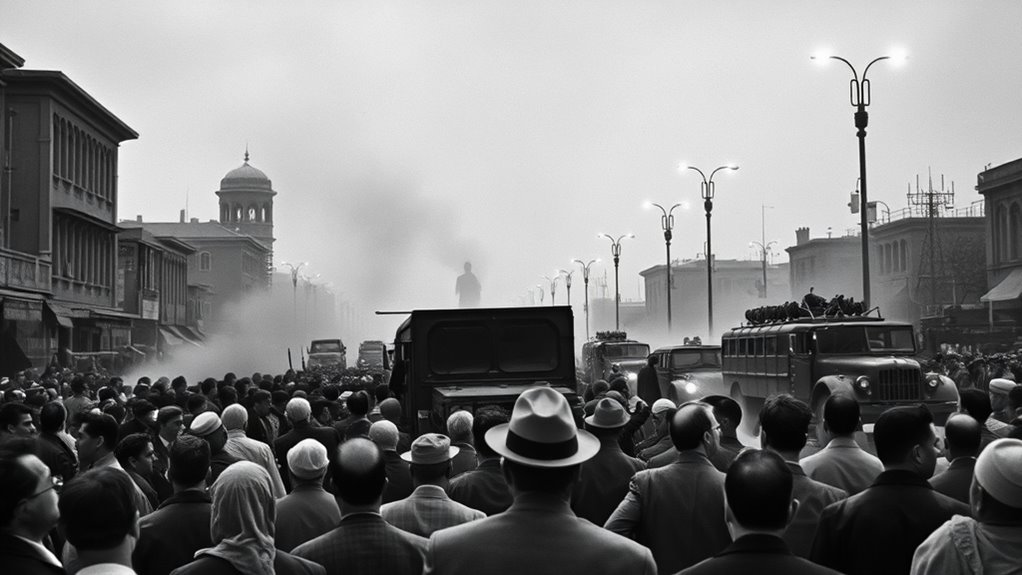

In 1953, the CIA and MI6 orchestrated a covert operation to overthrow Iran’s Prime Minister Mosaddegh, driven by Cold War fears and Western oil interests. They used propaganda, bribery, and organized protests, exploiting internal dissent and fears of communism. By supporting opposition groups and destabilizing Mosaddegh’s government, they successfully reinstated the Shah’s power. To understand the full scope of their strategies and consequences, explore how they manipulated Iran’s political landscape during this pivotal event.
Key Takeaways
- The CIA orchestrated Operation Ajax by employing propaganda, covert funding, and political manipulation to undermine Prime Minister Mosaddegh.
- Cold War fears of Soviet influence justified the covert intervention, framing it as necessary for U.S. and U.K. interests.
- Domestic opposition from Iran’s elites and military, fearing economic instability and communist infiltration, facilitated collaboration with foreign operatives.
- Propaganda campaigns and organized protests created confusion and weakened Mosaddegh’s government, paving the way for military intervention.
- The successful coup reinstated the Shah’s power, demonstrating Cold War tactics of exploiting internal dissent for regime change.
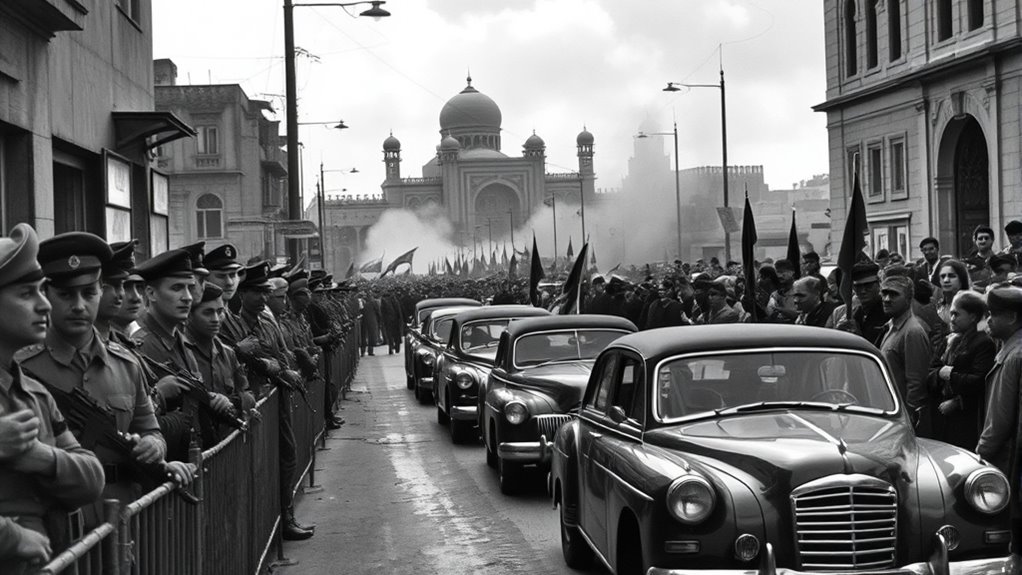
The 1953 Iran Coup, also known as Operation Ajax, was a covert operation orchestrated by the United States and the United Kingdom to overthrow Iran’s democratically elected Prime Minister, Mohammad Mosaddegh. At the core of the operation was the Cold War context, where the U.S. and UK aimed to prevent any perceived spread of communism in Iran. They viewed Mosaddegh’s nationalist policies, especially his move to nationalize the Iranian oil industry, as a threat to Western interests and as potentially opening the door for Soviet influence. To counter this, they devised a plan to destabilize his government, leveraging Cold War fears to justify their actions.
Operation Ajax aimed to overthrow Iran’s democratically elected leader during Cold War fears of Soviet influence.
You’d learn that the operation didn’t succeed solely because of international pressure; domestic opposition to Mosaddegh also played a *pivotal* role. Many traditional elites, including the Shah and military leaders, grew wary of Mosaddegh’s populist approach and the chaos surrounding his tenure. They feared losing influence and believed that removing him would restore stability and protect their interests. The Shah, in particular, was persuaded by foreign powers that his position was at risk, leading him to support the coup. This domestic opposition was fueled by fears of communist infiltration, economic instability, and a desire to maintain the status quo, which made collaboration with foreign operatives easier.
As you follow the covert activities, you see how the CIA and MI6 employed propaganda, covert funding, and political manipulation to sway public opinion and undermine Mosaddegh’s government. They supported opposition groups, organized protests, and created confusion within the Iranian political landscape. The Cold War influences played a significant role here—they framed the coup as a necessary step to prevent Iran from becoming a Soviet satellite, tapping into fears that resonated with many Iranians who were wary of radical change or communist sympathizers. Moreover, the operation’s success was also aided by the domestic political landscape, where dissent was exploited to justify intervention.
You realize that the domestic opposition, combined with Cold War fears and international backing, created a *definitive* storm that allowed the coup to succeed. The operation culminated in the military overthrow of Mosaddegh’s government, reinstating the Shah as a monarch with increased powers. This event not only altered Iran’s political trajectory but also demonstrated how Cold War dynamics and internal dissent could be exploited by foreign powers to engineer regime change. Understanding this helps you see how deeply intertwined international strategy and domestic politics were in shaping Iran’s history during that period.
Cold War: For Forty-Five Years the World Held Its Breath

A compelling account of the Cold War's history and global impact, available in good used condition.
As an affiliate, we earn on qualifying purchases.
As an affiliate, we earn on qualifying purchases.
Frequently Asked Questions
Were Any Iranian Officials Involved in the Coup Planning?
You should know that some Iranian officials were involved in the coup planning, driven by political motivations and internal dissent. These officials collaborated with external actors like the CIA to orchestrate the overthrow, believing it would protect national interests or restore stability. Their involvement highlights how internal dissent and conflicting political motivations played a pivotal role in shaping the coup’s success, ultimately leading to a significant shift in Iran’s political landscape.
How Did the Shah Regain Power After the Coup?
Ever wonder how the Shah regained power after the coup? You see, he returned with strong backing from the CIA, which helped him quickly consolidate his regime. By suppressing opposition and reinforcing loyalty within the military, the Shah solidified his control. His strategic moves, supported by external influence, guaranteed his regime’s survival and strengthened his authority, making his return a pivotal moment in Iran’s history.
What Was the Role of British Intelligence in the Operation?
You should know that British intelligence played a key role in the operation through covert collaboration. Their influence helped orchestrate the coup by providing pivotal information, resources, and strategic support to the CIA. This partnership strengthened the efforts to undermine Prime Minister Mossadegh’s government and restore the Shah’s power. British influence was instrumental in shaping the success of the operation, demonstrating a significant foreign role in the regime change.
Were There Any Covert Operations Besides the Cia’s Efforts?
Did you know that besides the CIA’s efforts, other foreign operatives carried out clandestine activities during the 1953 Iran Coup? Yes, British intelligence played a significant role, coordinating covert operations to influence Iran’s political landscape. These foreign operatives worked behind the scenes, employing secret strategies to support the overthrow. Their combined clandestine activities helped shape the outcome, demonstrating how international covert efforts often operate together to achieve strategic goals.
How Did the Coup Impact Iran-U.S. Relations Long-Term?
The coup caused lasting diplomatic fallout, straining Iran-U.S. relations for decades. You’d notice increased mistrust and suspicion between the two nations, leading to strategic shifts in foreign policy. The event’s legacy influences current geopolitics, shaping U.S. involvement in the Middle East. This long-term impact underscores how covert actions can markedly alter diplomatic ties, making future cooperation more complex and cautious.
Conclusion
You can’t ignore how a secret operation by the CIA reshaped Iran’s future forever. The 1953 coup wasn’t just a political shift; it was a seismic event that dictated decades of turmoil and unrest. Knowing this history, you realize how fragile democracy truly is—sometimes, it takes just one covert act to change the course of a nation’s destiny. Remember, the ripple effects of that single operation still echo louder than thunder today.