

TL;DR
U.S. Treasury Secretary Scott Bessent and Japanese Prime Minister Sanae Takaichi expressed concern over excessive currency market volatility. Bessent called it ‘undesirable’ after their meeting in Tokyo.
U.S. Treasury Secretary Scott Bessent stated that both Washington and Tokyo view excessive foreign exchange market volatility as undesirable, following his meeting with Japanese Prime Minister Sanae Takaichi in Tokyo on May 12, 2026.
During the meeting, Bessent and Takaichi discussed recent fluctuations in currency markets, particularly the yen’s movements against the dollar. Bessent emphasized that instability in FX markets hampers economic stability and mutual cooperation. The statement reflects a shared concern between the U.S. and Japan over recent volatility, which has been influenced by monetary policy divergences and geopolitical tensions. Bessent’s comments align with ongoing U.S. and Japanese efforts to promote market stability amid global financial uncertainties.
Why It Matters
This development underscores the importance both the U.S. and Japan place on currency stability, which affects trade, investment, and economic policy. The statement signals potential diplomatic or policy actions aimed at mitigating FX volatility, which could influence global markets. It also highlights ongoing concerns about the impacts of monetary policy divergence and geopolitical risks on currency markets, with implications for investors and policymakers worldwide.
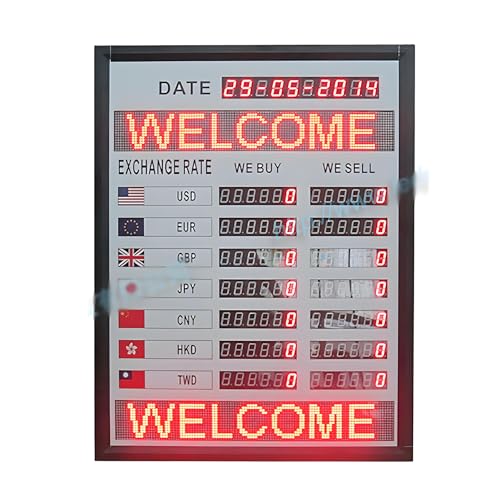
Foreign Exchange Price Exchange Rate Screen, Led Nation Exchange Rate Display WithRemote Control, U Disk Transfer Content, Automatic Time Update, Power-Off Memory, for Banks, Office
- Content Transfer via U Disk: Change display content quickly with USB
- Programmable Display: Edit and store settings via software
- High-Brightness Digital Tube: Clear, easy-to-read display with automatic time update
As an affiliate, we earn on qualifying purchases.
As an affiliate, we earn on qualifying purchases.
Background
Recent months have seen heightened volatility in currency markets, driven by divergent monetary policies between major economies, geopolitical tensions, and intervention attempts by Japan to stabilize the yen. The yen’s sharp movements have raised concerns among policymakers about the effects on trade and financial stability. Previous discussions between the U.S. and Japan have focused on coordinated efforts to manage FX fluctuations, especially amid global economic uncertainties. Bessent’s comments follow Japan’s interventions aimed at supporting the yen and reflect ongoing diplomatic engagement on currency issues.
“Both Washington and Tokyo see excessive volatility in currency markets as undesirable.”
— Scott Bessent
“We discussed the importance of stable currency markets for economic growth and cooperation.”
— Sanae Takaichi

FX Options with Python: Pricing, Volatility Surfaces, Hedging, and Systematic Analysis
As an affiliate, we earn on qualifying purchases.
As an affiliate, we earn on qualifying purchases.
What Remains Unclear
It is not yet clear whether the U.S. and Japan will coordinate specific policy measures to address FX volatility or if further diplomatic discussions are planned. Details of any potential joint interventions or policy alignments remain undisclosed.

A Student's Guide: Investment Strategies in the Foreign Exchange Market
As an affiliate, we earn on qualifying purchases.
As an affiliate, we earn on qualifying purchases.
What’s Next
Further discussions and diplomatic engagements are expected between the U.S. and Japan to explore measures aimed at stabilizing currency markets. Markets will watch for any official policy announcements or coordinated actions in the coming weeks.

50ct Regular Bill Currency Holder – Semi Rigid Currency Holder Collecting Supplies for Collectors, Waterproof Protective Sleeves for Bill, Currency Notes & Banknotes, Clear Money Holders
- Exterior Dimensions: Fits regular-sized bills securely
- Rounded Edge Polishing: Smooth, burr-free, safe handling
- Reinforced Sealed Structure: Durable, crack-resistant, reusable
As an affiliate, we earn on qualifying purchases.
As an affiliate, we earn on qualifying purchases.
Key Questions
What caused the recent FX market volatility?
Recent volatility has been driven by divergent monetary policies, geopolitical tensions, and Japan’s interventions to support the yen, along with global economic uncertainties.
What actions might the U.S. and Japan take to stabilize markets?
Potential actions include coordinated currency interventions, diplomatic agreements, or adjustments in monetary policies, though specific plans have not been disclosed.
Why does FX volatility matter for the global economy?
High volatility can disrupt trade, investment, and financial stability, affecting economies worldwide and complicating policymaking.
Are there any immediate market impacts from this meeting?
As of now, there are no confirmed market reactions directly linked to this meeting. Market movements will depend on future policy signals.



![Computer-Aided Language Development in Nonspeaking Children (1968) [pdf]](https://aiespionage.net/wp-content/uploads/2026/06/computer-aided-language-development-in-nonspeaking-children-1968-pdf-featured-260x140.jpg)