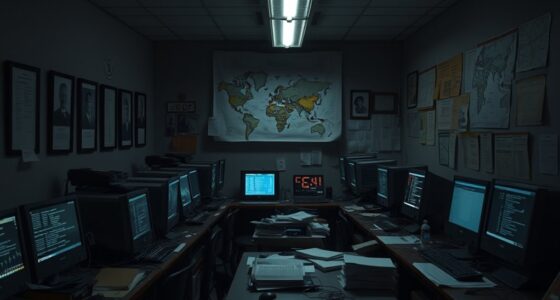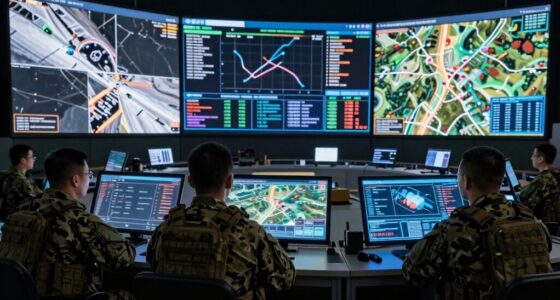
As a soldier, your G-2 intelligence team serves as your eye on the battlefield, gathering and analyzing vital information through advanced tools like cyber warfare and signal interception. They help you understand enemy movements, intentions, and vulnerabilities in real-time, giving you a strategic advantage. Staying ahead requires sharp skills in cybersecurity and communication analysis. If you keep exploring, you’ll discover how these tools work together to keep you safe and informed in combat.
Key Takeaways
- G-2 provides critical battlefield intelligence through data collection, analysis, and interpretation to support decision-making.
- It employs advanced cyber warfare tools to disrupt and gather enemy information digitally.
- Signal interception enables real-time insights into enemy communications and movements.
- Skilled personnel operate sophisticated technology for encryption, decoding, and cyber operations.
- Strategic advantage is achieved by maintaining vigilance, technical expertise, and continuous adaptation.
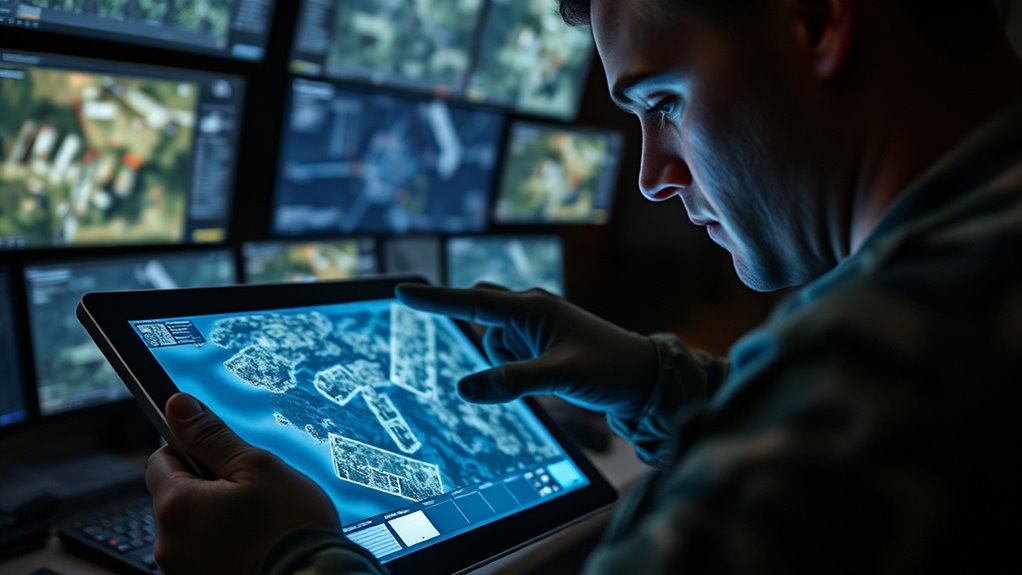
Have you ever wondered how armies gather critical information to stay ahead of their enemies? It’s a complex and high-stakes process that relies heavily on advanced intelligence operations. Central to this effort is the role of Army Intelligence, specifically the G-2, which acts as the soldier’s eye on the battlefield. Your success depends on how well you can collect, analyze, and interpret data from diverse sources to make informed decisions quickly. One of the most essential aspects of modern intelligence involves cyber warfare and signal interception. These tools allow you to tap into enemy communications and disrupt their operations before they even begin.
Army Intelligence, the G-2, is your eye in the battlefield, using cyber warfare and signal interception to outsmart enemies.
Cyber warfare has transformed the battlefield, giving you the ability to penetrate enemy networks, gather critical information, and even sabotage their systems. When you engage in cyber operations, you can uncover plans, locate key personnel, and identify vulnerabilities. It’s a strategic advantage that’s often invisible but incredibly powerful. The challenge lies in staying ahead of the enemy’s cyber defenses, which continually evolve to counter your efforts. That’s why your training emphasizes the importance of understanding digital infrastructure and practicing continuous adaptation to new threats. Signal interception, on the other hand, is about eavesdropping on enemy transmissions—be they radio, satellite, or other electronic signals. By intercepting these signals, you can gain real-time insights into enemy movements, intentions, and capabilities.
Your ability to analyze intercepted signals quickly is essential. You need to sift through vast amounts of data to find the pieces that matter most. This might involve decoding encrypted messages or identifying patterns that reveal the enemy’s plans. Signal interception also helps you confirm intelligence gathered through other means, creating a clearer picture of the battlefield. Both cyber warfare and signal interception require sophisticated technology and highly trained personnel. You’ll work closely with specialists who understand the intricacies of digital communication, encryption, and electronic signals. Your role is to ensure that this intelligence reaches the decision-makers promptly, so they can act decisively.
Ultimately, the success of Army Intelligence hinges on your ability to leverage these tools effectively. Cyber warfare and signal interception are not just technical tasks—they’re strategic weapons that can turn the tide of battle. As a soldier in this field, your vigilance, technical skill, and quick thinking can make all the difference. Staying informed, adaptable, and prepared ensures you maintain the edge needed to outsmart and outmaneuver your enemies on today’s dynamic battlefield. Developing a deep understanding of cybersecurity and encryption is crucial to maintaining operational superiority in this digital age.

Security Guard Training Program & Kit on USB – Safeguarding Information – Includes Instructor Guidebook, PowerPoint, Exam, and More Resources
- Instructor's Guidebook: Comprehensive training manual
- Editable PowerPoint: Customizable training slides
- 20-Question Exam: Ready-to-use exam and answer key
As an affiliate, we earn on qualifying purchases.
As an affiliate, we earn on qualifying purchases.
Frequently Asked Questions
How Does Army Intelligence Gather Real-Time Battlefield Data?
You gather real-time battlefield data through satellite imagery and signal interception. Satellite imagery provides high-resolution visuals of enemy movements and terrain changes, while signal interception captures communications and electronic signals. By analyzing this data rapidly, you can assess threats, track enemy positions, and make informed decisions. Combining these methods ensures you stay ahead of the battlefield, gaining critical intelligence to support mission success.
What Technologies Are Used in Modern Army Intelligence Operations?
You use advanced technologies like drone surveillance and satellite imagery to gather real-time battlefield data. Drones provide live aerial views, allowing you to monitor enemy movements and terrain changes quickly. Satellite imagery offers broad, detailed overviews of large areas, helping you identify strategic targets and assess damage. These tools enhance your situational awareness, enabling faster, more accurate decisions in dynamic combat environments.
How Do Soldiers Interpret Intelligence Reports Effectively?
You sift through intelligence reports like a skilled detective, honing your visual analysis to spot vital details. Trust in source credibility guides your judgment, ensuring you don’t get lost in false promises or misleading data. By connecting dots quickly and critically evaluating information, you turn raw data into a clear picture, empowering your decisions on the battlefield. Your sharp eye transforms chaos into clarity, keeping your unit one step ahead.
What Challenges Does Army Intelligence Face in Cyber Warfare?
You face challenges in cyber warfare like maintaining robust cyber defense and identifying misinformation tactics. Hackers constantly evolve their methods, making it hard to protect critical data and infrastructure. Misinformation tactics spread false narratives, disrupting operations and eroding trust. To succeed, you must stay ahead by continuously updating defenses, analyzing digital threats, and training personnel to recognize and counteract sophisticated cyber attacks and deceptive information campaigns.
How Is Intelligence Shared Securely Among Allied Forces?
You guarantee secure intelligence sharing among allied forces by using encrypted communication channels, which protect sensitive data from interception. You establish common protocols and standards for allied information sharing, making sure everyone adheres to strict cybersecurity measures. Regularly, you update encryption methods and conduct joint cybersecurity exercises to identify vulnerabilities. This proactive approach helps maintain secure, confidential exchanges, fostering trust and coordination among allied forces in complex operational environments.

Bingfu FM Radio Dipole Antenna for Stereo Receiver Indoor Pioneer Onkyo Yamaha Marantz Bose Wave Music System Home FM Radio AV Audio Video Home Theater Receiver
- Adhesive Mounting FM Antenna: Easy indoor installation with adhesive mount
- Universal Compatibility: Works with Yamaha, Pioneer, Onkyo, Bose, and more
- Includes 10ft Coaxial Cable: Extended reach for flexible placement
As an affiliate, we earn on qualifying purchases.
As an affiliate, we earn on qualifying purchases.
Conclusion
You rely on army intelligence to see beyond the chaos, to understand the unseen, to anticipate the unpredictable. It guides your decisions, sharpens your awareness, strengthens your resolve. It’s your eye on the battlefield, your shield in the storm, your voice in the silence. Without it, you’re blind. With it, you stand stronger, smarter, prepared. It’s the soldier’s eye on the battlefield, the mind’s eye in every mission, the heartbeat of every victory.

Patriot ConX | Dugout-to-Player Electronic Communications Device | Pitch Calling | Play Calling
- Includes 1 Watch System: Coach's command center with watch and case
- Easy to Use and Editable: 10-minute setup, game-ready
- No Internet Needed: Operates without service plan
As an affiliate, we earn on qualifying purchases.
As an affiliate, we earn on qualifying purchases.

Portable Tinysa Spectrum Analyzer, AURSINC V0.3.1 Handheld Frequency Analyzer, Signal Generator 100kHz to 960MHz MF/HF/VHF UHF Input ESD Protected Function with 2.8 inch Touchscreen
- Hardware Version: V0.3.1 with firmware updates
- Frequency Range: 0.1MHz to 960MHz
- Input Types: MF/HF/VHF and UHF inputs
As an affiliate, we earn on qualifying purchases.
As an affiliate, we earn on qualifying purchases.