
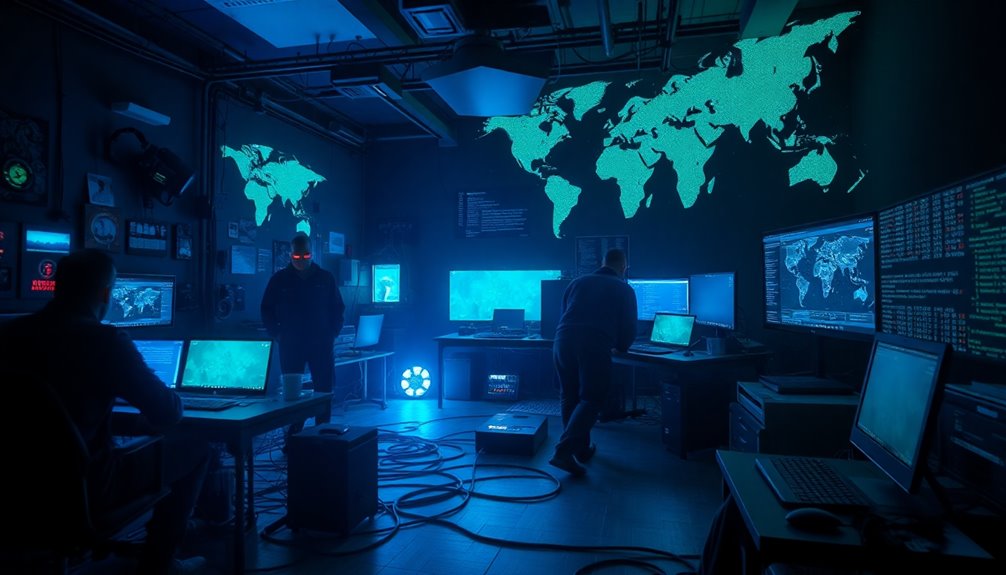
As cyber threats escalate globally, China's state-sponsored hacking operations have emerged as a significant concern, impacting various sectors and countries. You mightn't realize it, but these operations target everything from critical infrastructure to educational institutions, and they're not just a minor nuisance. Western nations frequently accuse China of conducting extensive cyber espionage campaigns, which adds another layer of complexity to international relations.

Get privacy and security gear delivered free — and shop member deals
- Fast, free delivery on millions of items
- Access to Prime Big Deal Days deals on October 6–7
- Prime Video, Amazon Music and more included
Chinese hackers employ a variety of sophisticated techniques to achieve their goals. They often exploit newly disclosed vulnerabilities in widely used software, like Pulse Secure and Microsoft products. Once they find a weakness, they don't stop there. They use virtual private servers (VPSs) as encrypted proxies to mask their activities and evade detection, making it extremely difficult to trace their steps back to their origin. This tactic allows them to move laterally within networks, gathering sensitive data without raising alarms.
Chinese hackers leverage sophisticated techniques, exploiting software vulnerabilities and using encrypted proxies to stealthily gather sensitive data.
The targeted sectors reveal just how broad the scope of their operations is. Energy and telecommunications companies, for instance, are often in the crosshairs, as are universities rich in intellectual property and research data. The defense industrial base is another prime target, with hackers seeking sensitive military information. Managed service providers, which help clients with IT services, are also frequently attacked to gain access to multiple networks, amplifying the reach of these cyber operations. Analysts have noted that these operations indicate a maturing cyber espionage ecosystem which supports China's extensive capabilities.
You might've heard of advanced persistent threats (APTs) like APT31 and APT40. These groups are linked to various Chinese state entities and focus on high-value targets. APT31, for example, is connected to the Ministry of State Security, while APT40 often zeroes in on maritime industries. Other groups, like Volt Typhoon and Flax Typhoon, target critical infrastructure using tactics that blend in with normal network activity, known as "living off the land."
Despite the mounting evidence, China consistently denies involvement in these operations. They often point to historical U.S. cyber espionage activities to deflect accusations. Yet, the global impact of these hacking operations is undeniable, as they support China's geopolitical objectives by influencing strategic decision-making and shaping international relations.
Tensions between the U.S. and China continue to rise, prompting nations to collaborate more closely to counter these threats. By sharing intelligence and issuing joint advisories, countries are taking steps to protect themselves from the shadows cast by China's hacking operations.
cybersecurity VPN proxy
As an affiliate, we earn on qualifying purchases.
As an affiliate, we earn on qualifying purchases.
Fall Picks
fall essentials
As an affiliate, we earn on qualifying purchases.