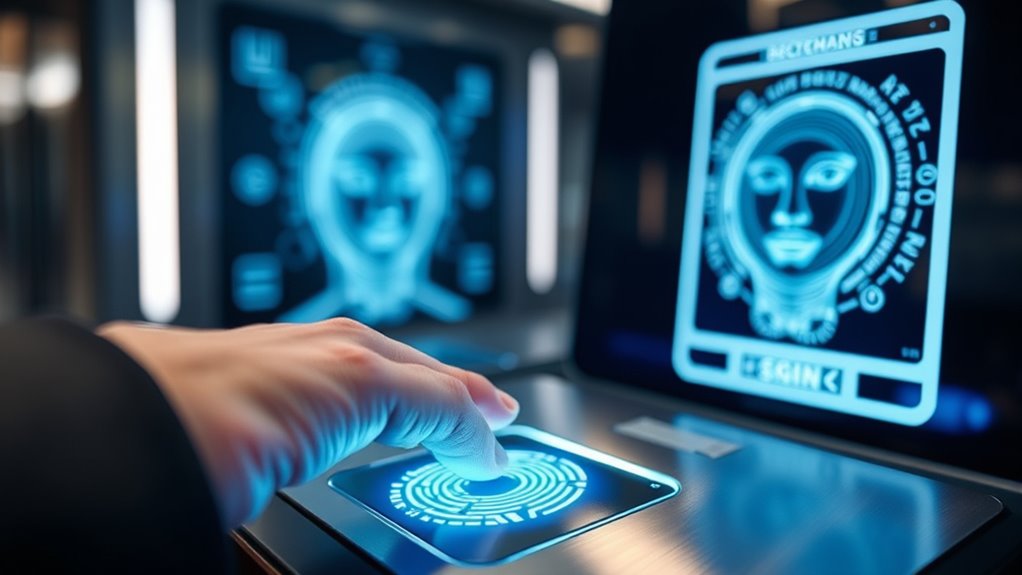

Biometric security uses your unique physical and behavioral traits, like fingerprints, face scans, or typing patterns, to verify your identity. It moves beyond traditional methods by analyzing behaviors that are hard to imitate, such as how you walk or type. Advanced encryption protects your biometric data during storage and transfer, ensuring your privacy. Combining behavioral analysis with encryption creates a robust security system that stays seamless and secure. To discover how these technologies work together, keep exploring.
Key Takeaways
- Biometrics use unique physical and behavioral traits, like fingerprints and face scans, for secure identity verification.
- Behavioral analysis enhances security by monitoring actions such as typing and walking to detect anomalies.
- Encryption protects stored biometric data and during transmission, preventing interception and unauthorized access.
- Biometric encryption converts raw biometric images into secure, unreadable data, ensuring privacy and security.
- Combining behavioral analysis with encryption creates a robust, seamless security system that safeguards user data.
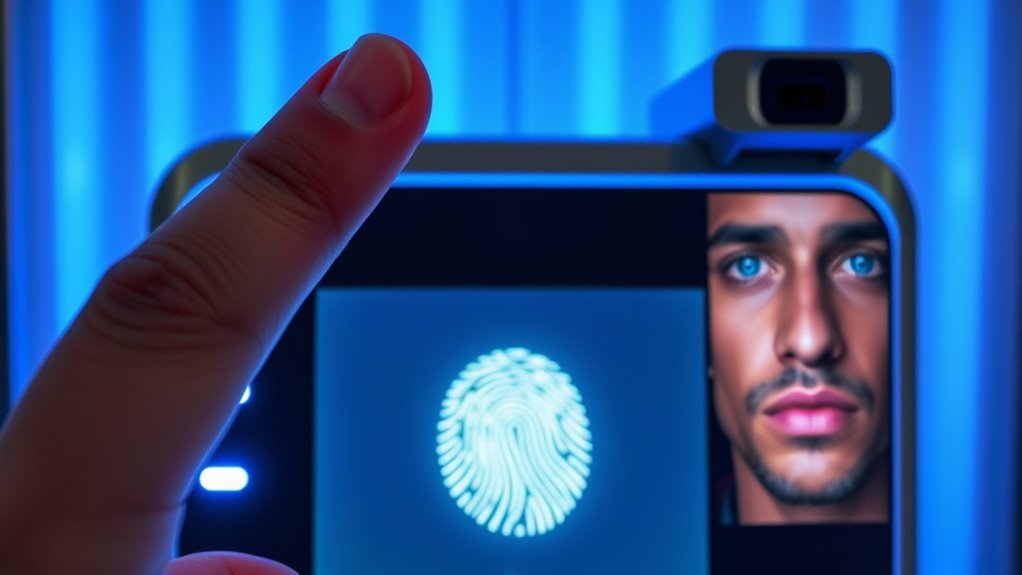
Biometrics plays a essential role in enhancing security by using unique physical or behavioral traits to verify identities. When you think about how your identity is confirmed, it’s not just about matching fingerprints anymore. Behavioral analysis has become a key part of modern biometric systems. This technique examines patterns in your actions, such as how you type, walk, or even how you hold your device. Because these behaviors are difficult for others to mimic, they add an extra layer of protection. For example, your typing rhythm, known as keystroke dynamics, can confirm your identity each time you log into a system, making it harder for someone else to gain access using stolen credentials. Behavioral analysis helps detect anomalies—if your behavior suddenly changes or appears suspicious, the system can flag this, prompting additional verification steps. This continuous monitoring makes security more dynamic and personalized, reducing the chances of unauthorized access. Secure data transmission is also crucial, ensuring that biometric data remains protected during transfer. Biometric encryption is another essential element in safeguarding your biometric data. When your biometric features—like fingerprints or facial scans—are stored, they’re not simply saved as raw images. Instead, they’re encrypted using advanced algorithms, making the data unreadable without a special key. This approach ensures that even if hackers manage to breach the storage system, they can’t access usable biometric information. Biometric encryption also enables secure transmission of biometric data across networks. When you authenticate yourself, the system encrypts your biometric data on the fly, verifying it against the stored encrypted version without ever exposing the raw data. This process considerably reduces the risk of interception or theft. It’s akin to sending a coded message that only the intended system can decode, ensuring your identity remains protected at every step.
Together, behavioral analysis and biometric encryption form a formidable duo in biometric security. Behavioral analysis adds context and behavioral verification, making it harder for imposters to fool the system with static biometric traits alone. Meanwhile, biometric encryption ensures that your biometric data is always protected during storage and transmission, preventing unauthorized access or misuse. As technology advances, these methods are becoming more sophisticated, allowing for seamless, secure authentication without sacrificing convenience. You benefit from a system that not only recognizes your unique physical and behavioral traits but also keeps that information secure behind multiple layers of encryption. This integration enhances overall security, giving you confidence that your identity remains private and protected in our increasingly digital world.

Digital Persona 88003-001U.are.u 4500 Reader 70" Cable
- Target Applications: Desktop PC, Mobile, Custom apps
- Usage Environment: Indoor, home, office use
- LED Indicator: Soft blue glow, unobtrusive
As an affiliate, we earn on qualifying purchases.
As an affiliate, we earn on qualifying purchases.
Frequently Asked Questions
How Do Biometric Systems Handle False Positives and Negatives?
Biometric systems handle false positives and negatives through threshold adjustments, which set sensitivity levels for matching. If false positives are high, you can raise the threshold to improve accuracy, while lowering it reduces false negatives. Error rate mitigation involves fine-tuning these thresholds and using multi-factor authentication, ensuring the system balances security and user convenience effectively. By continuously monitoring and adjusting, you minimize errors and enhance overall reliability.
Can Biometric Data Be Hacked or Stolen?
Yes, biometric data can be hacked or stolen through biometric data breaches, risking unauthorized biometric access. Cybercriminals may target databases storing fingerprint, face scan, or other biometric information, which, if compromised, can be misused for identity theft or unauthorized entry. To protect yourself, guarantee systems have strong security measures like encryption and regular updates, and stay alert for signs of potential breaches to minimize the risk of unauthorized biometric access.
What Are the Privacy Concerns Associated With Biometric Databases?
You should be aware that biometric databases raise privacy concerns like data breaches, where your sensitive info could be stolen or misused. Additionally, consent issues often arise if your biometric data is collected or shared without clear permission, risking your privacy rights. These problems highlight the importance of strict security measures and transparent policies to protect your biometric information from unauthorized access and misuse.
How Do Biometric Authentication Methods Compare in Speed and Accuracy?
Think of biometric methods as race cars on a track. Facial recognition often wins in speed, quickly scanning your face for a match, while fingerprint scanning offers high accuracy but might take a little longer. Facial scans are fast but can sometimes be less precise in certain lighting, whereas fingerprints are reliably accurate but require direct contact. You choose based on whether you prioritize speed or precision.
Are There Any Legal Regulations Governing Biometric Data Use?
You need to be aware that legal regulations govern biometric data use to ensure legal compliance and data protection. Laws like GDPR in Europe and CCPA in California set strict standards for collecting, storing, and sharing biometric information. These regulations require you to obtain explicit consent, implement secure data handling practices, and provide transparency. Ignoring these rules can lead to hefty fines and legal consequences, so always prioritize adherence in your biometric data practices.

Smart Door Lock with 3D Face Recognition & Camera, Video Doorbell with Intercom, Fingerprint Keyless Entry, Password, IC Card, Key, Alexa Compatible, Tuya App Control, Smart Home Front Door Security
- 3D Face Recognition: Fast, secure, touchless unlocking
- Multiple Unlock Methods: Face ID, fingerprint, password, IC card, key, app, codes
- Video Intercom & Audio: Real-time visitor communication
As an affiliate, we earn on qualifying purchases.
As an affiliate, we earn on qualifying purchases.
Conclusion
Think of your biometric data as the keys to your digital fortress—you wouldn’t hand over your keys to just anyone. As more than 70% of security breaches now involve stolen or compromised biometrics, understanding how these tools protect you is essential. Just like a fingerprint uniquely identifies you, your biometric info acts as a personalized lock, making it harder for hackers to breach your defenses. Embrace these technologies wisely—they’re your modern-day security guard.

Continuous Biometric Authentication Systems: An Overview (SpringerBriefs in Computer Science)
As an affiliate, we earn on qualifying purchases.
As an affiliate, we earn on qualifying purchases.

Windows Hello Fingerprint Reader for Windows 11 10, Offline Physical Security Vault for PC, USB Biometric Fingerprint Scanner, 360° Touch Secure Login & Data Encryption Device for Laptop Sliver
- Offline Physical Vault: Secure offline biometric data storage
- Fast 0.1s Unlock: Instant fingerprint recognition from any angle
- 360° Touch Sensor: High-sensitivity capacitive fingerprint scanner
As an affiliate, we earn on qualifying purchases.
As an affiliate, we earn on qualifying purchases.