

The Bay of Pigs invasion in 1961 was a failed CIA effort to overthrow Fidel Castro, exposing major flaws in U.S. covert operations. You might assume funding and support alone would spark rebellion, but the operation underestimated Castro’s strength, lacked local backing, and suffered from poor planning. This failure shook U.S. confidence and revealed the limits of secretive interventions. If you want to understand why it all went wrong, there’s more behind the story.
Key Takeaways
- The Bay of Pigs was a failed CIA-led invasion aimed at overthrowing Fidel Castro in 1961.
- Underestimating Castro’s support and security forces led to the operation’s quick failure.
- Poor planning, lack of local support, and insufficient intelligence contributed to the defeat.
- The failure undermined U.S. confidence in covert operations during the Cold War.
- It highlighted the dangers of overreliance on secret funding without broader strategic support.
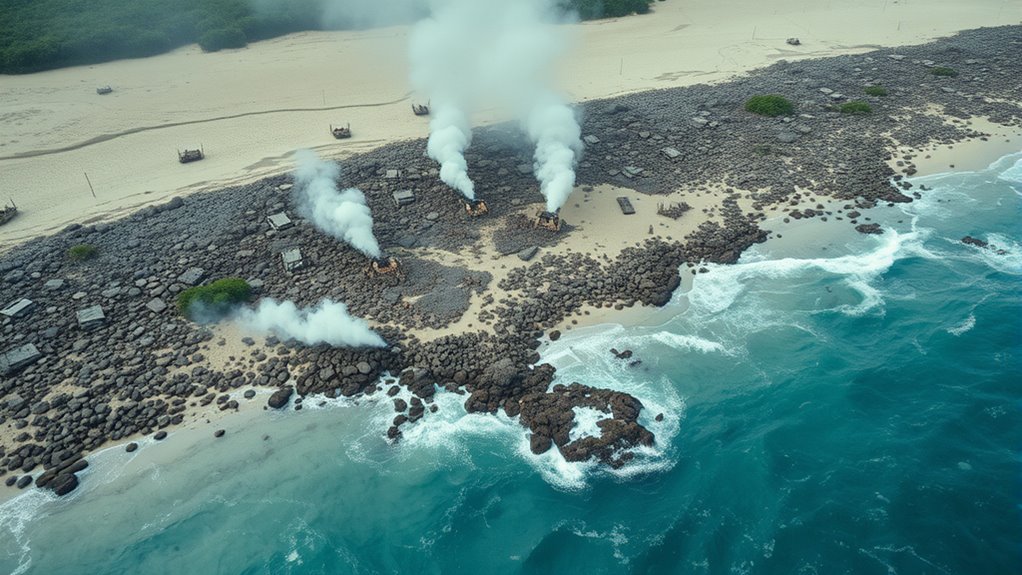
The Bay of Pigs CIA Operation was a failed attempt by the United States to overthrow Cuba’s Fidel Castro in April 1961. You’re about to learn how this covert plan unraveled, exposing weaknesses in U.S. strategy and confidence. At its core, the operation relied heavily on counterinsurgency tactics, aiming to spark an uprising against Castro’s government by supporting Cuban exiles. These tactics involved training and equipping the exiles to carry out sabotage, guerrilla warfare, and psychological operations to weaken Castro’s grip. However, what seemed like a solid plan on paper quickly fell apart when the operation faced reality in the Bay of Pigs.
One critical mistake was underestimating Castro’s support base and the strength of his security forces. You might think that covert funding alone would be enough to ignite rebellion, but without proper intelligence and local support, it’s a gamble. The CIA allocated significant resources—funds, weapons, training—believing that a small force of exiles could inspire a popular uprising. But the operation was poorly coordinated, and the exiles lacked the element of surprise. When the invasion began, Castro’s forces were ready, and the element of covert funding was rendered ineffective against their well-prepared defenses.
Underestimating Castro’s forces showed covert funding alone couldn’t guarantee success.
The failure of the operation revealed fundamental flaws in U.S. planning. You see, counterinsurgency tactics require more than just supplying weapons and planning covert operations; they demand a deep understanding of the local context, political dynamics, and public sentiment. The CIA’s focus on supporting exile groups without ensuring they had widespread popular backing was a critical oversight. As the operation faltered, it became clear that relying solely on covert funding and tactical support couldn’t substitute for genuine political engagement or local legitimacy. Additionally, the reliance on secretive efforts without thorough planning amplified the operation’s failure.
The aftermath of the Bay of Pigs shook U.S. confidence, exposing the limits of covert operations and counterinsurgency tactics that had been heavily relied upon during the Cold War. It became evident that secretive efforts could backfire spectacularly if not backed by exhaustive intelligence and realistic assessments. As you study this operation, it’s clear that successful covert intervention requires meticulous planning, understanding of local dynamics, and sustainable support—lessons that the U.S. learned the hard way. The Bay of Pigs stands as a cautionary tale about the dangers of overestimating the power of covert funding and underestimating the resilience of a determined regime.
As an affiliate, we earn on qualifying purchases.
Frequently Asked Questions
What Were the Long-Term Political Consequences of the Bay of Pigs Failure?
The long-term political consequences of the Bay of Pigs failure include significant diplomatic fallout, as U.S. credibility took a hit and strained relations with Latin American countries. You might notice how it shifted public perception, making Americans more skeptical of government promises. This failure also encouraged Cuba and the Soviet Union to strengthen their alliance, heightening Cold War tensions and pushing the U.S. to pursue more covert and aggressive strategies.
How Did the CIA Plan and Prepare for the Operation?
You see, during operation planning, the CIA focused on covert logistics to guarantee secrecy. They trained exile fighters and devised a surprise attack strategy. The agency also coordinated supplies, communications, and transportation secretly, aiming to minimize detection. However, despite meticulous planning, flaws in intelligence and execution led to failure. Your understanding shows how the CIA’s efforts in covert logistics and operation planning ultimately couldn’t overcome the challenges they faced.
Were There Any Covert Support Activities for the Operation Beyond Cuba?
Yes, there were extracurricular espionage activities supporting the operation beyond Cuba. You might not realize it, but covert communications played a key role, enabling secret coordination between operatives. These activities included gathering intelligence, establishing clandestine contacts, and conducting covert communications to guarantee secrecy. Such extracurricular espionage efforts aimed to bolster the operation’s success, but ultimately, they fell short, revealing the extent of covert activities involved in the mission.
What Role Did International Allies Play in the Bay of Pigs Invasion?
You might think international allies played a major role, but in reality, their support was minimal and shaky at best. During the Bay of Pigs invasion, international diplomacy was mostly silent, and allied covert activities were almost nonexistent. The U.S. relied heavily on its own plans, leaving allies on the sidelines, unsure whether to back a failed operation that ultimately embarrassed everyone involved and shook global confidence.
How Did the Bay of Pigs Influence U.S. Cold War Strategy?
You see, the Bay of Pigs made the U.S. rethink Cold War strategy by highlighting the importance of Cuban exiles and U.S. propaganda. It showed that relying on covert operations was risky, and it pushed leaders to strengthen intelligence and military plans. The failure also made the U.S. more cautious about direct intervention, emphasizing a need for better planning and global image management to prevent similar setbacks.
CIA covert operations documentary
As an affiliate, we earn on qualifying purchases.
As an affiliate, we earn on qualifying purchases.
Conclusion
The Bay of Pigs disaster proves that even the best plans can fail when underestimated risks and poor execution collide. If you visualize this event, imagine a fragile ship sailing into a storm, only to be struck by unseen waves. It reminds you that intelligence and preparation matter, but so does humility and adaptability. Ultimately, this operation teaches that overconfidence can lead to unexpected chaos, shaking trust and revealing vulnerabilities that can’t be ignored.
Bay of Pigs invasion history DVD
As an affiliate, we earn on qualifying purchases.
As an affiliate, we earn on qualifying purchases.
Cold War strategic analysis book
As an affiliate, we earn on qualifying purchases.
As an affiliate, we earn on qualifying purchases.