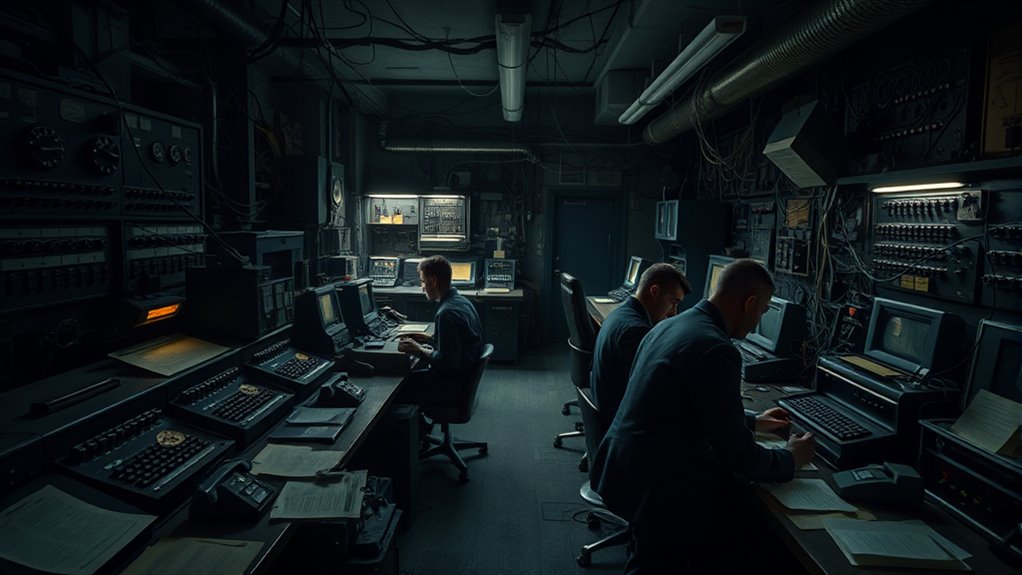

During WWII, codebreakers and early computers transformed espionage by breaking enemy codes like the German Enigma, which shifted military strategies and turned the tide of the conflict. These innovations led to the development of machines like Colossus, speeding up data analysis and decoding. This breakthrough not only advanced military intelligence but also laid the foundation for modern digital security and computing systems. Exploring further reveals how these wartime technologies continue to influence today’s cybersecurity landscape.
Key Takeaways
- WWII codebreakers developed early computers like Colossus to rapidly analyze intercepted enemy communications.
- Deciphering the Enigma machine advanced cryptographic techniques, influencing modern secure communication systems.
- Wartime technological innovations fostered collaboration among mathematicians, engineers, and cryptographers, shaping espionage methods.
- Early computers increased decoding speed, significantly impacting military strategies and intelligence accuracy.
- These advancements laid the foundation for modern digital security, cybersecurity, and the evolution of espionage technology.

During World War II, codebreakers played a pivotal role in turning the tide of the conflict by deciphering enemy communications. This period marked a significant turning point in the cryptography evolution, where the need for secure communication pushed both sides to develop increasingly complex encryption methods. Wartime hacking became a clandestine art, as intelligence agencies sought to intercept and decode messages that could reveal enemy plans. Your understanding of this era reveals how technological innovation was driven by the urgency of war, leading to breakthroughs that would influence future espionage tactics and computing.
WWII codebreakers transformed cryptography, driving innovations that shaped modern digital security and espionage techniques.
The wartime hacking efforts pushed cryptography to new heights, transforming it from simple cipher systems into sophisticated encryption techniques. Codebreakers like those at Bletchley Park tackled complex ciphers such as the German Enigma machine, which encoded military and diplomatic messages. Deciphering Enigma was a monumental achievement, requiring not only linguistic skills but also the development of early computing devices. These efforts laid the groundwork for the evolution of cryptography, demonstrating how breaking enemy codes directly impacted military strategy and outcomes. The need for speed and accuracy in wartime hacking meant that cryptography evolved rapidly, giving rise to new methods that could outpace enemy efforts to encrypt their communications.
Your role in understanding this history highlights how the demands of wartime hacking accelerated technological progress. The development of early computers, like the Colossus machine, was a direct response to the challenge of deciphering encrypted messages efficiently. These machines performed calculations at unprecedented speeds, which allowed codebreakers to process vast amounts of intercepted data quickly. The advancements made during this period didn’t just aid military operations—they laid the foundation for modern computing. As you explore this era, you see how the urgency of wartime hacking compelled innovation, shaping the future of digital technology and cybersecurity. Additionally, these innovations demonstrate how technological innovation was driven by the urgency of war, leading to breakthroughs that would influence future espionage tactics and computing.
In essence, WWII technology didn’t just serve the battlefield; it revolutionized espionage and cryptography itself. The collaboration between mathematicians, engineers, and cryptographers created tools that transformed secret communication into a science. These innovations in cryptography, born from the pressures of wartime hacking, would evolve into the secure communication systems we rely on today. Your understanding of this history underscores that the technological strides made during WWII were pivotal, not only in winning the war but in shaping the modern digital age.
As an affiliate, we earn on qualifying purchases.
Frequently Asked Questions
How Did WWII Influence Modern Cybersecurity Practices?
WWII revolutionized modern cybersecurity by accelerating cryptography evolution and emphasizing cyber defense. You benefit from these advances as cryptographic techniques improved, making data more secure. Military and civilian systems adopted stronger encryption methods, and the focus on cyber defense grew to protect critical infrastructure. This war’s innovations laid the groundwork for today’s cybersecurity practices, ensuring your information stays protected against evolving digital threats.
What Were the Key Breakthroughs in Early Computer Hardware?
Think of early computer hardware as the foundation of a mighty fortress. You see, mechanical calculators laid the stone pathways, enabling basic calculations with gears and levers. Punch card systems acted as the fortress’s scrolls, storing and processing data efficiently. These breakthroughs transformed raw machinery into powerful tools, paving the way for digital computers and shaping modern technology you rely on today.
Who Were the Unsung Heroes Behind Codebreaking Efforts?
You might not know their names, but cryptanalyst pioneers and covert operatives were the unsung heroes behind codebreaking efforts. They worked tirelessly, often in secret, deciphering complex enemy messages that shaped wartime strategies. These individuals combined sharp intellects and daring tactics, laying the groundwork for modern espionage. Their dedication and ingenuity often went unnoticed, yet their impact was vital in turning the tide of WWII.
How Did Espionage Tactics Evolve With Technological Advancements?
You see, with technological advancements, espionage tactics evolved considerably. You now rely on encrypted communication to keep your messages secure from interception, making your operations more secretive. Covert infiltration becomes more sophisticated as advanced tools help you gather intelligence discreetly. These innovations allow you to stay steps ahead of adversaries, ensuring your missions remain clandestine and effective in a rapidly changing digital landscape.
What Lessons From WWII Tech Are Applied in Today’s Intelligence?
You leverage lessons from WWII tech to enhance intelligence operations today. Cryptanalysis strategies evolved, emphasizing encryption and decryption techniques, while covert communication techniques prioritize privacy and security. These lessons teach you to stay steps ahead, safeguarding secrets and intercepting signals. By embracing innovative ideas rooted in wartime breakthroughs, you strengthen surveillance, thwart threats, and ensure strategic success in modern intelligence efforts.
As an affiliate, we earn on qualifying purchases.
Conclusion
You might think that WWII tech only changed warfare, but it also revolutionized espionage through early computers and codebreaking. The theory that these innovations solely served military needs overlooks their lasting impact on intelligence tactics and computing. By embracing this technology, you see how WWII efforts laid the groundwork for modern cybersecurity and data analysis. This proves that wartime inventions didn’t just end conflicts—they transformed how you and the world communicate and protect information today.
cryptography and encryption kits
As an affiliate, we earn on qualifying purchases.
As an affiliate, we earn on qualifying purchases.
As an affiliate, we earn on qualifying purchases.