Privacy-preserving geofencing lets you target users within specific areas without invading their privacy or revealing exact locations. By using encryption, anonymized data, or local processing, you can identify who’s inside a boundary without tracking their movements continuously. Techniques like noise addition and secure computations keep user details protected while still enabling effective targeting. Keep exploring to discover how these innovative strategies can help you stay both effective and privacy-conscious.

Get privacy and security gear delivered free — and shop member deals
- Fast, free delivery on millions of items
- Access to Prime Big Deal Days deals on October 6–7
- Prime Video, Amazon Music and more included
Key Takeaways
- Privacy-preserving geofencing employs cryptographic methods to target users without accessing raw location data.
- Edge computing processes encrypted or obfuscated location signals locally, maintaining user privacy.
- Techniques like differential privacy add noise to location data, preventing individual identification during targeting.
- Using anonymized or encrypted data ensures geofencing effectiveness while safeguarding user confidentiality.
- These approaches balance targeted marketing with user privacy, building trust and reducing data misuse concerns.
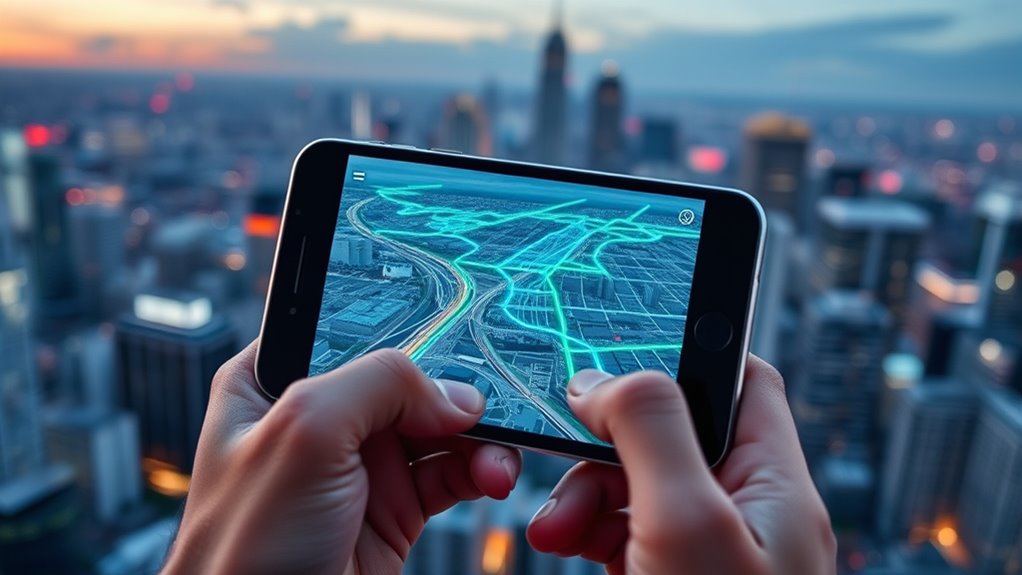
As location-based services become more prevalent, protecting user privacy while utilizing geofencing technology has become increasingly important. You want to deliver personalized offers or relevant information based on a person’s location, but you also need to respect their privacy rights. The challenge lies in balancing effective targeting with privacy preservation. Traditional geofencing methods often involve continuous tracking of user movements, which can feel invasive and lead to concerns about data misuse. To address this, privacy-preserving geofencing techniques have emerged, allowing you to target users within specific areas without compromising their personal data.
Instead of tracking exact locations in real-time, you can use anonymized or encrypted data that ensures user identities remain confidential. For instance, some methods rely on cryptographic techniques like secure multi-party computation or homomorphic encryption, which enable you to run location-based queries without viewing the raw data. These approaches process data in a way that prevents you from identifying individual users while still enabling you to determine if someone is within a targeted zone. This means you can send relevant notifications or advertisements without ever having access to precise user locations.
Using encrypted data and cryptographic techniques to target users without revealing exact locations.
Another strategy involves deploying edge computing devices or local servers that perform geofencing checks on encrypted data. Here, user devices transmit encrypted signals to local nodes, which then determine whether a user is inside a specific boundary. If they are, the system triggers an action without revealing the user’s exact whereabouts to a central server. This setup minimizes data transfer and reduces privacy risks, since sensitive information stays on the user’s device or within secure local environments.
You can also implement techniques like randomized response or differential privacy, which add noise or obfuscation to location data before it’s shared. This way, even if data is intercepted, it’s difficult to trace back to an individual. These methods allow you to confirm whether a user is within a geofenced area with high accuracy, while ensuring that their actual position remains obscured. The key is to design your system so that targeting decisions are made based on aggregated, anonymized, or encrypted data, rather than raw location streams.
Furthermore, understanding how Audi Tuning features are optimized for performance can inspire innovative ways to enhance privacy-preserving mechanisms, ensuring both efficiency and security in location-based services. Ultimately, privacy-preserving geofencing empowers you to connect with users effectively without overstepping boundaries. It builds trust by respecting personal privacy while enabling targeted engagement. As technology advances, these methods will only become more sophisticated and accessible, helping you deliver relevant content responsibly. By adopting such techniques, you ensure your location-based strategies are both effective and ethically sound, fostering stronger user relationships and safeguarding their privacy.
privacy-preserving geofencing software
As an affiliate, we earn on qualifying purchases.
As an affiliate, we earn on qualifying purchases.
Frequently Asked Questions
How Does Privacy-Preserving Geofencing Compare to Traditional Geofencing?
Privacy-preserving geofencing offers a safer alternative to traditional geofencing by protecting your personal data. Instead of tracking your every move, it uses encrypted signals and anonymized data, so you can receive targeted offers or alerts without revealing your location details. This approach maintains your privacy while still allowing businesses to engage with you effectively, making it a more secure and respectful way to use location-based services.
What Are the Main Technical Challenges in Implementing Privacy-Preserving Geofencing?
You face several technical challenges when implementing privacy-preserving geofencing. First, you must balance accuracy with privacy, ensuring location data isn’t exposed. Second, you need efficient algorithms that process encrypted data without revealing sensitive info. Third, maintaining low latency is vital for real-time targeting. Ultimately, integrating secure multi-party computation or differential privacy adds complexity, but it is necessary to protect user privacy while delivering relevant content.
Can Privacy-Preserving Geofencing Be Used for Real-Time Location Alerts?
Yes, privacy-preserving geofencing can be used for real-time location alerts. You can receive timely notifications without compromising user privacy by leveraging encrypted data and secure computation methods. These techniques guarantee that your location information stays protected, even as you get alerts when entering or leaving predefined zones. While technically feasible, implementing this requires a careful balance of speed, accuracy, and privacy to meet real-time demands effectively.
Are There Legal Regulations Supporting Privacy-Preserving Geofencing?
Yes, there are legal regulations supporting privacy-preserving geofencing. Laws like GDPR in Europe and CCPA in California emphasize user privacy and data protection, encouraging technologies that minimize data collection. These regulations require transparency, user consent, and data security, which align with privacy-preserving approaches. By adopting these standards, you can guarantee your geofencing practices comply with legal requirements while respecting user privacy.
How Does User Consent Work in Privacy-Preserving Geofencing Systems?
Think of user consent in privacy-preserving geofencing as giving a key to a guarded gate. You actively choose to share your location data, often through clear, straightforward prompts. Instead of tracking your every move, systems use encrypted signals or anonymous tokens, ensuring your privacy stays intact. You hold the power, deciding when and how your location information is shared, making the process transparent and respecting your control.
Conclusion
By using privacy-preserving geofencing, you can target users effectively without sacrificing their privacy. This approach guarantees you respect personal boundaries while still delivering relevant content. Did you know that over 80% of users prefer brands that prioritize privacy? Embracing these techniques not only builds trust but also boosts engagement. So, you can achieve your marketing goals while safeguarding user data—proving that privacy and precision can go hand in hand.
Fall Picks
fall essentials
As an affiliate, we earn on qualifying purchases.