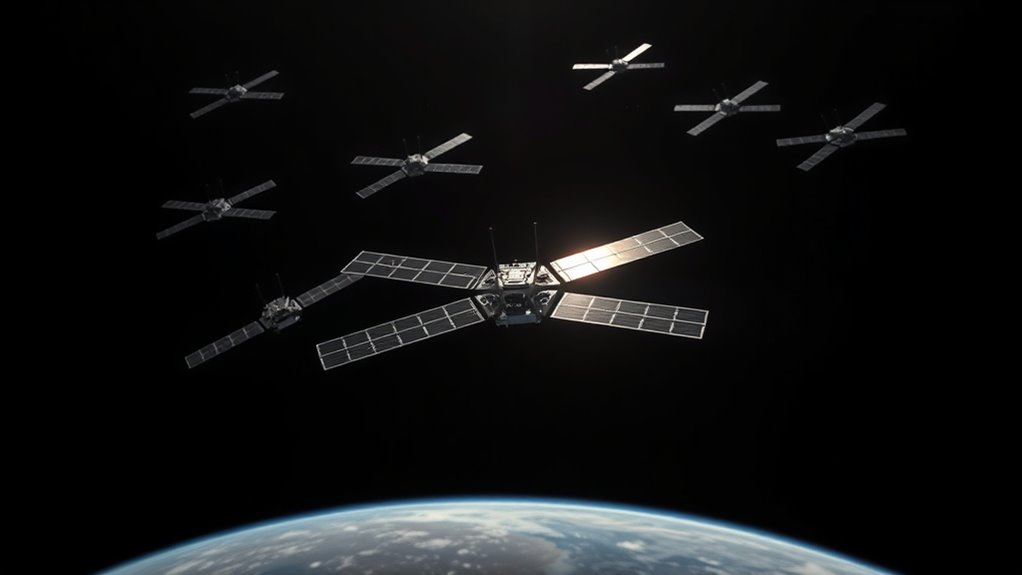

Spy satellites orbit silently above Earth, acting as high-tech eyes that capture detailed images and gather crucial data to monitor borders, military activities, and natural disasters. They use advanced sensors like optical cameras and radar to see through clouds and operate day or night. With their strategic positioning, they provide real-time intelligence that supports security, disaster response, and global monitoring. If you want to understand more about these space-enabled surveillance tools, there’s plenty more to explore.
Key Takeaways
- Spy satellites monitor borders, military activities, and natural disasters using advanced sensors and imaging systems from space.
- They operate in low Earth orbit or geostationary orbit for high-resolution and continuous regional coverage.
- Equipped with optical cameras and synthetic aperture radar to penetrate clouds and function day and night.
- Collected data is transmitted to ground stations and analyzed with AI for quick, accurate intelligence insights.
- Ongoing technological advancements enhance their resolution, versatility, and strategic importance in global security.
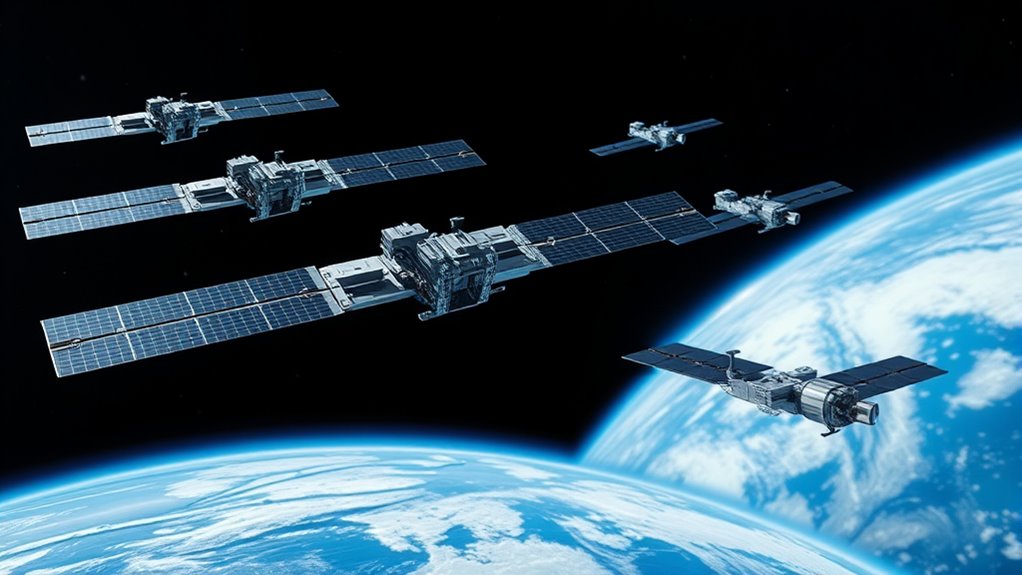
Have you ever wondered how nations monitor their borders, military movements, or even natural disasters from space? The answer lies in the incredible capabilities of spy satellites, which serve as the high-tech eyes orbiting above us. These satellites are equipped with advanced sensors and imaging systems that perform orbital surveillance, providing real-time intelligence that’s essential for national security and disaster management. Through remote sensing technology, they capture detailed images and data from space, giving governments a thorough view of activities on the ground without ever setting foot there.
When you think of spy satellites, imagine them as invisible observers silently circling the Earth. They utilize orbital surveillance to track troop movements, monitor border crossings, or detect missile launches from afar. These satellites can be positioned in various orbits, such as low Earth orbit (LEO) for high-resolution imaging or geostationary orbit for continuous coverage of specific regions. This strategic positioning allows them to gather a diverse range of information with precision and speed, often surpassing what’s possible through traditional surveillance methods. Their remote sensing capabilities enable them to distinguish between different types of land use, identify military equipment, or assess damage after natural disasters, all from hundreds of miles above the Earth’s surface. As technology advances, the integration of AI and machine learning algorithms further enhances their ability to analyze data more quickly and accurately.
The technology behind these satellites is constantly evolving. High-resolution optical cameras and synthetic aperture radar (SAR) sensors can penetrate cloud cover and operate day or night, ensuring uninterrupted surveillance. This means you can get clear images even during adverse weather conditions. The collected data is then transmitted back to ground stations, where analysts interpret the information to support decision-making. Whether it’s tracking illegal activities, verifying treaty compliance, or coordinating emergency responses, spy satellites provide essential intelligence that shapes national policies and security strategies. Their ongoing development underscores the importance of technological innovation in maintaining global security and situational awareness.
In essence, orbital surveillance and remote sensing have transformed the way countries observe their environment from space. They serve as sophisticated tools that offer a strategic advantage in an increasingly complex world. With each new technological breakthrough, these high-tech eyes become even more precise, versatile, and indispensable. As you consider the importance of security and disaster preparedness, remember that spy satellites are quietly working in the background, offering a vigilant gaze that keeps nations informed and protected from above.

Celestron – NexImage 5 Solar System Imager – 5MP CMOS Sensor (MT9P031) – Beginner Camera for Lunar & Planetary Astrophotography – High-Resolution Color Imaging, USB 2.0
- Beginner-Friendly Setup: Easy plug-and-play astrophotography
- High-Resolution Sensor: 5 MP CMOS captures detailed color images
- USB 2.0 Connectivity: Plug-and-play connection to Windows computers
As an affiliate, we earn on qualifying purchases.
As an affiliate, we earn on qualifying purchases.
Frequently Asked Questions
How Do Spy Satellites Avoid Detection?
You can avoid detection by using stealth technology, making your satellite less visible to enemy sensors, and by employing signal jamming to disrupt tracking efforts. These tactics help you stay hidden in space, preventing adversaries from pinpointing your location. Combining low-profile design with active electronic countermeasures guarantees your spy satellite remains covert, allowing you to gather intelligence without revealing your presence.
What Countries Operate the Most Spy Satellites?
You’d be amazed at how the United States and China dominate the satellite manufacturing world, launching hundreds of spy satellites into space—like two giants battling for the sky’s secrets. They operate the most, thanks to advanced tech and space treaties that regulate their activities. These nations constantly upgrade their fleets, making it seem like their space arsenals stretch endlessly, watching and collecting intelligence across the globe.
How Long Can Spy Satellites Remain in Orbit?
You might be surprised to learn that spy satellites can remain in orbit for several years, often between 5 to 15 years, depending on their orbit longevity and satellite lifespan. Lower orbits tend to see shorter durations due to atmospheric drag, while higher orbits can extend operational life. Factors like fuel for adjustments and hardware durability influence how long your satellite stays functional, making orbit longevity vital for mission success.
Can Spy Satellites Intercept Communications?
Think of spy satellites as digital eavesdroppers with a bird’s-eye view. They can intercept signals and monitor communications from space, acting like invisible listeners. Using advanced sensors, they track and analyze electromagnetic signals, making it possible to gather intel on communication networks. So yes, these satellites are capable of signal interception, providing vital intelligence by quietly tapping into the flow of information transmitted across the globe.
What Are the Ethical Implications of Spy Satellite Use?
You should consider that using spy satellites raises significant ethical issues, especially regarding privacy concerns and international law. You might invade individuals’ or nations’ privacy, leading to mistrust and potential conflicts. It’s essential to weigh the security benefits against these concerns, ensuring that satellite use complies with international regulations and respects human rights. Responsible use helps maintain global stability while protecting privacy rights.

Synthetic Aperture Radar
- Number of Figures: Approx. 200 figures
- Number of Citations: 1034 citations
As an affiliate, we earn on qualifying purchases.
As an affiliate, we earn on qualifying purchases.
Conclusion
Even if you think spy satellites invade privacy, their high-tech surveillance helps keep nations safe and prevents conflicts. While concerns about privacy are valid, these satellites provide essential intelligence that promotes security and peace. Without them, threats could go unnoticed, leading to chaos. So, consider their role not just as eyes in space, but as tools that protect lives and maintain stability worldwide. Their presence is a necessary balance between security and respecting privacy.

The 2027-2032 World Outlook for Satellite Ground Station Equipment
As an affiliate, we earn on qualifying purchases.
As an affiliate, we earn on qualifying purchases.

An Introduction to Contemporary Remote Sensing
- Condition: Used Book in Good Condition
As an affiliate, we earn on qualifying purchases.
As an affiliate, we earn on qualifying purchases.