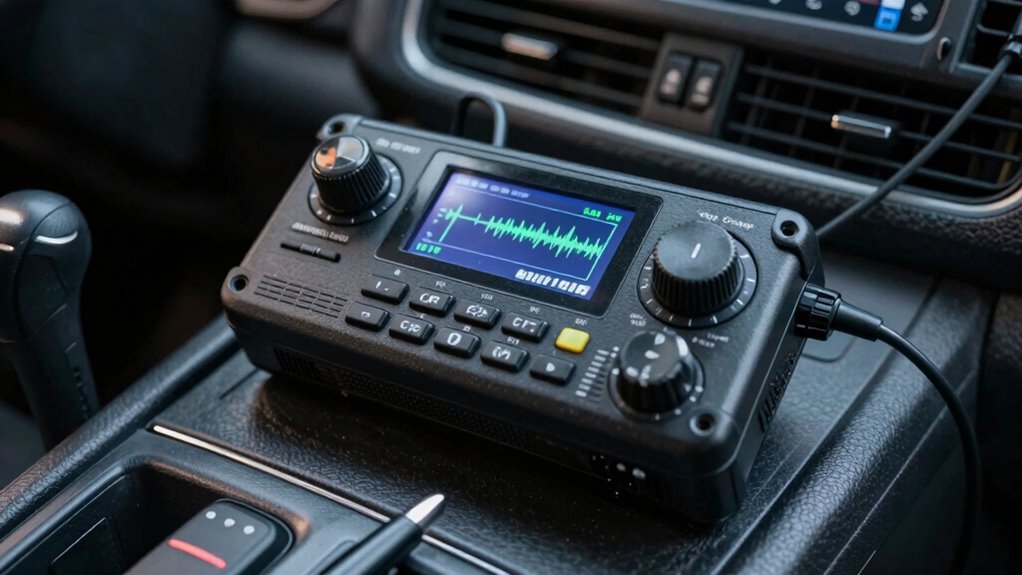
Police scanner radios pick up public safety traffic by tuning into specific radio frequencies assigned to emergency services. They use antennas to receive electromagnetic signals traveling through the air, which are then processed into audio you can hear. Many scanners are programmed to lock onto these frequencies for continuous monitoring. They cycle through channels to catch active transmissions. If you keep exploring, you’ll discover more about how these signals work and how scanners provide real-time updates.
Key Takeaways
- Police scanner radios tune into specific radio frequencies used by public safety agencies.
- They use antennas to pick up electromagnetic signals transmitted over these frequencies.
- Programming and locking onto agency channels allows scanners to monitor relevant traffic continuously.
- Many public safety channels are open and unencrypted, making them accessible to scanners.
- Advances in scanner technology improve signal filtering, clarity, and automatic channel prioritization.

Your scanner works by scanning a range of radio frequencies used by police, fire, EMS, and other emergency services. Each agency broadcasts on specific channels, and your device can be programmed to lock onto these frequencies. When an incident occurs, like a traffic stop or a fire response, the relevant agency transmits details over their designated channel, which your scanner picks up. This process relies heavily on radio frequency analysis, where the scanner’s internal circuitry identifies and isolates signals from the noise, guaranteeing you hear clear, uninterrupted transmissions. Understanding how these devices receive public safety traffic involves recognizing that radio signals are transmitted via electromagnetic waves. These waves travel through the air and are picked up by your scanner’s antenna. As signals are broadcast on different frequencies, your scanner cycles through these channels, listening for activity. When it detects a transmission, it decodes the signal, converting it into audio you can hear. Many scanners allow you to lock onto specific frequencies, making sure you don’t miss important updates from your preferred agencies. Emergency communication relies on a network of radio frequencies that are often kept secure or limited to authorized personnel. However, many of these channels are accessible to the public, especially those designated for non-encrypted, open communication. This accessibility is what makes police scanner radios popular among enthusiasts and concerned citizens. It’s important to remember that radio frequency analysis isn’t just about listening; it involves understanding which frequencies are active, how signals are transmitted, and how to tune your scanner for peak reception. Advances in radio frequency analysis technology have improved scanners’ ability to filter and analyze radio signals, providing clearer audio and more reliable reception. Some sophisticated models can automatically scan and prioritize channels based on activity, making it easier for you to stay updated without manually switching frequencies. This constant process of radio frequency analysis ensures you’re tuned into the latest public safety traffic, providing real-time insights into emergency situations as they unfold. Additionally, understanding signal encryption helps explain why some channels remain inaccessible to the public, ensuring the security of sensitive communications. Moreover, ongoing developments in radio technology aim to enhance both security and accessibility, balancing public information with privacy concerns.
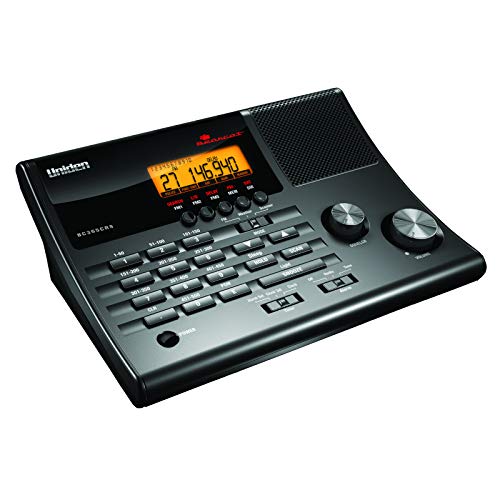
Uniden BC365CRS 500 Channel Scanner and Alarm Clock, Snooze, FM Radio, Weather Alerts, Search Bands used for Aviation, Railroad, Marine, Non-Digital Police/Fire/Public Safety transmissions and more
- All-in-One Design: Scanner, alarm clock, FM radio in one device
- 500 Pre-Set Channels: Includes police, fire, weather, marine, aircraft, and more
- Built-In FM Radio: Save up to 30 stations for quick access
As an affiliate, we earn on qualifying purchases.
As an affiliate, we earn on qualifying purchases.
Frequently Asked Questions
How Do Police Scanners Differentiate Between Multiple Agencies on the Same Frequency?
You can differentiate between multiple agencies on the same frequency by tuning your scanner to specific IDs or talkgroups assigned to each agency. However, encryption challenges often prevent you from hearing agency communications altogether. This makes agency coordination difficult, especially during joint operations. Despite these hurdles, some scanners allow you to program unique IDs, helping you identify which agency is transmitting even if the content remains encrypted.
Can Police Scanner Radios Pick up Encrypted or Private Communications?
You can’t usually pick up encrypted signals or private channels with police scanner radios. These communications are intentionally scrambled or coded to prevent unauthorized listening, ensuring privacy and security. Police scanner radios are designed to pick up public safety traffic on open, unencrypted channels. So, if a channel is encrypted or marked as private, your scanner won’t be able to decode or access those communications.
What Equipment Is Required to Build a Custom Police Scanner Setup?
To build a custom police scanner setup, you need a compatible scanner capable of wideband reception and good scanner programming features. You’ll also need the right antenna types, like discone or magnetic mount antennas, to improve reception quality. Connect the antenna properly, then program your scanner with the correct frequencies for your area. This setup allows you to monitor public safety traffic effectively while ensuring clear signals and reliable operation.
Are Police Scanner Frequencies the Same Nationwide or Do They Vary?
Public safety frequencies vary across the country, so your radio monitoring experience changes as you travel. You might tune into local police, fire, or emergency services, which all operate on different bands and channels depending on the jurisdiction. Think of it as a map of signals, constantly shifting and updating. Your scanner acts as a bridge, connecting you to the heartbeat of public safety, no matter where you are.
How Often Do Police Departments Change Their Scanner Frequencies?
Police departments typically change their scanner frequencies periodically, but the frequency of those changes varies by department. They do this to maintain secure public safety communications and prevent interference. You should stay updated with local scanner frequency lists or monitoring apps, as radio signals can shift due to operational needs or security reasons. Regularly checking for updates guarantees you’re tuned into the latest public safety traffic, keeping you informed.

Uniden BEARTRACKER 885 Hybrid Full-Featured CB Radio + Digital TrunkTracking Police/Fire/Ambulance/DOT Scanner w/ BearTracker Warning System Alerts, 40-channel CB, 4-Watts power, 7-color display.
- Public Safety Scanner: Monitors police, fire, ambulance, DOT traffic
- BearTracker Warning System: Alerts for nearby safety transmissions with GPS
- Full-Featured CB Radio: 40 channels, 4-watt power, 7-color display
As an affiliate, we earn on qualifying purchases.
As an affiliate, we earn on qualifying purchases.
Conclusion
Understanding how police scanner radios receive public safety traffic reveals their essential role in community awareness and safety. While some might worry about privacy concerns, these radios are designed to broadcast only public safety information, not private conversations. By staying informed through scanners, you gain a better grasp of local emergencies and responses without infringing on individual privacy. This transparency enhances trust and cooperation between law enforcement and the community, reinforcing the importance of accessible public safety communication.

Antenna for Police Scanner Radios | 920S Remtronix | SMA End Type | 400-480MHz & 700~900 MHz UHF Digital, Analog & Trunked Frequencies | 9" Flexible Whip | Increase Reception 25-100%
- Compatibility with Police Scanners: Uniden SDS150, SDS100, BCD436HP
- Reception Boost: Increases reception by 25-100%+
- Antenna Details: 920S, SMA end, 9-inch flexible whip
As an affiliate, we earn on qualifying purchases.
As an affiliate, we earn on qualifying purchases.

New Uniden SDS150, Our Most Advanced Digital Radio Scanner Ever, Software Defined Radio (SDR) Technology, Exceptional Performance in Simulcast and Weak-Signal environments, Built-in GPS
- Advanced Digital Radio Scanner: Most advanced Uniden model ever
- Enhanced Sensitivity: Improved signal reception and filtering
- User-Friendly Interface: Simplified control layout and digital display
As an affiliate, we earn on qualifying purchases.
As an affiliate, we earn on qualifying purchases.