
TL;DR
Prime for Young Adults — start your free trial
Fast free delivery, streaming and member deals for eligible 18–24 year olds.
Try it freeAs an affiliate, we earn on qualifying purchases.
Corvus ISR published a reproducible synthetic benchmark reporting that its v2 tracker reduced identity switches by 42.1% with 150 moving objects and 42.7% with 400. The test offers fixed conditions and perfect ground truth, but the results remain company-hosted and have not been independently replicated.
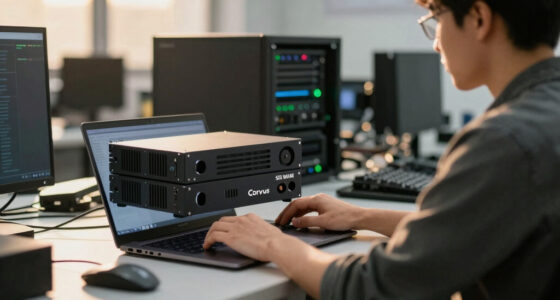
Corvus ISR has published reproducible test results reporting that its current multi-object tracker cut identity switches by about 42% in two synthetic wide-area motion imagery scenarios, including a dense test involving 400 moving objects. The improvement matters because identity switches indicate that tracking software has lost continuity and assigned a different identity to the same object.
In the benchmark’s standard configuration of 150 movers at two frames per second, reported identity switches fell from 2,042 to 1,183 per minute, a 42.1% reduction. In the denser 400-mover configuration, the count declined from 14,032 to 8,040, or 42.7%.
The comparison used a fixed-seed synthetic scene, identified as seed 1337, with a 20-second warm-up and 120-second measurement period for each row. Corvus ISR says the sensor model, detection generation and metric definitions were identical between runs, leaving the tracker as the only changed component. Because the demonstration is wholly synthetic, it contains no real people, vehicles or locations and provides exact ground-truth identities.
Smaller gains were reported under harsher conditions. Identity switches declined by 16.6% at 0.5 frames per second, by 18.6% with 20% occlusion, and by 18.1% in a test combining one frame per second, jitter and 70% contrast. Corvus ISR says detection rates were identical for both trackers by construction because detection was treated as a sensor property.
Identity Continuity Improves Under Density
Multi-object tracking depends on keeping a stable identity across successive frames. An identity switch can corrupt an object’s movement history, split one trajectory into several records or combine observations that belong to different objects. The reported reductions suggest that v2 preserves identities more consistently than the deliberately simple baseline under the tested conditions.
The dense result also addresses whether the added association logic can operate within the demonstration’s timing limits. Corvus ISR reports that v2 averaged about 1.2 milliseconds per sensor tick with 400 movers and recorded a worst result of about 5 milliseconds against a 10-millisecond budget. Those figures support the company’s claim of browser-based real-time operation, although performance on other hardware or non-synthetic imagery is not established by this test.
multi-object tracking software
As an affiliate, we earn on qualifying purchases.
As an affiliate, we earn on qualifying purchases.
Fixed Seed Separates Tracker Changes
The earlier v1 tracker, called “greedy nearest-neighbour,” serves as the published baseline. It uses two-pass greedy association, constant-velocity prediction and fixed two-second coasting. Archived demonstration slices one and two retain that model, allowing users to run the older implementation.
The current v2 tracker, labeled “confirmed-track auction,” appears in demonstration slice three. According to Corvus ISR, it adds track confirmation, three-tier auction association, velocity-consistency gating, a noise-scaled reservation price and confidence-decayed coasting. Corvus ISR also says the tracker was built by an AI executor against a written acceptance contract and reviewed independently before release, but no reviewer, review report or methodology was identified.
“Vendors who show only successes ask for faith; a published failure matrix asks for measurement.”
— Corvus ISR benchmark documentation
Real-World Accuracy Still Untested
The benchmark does not establish how v2 performs on real aerial imagery, where detector errors, changing terrain, camera artifacts and imperfect labels may affect tracking. The reported figures come from Corvus ISR’s own synthetic platform, and no independent replication or peer-reviewed evaluation was provided.
The raw switch counts also remain high: v2 recorded 1,183 errors per minute in the standard row and 8,040 per minute in the dense row. Corvus ISR uses a stricter measure than the MOTChallenge identity-switch definition, counting fragmentation and reacquisition as switches whenever the identity assigned to a ground-truth object changes. That choice makes direct comparisons with other tracking benchmarks difficult without recalculating results under the same definition.
Future Trackers Face Same Seed
Corvus ISR says each future tracker will be added as a new public benchmark row using the same seed and test construction. Readers can examine the matrix at corvusisr.com/benchmark and rerun available cases through corvusisr.com/demo; outside replication and testing on real imagery would provide the next evidence about whether the reported gains carry beyond the synthetic demonstration.
Key Questions
What exactly improved in the Corvus ISR test?
The measured improvement was a reduction in tracker identity switches, not a higher detection rate. Switches fell by 42.1% in the 150-mover test and 42.7% in the 400-mover test.
What is an identity switch?
An identity switch occurs when a tracking system assigns a different track identity to the same ground-truth object across frames. Corvus ISR’s definition also counts fragmentation and reacquisition, making it stricter than the common MOTChallenge measure.
Were real people or vehicles tracked?
No. The benchmark is an entirely synthetic demonstration in which every pixel is generated. It includes no real people, vehicles or places.
Can users reproduce the reported numbers?
Corvus ISR says users can press “Run benchmark” in the public demonstration without signup or an NDA. The runs use fixed seed 1337, a 20-second warm-up and a 120-second measurement window.
Do the results prove better real-world tracking?
No. They provide evidence of improved performance under controlled synthetic conditions, but they do not confirm results on operational imagery. Independent replication and real-data testing have not been reported.
Source: Thorsten Meyer AI
Source: Thorsten Meyer AI
Fall Picks
fall essentials
As an affiliate, we earn on qualifying purchases.