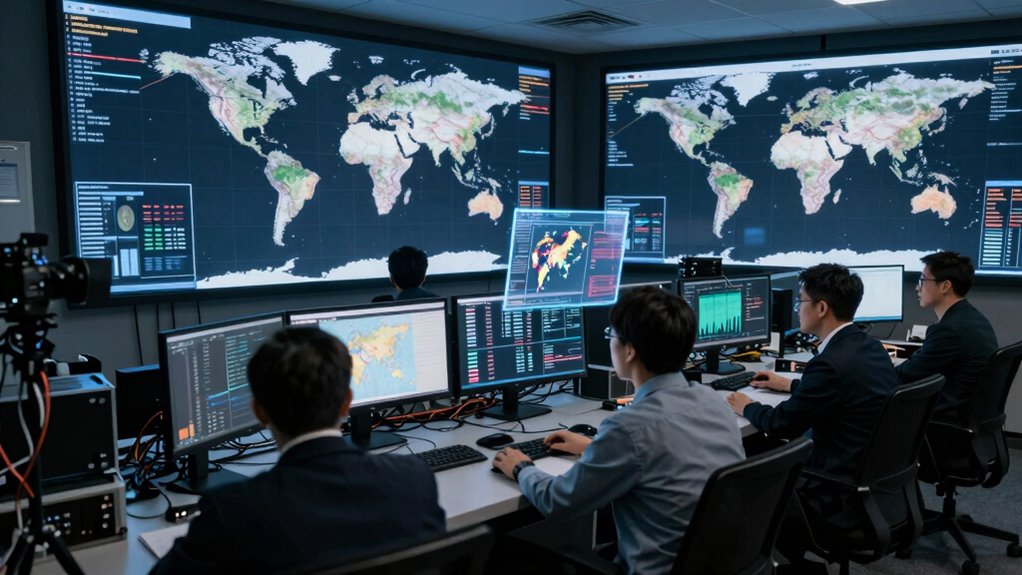

Inside the NGA’s mission to map global security risks, you see how they transform raw data—like satellite imagery and geospatial info—into actionable insights. They focus on understanding geopolitical shifts, monitoring movements, and detecting vulnerabilities that threaten national interests. By analyzing patterns and anomalies, they evaluate threats and support policymaker decisions. Using advanced tools for visualization, the NGA constantly improves its methods. Continue exploring to discover how these efforts shape national security strategies.
Key Takeaways
- The NGA transforms raw geospatial data into actionable intelligence to identify global security vulnerabilities.
- It analyzes satellite imagery and open-source information to detect military movements and infrastructure changes.
- Advanced data tools visualize threats, enabling real-time assessments and pattern recognition.
- The NGA evaluates risks by assessing adversary capabilities and regional strategic importance.
- Continuous technological updates improve threat detection, scenario simulation, and strategic decision support.

Have you ever wondered how national security agencies anticipate and prepare for emerging threats? It’s a complex process that relies heavily on intelligence analysis and threat assessment. Agencies like the NGA, or National Geospatial-Intelligence Agency, play a crucial role in this effort by transforming raw data into actionable insights. They collect imagery, geospatial data, and other intelligence sources to create detailed maps and models that reveal potential security risks around the globe. This process isn’t just about mapping terrain; it’s about understanding the geopolitical landscape, monitoring movements, and identifying vulnerabilities that could threaten national interests.
National security agencies analyze geospatial data to identify threats and understand geopolitical risks worldwide.
Your understanding of the NGA’s work begins with intelligence analysis. Analysts sift through vast amounts of satellite imagery, sensor data, and open-source information to identify patterns and anomalies. They look for signs of military buildup, infrastructure changes, or unusual activity in critical regions. This detailed analysis helps build an all-encompassing picture of current conditions and potential threats. The goal is to anticipate future developments rather than simply react to events after they happen. By integrating multiple sources of data, analysts can spot emerging risks early, giving decision-makers valuable time to respond. Additionally, geospatial intelligence tools are vital in processing and visualizing this complex information. Incorporating advanced data analysis techniques enhances their ability to interpret patterns and trends more effectively. These technological advancements also enable real-time updates, which are crucial in fast-changing scenarios. Recognizing the importance of multisource data integration, the NGA continually improves its methods to stay ahead of sophisticated adversaries.
Threat assessment is another essential component of the NGA’s mission. It involves evaluating the likelihood and potential impact of identified risks. Based on their intelligence analysis, experts determine whether a specific activity or development constitutes a security threat. They assess the capabilities of adversaries, the strategic importance of regions, and the possible consequences of various scenarios. This rigorous evaluation allows the agency to prioritize threats and allocate resources efficiently. It’s about painting a clear picture of what could go wrong and advising policymakers on the most effective responses.
Inside the NGA, advanced technology supports this work. Geospatial intelligence tools process massive datasets, generate detailed maps, and visualize complex scenarios. These tools enable analysts to simulate potential conflicts, monitor ongoing operations, and assess the effectiveness of strategic decisions. As threats evolve, so does the agency’s ability to adapt, thanks to continuous updates and improvements in data collection and analysis methods. The integration of satellite imagery and other data sources ensures a comprehensive approach to threat detection and risk mitigation.
Ultimately, the NGA’s mission to map global security risks is about more than just creating maps. It’s about providing a strategic advantage—helping your country stay one step ahead of potential threats. Through meticulous intelligence analysis and thorough threat assessments, the agency aims to safeguard national security by transforming data into insights that inform critical decisions. In a world of rapid change and unpredictable dangers, the NGA’s work ensures you’re better prepared for whatever challenges lie ahead.
Imagery and GIS: Best Practices for Extracting Information from Imagery

As an affiliate, we earn on qualifying purchases.
As an affiliate, we earn on qualifying purchases.
Frequently Asked Questions
How Does NGA Ensure Data Privacy During Global Mapping Projects?
You can trust that the NGA guarantees data privacy during global mapping projects by implementing strict privacy protocols and data encryption methods. They limit access to sensitive information only to authorized personnel and continuously monitor data security. By adhering to rigorous privacy protocols, they safeguard your data from unauthorized use or breaches, ensuring your information remains secure throughout the mapping process.
What Technologies Are Primarily Used by NGA for Real-Time Security Risk Assessment?
Think of the NGA’s tools as a sharp scalpel in a surgeon’s hand. You rely on satellite imagery and GIS analysis to assess security risks in real time. These technologies enable you to detect changes quickly, analyze terrain, and identify threats as they emerge. By integrating live satellite feeds with advanced GIS systems, you can stay one step ahead, making informed decisions that enhance global security efforts.
How Does NGA Collaborate With International Partners on Security Mapping?
You collaborate with international partners through data sharing and intelligence coordination, which helps enhance global security mapping efforts. By exchanging relevant information securely, you guarantee that your combined insights provide a clearer picture of potential threats. This cooperation allows you to identify risks more quickly, adapt strategies effectively, and strengthen global security measures. The partnerships foster trust and improve the overall accuracy of security assessments worldwide.
What Training Is Required for Personnel Involved in Nga’s Mapping Initiatives?
You need specialized training in geospatial analysis, data confidentiality, and mapping accuracy to be involved in NGA’s mapping initiatives. This includes mastering advanced GIS tools, understanding security protocols for sensitive data, and honing your skills in precise data interpretation. Such training guarantees you maintain high mapping accuracy while safeguarding data confidentiality, which is essential for effective security assessments and international collaborations.
How Does NGA Update and Validate Its Global Security Risk Data?
You’re responsible for ensuring NGA updates and validates its global security risk data through rigorous risk analysis and data accuracy checks. You regularly review intelligence reports, satellite imagery, and open-source information to confirm data validity. Collaborating with intelligence partners, you cross-verify findings and use advanced analytics to identify discrepancies. This continuous process helps maintain precise, current risk assessments, which are essential for effective decision-making and response planning in global security operations.
Conclusion
As you explore the NGA’s efforts, remember that they analyze over 70,000 daily satellite images to identify emerging security threats worldwide. This massive data collection helps you understand complex global risks and respond proactively. The agency’s work is vital in safeguarding nations, emphasizing the importance of precise mapping and timely intelligence. By staying informed through these efforts, you contribute to a safer world—highlighting how technology and vigilance work together in today’s security landscape.