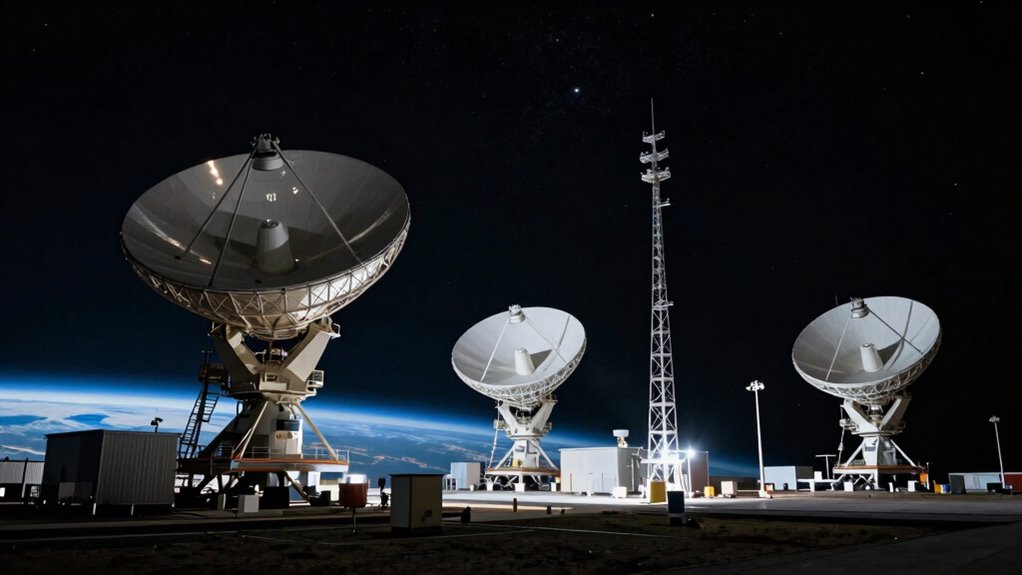
As you explore Space Force’s efforts, you’ll see they’re leading the global race to develop advanced systems for tracking space debris. They use cutting-edge sensors, radar, and AI algorithms to monitor tiny, fast-moving fragments that threaten satellites and future missions. Their goal is to improve collision prediction and guarantee safer orbital operations. If you keep exploring, you’ll uncover how these innovations help keep space accessible and secure for everyone.
Key Takeaways
- The U.S. Space Force leads efforts to develop advanced orbital surveillance systems for tracking space debris and ensuring space safety.
- Integration of sensors, radar, and AI enhances real-time debris detection and collision prediction capabilities.
- International collaboration is vital for sharing orbital data and establishing responsible space behavior.
- Technological advancements reinforce U.S. dominance in space domain awareness and debris mitigation.
- Enhanced monitoring supports sustainable and secure space operations amid increasing orbital congestion.
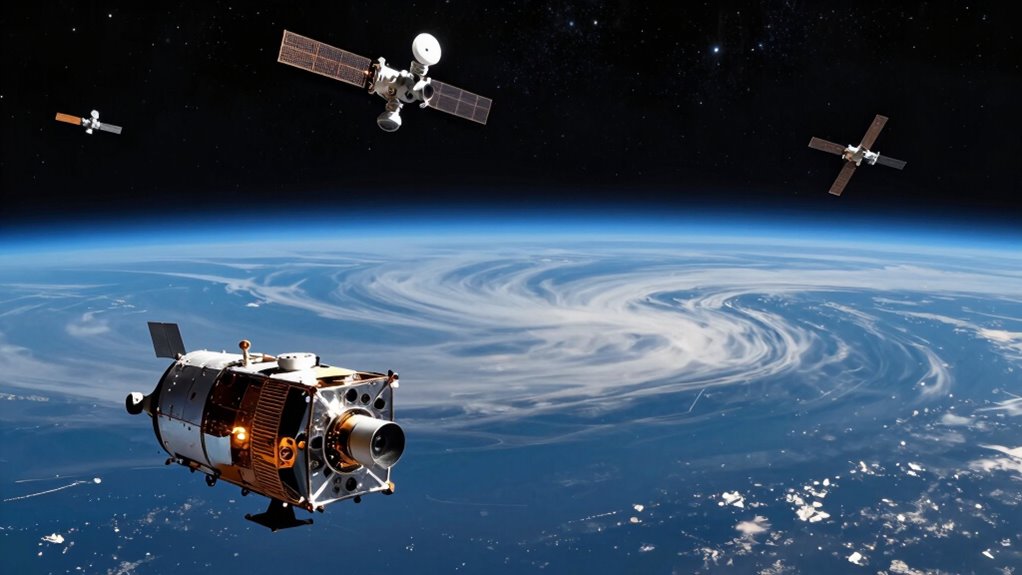
As space becomes increasingly crowded, the United States Space Force is racing to develop advanced intelligence capabilities to monitor orbital activity. The rapid increase in satellite debris, caused by discarded rocket stages, defunct satellites, and collision remnants, poses a significant threat to operational spacecraft and future missions. This accumulation of debris makes orbital surveillance more essential than ever. You need to understand that without precise tracking, the risk of collisions rises exponentially, jeopardizing both commercial and military assets in space.
The challenge lies in tracking tiny pieces of satellite debris that zip through orbit at thousands of miles per hour. Traditional ground-based radar systems struggle to detect and identify these small fragments, especially in densely populated regions of space. That’s why the Space Force is investing in cutting-edge sensors, optical telescopes, and space-based radar systems designed specifically for orbital surveillance. These systems aim to provide real-time data, allowing operators to predict potential collisions and implement avoidance maneuvers well ahead of time. Your role in this technological evolution is essential, as improved surveillance means better safety and sustainability for space operations.
Developing a thorough picture of the orbital environment demands more than just detecting debris. It requires sophisticated algorithms that can analyze the data, differentiate between harmless objects and potential hazards, and predict their future trajectories. The Space Force is working on integrating these capabilities into a unified system—an orbital traffic management network—that provides a continuous, real-time picture of everything in space. This network will serve as a key tool for decision-makers, helping to craft strategies to mitigate debris and prevent space accidents. Advanced tracking technology is crucial for improving the accuracy of debris monitoring and avoiding collisions. Recognizing the importance of space situational awareness, the U.S. is pushing to enhance these capabilities further to maintain dominance in orbital monitoring. Additionally, employing natural features in the landscape can assist in calibrating sensors and improving tracking precision. Moreover, the development of AI-driven analysis is accelerating the ability to process massive datasets quickly and accurately.
You should also recognize the importance of international cooperation in orbital surveillance. Space is a global commons, and debris from one country can threaten assets owned by others. The U.S. is leading efforts to share data and establish norms for responsible space behavior, which is essential for maintaining a sustainable orbital environment. As the Space Force advances its intelligence capabilities, your understanding of these collaborations highlights how space security extends beyond national borders.
In this race against satellite debris, the development of superior orbital surveillance systems is a game-changer. It offers the promise of safer, more sustainable space operations and underscores the pivotal role the Space Force plays in defending this new frontier. Your awareness of this evolving landscape is key to appreciating the importance of these technological strides, ensuring that space remains accessible and secure for generations to come. Understanding orbital debris tracking is vital for grasping the full scope of these efforts.

Compacted Air Detection Sensors with Relative Humidity Measurement for Home Automation Systems Elevator Position Tracking IoT Humidity Temperature Sensors
- Real-Time Atmospheric Data: Supports indoor air quality and weather forecasting
- Multi-Parameter Precision: Enables accurate tracking and climate control
- Advanced VOC Detection: Detects VOC fluctuations and environmental changes
As an affiliate, we earn on qualifying purchases.
As an affiliate, we earn on qualifying purchases.
Frequently Asked Questions
How Does Space Force Differentiate Between Friendly and Hostile Satellites?
You can differentiate friendly from hostile satellites through satellite identification, which involves analyzing unique signatures and transponder data. Signal interception plays a key role, as it allows you to gather communication patterns and identify encryption protocols. By comparing this information with known databases, you can quickly determine if a satellite is friendly or poses a threat. This process guarantees accurate monitoring and response, maintaining space security and avoiding accidental conflicts.
What Technologies Are Used to Detect Covert Space Activities?
You use advanced radar and optical sensors to detect covert space activities, focusing on unusual orbital patterns and satellite behavior. These systems analyze satellite movements to spot anomalies that may indicate espionage or weapons deployment. Additionally, you monitor satellite signals for signs of encryption, like encrypted communications or disruptions, which help identify covert operations. Combining these technologies allows you to uncover hidden activities in orbit effectively.
How Often Is Orbit Data Updated and Analyzed?
Imagine orbit as a busy highway constantly in motion. You rely on satellite tracking and data analytics to keep up with this traffic, updating and analyzing orbit data multiple times a day—sometimes every few minutes during critical periods. This rapid cycle guarantees you catch any changes or anomalies swiftly, like a vigilant eye scanning the skies, so you’re always aware of what’s happening in the celestial rush hour.
What Are the Legal Implications of Monitoring Foreign Satellites?
Monitoring foreign satellites raises important satellite legalities and sovereignty concerns. You should know that tracking and analyzing these satellites can be legally complex, especially if it infringes on a nation’s sovereignty or breaches international treaties. While monitoring generally falls into the sphere of national security, you must guarantee your activities respect international laws and avoid actions seen as provocative or illegal, as these could have diplomatic repercussions.
How Does Space Debris Impact Monitoring Efforts?
Did you know there are over 23,000 pieces of space debris larger than a softball orbiting Earth? Space debris and orbital clutter considerably hinder monitoring efforts by creating hazards and false targets, making it harder to track active satellites and potential threats. This debris can damage or disable valuable equipment, forcing you to invest more in advanced detection systems and increasing the complexity of maintaining a clear, secure view of space activities.
As an affiliate, we earn on qualifying purchases.
Conclusion
You see, as the Space Force races to monitor orbit, staying ahead of potential threats is essential. With new technology and strategies, you’re in a constant game of cat and mouse, trying to keep pace. The stakes are high, and the challenge is real—if you blink, you might miss an emerging danger. So, it’s clear that in this race, being prepared and vigilant isn’t just smart; it’s the name of the game.

4MP/2K Window Camera for Home Security, 2Pack No Drill 5G&2.4G WiFi Indoor Security Cameras, Outdoor Monitoring thru Glass, Blacklight Color Night Vision, 24/7 AI Human Detection, Apt. Easy Mag. Mount
- 4MP 2K Full-Color Night Vision: Crisp, vivid footage day and night
- No Glass Damage Magnetic Mount: Easy, residue-free window installation
- Lightweight Magnetic Design: Reposition camera effortlessly
As an affiliate, we earn on qualifying purchases.
As an affiliate, we earn on qualifying purchases.
space situational awareness tools
As an affiliate, we earn on qualifying purchases.
As an affiliate, we earn on qualifying purchases.