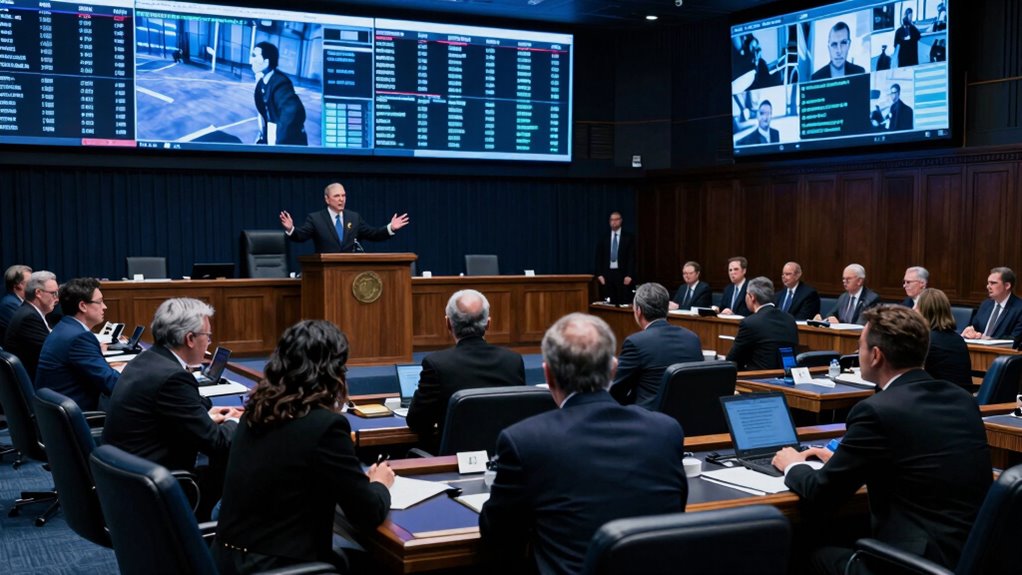
Congress keeps returning to the surveillance reform debate because balancing national security with protecting your privacy is a complex, ongoing challenge. As technology advances, government agencies can monitor more data, often pushing legal boundaries without clear oversight. Public concerns grow as trust erodes and privacy fears increase. Lawmakers revisit these issues repeatedly, trying to find a balance that safeguards security without infringing on civil liberties. To understand why this cycle continues, explore the key issues at play.
Key Takeaways
- Ongoing technological advancements outpace existing legal frameworks, prompting repeated legislative reviews.
- Privacy concerns and civil liberties fears persist as surveillance programs expand and lack transparency.
- Public outrage and high-profile breaches trigger renewed congressional attention on reform efforts.
- Balancing national security needs with individual rights creates an ongoing, contentious policy cycle.
- Legal and ethical ambiguities in surveillance practices require continuous reassessment and oversight.

Have you ever wondered whether the balance between national security and personal privacy is tipping too far in one direction? It’s a question that keeps bringing lawmakers back to the surveillance reform debate. As technology advances and government agencies seek more power to monitor potential threats, concerns about privacy and civil liberties grow louder. You might feel caught between two conflicting priorities: protecting the country and safeguarding individual rights. That tension fuels ongoing debates, making it clear why Congress keeps revisiting this issue over and over again.
The core of the problem lies in the way surveillance programs often operate in a gray area—sometimes exceeding legal limits, sometimes pushing the boundaries of what’s acceptable. Privacy concerns arise because many of these programs collect vast amounts of data, often without explicit consent or clear oversight. When your personal information is swept up in government searches, you might worry about how your data is used, stored, or shared. These fears are amplified when surveillance is conducted in secret, with little transparency or accountability. Civil liberties, like freedom of speech, association, and privacy, are at risk when government power expands unchecked. Additionally, the rapid pace of technological change makes it difficult for legal frameworks to keep up, further complicating oversight and accountability.
Surveillance often operates in a gray area, risking privacy, transparency, and civil liberties.
Congress returns to the surveillance reform debate because these issues are deeply rooted in fundamental rights. On one side, national security advocates argue that broad surveillance tools are essential for preventing terrorism and other threats. On the other, civil liberties groups warn that such programs violate constitutional protections and set dangerous precedents. As new hacking techniques, digital platforms, and data collection methods emerge, lawmakers find themselves trying to strike a delicate balance. They aim to give intelligence agencies enough authority to do their job without infringing on your rights. Additionally, the ongoing development of home theatre projectors demonstrates how technology can be both a tool for entertainment and a potential privacy concern when connected devices are not properly secured. This ongoing evolution of digital technology makes it even more challenging to draw clear boundaries. The risk of data misuse underscores the importance of comprehensive oversight and accountability measures in these programs. Furthermore, the rapid growth of cybersecurity vulnerabilities complicates efforts to establish effective safeguards.
The recurring nature of these debates also stems from public outrage and legal challenges. Whenever a new program is exposed or a privacy breach occurs, congressional attention intensifies. Calls for reform grow louder, demanding more transparency, stricter oversight, and limits on data collection. You may feel frustrated by the seeming cycle of promises and setbacks, but the core issue remains: how do we ensure security doesn’t come at the expense of civil liberties? Lawmakers keep returning to this question because it’s a fundamental challenge—one that requires constant reassessment as technology and threats evolve. The gray area in surveillance practices further highlights how difficult it is to establish clear legal boundaries that adapt to changing circumstances.
In the end, the surveillance reform debate is about more than just policy; it’s about the kind of society you want to live in. Do you accept broader government surveillance as a necessary evil for security, or do you prioritize your privacy and civil liberties? This ongoing discussion highlights the difficulty of balancing these competing interests, ensuring that neither side is ignored. That’s why Congress keeps returning to the issue—because the stakes are too high to ignore.
privacy screen protector for digital devices
As an affiliate, we earn on qualifying purchases.
As an affiliate, we earn on qualifying purchases.
Frequently Asked Questions
How Has Public Opinion Shifted on Surveillance Over the Years?
You’ve likely noticed that public perception on surveillance has shifted over the years, with more people expressing privacy concerns. As awareness of government and corporate data collection grows, you might feel increasingly wary of how your information is used. This change pushes policymakers to revisit surveillance laws, balancing national security with individual privacy. Your concerns influence debates, urging Congress to contemplate stricter regulations to protect your privacy rights.
What Are the Main Technological Challenges in Reforming Surveillance Laws?
Imagine maneuvering a maze with encryption barriers blocking your path and data localization laws like high walls, making cross-border cooperation tricky. These technological challenges are like trying to solve a puzzle where each piece—encryption and data rules—must fit without exposing vulnerabilities. Reforming surveillance laws requires cutting through these digital thickets, balancing security with privacy, all while avoiding the pitfalls of technology that evolves faster than lawmakers can keep up.
Who Are the Key Stakeholders Influencing the Debate?
You should know that key stakeholders shaping the surveillance reform debate include government agencies, tech companies, civil liberties groups, and the public. Government agencies prioritize national security, often citing privacy concerns, while civil liberties organizations push for stronger protections of individual rights. Tech companies balance innovation with privacy, and the public’s opinions influence policy changes. Together, these stakeholders continually influence the ongoing debate on surveillance laws and reforms.
How Do International Surveillance Practices Impact U.S. Policy?
Imagine a vast web connecting nations, where each strand—like global data sharing—can strengthen alliances or spark conflicts. International surveillance practices influence U.S. policy by shaping diplomatic espionage efforts and data exchange agreements. When foreign agencies access or share data, it impacts national security and privacy laws. You see, these practices compel the U.S. to adapt its policies to balance intelligence needs with diplomatic relationships, often rekindling debates over surveillance reform.
What Are the Potential Consequences of Failing to Reform Surveillance?
If surveillance reform fails, you risk exposing privacy concerns that could erode public trust and lead to misuse of data. Legal implications may increase as unregulated practices potentially violate laws, resulting in lawsuits or penalties. Without reform, authorities might overreach, infringing on individual rights and freedoms. Ultimately, neglecting necessary changes could hinder accountability, compromise privacy, and create a climate of suspicion, undermining the balance between security and civil liberties.
Conclusion
You see, the debate over surveillance reform is like a persistent storm cloud—always looming, never quite dissipating. As lawmakers dance around the issue, the shadows of past mistakes cast long, dark silhouettes. Yet, with each thunderclap of new revelations, hope flickers like lightning, illuminating the path forward. It’s a cycle of storm and calm, reminding you that change is a relentless tide—if you’re willing to ride it, change becomes inevitable.