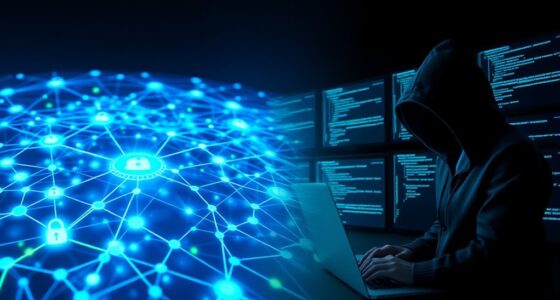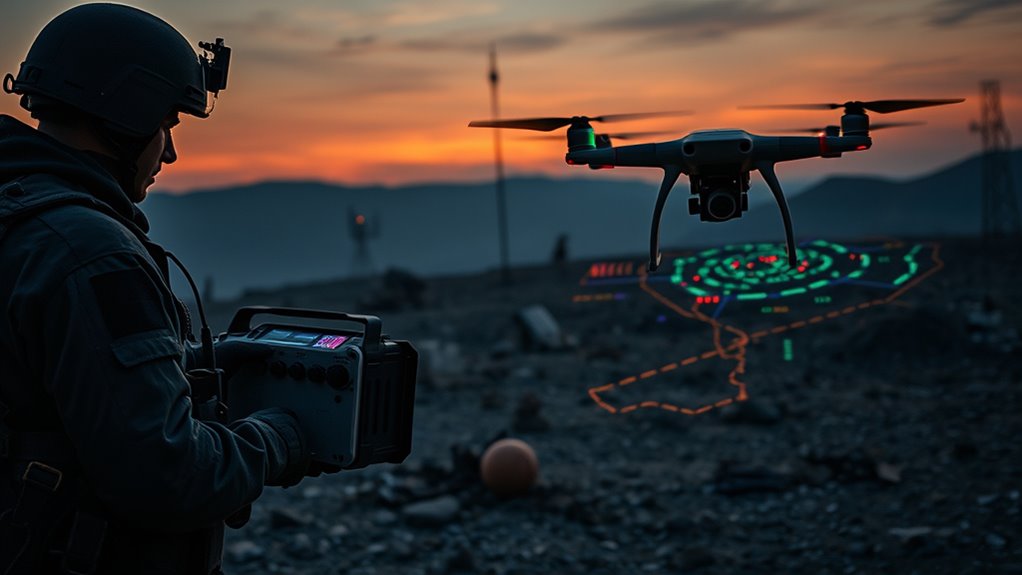

Electronic warfare on the battlefield involves using jamming, spoofing, and scanning to keep your forces secure and gain advantages. You can jam enemy communications, making their devices unreliable, or spoof signals to mislead their systems and drones. Scanning helps you detect and analyze enemy signals, enabling targeted countermeasures. Combining these techniques with encryption guarantees operational security. To learn how these strategies work together to dominate the electronic battlefield, explore further.

Get privacy and security gear delivered free — and shop member deals
- Fast, free delivery on millions of items
- Access to Prime Big Deal Days deals on October 6–7
- Prime Video, Amazon Music and more included
Key Takeaways
- Electronic warfare involves disrupting or deceiving enemy communications and sensors through jamming, spoofing, and scanning techniques.
- Scanning detects enemy signals, identifies vulnerabilities, and informs targeted electronic countermeasures.
- Jamming transmits interference signals to disable or degrade enemy command links and UAV operations.
- Spoofing mimics legitimate signals to mislead or manipulate enemy systems covertly.
- Signal encryption enhances operational security by protecting communications from interception and manipulation.
Have you ever wondered how modern military forces gain the upper hand on the battlefield without firing a single shot? It all comes down to mastering electronic warfare, where jamming, spoofing, and scanning play pivotal roles. One of the key tactics involves drone interference, disrupting enemy unmanned aerial vehicles that could otherwise gather intelligence or direct fire. By deploying electronic countermeasures, you can jam the signals controlling drones, causing them to lose connection or crash, effectively neutralizing their threat without risking personnel or equipment. Signal encryption also forms an essential part of this strategy, securing your communications and command links against interception and hacking attempts. When your signals are encrypted, enemies find it much harder to decipher your intentions or manipulate your systems through electronic means. This layered defense ensures that even if adversaries attempt to eavesdrop or spoof your signals, they face significant obstacles, maintaining your operational security.
Scanning plays a fundamental role in electronic warfare by allowing you to detect, analyze, and respond to enemy electronic emissions. Using sophisticated sensors, you can identify the frequency bands and signal patterns used by opposing forces, providing insight into their tactics and equipment. This intelligence enables you to decide whether to jam, spoof, or evade their signals, adapting your approach in real time. For example, if you detect enemy command signals, you might initiate targeted jamming to block their control over drones or communication networks. Conversely, you can use scanning to find gaps in enemy signal coverage, exploiting these vulnerabilities for your advantage. The ability to accurately scan and interpret signals gives you a strategic edge, ensuring you stay one step ahead in electronic battles.
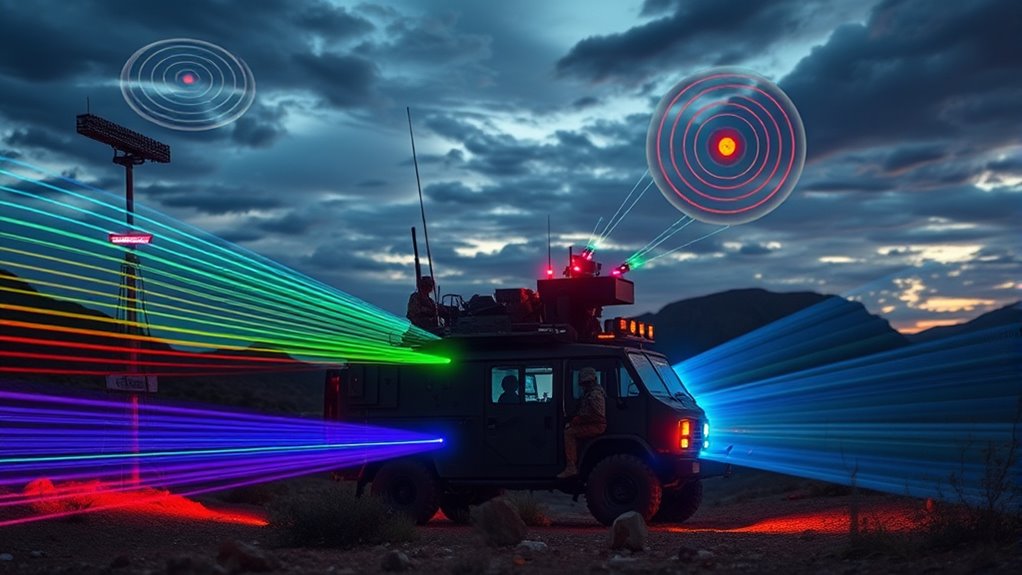
Jamming is another core element of electronic warfare, where you transmit disruptive signals to drown out or distort enemy communications and control channels. When executed correctly, jamming renders enemy devices useless or unreliable, forcing them to halt operations or switch to less effective methods. Spoofing, on the other hand, involves mimicking legitimate signals to deceive enemy systems. For instance, by spoofing GPS signals, you can mislead enemy drones or vehicles, guiding them off course or into traps. Both jamming and spoofing require a deep understanding of signal encryption and protocols to succeed without affecting your own systems.
Electronic warfare signal jammer
As an affiliate, we earn on qualifying purchases.
As an affiliate, we earn on qualifying purchases.
Frequently Asked Questions
How Do Electronic Warfare Tactics Evolve Against Emerging Threats?
You adapt electronic warfare tactics by leveraging frequency agility to stay ahead of emerging threats. Continuous threat analysis helps you identify new vulnerabilities and countermeasures, allowing you to modify jamming and spoofing techniques promptly. This proactive approach guarantees your electronic defense remains effective against evolving tactics, making it harder for adversaries to exploit weaknesses. Staying flexible and informed is key to maintaining dominance in the dynamic battlefield environment.
What Are the Ethical Considerations in Electronic Warfare Applications?
Imagine you’re steering a crowded street, aware that your actions could inadvertently cause harm. In electronic warfare, ethical concerns focus on avoiding collateral damage and ensuring civilian safety. You must balance strategic advantage with moral responsibility, recognizing that missteps could lead to unintended harm. Ethical considerations compel you to minimize civilian impact, uphold human rights, and prevent technology from becoming a tool for unnecessary suffering.
How Is Electronic Warfare Integrated With Cyber Warfare Strategies?
You integrate electronic warfare with cyber warfare by combining signaling intelligence and electromagnetic spectrum tactics to disrupt or deceive enemy systems. You leverage electronic measures like jamming and spoofing to degrade communications, while cyber strategies target networks and data. This coordination enhances your ability to control the electromagnetic spectrum and exploit vulnerabilities, enabling an all-encompassing approach that hampers enemy operations across both electronic and cyber domains, giving you a strategic edge.
What Training Is Required for Electronic Warfare Personnel?
You need specialized electronic warfare training to effectively identify threats and operate complex equipment. This training covers threat recognition, so you can detect and respond to jamming, spoofing, and scanning activities. You’ll also learn tactical techniques, system operation, and situational awareness. Continuous updates and hands-on exercises ensure you stay current with evolving electronic threats, making you a crucial asset in protecting military assets and maintaining operational superiority.
How Do International Laws Regulate Electronic Warfare Operations?
You might think electronic warfare is a free-for-all, but international treaties and legal frameworks actually establish the rules. They regulate operations to prevent chaos and ensure accountability. While some nations push boundaries, these agreements aim to limit harmful jamming, spoofing, and scanning. So, even in high-tech battles, you’re bound by laws that keep warfare within certain moral and legal limits, whether you like it or not.
Conclusion
Now you see how electronic warfare weaves a complex dance of shadows and signals on the battlefield. Jamming, spoofing, and scanning are your stealthy instruments, turning the airwaves into a battlefield of deception and control. Like a master puppeteer pulling strings behind the curtain, you manipulate the digital currents to outsmart your adversaries. In this silent war of waves, your expertise becomes the unseen force shaping victory—silent, swift, and unstoppable.
Fall Picks
fall essentials
As an affiliate, we earn on qualifying purchases.