
Facial recognition in security is used to analyze your facial features quickly to identify or verify your identity, helping authorities monitor crowds, prevent crime, and control access. However, its use sparks controversy because it raises serious privacy concerns and the risk of data breaches. While it improves security, this technology can lead to unwarranted surveillance and misidentifications. If you’re curious about how these issues balance out and what safeguards exist, there’s more to explore.
Key Takeaways
- Facial recognition analyzes facial features to identify individuals, enhancing security in crowded or sensitive environments.
- Its deployment improves law enforcement efficiency but raises privacy and data security concerns.
- Accuracy depends on image quality; errors can lead to false positives, impacting individual rights.
- Ethical and legal issues arise from surveillance potential and misuse of biometric data without proper safeguards.
- Responsible use requires balancing security benefits with privacy protections and implementing strict data regulation.
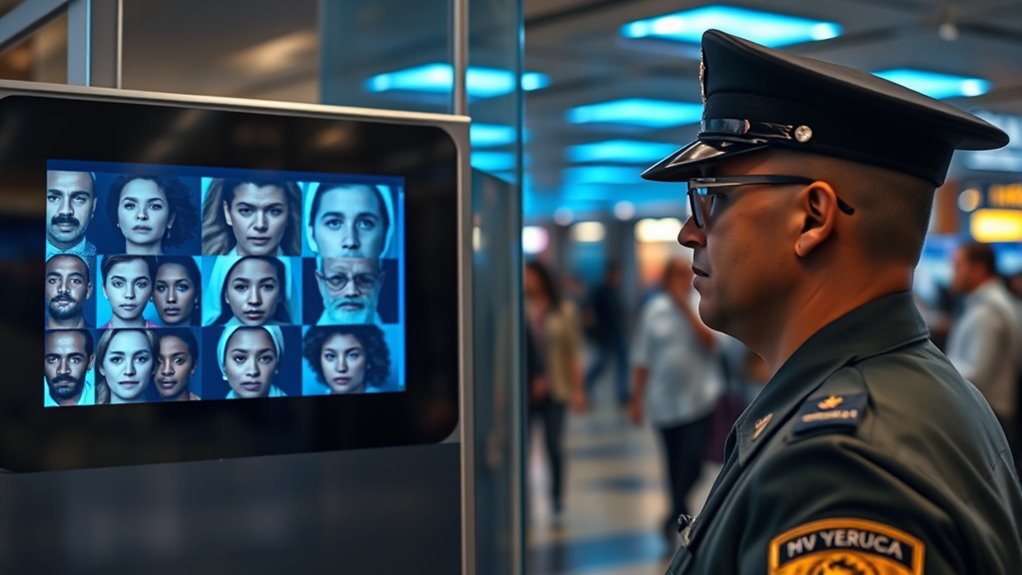
Have you ever wondered how security systems quickly identify individuals in crowded places? It all comes down to facial recognition technology, which analyzes unique facial features to match faces against databases. This technology is impressive because it can scan crowds rapidly, helping authorities spot persons of interest, verify identities, or enhance access control. Yet, despite its efficiency, facial recognition raises significant privacy concerns that can’t be ignored. When your face is scanned and stored in a database, questions about data security and misuse surface. Are your biometric details protected from hackers? Could this data be used for surveillance beyond security purposes? These worries highlight the importance of privacy safeguards and transparent policies. On the other hand, technological accuracy plays a vital role in determining how reliable these systems are. If facial recognition isn’t precise, it can lead to false positives or negatives, causing innocent people to be mistaken for suspects or missing actual threats. The technology’s accuracy depends on multiple factors, including image quality, lighting conditions, and the algorithms employed. Advanced systems with AI and machine learning tend to improve accuracy, but they’re still not flawless. Misidentifications can have serious consequences, especially in law enforcement or airport security, where mistakes can impact personal freedom or safety. As you consider the deployment of facial recognition, it’s essential to balance its benefits with the accompanying risks. While it can streamline security processes and deter criminal activity, it also risks infringing on individuals’ privacy rights if used irresponsibly or without proper oversight. Additionally, the effectiveness of facial recognition is closely tied to the quality of the images used, which can be influenced by factors like image quality, lighting, and the technology’s sophistication. Developers are working on algorithms that minimize bias and false matches, but progress is slow and complex. Meanwhile, laws and regulations struggle to keep up with rapid technological advancements. As a user, you might feel both reassured by the enhanced security and concerned about how your personal data is handled. You could be comfortable with facial recognition in airports but wary of its use in everyday public spaces. Ultimately, the key lies in responsible implementation—ensuring that privacy concerns are addressed through strict data protection measures, and that technological accuracy is continuously improved to prevent errors. As this technology evolves, staying informed and advocating for ethical standards can help guarantee that facial recognition serves society’s safety without compromising individual rights.
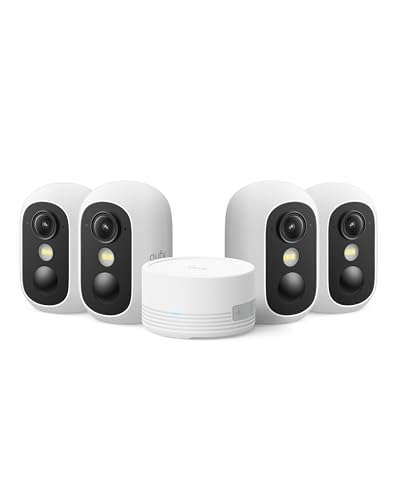
eufy Security eufyCam C35 4-Cam Kit, Wireless Security Indoor/Outdoor Camera, Magnetic Mount, Color Night Vision, Local Storage, No Monthly Fee, IP67, Facial Recognition, Solar Panel Compatible, White
- Magnetic & Screw-free Mounting: Easy installation with magnetic base
- Color Night Vision: See true colors in darkness
- Includes HomeBase Mini: Enables AI features like facial recognition
As an affiliate, we earn on qualifying purchases.
As an affiliate, we earn on qualifying purchases.
Frequently Asked Questions
How Accurate Is Facial Recognition Technology in Different Lighting Conditions?
You’ll find that facial recognition accuracy varies with lighting conditions, facing significant lighting challenges. In bright or low-light settings, the technology can struggle, but recent algorithm improvements help mitigate these issues. These updates enhance the system’s ability to identify faces correctly despite poor lighting. While not perfect, ongoing advancements are making facial recognition more reliable across diverse lighting environments, though some challenges still remain in extreme conditions.
What Are the Privacy Rights of Individuals Regarding Facial Recognition Data?
You have the right to control your facial recognition data through data ownership and clear consent mechanisms. Organizations should obtain your explicit consent before collecting or using your facial data. You can also request to access, correct, or delete your data to safeguard your privacy. Laws and policies aim to ensure your rights are respected, but staying informed and vigilant helps you maintain control over your personal biometric information.
Can Facial Recognition Be Fooled by Disguises or Photos?
Yes, facial recognition can be fooled by disguise challenges and photo deception! Clever disguises like masks or makeup can completely throw off the technology, making it think you’re someone else. Photos, especially high-quality ones, can also trick systems into recognizing the wrong person or failing entirely. While advancements are happening, these vulnerabilities mean that facial recognition isn’t infallible and can be manipulated by those trying to deceive it.
How Do Governments Regulate Facial Recognition Usage?
Governments regulate facial recognition through legal frameworks that set rules on its deployment, ensuring privacy and civil liberties are protected. They often require transparency, data security measures, and oversight to prevent misuse. Ethical considerations also play a key role, prompting laws to limit surveillance scope and prevent discrimination. You should stay informed about these regulations, as they aim to balance security benefits with individual rights and societal trust.
What Are the Potential Biases in Facial Recognition Algorithms?
You should know that algorithm bias in facial recognition arises when training data isn’t diverse enough, leading to inaccurate results. If the training data mainly includes certain skin tones or ages, the algorithms tend to perform poorly on others, causing unfair misidentifications. This bias affects accuracy and fairness, making it vital for developers to use balanced, representative training data to minimize errors and guarantee equitable application across all populations.

MENGQI-CONTROL Biometric Fingerprint RFID Password Access Control System+ 600lbs Force Electric Magnetic Lock +Cards and Key Fobs Controller 110V-240V Power Adapter Keypad Reader
- Easy Installation: Includes video guide and online support
- Indoor Access Control: Color screen supports fingerprint, RFID, password
- High-Quality Sensor: Accepts dry and wet fingers with clear images
As an affiliate, we earn on qualifying purchases.
As an affiliate, we earn on qualifying purchases.
Conclusion
Facial recognition technology is becoming a powerful tool in security, helping authorities identify suspects faster. However, it’s also raising serious privacy concerns. Did you know that a 2022 survey found that 65% of people are uncomfortable with how their face data is used? As you can see, balancing safety and privacy is vital. By staying informed, you can better understand this evolving technology and its impact on your everyday life.

WALFRONT Face Recognition Attendance System with Dynamic Facial Recognition and Card Swiping for Small Business Offices Factories Schools Hotels Infrared Liveness
- Dynamic Facial Recognition: Quick, imperceptible employee access
- Large User Capacity: Stores up to 2,000 registrations
- Enhanced Security: Binocular recognition for secure access
As an affiliate, we earn on qualifying purchases.
As an affiliate, we earn on qualifying purchases.

AI Skin Analyzer Device for Face & Scalp – Multi-Light Detection for Acne, Aging, Pigmentation, Sensitivity, UV & Microflora Analysis, Sleep & Weight Reports, Home & Professional Use (Grey, 15.6 Inch)
- Targeted Skin Analysis: For face and scalp diagnostics
- Multi-Light Technology: Includes UV and cross-polarized imaging
- Detects Microflora & Microbiome: Analyzes microbial balance and inflammation
As an affiliate, we earn on qualifying purchases.
As an affiliate, we earn on qualifying purchases.