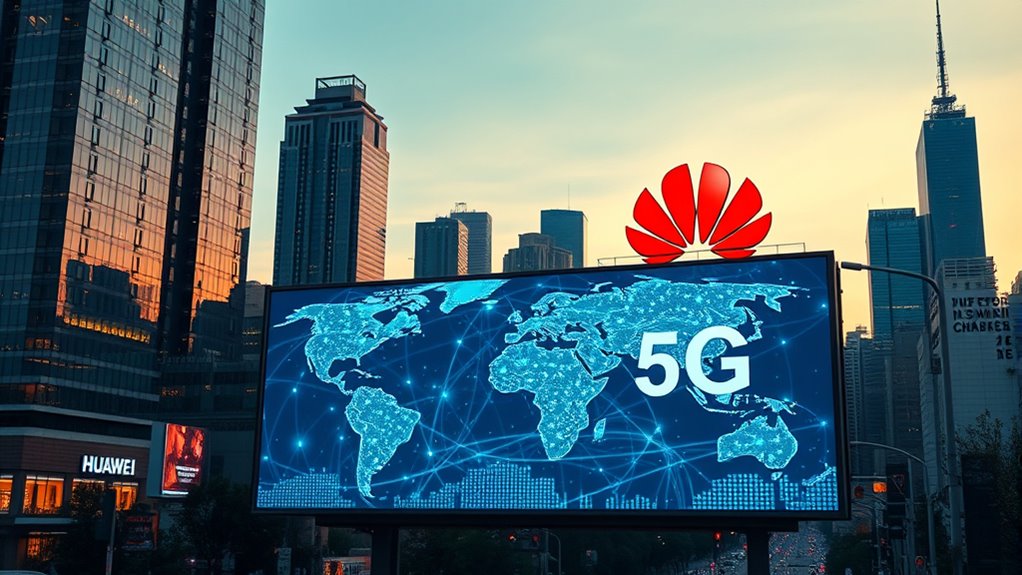

Huawei sparked a global debate because its role in developing 5G technology raised security and dominance concerns. Countries worry that Huawei’s ties to China could allow espionage or cyberattacks, prompting many to restrict or ban its involvement. The controversy reflects broader tensions over technological influence and national security. If you want to understand how this battle shapes future power dynamics, there’s much more to explore.
Key Takeaways
- Huawei’s role as a leading 5G infrastructure provider raised security concerns about Chinese government influence.
- Western fears of espionage and cyber threats linked to Huawei’s technology fueled global skepticism.
- Countries reassessed supply chains and imposed restrictions to safeguard national security and sovereignty.
- The debate reflects broader geopolitical struggles over technological dominance and strategic influence.
- Huawei’s controversy exemplifies the intersection of 5G technology, security, and global power dynamics.
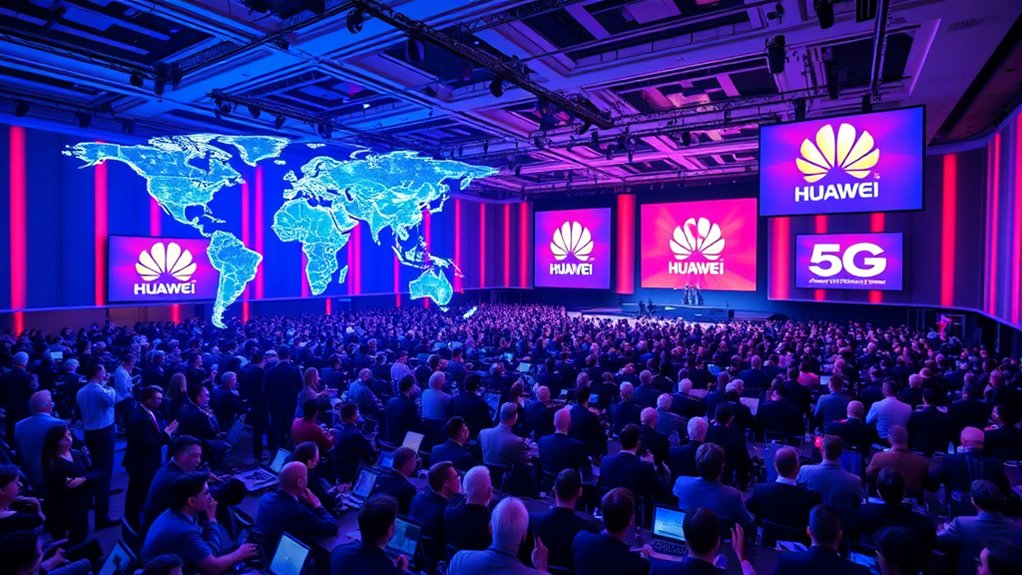
As 5G technology rapidly advances, its geopolitical implications become increasingly significant. You’re at the center of a global race where technology dominance isn’t just about faster internet or better connectivity; it’s about shaping the future power balance among nations. Countries see 5G as a strategic asset that can bolster their economic strength, military capabilities, and global influence. This shift raises critical questions about national security, especially when it comes to the companies leading the charge—most notably Huawei. When Huawei emerged as a key player in 5G infrastructure, many governments grew wary, fearing that the technology might be used for espionage or cyberattacks. Such concerns are rooted in the broader context of technology dominance, where control over 5G networks could give a nation unprecedented leverage over others. If a country controls the backbone of next-generation communications, it *unlocks* access to sensitive data, disrupts adversaries’ infrastructure, and potentially manipulates information flows. These capabilities threaten national security, making 5G a battlefield where trust in technology providers becomes a matter of sovereignty.
The controversy surrounding Huawei exemplifies how technological influence is intertwined with geopolitical strategy. Western countries, led by the United States, argue that Huawei’s close ties to the Chinese government pose a security risk, warning that allowing Huawei’s equipment into critical networks could open the door to espionage or cyber sabotage. Meanwhile, China defends Huawei as a private company that operates independently, emphasizing the importance of global cooperation and fair competition. Yet, for many nations, the choice isn’t just about technology performance; it’s about safeguarding their national interests. They fear that reliance on foreign technology — especially from a country with different legal and security standards — might compromise their sovereignty. Additionally, the integration of AI security measures into 5G networks aims to enhance threat detection and mitigate risks associated with cyber threats, further emphasizing the importance of robust security strategies in this high-stakes environment. Recognizing the influence of technology dominance is crucial for understanding these complex international dynamics. Moreover, the competition over 5G has led to a reevaluation of global supply chains, highlighting the need for domestic capabilities to ensure national resilience.
This debate has prompted governments worldwide to reevaluate their alliances and supply chains. Some have implemented bans or restrictions on Huawei’s involvement in their 5G infrastructure, prioritizing national security over cost or convenience. Others seek to develop their own domestic 5G capabilities to reduce dependence on foreign firms. As you watch these developments, it becomes clear that the battle for 5G leadership isn’t solely technological—it’s a strategic contest for influence and security. The stakes are high, and the outcome will shape the geopolitical landscape for decades to come. Ultimately, the race for technology dominance in 5G is about more than speed; it’s about securing a nation’s future in a connected world.
As an affiliate, we earn on qualifying purchases.
Frequently Asked Questions
How Does 5G Impact Global Economic Power Dynamics?
You see, 5G reshapes global economic power dynamics by boosting economic influence through faster connectivity and innovation. Countries leading in 5G technology gain technological dominance, attracting investments and talent. This shift enables them to set standards and control critical infrastructure, giving them strategic advantages. As a result, nations investing heavily in 5G can influence global markets, making economic influence a key factor in geopolitical strength and competition.
What Are the Environmental Implications of Widespread 5G Deployment?
You should consider the environmental implications of widespread 5G deployment, as it directly affects environmental sustainability and energy consumption. As 5G expands, it demands more energy, increasing carbon footprints and resource use. You must prioritize eco-friendly infrastructure, optimize energy efficiency, and advocate for sustainable technology practices. By doing so, you help balance technological progress with environmental health, ensuring a future where innovation coexists with planetary well-being.
How Do Different Countries Regulate 5G Security and Privacy?
You need to understand that countries regulate 5G security and privacy differently. Many set cybersecurity standards to protect networks from threats, while others emphasize data sovereignty, ensuring data remains within their borders. Some nations implement strict regulations on equipment providers, like Huawei, to safeguard sensitive information. By enforcing these policies, governments aim to secure their 5G infrastructure and maintain control over citizens’ data and privacy.
What Role Does International Law Play in 5G Technology Disputes?
International law plays a vital role in 5G disputes by setting frameworks through treaties that nations respect to maintain legal sovereignty. You need to understand that these treaties guide how countries handle disputes over technology and security, promoting cooperation and conflict resolution. When disagreements arise, international law helps guarantee that nations resolve issues peacefully and fairly, reinforcing global stability and trust in the deployment of 5G networks.
How Might 5G Influence Future Military and Defense Strategies?
Think of 5G as a secret weapon in the game of strategy, transforming military innovation and shaping future defense tactics. You’ll see nations use faster, more connected networks to gain strategic dominance, enabling real-time intelligence and autonomous systems. As 5G evolves, it’s likely to redefine warfare, making your security more reliant on cutting-edge technology and giving tech-savvy players a vital edge in the battlefield of tomorrow.

Industrial Cybersecurity: Efficiently monitor the cybersecurity posture of your ICS environment
- Title: Industrial Cybersecurity, 2nd Edition
- Publisher: Packt Publishing
- Book Type: ABIS Book
As an affiliate, we earn on qualifying purchases.
As an affiliate, we earn on qualifying purchases.
Conclusion
As you consider the complex web of technology and geopolitics, ask yourself: can a single company truly shape global security and innovation? Huawei’s rise has sparked debates that go beyond mere connectivity, challenging nations to rethink trust, sovereignty, and collaboration. In this rapidly evolving landscape, will you be a passive observer or an active participant in shaping the future of 5G? Ultimately, the choices made today will define the digital world of tomorrow.
As an affiliate, we earn on qualifying purchases.

McAfee Total Protection 5-Device | AntiVirus Software 2026 for Windows PC & Mac, AI Scam Detection, VPN, Password Manager, Identity Monitoring | 1-Year Subscription with Auto-Renewal | Download
- Device Security: Protects PCs, Macs, phones, and tablets
- AI Scam Detection: Identifies risky texts, emails, and deepfakes
- Secure VPN: Private, unlimited browsing on public Wi-Fi
As an affiliate, we earn on qualifying purchases.
As an affiliate, we earn on qualifying purchases.