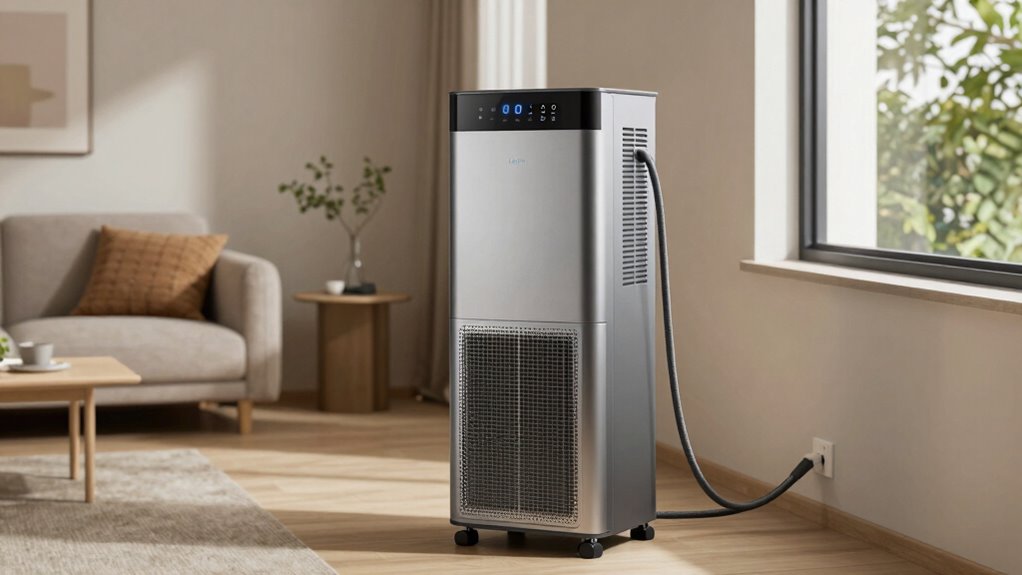

A dual-hose portable air conditioner draws outdoor air through one hose and expels hot air through the other, which can reduce the negative pressure that makes many single-hose units less effective. My best overall pick is the Humhold 14,000 BTU Inverter Dual-Hose Portable Air Conditioner, while the DREO 14,000 BTU model stands out as another inverter-equipped option and the Hisense HAP0825TWD suits smaller rooms where its stated 350-square-foot coverage and Wi-Fi controls fit the need. The main tradeoffs are room size versus portability, cooling output versus noise and power use, and smart features versus setup simplicity. Higher-capacity models may suit larger spaces, but their heavier bodies and window-kit requirements can make moving and installation harder. Read on for the full breakdown and help matching a unit to your room and priorities.

Get privacy and security gear delivered free with Prime
- Fast, free delivery on millions of items
- Prime Video, Amazon Music and more included
- Member-only deals all year
Key Takeaways
- The Humhold and DREO 14,000 BTU inverter dual-hose models lead the comparison because they pair the airflow advantage of two hoses with inverter operation, while each still needs a suitable window setup and room-size match.
- Several 16,000 BTU listings may appeal to larger-room shoppers, but listed capacity alone does not settle the choice: confirm the rating method, recommended room area, electrical needs, and whether the unit’s size works in your space.
- The Gasbye 12,000 BTU model is the lower-capacity alternative for buyers who do not need the largest output; it is a weaker fit for a large, sunny room or a space with high heat loads.
- The Hisense HAP0825TWD trades output for a more defined small-room fit, with stated coverage of 350 square feet, app and voice-platform support, and a listed 42 dB noise level.
- Smart controls and extra modes vary more than the basic two-hose idea: check whether Wi-Fi, dehumidification, and fan functions solve a real need before accepting added setup complexity or paying for features you may not use.
| Humhold 14,000 BTU Inverter Dual-Hose Portable Air Conditioner |  | Best for Larger Rooms | Cooling capacity: 14,000 BTU ASHRAE; 10,000 BTU SACC/CEC | Recommended floor area: Up to 700 sq. ft. | Modes: Cool, dry, fan | VIEW ON AMAZON | See Our Full Breakdown |
| DREO 14,000 BTU Inverter Dual-Hose Portable Air Conditioner |  | Best for Smart-Home Control | Cooling capacity: 14,000 BTU ASHRAE; 10,000 BTU DOE | Recommended room size: 200–300 sq. ft. | Hose design: Dual-hose | VIEW ON AMAZON | See Our Full Breakdown |
| ZAFRO Smart Inverter Portable Air Conditioner, 14,000 BTU |  | Best for Flexible Modes and Drainage-Free Use | Cooling capacity: 14,000 BTU; 10,000 BTU SACC | Modes: Cool, Dry, Fan, Sleep, Extra, Eco | Airflow: 480 m³/h | VIEW ON AMAZON | See Our Full Breakdown |
| 14,000 BTU Inverter Dual-Hose Portable Air Conditioner |  | Best for Wide Window Compatibility | Cooling capacity: 14,000 BTU ASHRAE; 10,000 BTU SACC DOE | Coverage area: Up to 700 sq. ft. | Modes: Cooling, dehumidifier, fan, turbo, sleep | VIEW ON AMAZON | See Our Full Breakdown |
| 16,000 BTU Inverter Portable Air Conditioner with Dual Hose |  | Best for Higher SACC Capacity | Cooling capacity: 16,000 BTU ASHRAE; 12,000 BTU SACC | Recommended room size: Up to 850 sq. ft. | Modes: Cool, Dry, Fan, Auto | VIEW ON AMAZON | See Our Full Breakdown |
| Gasbye Dual-Hose Portable Air Conditioner, 12,000 BTU, White |  | Best for Smaller Rooms | Cooling capacity: 12,000 BTU SACC (8,300 BTU ASHRAE) | Coverage area: Up to 450 sq. ft. | Noise level: 45 dB | VIEW ON AMAZON | See Our Full Breakdown |
| 16,000 BTU Dual-Hose Inverter Portable Air Conditioner |  | Best for Sleep Settings | Cooling capacity: 16,000 BTU ASHRAE (12,000 BTU SACC/CEC) | Modes: Cool, dry, fan | Sleep mode noise: Under 42 dB | VIEW ON AMAZON | See Our Full Breakdown |
| 16,000 BTU Inverter Portable Air Conditioner with Dual Hoses, Dehumidifier, Fan, and Remote |  | Best for High-Capacity Cooling | Cooling capacity: 16,000 BTU ASHRAE / 12,000 BTU SACC | Recommended room size: 600–800 sq. ft. (listing range) | Modes: Cooling, fan, dehumidifier | VIEW ON AMAZON | See Our Full Breakdown |
| ZAFRO Smart Inverter Portable Air Conditioner, 14,000 BTU |  | Best for Smart Controls | Cooling capacity: 14,000 BTU (10,000 BTU SACC) | Airflow: 390 m³/h | Energy efficiency: CEER 12.8 | VIEW ON AMAZON | See Our Full Breakdown |
| SereneLife 14000 BTU Inverter Portable Air Conditioner with Wi-Fi, Dual Hose System, Dehumidifier and Fan Modes (White) |  | Best for Easier Room-to-Room Moving | Cooling power: 14,000 BTU | Noise level: 49 dBA | Inverter type: DC inverter | VIEW ON AMAZON | See Our Full Breakdown |
| Hisense 8,000 BTU Portable Air Conditioner Dual Hose with Inverter, 350 sq ft, Wi‑Fi, ConnectLife App, Google & Alexa, 3 Modes, 42 dB Noise (HAP0825TWD) |  | Best for Quiet, Smaller Rooms | Cooling capacity: 8,000 BTU DOE/SACC; 10,000 BTU ASHRAE | Coverage area: Up to 350 sq ft | Hose system: Dual hose | VIEW ON AMAZON | See Our Full Breakdown |
| portable ac dual hose | Cooling capacity | Modes | Noise level | Dimensions and weight |
|---|---|---|---|---|
| Humhold 14,000 BTU Inverter Du | 14,000 BTU ASHRAE; 10,000 BTU SACC/CEC | Cool, dry, fan | 42 dB in sleep mode | 13 × 27 × 16 in.; 64.2 lb |
| DREO 14,000 BTU Inverter Dual- | 14,000 BTU ASHRAE; 10,000 BTU DOE | — | 42 dB | 14.37 × 17.32 × 28.13 in.; 55.4 lb |
| ZAFRO Smart Inverter Portable | 14,000 BTU; 10,000 BTU SACC | Cool, Dry, Fan, Sleep, Extra, Eco | As low as 42 dB | 14.25 × 16.5 × 27.2 in.; 54 lb |
| 14,000 BTU Inverter Dual-Hose | 14,000 BTU ASHRAE; 10,000 BTU SACC DOE | Cooling, dehumidifier, fan, turbo, sleep | As low as 42 dB | 13 × 16 × 27 in.; 65 lb |
| 16,000 BTU Inverter Portable A | 16,000 BTU ASHRAE; 12,000 BTU SACC | Cool, Dry, Fan, Auto | — | — |
| Gasbye Dual-Hose Portable Air | 12,000 BTU SACC (8,300 BTU ASHRAE) | Cooling, fan, dehumidifier | 45 dB | — |
| 16,000 BTU Dual-Hose Inverter | 16,000 BTU ASHRAE (12,000 BTU SACC/CEC) | Cool, dry, fan | — | — |
| 16,000 BTU Inverter Portable A | 16,000 BTU ASHRAE / 12,000 BTU SACC | Cooling, fan, dehumidifier | 42 dB | — |
| ZAFRO Smart Inverter Portable | 14,000 BTU (10,000 BTU SACC) | Cool, dry, fan, sleep, extra, eco | 42 dB | 14.25 × 16.54 × 27.2 in; 54 lb |
| SereneLife 14000 BTU Inverter | — | Cooling, fan, dehumidifier | 49 dBA | 14.09 × 16.5 × 27.09 in; 49 lb |
| Hisense 8,000 BTU Portable Air | 8,000 BTU DOE/SACC; 10,000 BTU ASHRAE | — | 42 dB(A) in Quiet mode | — |
More Details on Our Top Picks
Humhold 14,000 BTU Inverter Dual-Hose Portable Air Conditioner
The Humhold is the clearest fit here for buyers prioritizing broad stated coverage: it is rated for spaces up to 700 sq. ft., while the DREO is recommended for a more modest 200–300 sq. ft. room. Its dual-hose layout and inverter compressor pair with cooling, fan, and dry modes, so it can handle more than hot, dry days. Sleep mode is listed at 42 dB, and wheels make moving its 64.2-pound body between rooms more manageable.
The tradeoff is that the 14,000 BTU headline rating corresponds to 10,000 BTU SACC/CEC, and actual suitability depends on room conditions. Dry mode, or cooling above 85% humidity, calls for continuous draining, which makes it less hands-off than the ZAFRO’s stated drainage-free operation below 90% humidity. I’d pick Humhold for the larger-room brief, not for frequent lifting or humid spaces without a drain nearby.
Pros:- Dual-hose design and inverter compressor support its larger-room cooling role.
- Cooling, dry, and fan modes cover several common room-comfort needs.
- Sleep mode is specified at 42 dB, with a timer and remote for nighttime control.
- Four wheels help with room-to-room repositioning.
Cons:- At 64.2 lb, it is cumbersome to lift despite its wheels.
- Continuous draining is required in dry mode or above 85% humidity during cooling.
- The 14,000 BTU ASHRAE figure is paired with a lower 10,000 BTU SACC/CEC rating.
Best for: Households seeking a dual-hose inverter unit for a larger room and wanting cooling, fan, and dehumidifying modes in one appliance.
Not ideal for: People who need to carry an air conditioner up stairs often, or buyers who want drainage-free operation in very humid conditions.
- Cooling capacity:14,000 BTU ASHRAE; 10,000 BTU SACC/CEC
- Recommended floor area:Up to 700 sq. ft.
- Modes:Cool, dry, fan
- Noise level:42 dB in sleep mode
- Dehumidification:80–96 pints per day
- Dimensions and weight:13 × 27 × 16 in.; 64.2 lb
- Drainage:Self-evaporating; continuous draining required in dry mode or above 85% humidity in cooling mode
Our verdict“Choose the Humhold if stated coverage up to 700 sq. ft. matters more than low weight or minimal drainage.”
DREO 14,000 BTU Inverter Dual-Hose Portable Air Conditioner
The DREO makes the most sense for buyers who want to manage a portable dual-hose AC from more than the control panel. App, remote, and Alexa controls give it the most connected operating setup in this group, while its 55.4-pound weight is easier to move than the Humhold’s 64.2 pounds. Its 42 dB stated noise level and self-evaporating system also suit bedrooms or home offices where quiet operation and fewer drain interruptions matter.
Room guidance is more restrained than the Humhold’s: DREO recommends 200–300 sq. ft., despite the same 14,000 BTU ASHRAE headline and 10,000 BTU DOE figure. That makes it a more focused choice, not the pick for the largest stated coverage. Drainage-free operation is limited to humidity below 90%, and its window kit fits openings from 20 to 53 inches, so I’d check the window and local humidity before choosing it.
Pros:- App, remote, and Alexa controls offer flexible operation.
- Dual-hose and inverter design are intended to support cooling performance and efficiency.
- Self-evaporating operation can avoid manual drainage below 90% humidity.
- At 55.4 lb, it is lighter than the Humhold.
Cons:- Recommended room size is limited to 200–300 sq. ft., much less than the Humhold’s stated coverage.
- Drainage-free operation is not specified at humidity levels of 90% or higher.
- Window openings must fall within the stated 20–53 in. range.
Best for: Smart-home users cooling a 200–300 sq. ft. room who want app or Alexa operation alongside a remote.
Not ideal for: Buyers cooling a very large space, living in humidity at or above 90%, or dealing with windows outside the 20–53 in. fit range.
- Cooling capacity:14,000 BTU ASHRAE; 10,000 BTU DOE
- Recommended room size:200–300 sq. ft.
- Hose design:Dual-hose
- Noise level:42 dB
- Controls:App, remote, and Alexa
- Window opening range:20–53 in.
- Dimensions and weight:14.37 × 17.32 × 28.13 in.; 55.4 lb
- Refrigerant and power:R-32; 115 V; 1,540 W
Our verdict“Pick the DREO for connected controls and a smaller room, provided its window range and humidity limits suit your setup.”
ZAFRO Smart Inverter Portable Air Conditioner, 14,000 BTU
ZAFRO’s distinction is the combination of six operating modes and a specific drainage-free runtime: up to 72 hours when humidity stays below 90%. That gives it more operating flexibility than the Humhold’s three modes, and a clearer low-humidity drainage claim than the DREO’s general self-evaporating description. App and remote control, a 24-hour timer, and four-way oscillation add useful ways to direct and schedule airflow.
Its performance figures need context: the headline is 14,000 BTU, but the stated SACC capacity is 10,000 BTU. The 42 dB noise figure is also described as “as low as,” not as a level across every mode. At 54 pounds, it is the lightest of the first four options here, though still a substantial appliance to carry. Buyers in humidity above 90% should plan to use the included drain hose rather than count on extended self-evaporation.
Pros:- Six modes include Cool, Dry, Fan, Sleep, Extra, and Eco.
- Drainage-free operation is specified for up to 72 hours below 90% humidity.
- App and remote control support scheduling and everyday adjustments.
- At 54 lb, it weighs less than the Humhold and the unnamed 65-pound 14,000 BTU model.
Cons:- The stated SACC cooling capacity is 10,000 BTU, below its 14,000 BTU headline.
- A drain hose is needed when humidity exceeds 90%.
- The 42 dB figure is an “as low as” specification, rather than a stated level across modes.
Best for: Buyers who want multiple operating modes, app scheduling, and a stated 72-hour drainage-free window in humidity below 90%.
Not ideal for: People in very humid areas who need low-maintenance drainage, or buyers expecting the 14,000 BTU headline to represent its SACC capacity.
- Cooling capacity:14,000 BTU; 10,000 BTU SACC
- Modes:Cool, Dry, Fan, Sleep, Extra, Eco
- Airflow:480 m³/h
- Energy efficiency:CEER 12.8
- Noise level:As low as 42 dB
- Drainage-free operation:Up to 72 hours below 90% humidity
- Dimensions and weight:14.25 × 16.5 × 27.2 in.; 54 lb
- Power:115 V; 1,250 W
Our verdict“Choose ZAFRO if its six modes and defined low-humidity drainage-free runtime suit your routine, but plan for the 10,000 BTU SACC rating.”
14,000 BTU Inverter Dual-Hose Portable Air Conditioner
This 14,000 BTU inverter model earns its place through a 20.5–57.3 in. window-kit range, wider than the DREO’s stated 20–53 in. range. That extra reach may make installation possible in windows that rule out the DREO, while its dual-hose layout, inverter cooling, and modes for cooling, dehumidifying, fan, turbo, and sleep make it a versatile room unit. It also lists 277 CFM airflow and sleep noise as low as 42 dB.
Its published coverage of up to 700 sq. ft. matches the Humhold, but the capacity is 10,000 BTU SACC/DOE beneath the 14,000 BTU ASHRAE headline. At 65 pounds, it is the heaviest option among these first four, so wheels help more with rolling than with carrying. Manual draining may be needed in high humidity, making ZAFRO’s defined 72-hour low-humidity drainage-free operation a more explicit claim for buyers focused on condensate handling.
Pros:- Window kit fits openings from 20.5 to 57.3 in., wider than the DREO’s stated range.
- Cooling, dehumidifier, fan, turbo, and sleep modes offer several operating choices.
- Dual-hose inverter design is paired with stated coverage up to 700 sq. ft.
- Sleep noise is listed as low as 42 dB.
Cons:- At 65 lb, it is difficult to lift and is heavier than the Humhold.
- Manual draining may be needed in high-humidity conditions.
- The 14,000 BTU ASHRAE headline is paired with a 10,000 BTU SACC/DOE rating.
Best for: Renters or homeowners whose sliding window is wider than the DREO’s maximum and who want several operating modes.
Not ideal for: Buyers who frequently carry their AC between floors or want a clearly stated long drainage-free runtime in humid weather.
- Cooling capacity:14,000 BTU ASHRAE; 10,000 BTU SACC DOE
- Coverage area:Up to 700 sq. ft.
- Modes:Cooling, dehumidifier, fan, turbo, sleep
- Airflow:277 CFM
- Window kit width:20.5–57.3 in.
- Noise level:As low as 42 dB
- Dimensions and weight:13 × 16 × 27 in.; 65 lb
- Dehumidification:Up to 96 pints per day
Our verdict“Choose this model if its wider window-kit range solves an installation problem and you can accommodate its weight and drainage needs.”
16,000 BTU Inverter Portable Air Conditioner with Dual Hose
This is the capacity step-up in the group: its 12,000 BTU SACC rating exceeds the 10,000 BTU SACC/DOE figures listed for the Humhold and ZAFRO. The product is also specified for rooms up to 850 sq. ft., making it the most compelling candidate here for buyers whose priority is a larger stated cooling range. A dual-hose design and inverter compressor are paired with Cool, Dry, Fan, and Auto modes, plus four fan speeds.
That larger capacity comes with less detail on a few practical points than some rivals. Unlike the DREO, the supplied information does not list app or voice controls; unlike ZAFRO, it does not give a drainage-free runtime or humidity threshold. Its auto-discharge is said to work in 85% of environments, so I would not treat it as a no-drain guarantee. The 42 dB figure applies to sleep mode, and the broad room-size claim should be checked against the actual room and conditions.
Pros:- 12,000 BTU SACC capacity is higher than the 10,000 BTU SACC/DOE figures on the 14,000 BTU models listed here.
- Recommended room size reaches up to 850 sq. ft.
- Four fan speeds and Cool, Dry, Fan, and Auto modes allow more adjustment.
- Window kit supports vertical and horizontal sliding windows up to 60 in. wide.
Cons:- Automatic condensate discharge is stated to work in 85% of environments, not all conditions.
- The supplied product details do not list app or voice controls, unlike the DREO.
- No weight or precise window-width minimum is provided in the supplied specifications.
Best for: Buyers seeking the highest stated SACC capacity in this set for a larger space, with multiple fan speeds and a wide window-kit fit.
Not ideal for: Smart-home shoppers who want app or voice controls, or people who need a precisely stated drainage plan for consistently humid conditions.
- Cooling capacity:16,000 BTU ASHRAE; 12,000 BTU SACC
- Recommended room size:Up to 850 sq. ft.
- Modes:Cool, Dry, Fan, Auto
- Fan speeds:Four: low, medium, high, auto
- Sleep noise level:As low as 42 dB(A)
- Temperature range:61–86°F
- Window compatibility:Vertical and horizontal sliding windows; up to 60 in. wide
- Dimensions:14 × 27 × 16.5 in. (W × H × D)
Our verdict“Pick this 16,000 BTU model when higher stated SACC capacity and broad room coverage matter more than connected controls or detailed drainage guidance.”
Gasbye Dual-Hose Portable Air Conditioner, 12,000 BTU, White
The Gasbye is the more focused choice for buyers who want a dual-hose setup without stepping up to the 14,000- and 16,000-BTU models in this group. Its 12,000 BTU SACC rating is listed for rooms up to 450 sq. ft., making it a better match for a bedroom or modest living space than the larger-area claims attached to the 16,000 BTU inverter models. The 45 dB noise rating, display-off feature, and backlit remote suit evening use, while cooling, fan, and dehumidifier modes cover basic year-round needs. Compared with the ZAFRO Smart Inverter, Gasbye gives up app controls and extra modes for a simpler feature set. Its tradeoffs are the lower capacity and a stated 64–90°F cooling range; the unit still needs window installation space and room to roll.
Pros:- Dual-hose design is intended to cool faster while limiting indoor pressure imbalance.
- 45 dB listed noise level and display-off setting suit spaces used for sleeping.
- Cooling, fan, and dehumidifier modes cover more than temperature control.
- Backlit remote and rolling casters make everyday operation and repositioning easier.
Cons:- 12,000 BTU SACC capacity and stated 450 sq. ft. coverage are less suited to larger rooms than the higher-capacity models.
- The 64–90°F cooling range gives less low-temperature adjustment than models starting at 61°F.
- Window installation and the unit’s floor space limit how freely it can be placed.
Best for: People cooling a bedroom or living area up to about 450 sq. ft. who prefer straightforward remote controls over app features.
Not ideal for: Buyers cooling larger open-plan rooms or seeking smart-home control and inverter technology; the higher-capacity ZAFRO and 16,000 BTU options are better aligned with those needs.
- Cooling capacity:12,000 BTU SACC (8,300 BTU ASHRAE)
- Coverage area:Up to 450 sq. ft.
- Noise level:45 dB
- Modes:Cooling, fan, dehumidifier
- Dimensions:14.4 × 13.1 × 27.4 in
- Refrigerant:R-32
- Power:115 V; 1,046 W
- Controls:Remote and touch controls
Our verdict“Choose the Gasbye for a quieter, simpler dual-hose unit in a room up to about 450 sq. ft., not for large spaces or app-based control.”
16,000 BTU Dual-Hose Inverter Portable Air Conditioner
This 16,000 BTU ASHRAE model stands out for pairing higher capacity with a sleep mode rated under 42 dB. That combination makes it a stronger fit for someone cooling a larger room overnight than the Gasbye, whose stated coverage tops out at 450 sq. ft. Inverter technology, dry and fan modes, adjustable swing louvers, and a 1–24-hour timer add useful control without relying on app connectivity. The remote reaches up to 28 feet, while casters and hidden side handles help with room-to-room moves. Compared with the 16,000 BTU inverter model that lists 42 dB operation and self-evaporation, this unit emphasizes sleep features and maneuverability but gives no room-size rating or self-evaporating claim in the supplied details. At 65.8 lb, it is not a light option, and the remote needs separately supplied batteries.
Pros:- 16,000 BTU ASHRAE (12,000 SACC/CEC) capacity offers more cooling headroom than the Gasbye.
- Sleep mode is rated below 42 dB.
- Timer, remote, and auto-swing louvers allow flexible nighttime operation.
- Caster wheels and hidden side handles make rolling it between rooms easier.
Cons:- At 65.8 lb, it is cumbersome to lift or carry between floors.
- Remote batteries are not included.
- The supplied product details do not state a recommended room size or describe self-evaporating operation.
Best for: Light-sensitive sleepers who need a higher-capacity dual-hose AC, a quiet sleep setting, and a timer for overnight use.
Not ideal for: People who frequently carry an AC up stairs or want a published room-size estimate and self-evaporating water details before choosing.
- Cooling capacity:16,000 BTU ASHRAE (12,000 BTU SACC/CEC)
- Modes:Cool, dry, fan
- Sleep mode noise:Under 42 dB
- Cooling temperature range:61–90°F
- Dehumidification capacity:80–96 pints per day
- Timer:1–24 hours
- Airflow:30–85° auto-swing; 3 fan speeds
- Weight and dimensions:65.8 lb; 13 × 27 × 16 in
Our verdict“Pick this model for its quiet sleep setting and stronger rated capacity, provided you can accommodate its weight and do not need app control.”
16,000 BTU Inverter Portable Air Conditioner with Dual Hoses, Dehumidifier, Fan, and Remote
This model is the capacity-focused pick in this batch: its 16,000 BTU ASHRAE / 12,000 BTU SACC rating exceeds the Gasbye’s 12,000 BTU SACC figure, and the listing targets spaces of 600–800 sq. ft. That larger-area claim comes with some uncertainty, since the product details give a broad range rather than one clear room size. An inverter compressor, sleep mode, auto-swing, and a self-evaporating system make it better equipped for extended operation than a basic portable AC; the product says drainage may still be needed in humid conditions or dry mode. Compared with the other 16,000 BTU inverter option in this batch, it adds a stated 95-pint daily dehumidification capacity and includes a window sealing kit, exhaust hose, and drain pipe. Buyers should weigh those conveniences against the unclear coverage guidance and missing remote batteries.
Pros:- 16,000 BTU ASHRAE / 12,000 BTU SACC rating gives it more capacity than the Gasbye.
- Listed dehumidification capacity of 95 pints per day suits damp spaces.
- Inverter compressor, sleep mode, and auto-swing add control for longer or overnight use.
- Window sealing kit, exhaust hose, and drain pipe are included.
Cons:- The stated 600–800 sq. ft. coverage range is broad and varies within the product details.
- Drainage may be needed in humid conditions or when using dehumidifier mode.
- Remote control batteries are not included.
Best for: People seeking a higher-capacity dual-hose AC for a large room who also want strong dehumidification and included installation accessories.
Not ideal for: Buyers who need a precise, dependable room-size recommendation or expect drainage-free operation in humid conditions.
- Cooling capacity:16,000 BTU ASHRAE / 12,000 BTU SACC
- Recommended room size:600–800 sq. ft. (listing range)
- Modes:Cooling, fan, dehumidifier
- Dehumidifier capacity:95 pints per day
- Noise level:42 dB
- Temperature range:61–86°F
- Refrigerant:R-32
- Included accessories:Window sealing kit, exhaust hose, drain pipe
Our verdict“Choose this model for higher-capacity cooling and dehumidification if you can tolerate broad coverage guidance and occasional drainage.”
ZAFRO Smart Inverter Portable Air Conditioner, 14,000 BTU
The ZAFRO is the smart-control choice here, combining a dual-hose inverter design with Wi-Fi app access and a remote. Its listed six modes—cool, dry, fan, sleep, extra, and eco—give it more operating options than the Gasbye’s three, while its 42 dB noise rating is close to the quietest figures in this batch. The self-evaporating system is specified for up to 72 hours of drainage-free operation when humidity stays below 90%, a useful limit to understand rather than a promise for every climate. Its 10,000 BTU SACC rating is below the 12,000 BTU SACC figures of the 16,000 BTU models, so I would favor those for larger cooling loads. The tradeoff is a more involved setup: it still needs a suitable window opening, and very humid conditions may call for a drain hose.
Pros:- Wi-Fi app and remote controls offer more access options than the Gasbye’s remote and touch controls.
- Six listed modes include sleep and eco settings.
- 42 dB noise rating supports quieter operation.
- Self-evaporating operation is listed for up to 72 hours below 90% humidity.
Cons:- 10,000 BTU SACC capacity is lower than the 12,000 BTU SACC 16,000 BTU models in this batch.
- A drain hose may be needed when humidity exceeds 90%.
- Installation still depends on a suitable window opening.
Best for: App-oriented buyers cooling a medium-sized room who want multiple modes and remote operation from a phone or handheld control.
Not ideal for: People cooling a large open space or those who need drainage-free operation in very humid weather; the higher-SACC 16,000 BTU options offer more capacity.
- Cooling capacity:14,000 BTU (10,000 BTU SACC)
- Airflow:390 m³/h
- Energy efficiency:CEER 12.8
- Noise level:42 dB
- Modes:Cool, dry, fan, sleep, extra, eco
- Controls:Wi-Fi app and remote
- Drainage-free operation:Up to 72 hours below 90% humidity
- Dimensions and weight:14.25 × 16.54 × 27.2 in; 54 lb
Our verdict“Choose the ZAFRO if app control and mode variety matter more than the extra SACC capacity of the 16,000 BTU alternatives.”
SereneLife 14000 BTU Inverter Portable Air Conditioner with Wi-Fi, Dual Hose System, Dehumidifier and Fan Modes (White)
Among the 14,000 BTU options here, the SereneLife stands out for its 49 lb listed weight, lighter than the ZAFRO’s 54 lb and well below the 65.8 lb 16,000 BTU model. That difference matters for buyers who expect to reposition a portable AC, though it remains a substantial appliance rather than an easy carry. Its DC inverter and dual-hose setup target quieter, more efficient cooling, with noise listed at up to 49 dBA; that is less quiet on paper than the ZAFRO’s 42 dB rating. Wi-Fi app control sits alongside a remote and touch panel, giving this unit more control routes than the simpler Gasbye. It also offers fan and dehumidifier modes plus a washable filter. The tradeoffs are the absence of a stated SACC rating or room-size estimate in the supplied specifications and the need to install a window vent kit.
Pros:- At 49 lb, it is lighter than the ZAFRO and the 16,000 BTU model in this batch.
- Wi-Fi app, remote, and touch-panel controls provide several ways to operate it.
- Dual-hose design and DC inverter are intended to support efficient cooling.
- Fan and dehumidifier modes and a washable filter extend its everyday utility.
Cons:- The supplied specifications do not give a SACC capacity or recommended room size.
- Listed noise reaches 49 dBA, higher than the ZAFRO’s 42 dB rating.
- Window vent kit installation may be cumbersome, and the unit is still heavy to carry.
Best for: Apartment dwellers or home-office users who want Wi-Fi control and expect to roll the AC between rooms without lifting a heavier 16,000 BTU unit.
Not ideal for: Buyers who need a clear SACC capacity or room-size figure for comparison, or who prioritize the lowest listed noise level over mobility.
- Cooling power:14,000 BTU
- Noise level:49 dBA
- Inverter type:DC inverter
- Modes:Cooling, fan, dehumidifier
- Controls:App, remote control, touch panel
- Power:115 V; 1,000 W
- Refrigerant and filter:R-32; washable filter
- Dimensions and weight:14.09 × 16.5 × 27.09 in; 49 lb
Our verdict“Pick the SereneLife if lighter room-to-room rolling and Wi-Fi controls matter more than a published SACC rating or the quietest operation.”
Hisense 8,000 BTU Portable Air Conditioner Dual Hose with Inverter, 350 sq ft, Wi‑Fi, ConnectLife App, Google & Alexa, 3 Modes, 42 dB Noise (HAP0825TWD)
I’d choose the Hisense HAP0825TWD for a bedroom, home office, or other room where low operating noise and app control matter more than maximum cooling capacity. Its dual-hose design and inverter support steady cooling for spaces up to 350 sq ft, while Quiet mode is rated at 42 dB(A). Compared with the 14,000 BTU Humhold and DREO options in this roundup, the Hisense is aimed at a smaller footprint and lower cooling demand, not large or especially hot rooms. Wi‑Fi, ConnectLife, and Google Assistant or Alexa controls add convenience, and the snap-together window kit should simplify setup. The tradeoff is substantial: at 65 pounds, it is not easy to move between rooms, and its listed 90-day limited warranty is short. I’d skip it if broad coverage or longer warranty protection is the priority.
Pros:- Dual-hose system supports consistent cooling without relying on a single-hose setup.
- Inverter technology is listed as up to 40% more efficient, which may help limit energy use during sustained operation.
- Quiet mode is rated at 42 dB(A), a useful fit for bedrooms and work areas.
- ConnectLife app, Google Assistant, and Alexa provide several remote-control options.
Cons:- The 8,000 BTU DOE/SACC capacity and 350 sq ft coverage are modest beside the roundup’s 12,000–16,000 BTU alternatives.
- At 65 pounds, the unit can be cumbersome to reposition.
- The listed 90-day limited warranty is brief.
Best for: People cooling a bedroom or home office up to 350 sq ft who value quiet operation, inverter control, and smart-home compatibility.
Not ideal for: Buyers cooling large, open-plan, or persistently hot spaces, or anyone who needs a lightweight unit to move frequently or wants a longer listed warranty.
- Cooling capacity:8,000 BTU DOE/SACC; 10,000 BTU ASHRAE
- Coverage area:Up to 350 sq ft
- Hose system:Dual hose
- Noise level:42 dB(A) in Quiet mode
- Power:115 V; 700 W
- Smart controls:ConnectLife app, Google Assistant, and Alexa
- Dimensions:12.9 x 17.48 x 28.26 in (D x W x H)
- Weight:65 lb
- Warranty:90-day limited
Our verdict“Choose the Hisense for quieter, smart-controlled cooling in a smaller room, but pick a higher-capacity roundup option for larger spaces.”

How We Picked
I ranked these models around how well they serve the specific job of a portable dual-hose AC: cooling a room without relying on a single exhaust hose. I weighed stated cooling capacity and inverter design alongside practical fit, including the intended room size, window-kit compatibility, mobility, operating noise information, and available controls. I also treated dehumidifier and fan modes as useful extras, not substitutes for suitable cooling capacity.
The ranking favors options with a clearer balance of cooling approach and buyer usability, rather than placing every 16,000 BTU listing ahead of every 14,000 BTU model. Product names and supplied details do not establish comparable testing conditions or identical capacity-rating methods, so I avoid treating their BTU figures as directly interchangeable. Models with limited supplied details rank behind picks with more specific room-fit or feature information; buyers should verify current manufacturer specifications and included installation parts before choosing.
| portable ac dual hose | Modes |
|---|---|
| Humhold 14,000 BTU Inverter Du | Cool, dry, fan |
| DREO 14,000 BTU Inverter Dual- | — |
| ZAFRO Smart Inverter Portable | Cool, Dry, Fan, Sleep, Extra, Eco |
| 14,000 BTU Inverter Dual-Hose | Cooling, dehumidifier, fan, turbo, sleep |
| 16,000 BTU Inverter Portable A | Cool, Dry, Fan, Auto |
| Gasbye Dual-Hose Portable Air | Cooling, fan, dehumidifier |
| 16,000 BTU Dual-Hose Inverter | Cool, dry, fan |
| 16,000 BTU Inverter Portable A | Cooling, fan, dehumidifier |
| ZAFRO Smart Inverter Portable | Cool, dry, fan, sleep, extra, eco |
| SereneLife 14000 BTU Inverter | Cooling, fan, dehumidifier |
| Hisense 8,000 BTU Portable Air | — |
Factors to Consider When Choosing Portable Ac Dual Hose
Choosing a dual-hose unit is not just a matter of selecting the biggest BTU figure. I would match the machine to the room, the window, and the way the space gains heat, then check whether the extra capacity or controls solve a genuine problem.
Match Capacity to the Room and Its Heat Load
Start with the manufacturer’s recommended room area, then account for conditions that make cooling harder: direct sun, high ceilings, frequent door opening, and heat-producing equipment. A bedroom with one shaded window can behave differently from an open-plan room with the same floor area. Do not assume that a larger BTU number automatically cools faster or more comfortably; oversized equipment can cycle differently, while an undersized unit may run for long stretches without catching up. Compare capacity figures only when their rating basis is clear, since listings may use different standards. When a product page gives no room guidance, seek the manufacturer’s full specification rather than guessing from the title.
Check Window Fit Before You Buy
A dual-hose design needs room for two air paths, so the window kit and hose layout can decide whether the unit is practical at all. Measure the opening, note whether it slides vertically or horizontally, and check how the kit seals around the frame. Casement windows, unusual openings, and windows blocked by screens or security fittings may require a separate solution. Keep the hoses as short and straight as the installation allows; awkward bends and long runs can complicate setup and airflow. Also check where the appliance can sit without blocking a walkway, outlet, or furniture. A strong cooling specification is of little use if the included panel cannot fit your window.
Balance Portability Against Cooling Output
Portable describes the format, not how easy a particular machine is to move. Higher-capacity units commonly take up more floor space and may be harder to reposition, so check dimensions, weight, caster details, and handle placement. If you plan to move the AC between rooms, think about the time needed to reinstall and seal both hoses each time. A smaller unit can be the more useful choice when it fits the room and can be moved without help. For seasonal storage, also allow space for the hoses and window panel, not just the appliance. Buyers focused on room-to-room flexibility should value manageable setup as much as headline output.
Treat Noise and Inverter Claims as Practical Clues
Noise matters most in bedrooms, home offices, and spaces where calls or sleep are easily interrupted. Look for a sound figure with a stated measurement method and operating mode; one number without that context may not predict what you hear from across the room. Inverter operation can vary compressor output rather than relying only on repeated full-power starts, which may support steadier operation, but it does not make a unit silent or guarantee a specific energy bill. The room, installation, and selected setting all affect the result. If nighttime use is a priority, check sleep controls, display dimming, and fan options instead of relying on the word inverter alone.
Choose Smart Features for a Real Use Case
Wi-Fi and voice-platform support are useful if you want to change settings before arriving home or control the AC without reaching the unit. They add little for buyers who prefer a straightforward remote and do not want another app or account. Confirm which platforms are supported, whether basic functions work without an internet connection, and whether the controls offer scheduling you will actually use. Dehumidifier and fan modes can extend the appliance’s usefulness during milder weather, but they do not replace a dedicated dehumidifier or a correctly sized cooling system in every situation. Compare the control features against your routine, not against a longer feature list. Simpler controls can be the better fit for shared homes or occasional use.
Plan for Drainage, Power, and Seasonal Care
Portable ACs collect moisture as they cool, and drainage needs depend on the model, humidity, and operating conditions. Check the manual for drain location, continuous-drain support, and any restrictions on hose placement before deciding where the unit will sit. A feature such as self-evaporation does not mean every room or climate will be maintenance-free. Verify the electrical requirements and use a suitable outlet, following the manufacturer’s guidance rather than relying on an extension cord. Cleanable filters need regular attention to help maintain airflow, and hoses and window seals should be checked for gaps. These routine details can shape day-to-day convenience more than a remote-control feature does.
Frequently Asked Questions
Is a dual-hose portable AC worth choosing over a single-hose unit?
A dual-hose model uses one hose to bring in outdoor air and another to exhaust hot air, reducing the room-pressure imbalance associated with many single-hose designs. That makes it a strong option when you want a portable appliance and cannot install a window AC. It is not automatically the right choice for every room: the two hoses need window space, and the appliance still needs to match the room’s cooling load. Compare complete room-fit and installation details, not just the hose count. If the window cannot accommodate the kit, a different AC format may be more practical.
How much room can a 14,000 BTU dual-hose model cool?
There is no reliable room-area answer from the BTU figure alone, because capacity ratings, room conditions, and manufacturer guidance differ. Sun exposure, ceiling height, insulation, occupancy, and heat from appliances can all change the cooling demand. Use the specific model’s stated coverage as a starting point, then allow for a harder-working room rather than assuming the maximum area will feel comfortable in every setting. The roundup includes 14,000 BTU models, but their shared number does not prove identical performance. If the product listing omits coverage or rating details, confirm them with the manufacturer before purchase.
Should I choose a 16,000 BTU model instead of a 14,000 BTU model?
A 16,000 BTU listing may suit a larger or more heat-exposed room, but the number alone cannot show whether it is the better match. Check the rating standard, recommended coverage, dimensions, electrical requirements, and installation kit for each exact model. A larger appliance can be heavier and take up more space, which may be a poor trade if you need to move it often or cool a modest room. The lineup includes several 16,000 BTU listings with limited distinguishing details, so verify the full specifications before comparing them against the Humhold or DREO 14,000 BTU models. Choose the higher figure only when the room and the model documentation support it.
Can a dual-hose portable AC work with a casement or unusual window?
It can work only if you can create a stable, sealed opening for both hoses. Many included kits are designed around common sliding windows, so a casement window or an irregular frame may need a separately sourced panel or a custom seal. Measure the opening and read the kit’s adjustment range before ordering, and check whether the panel can be secured without damaging the frame. A loose seal lets outdoor heat and humidity back into the room, reducing the benefit of the AC. If you cannot make a secure two-hose opening, compare another cooling format before committing.
Is the Hisense HAP0825TWD a better choice for a bedroom than a 14,000 BTU model?
It may be a more fitting candidate for a smaller bedroom if its stated 350-square-foot coverage matches the room and you value its Wi-Fi controls and listed 42 dB noise figure. That figure should be checked against the manufacturer’s measurement conditions and the sound level in the operating mode you plan to use. A 14,000 BTU model may offer more capacity for a larger or hotter room, but the extra output does not automatically make it the better bedroom choice. Consider sleep controls, display behavior, unit placement, and the room’s heat load alongside the capacity. For a small, quiet-use space, prioritize documented fit and noise information over choosing the largest number.
Conclusion
For the strongest all-around starting point, I would choose the Humhold 14,000 BTU Inverter Dual-Hose Portable Air Conditioner; the DREO 14,000 BTU model is a close alternative for buyers comparing inverter-equipped dual-hose designs. My best value direction is the Gasbye 12,000 BTU unit when its lower stated capacity fits a modest room and the full feature set meets your needs. For a premium-capacity need, compare the 16,000 BTU models only after confirming their rating basis, room guidance, size, and window-kit details. The best beginner fit is the option whose installation kit, drainage instructions, and controls are clearest for your window and routine, rather than the one with the longest feature list. For smaller rooms and connected controls, the Hisense HAP0825TWD is the specific-use pick; verify its coverage and sound specifications against your space. Match the unit to your room and window first, then use extra capacity and smart features as tie-breakers.