
During the Cold War, machine translation became a secret weapon that helped you decode messages in over 100 languages, giving vital insights into your adversaries’ plans. These systems, focused on languages like Russian, Chinese, and Arabic, sped up translations and reduced reliance on slow human linguists. They also captured meaning and tone, supporting high-stakes intelligence work. Exploring this further reveals how these technologies laid the foundation for today’s advanced language processing tools.
Key Takeaways
- Early Cold War MT systems used rule-based algorithms and specialized dictionaries to decode messages in critical languages like Russian and Chinese.
- Machine translation enabled faster interpretation of intercepted communications, reducing reliance on human linguists during high-stakes intelligence operations.
- Secrecy surrounded many MT projects, with classified code names and constant updates to improve translation accuracy across 100 languages.
- Overcoming linguistic nuances, idioms, and cultural references was essential to capturing meaning, tone, and intent in translations.
- These advancements laid the foundation for future natural language processing and highlighted the strategic importance of multilingual translation during the Cold War.
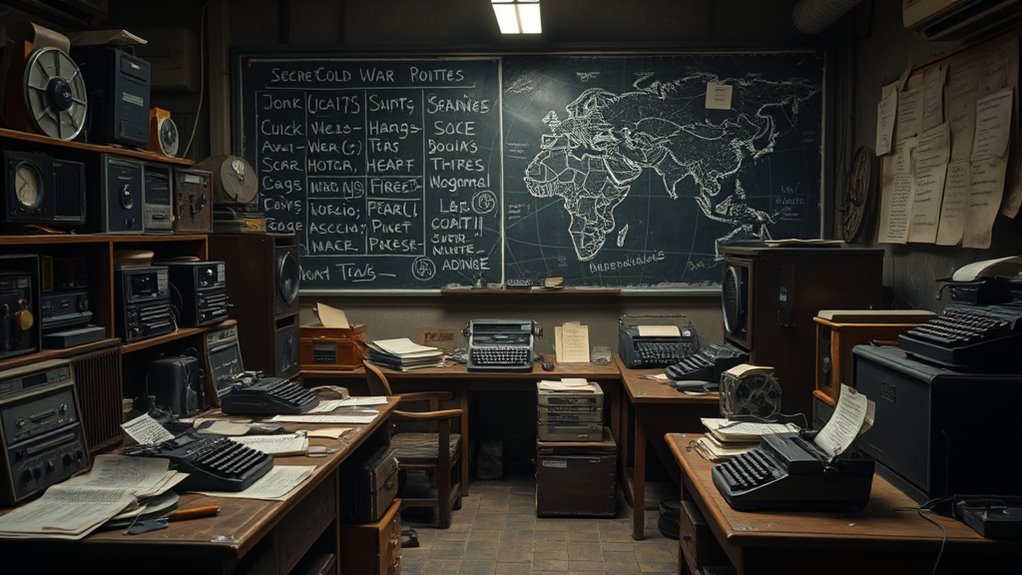
During the Cold War, machine translation emerged as a essential tool for bridging language barriers between intelligence agencies and governments. You might not realize it, but behind the scenes, these early systems helped decode countless messages, giving you critical insights into the plans and intentions of adversaries. The stakes couldn’t be higher—misunderstanding a single message could lead to missed opportunities or even catastrophic conflicts. That’s why, during this tense period, developing reliable translation tools became a priority for both superpowers and their allies.
You see, at that time, most translation relied on human linguists working tirelessly through manuals and dictionaries, which was slow and often insufficient for urgent intelligence needs. Machine translation aimed to speed things up by automating the process. Early efforts focused on rule-based systems that used complex algorithms to analyze sentence structure and vocabulary. These systems weren’t perfect—they often produced awkward or inaccurate translations—but they marked a significant step forward. You could think of them as the first attempts to teach computers how to understand language, even in its most complex forms.
The challenge was immense because languages are inherently nuanced, filled with idioms, slang, and cultural references. You might not realize how tricky this is, but machine translation had to grapple with over 100 languages, many with little digital data available. Despite these hurdles, agencies managed to develop specialized dictionaries and phrase databases that improved accuracy over time. They prioritized languages critical for espionage—Russian, Chinese, Arabic, and others—ensuring that messages from spies or foreign officials could be deciphered quickly. This wasn’t just about translating words; it was about capturing meaning, tone, and intent.
You’d be surprised to learn that some of the earliest machine translation projects were shrouded in secrecy, with code names and classified documents. These systems were often tested against real intercepted messages, and their success depended on constant updates and refinements. As technology advanced, so did the complexity of the translations. The goal was to create a tool that could process and understand 100 languages, delivering results fast enough to influence diplomatic negotiations or military decisions. Achieving this meant pushing the boundaries of what computers could do with language, laying the groundwork for future breakthroughs in natural language processing.
Additionally, the development of these systems highlighted the importance of linguistic diversity and the need for tailored solutions for different languages and dialects, which remains a challenge even today. The goal was to create a tool that could process and understand 100 languages, delivering results fast enough to influence diplomatic negotiations or military decisions. Achieving this meant pushing the boundaries of what computers could do with language, laying the groundwork for future breakthroughs in natural language processing.
Language Translator Device, Portable Translator No WiFi Needed, Offline Voice Photo Translation, 150 Languages Supported, High Accuracy VORMOR Translator for Travel Business Learning (Black)

Portable offline translator supporting 150 languages with high accuracy, photo translation, and ChatGPT integration for travel, work, and learning.
As an affiliate, we earn on qualifying purchases.
As an affiliate, we earn on qualifying purchases.
Frequently Asked Questions
What Were the Main Covert Operations Involving Machine Translation?
You should know that during the Cold War, covert operations heavily relied on machine translation to intercept and understand enemy communications. Intelligence agencies used early translation systems to decode secret messages in various languages quickly, giving them strategic advantages. These operations often involved secretly developing and deploying translation technology to gather intelligence, monitor foreign communications, and maintain national security without revealing their methods or sources.
How Did Cold War Politics Influence Translation Technology Development?
You see, Cold War politics fueled rapid advances in translation technology, as nations scrambled to outsmart each other. Governments poured resources into developing machine translation, aiming to decode enemy secrets and gain an edge. This high-stakes environment turned translation tech into a tool of espionage and diplomacy, making breakthroughs happen faster. Fundamentally, the geopolitical chess game pushed the boundaries of what translation machines could achieve, shaping their evolution in profound ways.
Were Any Languages Prioritized Over Others During the Cold War?
Yes, during the Cold War, certain languages like Russian, Chinese, and Arabic received priority because of their strategic importance. You’d notice that resources, research, and translation efforts focused more heavily on these languages to gather intelligence and facilitate diplomatic communication. As a result, lesser-known languages often got less attention, limiting the development of translation technology for those areas. This bias shaped the early landscape of machine translation efforts.
What Role Did Machine Translation Play in Espionage Activities?
You might think machines only helped with language barriers, but during the Cold War, machine translation secretly fueled espionage. It allowed spies to quickly decode and understand intercepted messages, giving them a essential edge. By automating translation, you could access critical intelligence faster than ever, often before human analysts could even grasp the content. This technological leap transformed espionage, making it more efficient and dangerous than anyone expected.
How Did Cold War Secrecy Affect Translation Technology Sharing?
During the Cold War, secrecy heavily restricted translation technology sharing. You’d find that governments kept advancements classified to prevent enemies from gaining insights. This meant limited collaboration and rapid development within isolated teams. You might also notice that translation tools were tailored for espionage, making open exchange difficult. Overall, secrecy created barriers that slowed innovation but enhanced security, keeping sensitive information tightly guarded and technology proprietary.
Conclusion
So, as you’ve seen, machine translation made a monumental mark during the Cold War, connecting cultures and conquering cryptic codes. This technological triumph transformed treacherous language barriers into bridges of understanding. Remember, your curiosity keeps these clandestine secrets and clever communications alive. Keep exploring, keep questioning, and embrace the extraordinary evolution that empowers us to communicate across continents and conflicts alike. The history of translation truly teems with tales of technology, tenacity, and transformation.
![Computer-Aided Language Development in Nonspeaking Children (1968) [pdf]](https://aiespionage.net/wp-content/uploads/2026/06/computer-aided-language-development-in-nonspeaking-children-1968-pdf-featured-560x300.jpg)