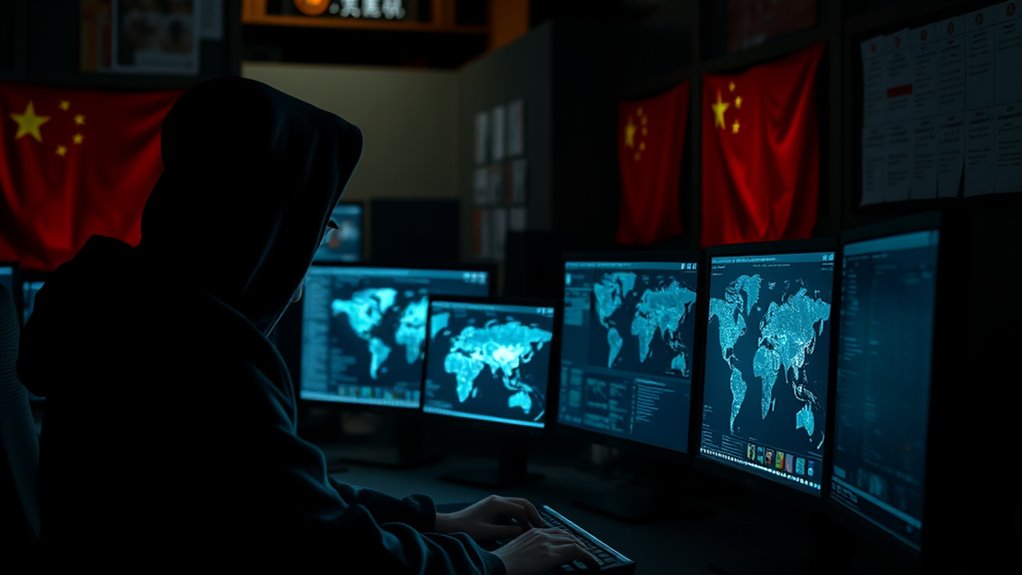

China’s espionage efforts have increasingly shifted from stealing trade secrets to executing sophisticated cyber hacks that target technology, research, and diplomatic networks worldwide. They employ well-funded, coordinated operations that exploit vulnerabilities in digital infrastructure, often before victims even realize they’ve been compromised. These covert activities blend seamlessly with legitimate political and business environments, making detection difficult. Understanding these evolving tactics can help you better recognize how China’s intelligence capabilities have grown—if you explore further, you’ll uncover more about their strategic approach.
Key Takeaways
- China has significantly increased its espionage activities, focusing on technological theft and diplomatic infiltration.
- Cyber intrusions are a primary method for covertly stealing trade secrets and intellectual property.
- Espionage operations now blend seamlessly into legitimate diplomatic and business environments, complicating detection.
- China’s tactics include embedding agents within foreign institutions and exploiting digital vulnerabilities for cyber hacks.
- International cooperation is urgently needed to counter these sophisticated and evolving espionage threats.

In recent years, China’s espionage activities have escalated markedly, posing a growing threat to global security and intelligence communities worldwide. You need to understand how this surge isn’t limited to traditional spying but has expanded into sophisticated domains like technological espionage and diplomatic infiltration. These tactics are reshaping the landscape of international intelligence, forcing nations to rethink their security measures.
Technological espionage, in particular, has become a hallmark of China’s covert operations. You might see it as a relentless pursuit of cutting-edge innovation, where hackers and spies target foreign companies, research institutions, and government agencies to steal valuable intellectual property. This isn’t just about acquiring secrets; it’s about gaining a competitive edge in global technology markets. These operations are often well-funded and highly coordinated, involving cyber intrusions that bypass traditional security and penetrate sensitive networks. You could be unaware that behind the scenes, malicious actors are exploiting vulnerabilities in software, hardware, and communication channels to extract data—sometimes even before the victim realizes they’ve been compromised. cyber intrusions have become a central method in China’s espionage toolkit, allowing covert access to confidential information.
China’s cyber spies target networks to steal valuable technology and intellectual property, often before victims realize they’ve been compromised.
Alongside technological espionage, diplomatic infiltration plays an essential role in China’s espionage strategy. You might think of diplomacy as a peaceful exchange, but in this environment, it’s a tool for gaining intelligence through subtle influence. Chinese agents and operatives embed themselves within diplomatic missions, think tanks, or cultural organizations to gather sensitive information. They establish relationships with officials, academics, and business leaders, often under the guise of legitimate interactions. This tactic allows them to access high-level discussions, policy deliberations, and proprietary information that would otherwise remain confidential. It’s a form of covert diplomacy, where the goal isn’t just to foster good relations but to extract strategic intelligence that can be used for economic, military, or political advantage.
What’s particularly concerning is how seamlessly these activities blend into legitimate diplomatic and business environments. You might not realize when a conversation or a seemingly innocent exchange is part of a larger intelligence-gathering effort. These operations are often meticulously planned, using a network of agents and cyber tools to gather and transmit intelligence discreetly. As China’s espionage capabilities evolve, you need to stay alert to the risks posed by technological espionage and diplomatic infiltration. They represent a sophisticated, persistent challenge that demands a coordinated international response to protect sensitive information and maintain security.
Frequently Asked Questions
How Has Chinese Espionage Evolved Over the Past Decade?
Over the past decade, Chinese espionage has evolved markedly through technological advancements, enabling more sophisticated cyber hacks and data breaches. You’ll notice increased efforts to steal trade secrets and military info, often bypassing traditional defenses. Diplomatic responses have intensified, with countries demanding accountability and strengthening cybersecurity measures. This evolution makes it essential for you to stay vigilant, as espionage threats become more complex and harder to detect.
What Are the Most Common Methods Used by Chinese Spies?
You should know that Chinese spies often use cyber infiltration to access sensitive information, exploiting weak security systems. They also rely heavily on social engineering, manipulating individuals to reveal secrets or grant access. These methods are sophisticated and adaptable, allowing them to target both government and corporate entities globally. Staying vigilant and implementing strong cybersecurity measures can help you defend against these common espionage techniques.
How Do International Laws Address Chinese Cyber Espionage?
International law struggles to fully address Chinese cyber espionage because of the concept of cyber sovereignty, which states that nations control their digital borders. While treaties like the UN Charter promote sovereignty, enforcement remains weak, and cyber activities often fall into a gray area. You must understand that this legal gap allows China to operate within a complex framework, making international responses challenging and inconsistent.
What Impact Does Chinese Espionage Have on Global Businesses?
Chinese espionage profoundly impacts your global business by risking your intellectual property and compromising competitive intelligence. You may face data theft, which weakens your market position and erodes innovation efforts. Cyber hacks can lead to leakage of sensitive information, forcing you to invest heavily in cybersecurity. This constant threat pressures you to enhance security measures and stay vigilant, ultimately increasing operational costs and challenging your ability to maintain a competitive edge worldwide.
How Are Countries Countering Chinese Espionage Activities?
Think of countries as castles under siege, solidifying their walls against intruders. They counter Chinese espionage by strengthening cyber defenses, like installing better security systems and encryption. Diplomatic strategies act as diplomatic flags, warning and negotiating with potential threats. Countries also collaborate internationally, sharing intelligence and best practices, to stay one step ahead, ensuring their secrets remain safe from covert infiltrations.
Conclusion
As you see, China’s espionage efforts have evolved from stealing trade secrets to launching sophisticated cyber hacks. Imagine you’re a tech firm, and suddenly your proprietary data vanishes after a targeted cyber attack—it’s a real threat. This rise means you must stay vigilant, strengthen your defenses, and understand that espionage is no longer just physical but digital. Staying ahead isn’t optional; it’s your best safeguard against this growing, hidden threat.