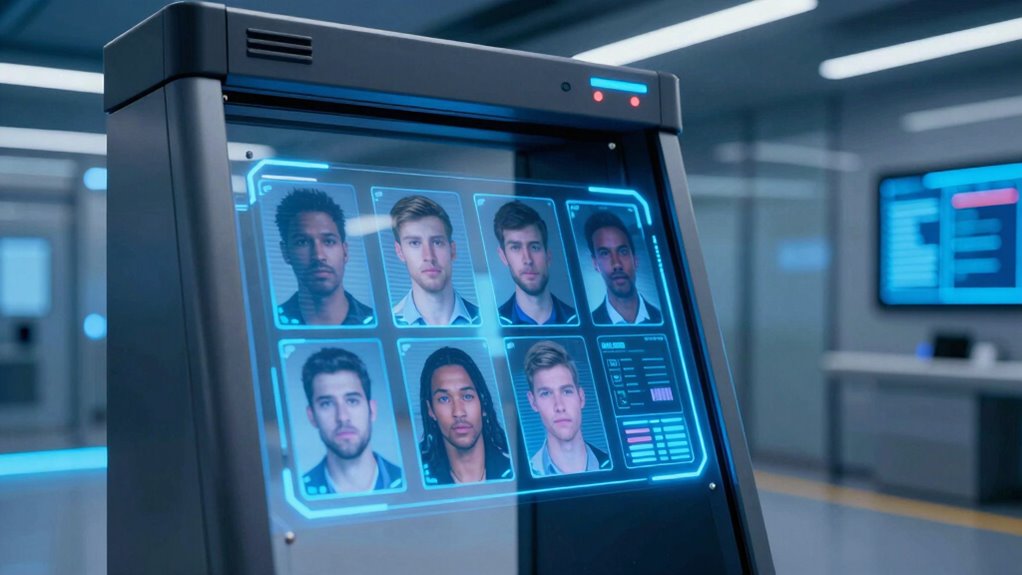

AI bias matters in national security screening because biased algorithms can unfairly target certain groups, leading to false positives and missed threats. If data isn’t diverse, your system might overlook key scenarios or unfairly target communities based on ethnicity or appearance. This not only weakens security but also erodes public trust. Addressing bias guarantees fairer, more effective safeguards. Keep exploring to understand how reducing bias can strengthen your security efforts and protect individual rights.

Get privacy and security gear delivered free with Prime
- Fast, free delivery on millions of items
- Prime Video, Amazon Music and more included
- Member-only deals all year
Key Takeaways
- Biased AI can lead to unfair targeting and discrimination against certain groups, undermining human rights and trust.
- Bias increases false positives or negatives, risking wrongful detentions or missed threats in security screening.
- Lack of diverse data causes blind spots, reducing AI system accuracy and effectiveness in various demographic contexts.
- Ignoring biases can erode public confidence and compromise the integrity of national security measures.
- Addressing AI bias ensures fair, reliable, and effective security screening that respects individual dignity.

Artificial intelligence has become a vital tool in national security screening, but it’s not without its flaws. One of the most significant issues you face is algorithm fairness. When AI systems are used to identify potential threats, their effectiveness hinges on unbiased algorithms. If these algorithms are biased, they may unfairly target certain groups, leading to false positives or negatives that can have serious consequences. For example, an AI trained on skewed data might disproportionately flag individuals based on ethnicity, nationality, or appearance, undermining trust in the system and risking discrimination. Ensuring algorithm fairness requires continuous evaluation and adjustment, so the technology remains impartial and reliable. Additionally, the development of robust testing protocols can help identify biases early and improve system fairness. Incorporating comprehensive training datasets is also crucial to ensure the system learns from diverse and representative information. Regularly updating these datasets can help adapt to evolving threats and reduce the risk of outdated biases influencing decisions. Recognizing that biases can be subtle and difficult to detect emphasizes the importance of ongoing bias mitigation strategies throughout the AI lifecycle.
AI fairness is crucial; biased algorithms can lead to discrimination and undermine trust in security systems.
Another essential factor you need to take into account is data diversity. AI models learn from vast amounts of data, but if that data isn’t diverse enough, the system’s ability to accurately recognize threats diminishes. When training data lacks representation from different populations, environments, or scenarios, the AI becomes less effective at detecting genuine threats across diverse contexts. For instance, a system mainly trained on data from specific regions might struggle to identify risks from less-represented areas or different cultural settings. This lack of data diversity can lead to blind spots, which security personnel might overlook, making the screening process less robust and more prone to errors. Recognizing the impact of dataset bias on performance is essential for developing more equitable AI systems in national security. The use of diverse data sources can significantly help in creating more balanced and accurate models.
You also have to recognize that biases in data and algorithms are interconnected. Biased data feeds into biased algorithms, perpetuating unfairness and reducing the system’s overall accuracy. As you deploy AI in national security, it’s essential to prioritize data collection that encompasses a broad range of demographics and scenarios. This approach helps mitigate the risk of systemic bias and makes the AI’s predictions more equitable and precise. Regular audits and updates are necessary to identify and correct biases before they cause harm, especially given the high stakes involved in national security. Recognizing and addressing these interconnected issues is vital for building trustworthy AI systems. It’s also important to understand that human oversight remains crucial to catch biases that automated systems might overlook or misinterpret.
Ultimately, the importance of addressing AI bias in security screening cannot be overstated. If you ignore issues like algorithm fairness and data diversity, you risk undermining the integrity of the entire system. Biased AI can lead to wrongful detentions, missed threats, and erosion of public trust. To keep national security effective and fair, you must focus on developing inclusive, balanced datasets and algorithms that prioritize fairness at every stage. Only then can AI truly serve as a reliable safeguard without compromising the rights and dignity of individuals it’s meant to protect.
AI bias detection tools
As an affiliate, we earn on qualifying purchases.
As an affiliate, we earn on qualifying purchases.
Frequently Asked Questions
How Can AI Bias Be Detected in Security Screening Systems?
You can detect AI bias in security screening systems by analyzing algorithm fairness across diverse data sets. Regularly auditing the system’s outputs helps identify bias, particularly if certain groups are unfairly flagged. Implement bias mitigation techniques, such as adjusting training data and refining algorithms, to improve fairness. By continuously monitoring and updating these systems, you guarantee that biases are minimized, maintaining both security and fairness in screening processes.
What Legal Challenges Arise From Biased AI in Security?
Like a house of cards teetering on instability, biased AI in security sparks legal storms. You face accountability issues when algorithms wrongly flag individuals, risking wrongful detention or discrimination. Privacy concerns mount as personal data gets mishandled or misused, leading to lawsuits and regulatory sanctions. These legal challenges threaten to unravel trust and demand strict oversight, making it imperative for you to guarantee AI systems are transparent, fair, and compliant with evolving laws.
Are There Successful Cases of Bias Correction in Security AI?
Yes, there are successful cases of bias correction in security AI. By increasing algorithm transparency, agencies can identify and address bias more effectively. Implementing ethical training for developers helps guarantee fairness from the start. For example, some airports have improved screening accuracy and reduced bias by refining algorithms and emphasizing transparency, demonstrating that proactive measures can considerably enhance security AI’s fairness and reliability.
How Does AI Bias Impact International Security Cooperation?
You might find it surprising, but AI bias can hinder international security cooperation by fueling mistrust. When algorithms lack cultural sensitivity and ethical oversight, they risk unfair profiling, which strains partnerships. These biases can lead to misjudgments, making countries hesitant to share intelligence or collaborate effectively. Tackling AI bias ensures more accurate, culturally aware security measures, fostering trust and strengthening global efforts against threats.
What Future Technologies Can Reduce AI Bias Risks?
You can decrease AI bias risks by developing future technologies that focus on machine learning algorithms designed to adapt and improve with diverse data inputs. Emphasizing data diversity ensures the AI system learns from a wide range of perspectives, minimizing bias. Invest in transparent, explainable AI models that allow you to identify and correct biases early. Combining these innovations will make national security screening fairer, more accurate, and less prone to unintended discrimination.
Conclusion
You must recognize that AI bias in national security screening is like a crack in a mirror—distorting the reflection of true safety. When biases go unchecked, they threaten to fracture trust and fairness, leaving security vulnerable. By addressing these biases, you help guarantee the system remains a clear, unblemished shield rather than a fractured lens. Only then can you truly protect what matters, keeping the foundation of security strong and unwavering.
Halloween Picks
halloween
As an affiliate, we earn on qualifying purchases.