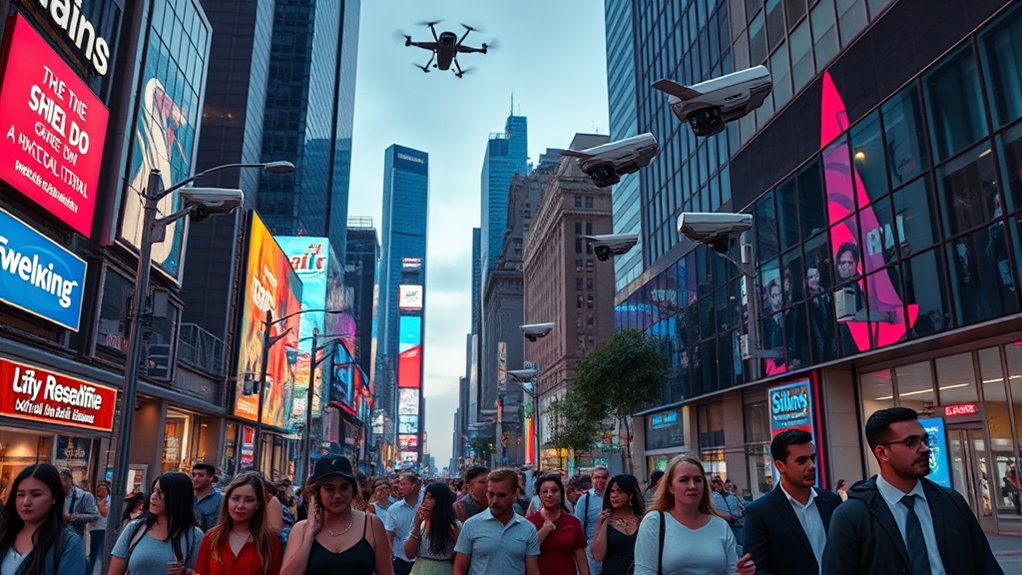

Balancing AI surveillance with privacy means you get security without sacrificing your personal freedoms. While facial recognition helps catch criminals and improves safety, it also risks misuse, data breaches, and invasion of privacy. It’s essential to have strict regulations, transparency, and oversight to prevent overreach. By understanding how to manage these tools responsibly, you can enjoy safety while protecting your rights. Staying informed will help you navigate this complex issue more confidently.
Key Takeaways
- Implementing strict regulations and oversight can help balance security benefits with privacy rights.
- Transparency in facial recognition deployment builds public trust and accountability.
- Enhancing data security measures protects biometric information from breaches and misuse.
- Limiting surveillance scope and obtaining informed consent reduces privacy infringements.
- Ongoing ethical evaluation ensures AI surveillance respects civil liberties while maintaining safety.

Have you ever wondered how artificial intelligence is transforming the way governments and corporations monitor public spaces? It’s a game-changer, especially with tools like facial recognition technology. This technology scans crowds in real time, matching faces against vast databases to identify individuals instantly. While this can be invaluable for catching criminals or locating missing persons, it raises serious questions about data security. When your face is stored in a database, how do organizations protect that sensitive information from hacking or misuse? If data security measures aren’t robust, your biometric data could fall into the wrong hands, leading to identity theft or surveillance overreach.
Facial recognition’s accuracy and reliability are also ongoing concerns. False positives can lead to innocent people being scrutinized or detained, which infringes on personal privacy. As you go about your day, you might not realize how often your image could be captured and analyzed without your consent. This constant surveillance can create a chilling effect, where you feel wary of expressing yourself freely. Governments and corporations argue that facial recognition enhances security, but without strict regulations, it can erode your privacy rights. Striking a balance means implementing strong data security protocols—encryption, access controls, and transparency about how your data is used.
Many are calling for clear limits on facial recognition deployment, insisting that privacy protections be baked into the systems from the start. Some regions have already banned or restricted its use in public spaces, recognizing the potential for abuse. It’s also important to understand how projector technology impacts the clarity and security of visual data, especially as surveillance methods evolve. It’s vital for you to stay informed about how your biometric data is collected and stored, and to advocate for policies that prioritize your privacy. Surveillance isn’t inherently bad, but unchecked use of facial recognition technology can lead to mass data collection and profiling, undermining individual freedoms.
Organizations must also consider the long-term implications of data security. Once your biometric information is compromised, it’s not like changing a password. Your facial data, once leaked, could be used for malicious purposes or identity theft. Hence, implementing airtight security measures is essential to protect citizens and consumers alike. As technology advances, so does the need for vigilant oversight. Ultimately, the goal should be to use AI surveillance responsibly—maximizing public safety without sacrificing the fundamental right to privacy. By demanding transparency and accountability, you can help guarantee that facial recognition and data security serve society’s best interests rather than infringing on personal liberties.

Windows Hello Fingerprint Reader for Windows 11 10, Offline Physical Security Vault for PC, USB Biometric Fingerprint Scanner, 360° Touch Secure Login & Data Encryption Device for Laptop Sliver
- Offline Physical Vault: Secure offline biometric data storage
- Fast 0.1s Unlock: Instant fingerprint recognition from any angle
- 360° Touch Sensor: High-sensitivity capacitive fingerprint scanner
As an affiliate, we earn on qualifying purchases.
As an affiliate, we earn on qualifying purchases.
Frequently Asked Questions
How Effective Is AI Surveillance in Preventing Crimes?
AI surveillance can be quite effective at preventing crimes by quickly analyzing data and identifying suspicious behavior. However, you should be aware of privacy concerns, as increased monitoring might infringe on civil liberties. While its technological effectiveness improves security, it also raises questions about overreach and data misuse. Ultimately, balancing these factors is essential to guarantee safety without compromising individual privacy rights.
What Legal Frameworks Govern AI Surveillance Practices Globally?
You’re governed by legal boundaries set by your country’s laws, which regulate AI surveillance practices to protect civil liberties. International treaties also influence these rules, promoting cooperation and standardization across borders. These frameworks aim to balance security needs with privacy rights. You must stay informed about local regulations and international agreements, as they determine how AI surveillance is implemented and monitored, ensuring respect for individual freedoms while maintaining public safety.
How Do Citizens Feel About AI Surveillance in Their Communities?
You likely feel mixed about AI surveillance in your community. Many citizens express privacy concerns, worried about how their personal data is collected and used. Public trust varies; some see surveillance as necessary for security, while others fear it infringes on civil liberties. Your feelings depend on transparency, accountability, and how well authorities balance security needs with respecting individual privacy rights.
What Are the Economic Impacts of Implementing AI Surveillance Systems?
Imagine your economy as a garden, and AI surveillance systems are the seeds you plant. When managed well, they foster economic growth and spark market innovation, attracting new businesses and creating jobs. However, neglecting ethical concerns can lead to weeds that choke progress. Balancing these factors encourages a thriving landscape, where technology fuels prosperity without overshadowing civil liberties, ensuring sustainable growth and vibrant innovation.
Can AI Surveillance Be Ethically Justified in Democratic Societies?
You might argue that AI surveillance can be ethically justified in democratic societies if it addresses ethical dilemmas like preventing crime while respecting privacy trade-offs. However, you should carefully consider civil liberties, transparency, and accountability. When implemented transparently with proper oversight, AI surveillance can enhance security without overly infringing on personal freedoms. Still, it’s essential to balance security needs with protecting individual rights to maintain trust in democratic values.

On Privacy: Twenty Lessons to Live By
As an affiliate, we earn on qualifying purchases.
As an affiliate, we earn on qualifying purchases.
Conclusion
As you weigh the benefits of AI surveillance against the need for privacy, remember that finding the right balance isn’t easy. Do we prioritize security at the expense of our civil liberties, or can we create safeguards to protect both? It’s a delicate dance, but staying informed and involved helps guarantee that technology serves us all. Ultimately, your voice matters—because in the end, safeguarding our freedoms depends on your choices and actions.

abyliee Upgraded Hidden Camera Detector – AI-Powered Anti-Spy Device, GPS Tracker & Bug Detector, Portable RF Signal Scanner for Hotels, Travel, Home & Office (Black)
- AI-Powered Detection: Detects cameras, listening devices, GPS trackers
- Easy to Use: Turn on, sweep, and get alerts
- Portable & Travel-Friendly: Lightweight, rechargeable, pocket-sized
As an affiliate, we earn on qualifying purchases.
As an affiliate, we earn on qualifying purchases.

Privacy-Preserving Machine Learning
As an affiliate, we earn on qualifying purchases.
As an affiliate, we earn on qualifying purchases.