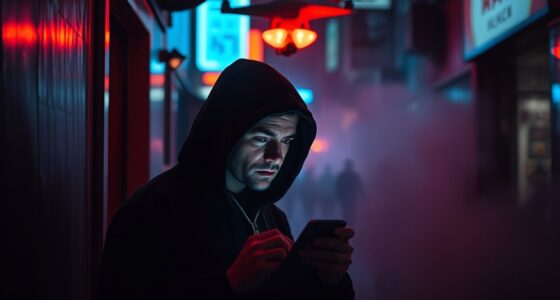
Facial recognition technology faces growing public backlash due to privacy worries and fears of mass surveillance. People are concerned about how their biometric data is collected, stored, and used without consent, leading many cities to ban its deployment. Citizens want to protect their personal freedoms and privacy rights, prompting stricter regulations. If you keep exploring, you’ll discover how these bans are shaping policies and the ongoing debate over balancing security with individual rights.
Key Takeaways
- Many cities ban facial recognition due to public concerns over mass surveillance and privacy violations.
- Citizens oppose intrusive tracking of their movements without consent, fueling societal backlash.
- Technological advancements have increased facial recognition capabilities, prompting calls for stricter regulation.
- Policy debates focus on balancing security benefits with protecting individual privacy rights.
- Bans aim to limit misuse, safeguard personal data, and prevent erosion of personal freedoms.
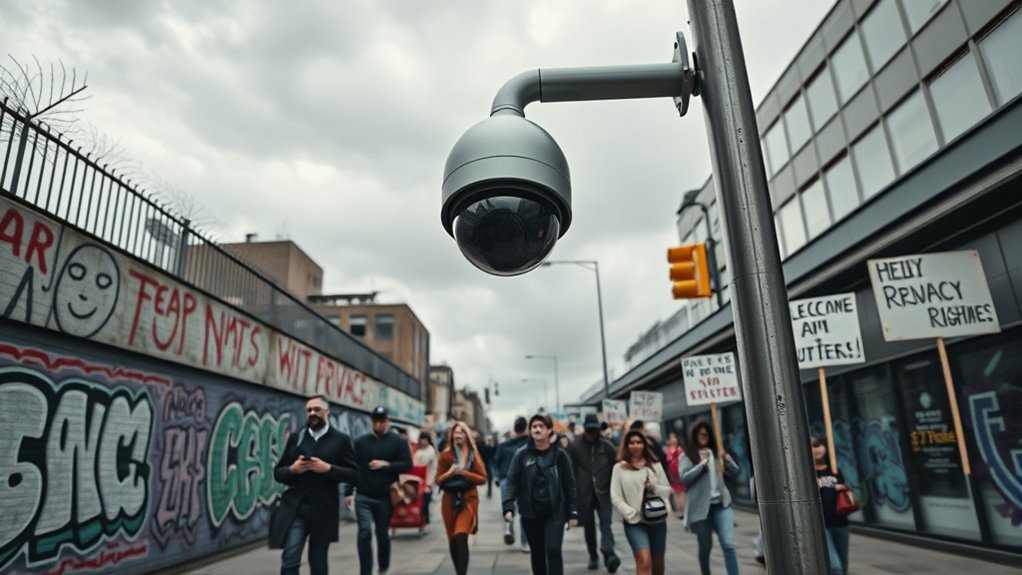
Facial recognition technology has become a controversial tool, prompting many cities and countries to impose bans on its use. You might find it alarming that what seems like a convenient security measure can also threaten your privacy. The core issue revolves around privacy concerns—people worry about how their biometric data is collected, stored, and potentially misused. Governments and advocacy groups argue that without proper safeguards, facial recognition can lead to mass surveillance, eroding personal freedoms. As a result, calls for stricter technology regulation intensify, aiming to limit or control how this technology is deployed.
Facial recognition raises privacy concerns and risks of mass surveillance without proper safeguards.
When cities decide to ban facial recognition, they’re often responding to public backlash. Citizens are increasingly aware of the intrusive nature of facial recognition systems, especially when used without explicit consent. The fear is that these systems could track your movements across public spaces, creating a detailed profile of your daily activities. This kind of pervasive monitoring can chill free expression and diminish your sense of anonymity in public. In many cases, people feel that the technology outpaces existing laws, leaving gaps that could be exploited or lead to abuse. These concerns propel policymakers to adopt bans or restrictions, seeking to strike a balance between security needs and individual rights. Additionally, advancements in machine learning algorithms have increased the sophistication of facial recognition, making regulation even more urgent.
The debate around technology regulation is central to the ongoing controversy. Critics argue that facial recognition technology has been implemented too quickly, often without adequate oversight or transparency. Without clear guidelines, there’s a risk that private companies or governments could misuse your biometric data or share it with third parties. Some jurisdictions have responded by enacting bans that prohibit law enforcement and commercial entities from deploying facial recognition. These measures aim to prevent potential abuses and safeguard your privacy rights. Conversely, supporters claim that regulation can stifle innovation and reduce public safety, pushing the debate further into the domain of policy and ethics.
In places where bans are enforced, you may notice a decline in intrusive surveillance and a stronger emphasis on privacy rights. These restrictions reflect a broader societal push for technology regulation that prioritizes individual freedoms over unchecked technological capabilities. Yet, the conversation isn’t settled—many still argue that facial recognition can be a useful tool if used responsibly and with proper safeguards. Until then, bans serve as a way to protect your privacy from being compromised by technology that many see as intrusive and potentially dangerous. The ongoing push for regulation underscores the importance of maintaining control over personal data in an increasingly digital world.

Tapo 4K Indoor Pan/Tilt Wired Security Camera – Works as a Baby Monitor, Person/Pet Detection, Facial Recognition, 360° AI Motion Tracking, Subscription-Free Local Storage or Optional Cloud, C260
- Ultra HD Resolution: 4K clarity for detailed images
- Full Area Coverage: 360° horizontal and 116° vertical view
- Powerful Digital Zoom: Up to 18x zoom for detailed surveillance
As an affiliate, we earn on qualifying purchases.
As an affiliate, we earn on qualifying purchases.
Frequently Asked Questions
How Do Facial Recognition Bans Impact Law Enforcement Capabilities?
Facial recognition bans limit law enforcement’s surveillance capabilities, making it harder to identify suspects quickly. You might notice increased surveillance challenges, as officers can’t rely on this technology to solve crimes efficiently. While bans protect civil liberties and prevent misuse, they also reduce the tools available for public safety. You need to balance privacy concerns with effective law enforcement, understanding that restrictions can both hinder crime-solving and uphold individual rights.
Are There Alternatives to Facial Recognition Technology for Security?
Yes, there are alternatives to facial recognition for security. You can rely on traditional surveillance methods like CCTV, access control systems, and behavioral analysis, which respect surveillance ethics and biometric privacy. These options help maintain security without infringing on personal rights. By using these methods, you balance safety and privacy concerns, ensuring that security measures are effective while safeguarding individual freedoms.
How Do Privacy Advocates Justify These Bans?
Privacy advocates justify these bans because they believe facial recognition technology threatens your civil liberties and privacy concerns. They argue that unchecked use can lead to mass surveillance, government overreach, and loss of anonymity in public spaces. By restricting its use, they aim to protect your personal freedoms and prevent potential abuses, ensuring that technology serves society without compromising fundamental rights.
What Are the Economic Effects on Tech Companies?
You’ll see that facial recognition bans can lead to significant economic repercussions for tech companies. These restrictions might limit your ability to innovate and deploy new AI-driven features, potentially reducing revenue. Additionally, they can damage consumer trust, making users wary of your products. As a result, your company’s growth could slow, and you might face increased regulatory costs. Overall, these bans can reshape the industry landscape and impact your bottom line.
How Might Facial Recognition Bans Influence Future Legislation?
Think of legislation as a compass guiding societal values; bans on facial recognition will steer future laws toward heightened surveillance concerns and stronger protections for civil liberties. You might see stricter regulations or bans expanding, reflecting public fears of privacy invasions. These laws could set a precedent, prompting governments worldwide to balance innovation with privacy rights, emphasizing the need to protect individual freedoms amid evolving surveillance technologies.

Mantra MFS 110 L1 Biometric Single Fingerprint Scanner | Aadhaar Authentication Device | Latest Updated RD Service | High Securety and Fast scanning | Reliable and Durable
- Model: MFS110 L1 USB Fingerprint Scanner
- Compatibility: Supports Windows, Android, Linux
- Registration: Includes 1 Year RD Service
As an affiliate, we earn on qualifying purchases.
As an affiliate, we earn on qualifying purchases.
Conclusion
As you watch this landscape shift, it’s clear that facial recognition technology is caught in a storm of public outrage. Just like a wildfire fueled by fear and mistrust, bans spread quickly, challenging the unchecked reach of big brother tech. Moving forward, you’ll need to decide whether to embrace innovation or stand firm against it, knowing that the battle for privacy is a delicate dance—one that could reshape your world like a pen rewriting a blank page.

SightPro Magnetic Laptop Privacy Screen 14 Inch 16:9 – Patented Removable Laptop Privacy Filter Shield and Protector
- Magnetic Snap-on Attachment: Easy magnetic attachment and removal
- Compatible Dimensions: Fits 14-inch screens, verify measurements
- Enhanced Privacy: Blacks out side viewing, clear front view
As an affiliate, we earn on qualifying purchases.
As an affiliate, we earn on qualifying purchases.

EYSOFT Privacy Cover Compatible for iPhone 17 Pro/17 Pro Max with Front Camera Cover,Protect Privacy and Security,Open/Close Face Recogition Anti-Spy Camera Cover, Easy-Adhesive Design-2Pack Black
- Includes 4 Privacy Covers: 2 for camera lens, 2 for front camera
- Dual Protection Design: Separate sliding covers for camera and face recognition
- Compatible with iPhone 17 Series: Back cover fits 17 Pro/Pro Max, front covers fit multiple models
As an affiliate, we earn on qualifying purchases.
As an affiliate, we earn on qualifying purchases.