

Drone swarms act as coordinated eyes in the sky, transforming traditional surveillance. You see multiple drones working together, sharing real-time data to cover large areas quickly and efficiently. They navigate autonomously through complex terrains, avoid obstacles, and adapt to changing environments. Their communication guarantees synchronized movements and resilience even if some units fail. If you want to discover more about how these advanced systems are changing surveillance forever, keep exploring their capabilities and future potential.
Key Takeaways
- Drone swarms operate collectively, providing extensive coverage and real-time surveillance over large areas.
- They communicate and coordinate autonomously, enhancing adaptability and resilience during missions.
- Advanced sensors and onboard processing enable autonomous navigation through complex environments.
- Swarms improve efficiency, flexibility, and situational awareness in security and border monitoring efforts.
- Future developments focus on increased autonomy, cybersecurity safeguards, and multi-dimensional surveillance capabilities.
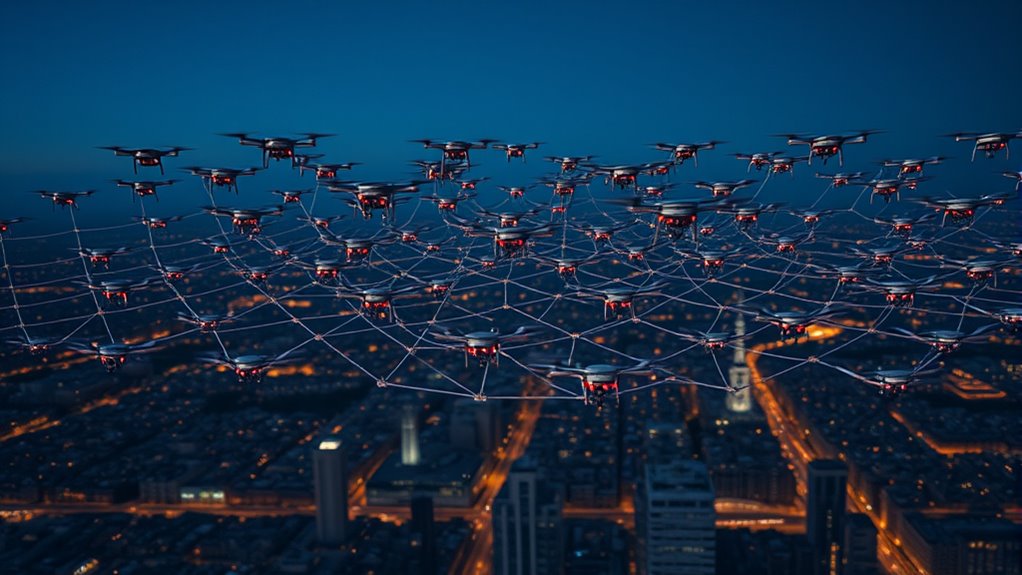
Have you ever wondered how drone swarms are transforming modern technology? These sophisticated systems are revolutionizing surveillance missions by acting as coordinated eyes in the sky. Unlike single drones, swarms operate collectively, sharing information and adapting to changing environments in real time. This coordination hinges on two critical elements: autonomous navigation and swarm communication. When these components work seamlessly, the result is a highly efficient, flexible, and resilient surveillance platform.
Autonomous navigation allows each drone within the swarm to independently understand its position, avoid obstacles, and follow designated paths without constant human control. You don’t need to micromanage each drone; instead, they can navigate complex terrains, urban areas, or remote wilderness with minimal oversight. This capability relies on advanced sensors, GPS, and onboard processing units that help drones make split-second decisions. Because each drone can operate independently yet remain part of the larger group, the entire swarm can cover vast areas quickly and efficiently, making them ideal for large-scale surveillance missions.
Each drone navigates independently using sensors and GPS, enabling efficient, large-scale surveillance without constant human control.
Swarm communication is what keeps these drones synchronized and working as a cohesive unit. Think of it as a digital conversation happening simultaneously among all members of the swarm. They constantly share data about their surroundings, positions, and status updates, which helps them coordinate movements and avoid collisions. This real-time exchange of information ensures that the swarm responds adaptively to unexpected events, such as spotting a new target or encountering an obstacle. Effective swarm communication also allows for decentralized decision-making, meaning no single drone is in charge—each one contributes to the collective effort based on shared data. This decentralization enhances the robustness of the swarm; even if one or a few drones fail, the rest can continue their mission seamlessly.
The synergy between autonomous navigation and swarm communication is what makes drone swarms so powerful for surveillance. You get a system that can operate autonomously over long durations, adapt to unpredictable situations, and maintain continuous coordination without direct human intervention. This makes them particularly useful for monitoring large borders, tracking moving targets, or conducting reconnaissance in hostile or inaccessible environments. As technology advances, these systems will become even more autonomous, smarter, and more reliable, further extending their capabilities. Additionally, the integration of ethical hacking principles can help safeguard these complex systems from cyber threats, ensuring operational security. Overall, drone swarms are transforming surveillance from a static, single-point activity into a dynamic, multi-dimensional operation, providing a new level of situational awareness and operational efficiency in modern security efforts.

Police Drone & Pilot Detection Kit– Handheld Drone Detection & Tracking Tool | Real-Time Alerts for Law Enforcement, Event Security & Emergency Response | Portable Airspace Awareness Device
- Real-Time Drone Detection: Detects drones via remote ID signals instantly
- Portable & Compact Design: Handheld, lightweight, and easy to carry
- Immediate Threat Alerts: Provides instant drone presence notifications
As an affiliate, we earn on qualifying purchases.
As an affiliate, we earn on qualifying purchases.
Frequently Asked Questions
How Do Drone Swarms Communicate in Real-Time During Missions?
You’re likely to see drone swarms communicate through mesh networks, which let each drone relay signals directly to others, creating a resilient web of communication. They use specialized signal protocols to guarantee real-time data sharing and coordination, even when some drones go offline or face interference. This setup enables the entire swarm to respond quickly and stay synchronized during missions, maintaining effective surveillance without relying on centralized control.
What Are the Legal Regulations Governing Drone Swarm Deployments?
Remember, forewarned is forearmed. You should know that drone swarm deployments are governed by national regulations concerning privacy concerns and international treaties. Many countries require permits, restrict certain areas, and enforce data protection laws. International treaties aim to prevent misuse and ensure safety. Staying informed and complying with these regulations helps you avoid legal trouble, protect privacy, and promote responsible drone use worldwide.
How Is Data Security Maintained Within Drone Networks?
You maintain data security within drone networks by implementing strong encryption protocols to protect transmitted data from interception. Access controls restrict unauthorized users from entering the system, ensuring only approved personnel can access sensitive information. Regular updates and security audits help identify vulnerabilities, while secure communication channels prevent hacking attempts. Combining these measures, you create a robust defense against cyber threats, safeguarding the integrity and confidentiality of drone-collected data.
Can Drone Swarms Operate Autonomously Without Human Input?
Like a flock of birds soaring seamlessly, drone swarms can operate autonomously, making decisions in real-time. You should know that advanced algorithms enable these swarms to coordinate tasks without human oversight, but they often still rely on human input for critical decisions. While they can perform many functions independently, complete autonomy depends on the mission’s complexity and safety protocols, ensuring human oversight remains a essential safety net.
What Are the Limitations of Drone Swarm Technology in Complex Environments?
You’ll find that drone swarm technology faces limitations in complex environments due to sensor limitations and environmental challenges. Thick foliage, urban structures, or weather conditions like rain and fog can impair sensors, reducing accuracy and coordination. These factors make it harder for the swarm to navigate, communicate, and maintain formations. Overcoming these challenges requires advanced sensors and adaptive algorithms, but current technology still struggles in highly unpredictable or obstructed settings.
Police Drone & Pilot Detection Kit– Handheld Drone Detection & Tracking Tool | Real-Time Alerts for Law Enforcement, Event Security & Emergency Response | Portable Airspace Awareness Device
- Real-Time Drone Detection: Detects drones via remote ID signals instantly
- Portable & Compact Design: Handheld, lightweight, and easy to carry
- Immediate Threat Alerts: Provides instant drone presence notifications
As an affiliate, we earn on qualifying purchases.
As an affiliate, we earn on qualifying purchases.
Conclusion
Imagine having a network of tiny eyes working seamlessly overhead, watching over everything. Drone swarms make surveillance more efficient and adaptable than ever before. As technology advances, could these coordinated eyes in the sky become our most reliable guardians or raise new privacy concerns? The future of surveillance is here—are you ready to trust these robotic watchers to keep us safe, or should we be cautious of what’s to come?

Engineering Autonomous Swarms: Drones, Robots, and Collective Intelligence: Design, Coordination, and Innovation in Multi-Robot Systems
As an affiliate, we earn on qualifying purchases.
As an affiliate, we earn on qualifying purchases.
drone sensors and navigation equipment
As an affiliate, we earn on qualifying purchases.
As an affiliate, we earn on qualifying purchases.