
Thermal monoculars detect heat signatures by sensing infrared radiation emitted by objects around you. They capture this heat as energy and convert it into electronic signals, creating a clear image based on temperature differences. Unlike night vision devices, they don’t rely on ambient light, so you can see in complete darkness and through fog, smoke, or foliage. Want to learn more about how these advanced devices work? Keep exploring to discover all their capabilities.
Key Takeaways
- Thermal monoculars sense infrared radiation emitted by objects based on their heat, rather than visible light.
- They use sensors that detect temperature differences to generate thermal images.
- Variations in heat signatures create contrast, making objects visible regardless of lighting conditions.
- The device’s sensor sensitivity influences its ability to detect subtle temperature differences.
- The thermal image is displayed as a visual map of heat signatures for analysis.
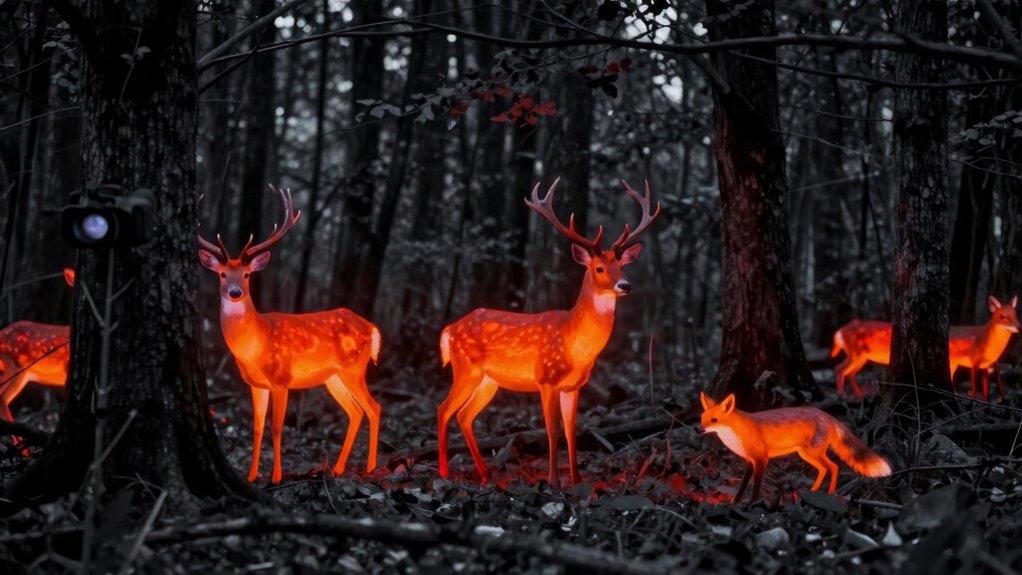
Have you ever wondered how security teams spot hidden threats in complete darkness? It’s a fascinating process that relies on advanced technology to see what the naked eye cannot. Thermal monoculars are at the forefront of this capability, allowing you to detect heat signatures even when everything else appears black and featureless. Unlike traditional night vision devices that amplify ambient light, thermal monoculars sense the infrared radiation emitted by objects, giving you a clear picture of heat differences. This makes them invaluable for surveillance, search and rescue, or wildlife observation in low-light or no-light conditions.
When you use a thermal monocular, you’re not just relying on light; you’re interpreting heat. The device captures heat signatures from objects and displays them as images that can be easily analyzed. This is where image resolution plays a vital role. Higher-resolution thermal monoculars provide sharper, more detailed images, enabling you to distinguish between different objects and identify potential threats more precisely. A low-resolution device might show a heat source, but it could be blurry or indistinct, making it harder to differentiate between a person, an animal, or a false alarm. With improved image resolution, you gain clarity, making your assessments faster and more accurate. Understanding heat signatures can significantly enhance your ability to interpret thermal images effectively.
Night vision devices operate differently—they amplify ambient light or infrared light that’s already present, which can sometimes be limited in complete darkness. Thermal monoculars, on the other hand, don’t depend on external light sources at all. Instead, they detect emitted heat, which means they can see through fog, smoke, or even foliage that might obscure traditional night vision. This ability to “see” heat signatures gives you an advantage in stealth operations or when monitoring large areas where visibility is compromised. Additionally, the effectiveness of thermal imaging is influenced by sensor sensitivity, which determines how well the device can detect subtle temperature differences.
You’ll notice that thermal monoculars often come with various image resolutions, which directly impact their effectiveness. High-resolution models allow you to see small heat sources at greater distances, providing more detail and context. This is essential during night patrols or search missions, where every second counts, and accurate identification can be the difference between success and failure. As technology advances, the gap between night vision and thermal imaging continues to narrow, but understanding how these devices work helps you choose the right tool for your needs. Understanding thermal imaging technology can help you maximize your device’s potential and make better decisions based on heat signatures.
TOPDON TS004 Thermal Imaging Monocular, 13mm 50Hz Night Vision

High-resolution thermal monocular with wireless connectivity, long battery life, and rugged IP67 design for hunting and outdoor adventures.
As an affiliate, we earn on qualifying purchases.
As an affiliate, we earn on qualifying purchases.
Frequently Asked Questions
How Does Ambient Temperature Affect Thermal Imaging Accuracy?
Ambient temperature and heat influence thermal imaging accuracy because they cause temperature fluctuations that can obscure or alter heat signatures. When ambient heat is high, it may reduce contrast, making it harder to distinguish objects. Conversely, cooler surroundings improve detection. You should be aware that sudden temperature shifts can temporarily affect clarity, so it’s best to operate your thermal monocular in stable conditions for the most reliable readings.
Can Thermal Monoculars Detect Through Walls or Obstacles?
Thermal monoculars can’t see through walls or obstacles because of wall penetration limits. They detect heat emitted by objects, but walls and solid obstacles reflect or block thermal signals, preventing detection beyond them. You might notice some reflection off surfaces, which can create false signals or obscure real heat signatures. So, while useful for many applications, thermal monoculars are limited by obstacle reflection and can’t penetrate walls or dense barriers.
What Is the Typical Range of Thermal Monoculars?
Imagine stretching an invisible net across the landscape—that’s how thermal monoculars see heat. Typically, you’ll get a range of 1000 to 2000 feet, depending on sensor resolution and environmental conditions. Higher sensor resolution enhances detail, while longer battery life guarantees you keep tracking heat signatures without interruption. Keep in mind, obstacles and weather can limit this range, so plan accordingly for your adventure or surveillance needs.
How Do Different Materials Impact Heat Signature Detection?
Different materials impact heat signature detection through their reflectivity and surface emissivity. High reflectivity materials, like metals, reflect thermal radiation, making heat signatures harder to detect. Conversely, materials with high surface emissivity emit more thermal radiation, enhancing detection. As you use thermal monoculars, keep in mind that non-emissive or reflective surfaces can obscure heat signatures, while absorptive surfaces reveal them more clearly, improving your ability to identify heat sources.
Are Thermal Monoculars Effective in All Weather Conditions?
Just as a lighthouse guides sailors through stormy seas, thermal monoculars enhance your nighttime visibility across various weather conditions. They reliably detect heat signatures even in fog, rain, or snow, thanks to their thermal resolution. While heavy weather like thick fog or torrential rain can diminish clarity, these devices still outperform traditional night vision, giving you a clear advantage in challenging environments.
Conclusion
So, now that you understand how thermal monoculars detect heat signatures, you realize how powerful and versatile these devices are. They let you see what’s invisible to the naked eye, whether for outdoor adventures or security. Isn’t it fascinating how technology can reveal hidden worlds around us? With a thermal monocular in your kit, you’re always a step ahead—seeing the unseen and uncovering heat signatures that tell a story only you can interpret.