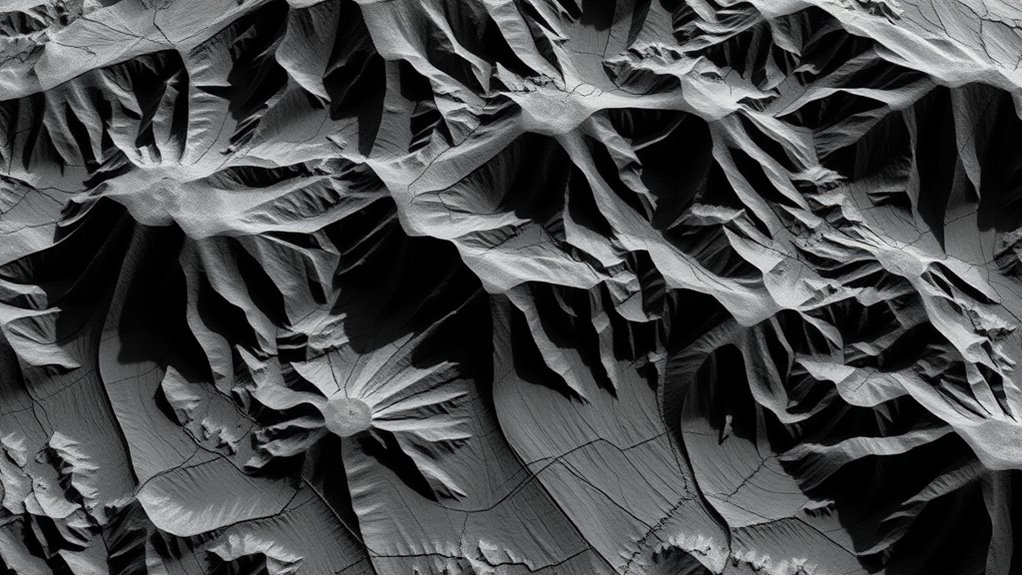

AI has transformed SAR image understanding by automating the interpretation of complex, textured radar data. It helps you recognize features like buildings, roads, and vegetation quickly and accurately, even in challenging weather or lighting conditions. AI algorithms also reduce noise and improve image clarity, making analysis more efficient. With ongoing advancements, AI continuously enhances your ability to monitor surface changes and respond swiftly. Keep exploring to uncover how these innovations can benefit your applications.
Key Takeaways
- AI leverages machine learning and deep learning to automatically interpret SAR images, identifying features like buildings, roads, and vegetation.
- Convolutional neural networks (CNNs) enhance classification and segmentation of textured SAR data for better understanding.
- AI models filter speckle noise, improving image clarity and enabling more accurate surface analysis.
- Automated AI methods facilitate rapid change detection, monitoring surface alterations and natural or human-made disasters.
- Integration of AI transforms SAR data from complex textured images into actionable insights for disaster response, environmental monitoring, and reconnaissance.

Have you ever wondered how synthetic aperture radar (SAR) images reveal detailed information about Earth’s surface regardless of weather or lighting conditions? It’s fascinating because SAR uses radio waves instead of visible light to capture images, allowing it to see through clouds, fog, and darkness. This capability makes SAR invaluable for applications like disaster monitoring, military reconnaissance, and environmental research. But interpreting SAR images isn’t straightforward. Unlike regular photographs, SAR images are complex, often appearing as textured patterns that can be difficult to decipher without specialized knowledge. That’s where artificial intelligence steps in, transforming raw radar data into meaningful insights.
AI, particularly machine learning and deep learning techniques, has revolutionized SAR image understanding. These algorithms can automatically identify features such as buildings, roads, vegetation, and water bodies. They learn from vast datasets, recognizing subtle patterns that might be invisible to the human eye or too time-consuming to analyze manually. For example, convolutional neural networks (CNNs) excel at image classification and segmentation tasks, enabling rapid and accurate analysis of large SAR datasets. When trained properly, they can distinguish between different surface types, detect changes over time, or even identify specific objects within cluttered scenes.
AI techniques like CNNs enable rapid, accurate analysis and feature recognition in complex SAR imagery.
One of the key advantages of integrating AI with SAR is the ability to handle the inherent complexities of radar data. SAR images often contain speckle noise—grainy artifacts caused by the radar’s coherent imaging process—that can obscure details. AI models can be trained to filter out this noise while preserving important features, improving the clarity and usability of the images. Additionally, AI facilitates the automation of large-scale analysis, reducing reliance on manual interpretation and speeding up decision-making processes. Whether it’s monitoring deforestation, tracking urban expansion, or detecting oil spills, AI-driven SAR interpretation provides timely, actionable information.
Moreover, AI enhances change detection capabilities. By analyzing sequential SAR images, algorithms can pinpoint subtle surface alterations, such as infrastructure development or natural disasters like floods and landslides. This ability allows for early warning and rapid response, which can save lives and resources. As AI continues to evolve, its integration with SAR imaging offers increasingly sophisticated tools, making radar eyes more precise and efficient. Ultimately, AI empowers users to *access* the full potential of SAR data, turning complex radar reflections into clear, insightful images that inform *crucial* decisions across multiple fields. Advances in AI technology further improve the accuracy and speed of SAR data analysis, opening new possibilities for real-time monitoring and response.

Sar Image Analysis, Modeling, and Techniques IV (Proceedings of Spie)
As an affiliate, we earn on qualifying purchases.
As an affiliate, we earn on qualifying purchases.
Frequently Asked Questions
How Does SAR Imaging Differ From Optical Imaging?
SAR imaging differs from optical imaging because it uses radio waves instead of visible light, allowing you to see through clouds, fog, and darkness. Unlike optical images that rely on sunlight and can be obstructed, SAR captures radar signals reflected from surfaces, providing detailed, high-resolution images regardless of weather or lighting conditions. This makes SAR especially useful for remote sensing, surveillance, and mapping in challenging environments.
What Are Common Challenges in SAR Image Interpretation?
You face several challenges in SAR image interpretation, including speckle noise, which makes images grainy and harder to analyze. You also struggle with geometric distortions caused by side-looking angles and varying surface conditions that affect reflectivity. Differentiating between objects with similar radar signatures can be tough, and interpreting images in complex environments, like urban areas, adds to the difficulty. These issues require advanced processing techniques and AI assistance for accurate analysis.
Can AI Improve Real-Time SAR Data Processing?
Yes, AI can markedly improve real-time SAR data processing. You can leverage AI algorithms to analyze data faster and more accurately, enabling quicker decision-making. AI models identify patterns, filter noise, and enhance image quality on the fly. With ongoing advances, you’ll find that AI reduces processing time, boosts efficiency, and helps you interpret complex SAR images more effectively, making real-time applications more practical and reliable.
What Are Typical Applications of SAR Image Analysis?
Imagine standing at the edge of a vast landscape, your eyes revealing hidden details beneath the surface. SAR image analysis lets you do just that, uncovering terrain features, tracking ships across oceans, or spotting changes in land use. You can monitor environmental shifts, assist in disaster management, or support military reconnaissance. Its applications transform raw radar signals into clear, actionable insights, empowering you to see beyond the visible and make informed decisions.
How Does Weather Affect SAR Image Quality?
Weather markedly impacts SAR image quality, especially through rain, snow, and fog. Rain and snow can cause signal scattering, reducing clarity and resolution. Fog mainly affects optical sensors, but heavy precipitation can still distort radar signals. Wind-induced surface movements can also introduce noise. You should account for weather conditions when planning SAR data collection, as adverse weather can degrade image quality and make interpretation more challenging.

Escort Redline 360c Plug and Play Radar Detector – Extreme Range, Rapid Response Times, Full Stealth, 360 Degree Awareness, Advanced Filtering, Built-in WiFi, Apple CarPlay & Android Auto Compatible
- Extreme Range: Twice the range of Redline EX
- Rapid Response: 25 times faster processing speed
- AI Filtering: GPS auto-learn and updateable IVT filter
As an affiliate, we earn on qualifying purchases.
As an affiliate, we earn on qualifying purchases.
Conclusion
As you explore SAR image understanding, you realize it’s like giving radar eyes a gentle touch of intelligence. While the technology gently unfolds its potential, it whispers promises of safer skies and clearer insights. Though still in its early whispers, this field quietly beckons you to imagine a future where unseen worlds become gently visible. Embrace this evolving journey, knowing that with each step, you’re helping to shape a more perceptive and secure tomorrow.

(1) Noise Filter 10 AMPS 12V HUM Filter Noise Engine Suppressor Wire IBNF10
- Power Rating: 10 AMP
- Voltage: 12V
- Application: Engine and speaker noise reduction
As an affiliate, we earn on qualifying purchases.
As an affiliate, we earn on qualifying purchases.

Image Analysis, Classification and Change Detection in Remote Sensing
As an affiliate, we earn on qualifying purchases.
As an affiliate, we earn on qualifying purchases.