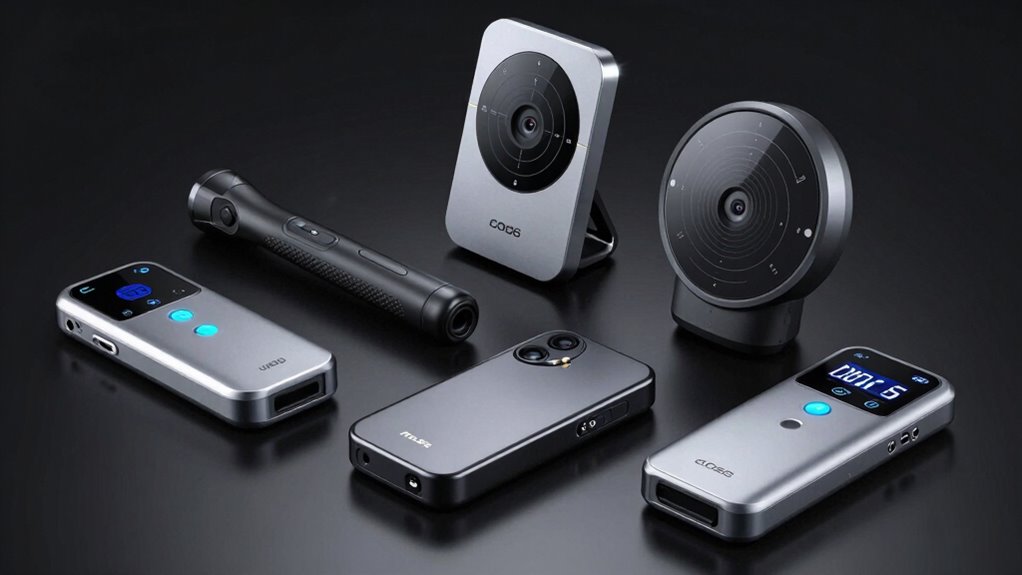
A bug detector device can help you check a hotel room, vehicle, or private workspace for suspicious wireless signals and camera lenses, but the five options here take noticeably different approaches. I rank the VigilEye 6-in-1 first for its broad stated frequency range and flexible probe; the CountureMode G007 Pro is a more travel-focused pick with six sensitivity levels and a listed two-year warranty; and the portable camera, bug, and GPS detector adds infrared lens scanning and a luggage alarm.

Get privacy and security gear delivered free with Prime
- Fast, free delivery on millions of items
- Prime Video, Amazon Music and more included
- Member-only deals all year
Those extra functions do not make every device equally suitable. Some listings provide frequency bands and alert details, while others lean on broad claims without specific detection ranges. I compare the options by the practical information supplied, portability, detection methods, and useful extras—not by treating a high function count as proof of better detection. The main tradeoff is between clearer stated capabilities, discreet portability, and added features that may take more practice to use.
Key Takeaways
- The VigilEye has the broadest stated frequency range here, at 1 MHz to 10 GHz, and a flexible probe for awkward spaces; its stated range and accuracy are not independently verified.
- The CountureMode G007 Pro is the clearest travel-oriented choice, weighing 2 oz and offering six sensitivity settings, three alert types, and a listed two-year warranty.
- The portable camera, bug, and GPS detector adds infrared lens scanning and door or luggage alarms, but its description does not specify supported signal bands or detection distance.
- The 6-in-1 device with AI signal detection and optical scanning lists a narrower 1 MHz to 6.5 GHz range, so its broad feature claims should not replace a check of supported signals.
- The 9-in-1 model lists the most detection functions and a 2000 mAh battery, but its larger form and more involved operation may be a poor fit for discreet, quick checks.
| VigilEye 6-in-1 Hidden Camera, GPS Tracker, and RF Detector |  | Best Overall for Broad Stated Coverage | Threat types: Hidden cameras, Wi-Fi bugs and signals, GPS trackers, magnetic fields, Bluetooth devices | Frequency range: 1 MHz to 10 GHz | Scan rate: Up to 2,000 scans per second, as stated | VIEW ON AMAZON | See Our Full Breakdown |
| 7-in-1 Hidden Camera and RF Detector for Travel, Cars, Offices, and Hotels |  | Best for Travel | Model: G007 Pro | Frequency range: 1 MHz to 8 GHz | Sensitivity: Six levels | VIEW ON AMAZON | See Our Full Breakdown |
| Portable Hidden Camera, Bug, and GPS Tracker Detector with Anti-Theft Alarm |  | Best for Camera Checks and Luggage Alerts | Detection methods: Wireless signal, infrared lens scan, magnetic field | Extra modes: Silent detection, door-opening and luggage-movement alarms | Antenna: Built-in AM antenna and extendable antenna | VIEW ON AMAZON | See Our Full Breakdown |
| 6-in-1 Hidden Camera Detector and GPS Tracker – Portable Anti-Spy Device with Intrusion and SOS Alerts |  | Best for Straightforward Sensitivity Adjustment | Detection range: 1 MHz to 6.5 GHz | Sensitivity: Four adjustable levels | Detection methods: AI signal detection and optical lens scanning, as described | VIEW ON AMAZON | See Our Full Breakdown |
| 9-in-1 AI Hidden Camera Detector, RF, GPS, Anti Spy, Bug Detector, Night Vision, Portable |  | Best for the Most Listed Detection Functions | Detection functions: Camera, RF, GPS, audio bug, infrared, laser, electromagnetic interference, motion, SOS | Sensor technology: Multi-sensor AI chip, as described | Sensitivity: Six levels | VIEW ON AMAZON | See Our Full Breakdown |
| bug detector device | Alerts | Sensitivity |
|---|---|---|
| VigilEye 6-in-1 Hidden Camera | Flashing LEDs, vibration, adjustable audio | — |
| 7-in-1 Hidden Camera and RF De | Vibration, flashing lights, audio beeps | Six levels |
| Portable Hidden Camera | — | — |
| 6-in-1 Hidden Camera Detector | Buzzing alarm and SOS flashing indicator | Four adjustable levels |
| 9-in-1 AI Hidden Camera Detect | — | Six levels |
More Details on Our Top Picks
VigilEye 6-in-1 Hidden Camera, GPS Tracker, and RF Detector
The VigilEye takes the top position because its product information gives the clearest broad frequency claim in this group: 1 MHz to 10 GHz. It is described as scanning for hidden cameras, wireless bugs, GPS trackers, Wi-Fi signals, magnetic fields, and Bluetooth devices. That combination gives buyers more named threat categories to compare than the listings for the simpler travel detectors, though a feature list is not a guarantee that every device will be found.
Its flexible probe is a practical distinction. It is intended to help inspect tight or hard-to-reach areas, where a single rigid handheld body may be awkward to position. Flashing LEDs, vibration, and adjustable audio also give the user different ways to receive alerts. Against the CountureMode G007 Pro, VigilEye supplies a wider stated frequency range and more detail about the probe, while CountureMode is lighter and has a clearly listed two-year warranty.
There are important qualifications. The stated detection distance of 2 inches to 50 feet and scan rate of up to 2,000 scans per second are product claims, not independently verified results in the supplied information. Warranty details conflict: one part lists one year and another claims two. I would choose it for its described coverage and access-friendly probe, not on the assumption that the large range figure guarantees a find.
Pros:- Lists coverage for cameras, RF and Wi-Fi signals, GPS trackers, magnetic fields, and Bluetooth devices.
- States a 1 MHz to 10 GHz frequency range, the broadest stated range among these five.
- Offers visual, vibration, and adjustable audio alerts.
- Flexible probe is designed for tight or hard-to-reach inspection spots.
Cons:- Warranty information conflicts, listing both one and two years.
- Detection distance and accuracy claims are not independently verified in the supplied details.
- The feature breadth may require more careful scanning than a basic, focused detector.
Best for: Buyers who want a broad set of named detection targets, multiple alert styles, and a probe for checking tight spaces.
Not ideal for: Travelers who want the lightest clearly specified option, or buyers who require consistent warranty terms and independently verified detection performance.
- Threat types:Hidden cameras, Wi-Fi bugs and signals, GPS trackers, magnetic fields, Bluetooth devices
- Frequency range:1 MHz to 10 GHz
- Scan rate:Up to 2,000 scans per second, as stated
- Stated detection distance:2 inches to 50 feet
- Alerts:Flashing LEDs, vibration, adjustable audio
- Inspection feature:Flexible probe and gain antenna
- Warranty:Inconsistent listing: one year in product details, two years in description
Our verdict“I rank VigilEye first for its broadest stated frequency coverage and flexible probe, with unverified performance claims and conflicting warranty details as clear caveats.”
7-in-1 Hidden Camera and RF Detector for Travel, Cars, Offices, and Hotels
For someone who expects to carry a detector between hotels, cars, and offices, the CountureMode G007 Pro is the most straightforward compact pick. At 2 oz, it is lighter than a device whose appeal depends on a probe or a larger set of sensors. Six sensitivity levels let the user adjust how responsive a scan is, while vibration, flashing lights, and beeps offer a choice of alert style for different surroundings.
Compared with the VigilEye, this model gives up some stated frequency coverage: its listed band is 1 MHz to 8 GHz, versus VigilEye’s 1 MHz to 10 GHz. In exchange, its warranty information is more consistent, with two years listed, and its lightweight travel role is easy to understand. A rechargeable battery and included charging cable add convenience, although the description does not state how long the battery lasts per charge.
The naming is less tidy than the physical pitch. The product is called 7-in-1 in the title but described as 6-in-1 elsewhere, which makes the exact function count unclear. I would focus on its stated adjustable sensitivity, alert types, portability, and frequency band instead of counting functions. It suits buyers who want a small detector with several alert options; people who need a probe, infrared lens scanning, or more clearly defined sensor functions should compare other entries.
Pros:- Weighs 2 oz, making it the lightest clearly quantified travel-focused choice here.
- Six sensitivity levels allow adjustment for different scanning environments.
- Vibration, flashing lights, and audio beeps provide three alert styles.
- Lists a two-year warranty and includes a rechargeable battery and charging cable.
Cons:- Product information calls it both 6-in-1 and 7-in-1.
- Battery runtime is not specified.
- Its stated range ends at 8 GHz, below VigilEye’s listed 10 GHz.
Best for: Frequent travelers who want a very light detector with adjustable sensitivity, multiple alert options, and a clearly listed warranty.
Not ideal for: Buyers who need a specified battery runtime, an inspection probe, or a consistent account of how many detection functions the device has.
- Model:G007 Pro
- Frequency range:1 MHz to 8 GHz
- Sensitivity:Six levels
- Alerts:Vibration, flashing lights, audio beeps
- Weight:2 oz
- Power:Included rechargeable lithium polymer battery
- Warranty:Two years listed
Our verdict“I recommend the CountureMode for light travel and adjustable alerts, but not for buyers who need fully consistent function details or a stated runtime.”
Portable Hidden Camera, Bug, and GPS Tracker Detector with Anti-Theft Alarm
This detector is the most distinct alternative to the RF-focused options because it combines infrared lens scanning with wireless-signal and magnetic-field detection. Those methods address different clues: signal scanning looks for transmissions, while an optical lens check can help locate a camera lens without relying on that camera broadcasting. The infrared scan is most useful in a dark room, so it adds a specific tool rather than a universal shortcut.
The device also includes a door-opening or luggage-movement alarm, plus silent detection mode and an extendable antenna. That makes it more versatile for someone who wants a privacy check and a simple alert against unwanted access to a bag. Its listed up to 25 hours of battery life is a helpful endurance detail that the CountureMode listing does not provide. By comparison, VigilEye states a broader frequency range and offers a flexible probe, but it does not list the same anti-theft alarm modes.
The main limitation is how little the description says about RF performance. It gives no detection distance or supported signal bands, leaving buyers less able to judge its reach than with VigilEye or CountureMode. The infrared feature also has a setting requirement: a dark room. I would shortlist it for buyers who value optical checks and luggage alerts, but skip it if precise frequency coverage is central to the decision.
Pros:- Combines wireless-signal, infrared lens, and magnetic-field detection methods.
- Includes door-opening and luggage-movement alarm modes.
- Silent mode supports quieter scans.
- Lists up to 25 hours of battery life and an extendable antenna.
Cons:- No detection range or supported signal bands are specified.
- Infrared lens scanning requires a dark room.
- The listing gives less performance detail than the VigilEye and CountureMode descriptions.
Best for: Travelers who want infrared lens scanning, silent operation, and a door or luggage movement alarm alongside signal and magnetic detection.
Not ideal for: Buyers who want a stated frequency range or detection distance, or who cannot perform infrared checks in a darkened space.
- Detection methods:Wireless signal, infrared lens scan, magnetic field
- Extra modes:Silent detection, door-opening and luggage-movement alarms
- Antenna:Built-in AM antenna and extendable antenna
- Battery life:Up to 25 hours
- Weight:27.22 g
- Power:Battery powered
- Use:Indoor and outdoor
Our verdict“I favor this model for buyers who value lens scanning and luggage alerts, but its missing range and band information makes it a less transparent RF choice.”
6-in-1 Hidden Camera Detector and GPS Tracker – Portable Anti-Spy Device with Intrusion and SOS Alerts
This 6-in-1 model sits between the compact CountureMode and the broader-coverage VigilEye. Its listing specifies a 1 MHz to 6.5 GHz range and four adjustable sensitivity levels, giving buyers two concrete points for comparison. It also describes AI signal detection and optical lens scanning, plus a buzzing alarm and SOS flashing indicator. For a buyer who wants both signal-oriented and visual checking in one portable device, that is a useful combination on paper.
Its narrower stated range is a real distinction. CountureMode lists coverage to 8 GHz and VigilEye to 10 GHz, so I would not pick this model for the widest frequency claim. Its stronger case is a simpler set of four sensitivity levels rather than CountureMode’s six, which may appeal to a person who wants fewer adjustment choices. USB-C fast charging and a long-lasting battery are claimed, but no capacity or runtime is supplied to back those descriptions with a concrete comparison.
The product information also says operation requires following instructions and warns of false alarms when sensitivity is set poorly. That makes setup part of the buying decision: a new user should expect to learn the controls and adjust sensitivity rather than rely on automatic detection alone. The AI label does not establish accuracy by itself. I place this behind the first three because its stated band is narrower and its battery details are less specific, while its optical scan and SOS alert may still suit buyers who want those particular features.
Pros:- Lists optical lens scanning alongside signal detection.
- Four sensitivity levels provide a simpler adjustment range than the six-level travel model.
- Includes buzzing and SOS flashing alerts.
- USB-C fast charging is listed.
Cons:- The stated 1 MHz to 6.5 GHz range is narrower than those listed for VigilEye and CountureMode.
- Battery capacity and operating runtime are not specified.
- Manual setup is required, and sensitivity settings can cause false alarms.
Best for: Buyers who want a compact device with optical scanning, four sensitivity settings, USB-C charging, and an SOS-style alert.
Not ideal for: People prioritizing the widest stated frequency range, quantified battery runtime, or a device that requires little instruction.
- Detection range:1 MHz to 6.5 GHz
- Sensitivity:Four adjustable levels
- Detection methods:AI signal detection and optical lens scanning, as described
- Alerts:Buzzing alarm and SOS flashing indicator
- Charging:USB-C fast charging
- Portability:Compact and lightweight, per listing
- Battery details:Long-lasting claimed; capacity and runtime not specified
Our verdict“I see this as a feature-mix option for buyers who want optical scanning and an SOS alert, but its narrower band and vague battery claims keep it below the leading picks.”
9-in-1 AI Hidden Camera Detector, RF, GPS, Anti Spy, Bug Detector, Night Vision, Portable
The 9-in-1 model has the longest list of functions here: camera, RF, GPS, audio bug, infrared, laser, electromagnetic interference, motion detection, and SOS alarm. It also lists six sensitivity levels, a 2000 mAh battery, eight hours of operating time, and 50 days of standby. Those details make it the feature-dense choice, especially for someone who wants a broad set of modes and a quantified battery capacity rather than a very simple travel scanner.
That breadth comes with more to learn. The listing says operation may involve a learning curve, and the device is described as larger and less discreet than some alternatives. In contrast, the 2 oz CountureMode is the more natural option for quick travel checks, while the VigilEye has a stated frequency range and probe that make its inspection approach easier to compare. The 9-in-1 product does not provide a frequency range, so its extensive function count does not tell a buyer which RF bands it can detect.
The product description claims AI-assisted identification, adjustable sensitivity, pinpointing, and a one-meter drop test, but those claims are not independent performance evidence. Its one-hour charging time and listed runtime are useful figures, though buyers should weigh them against the size and complexity. I rank it fifth not because a longer feature list is inherently poor, but because its missing band information and higher operating complexity make it a less transparent choice for the core job of detecting suspicious signals.
Pros:- Lists nine functions, including camera, RF, GPS, infrared, motion, and SOS features.
- Six sensitivity levels offer a range of adjustment.
- Specifies a 2000 mAh battery, eight hours of operating time, and 50 days of standby.
- Lists a one-hour charging time and a one-meter drop test.
Cons:- No RF frequency range is specified.
- The listing describes a larger body that may be less discreet.
- Operation may take more learning than the lighter, simpler travel option.
Best for: Buyers who want many listed detection modes, a larger battery, and several sensitivity settings, and are comfortable learning a more involved device.
Not ideal for: Travelers seeking a discreet pocket-size scanner, or buyers who need a clearly stated RF frequency range before choosing.
- Detection functions:Camera, RF, GPS, audio bug, infrared, laser, electromagnetic interference, motion, SOS
- Sensor technology:Multi-sensor AI chip, as described
- Sensitivity:Six levels
- Battery capacity:2000 mAh
- Operating time:Up to 8 hours
- Standby time:Up to 50 days
- Charging time:One hour
- Build detail:ABS plastic; one-meter drop test listed
Our verdict“I would choose this for its long function list and quantified battery details, but not when discreet portability or clear RF band coverage matters most.”

How We Picked
I ranked these devices by how clearly their listed capabilities match the job a buyer wants done. For a bug detector, that means looking beyond a label such as “6-in-1” or “AI” and asking what detection methods are actually described, whether frequency coverage is stated, and how the device alerts the user. I gave more weight to concrete details such as a frequency range, adjustable sensitivity, infrared lens scanning, alert modes, and physical design than to unsubstantiated claims of accuracy.
I also compared the compromises that can shape everyday use. A flexible probe may help reach tight spots, but a compact body may be easier to carry. Silent or vibration alerts suit discreet checks, while audible beeps can be easier to notice. Infrared lens scanning is a different tool from RF scanning and may require a dark room. Battery runtime, warranty information, and operation details matter too, though not every listing provides them consistently.
This ranking reflects only the supplied product information; the stated detection distances, ranges, and accuracy claims have not been independently verified here. Detection devices can miss equipment that is powered off, shielded, not transmitting, or outside the stated capabilities. I therefore favor options whose details give a buyer a clearer basis for comparison, while calling out unclear or inconsistent claims rather than treating them as established performance.
| bug detector device | Alerts | Sensitivity |
|---|---|---|
| VigilEye 6-in-1 Hidden Camera | Flashing LEDs, vibration, adjustable audio | — |
| 7-in-1 Hidden Camera and RF De | Vibration, flashing lights, audio beeps | Six levels |
| Portable Hidden Camera | — | — |
| 6-in-1 Hidden Camera Detector | Buzzing alarm and SOS flashing indicator | Four adjustable levels |
| 9-in-1 AI Hidden Camera Detect | — | Six levels |
Factors to Consider When Choosing Bug Detector Device
I would start by deciding what kind of clue you want a detector to find. RF scanning, optical lens checks, magnetic detection, and movement alarms are different functions; a device that combines them may be more versatile, but a larger feature list does not confirm stronger performance. Compare the concrete details supplied for each model with the places and situations where you plan to use it.
Match the detection method to the concern
RF detection looks for radio signals within the device’s supported bands. A stated frequency range gives a useful comparison point, as with VigilEye and CountureMode, but it does not prove that every signal in that range will be found. Optical lens scanning offers a separate way to look for camera lenses; the portable detector and the 6-in-1 model list that function, while the portable model says infrared checks need a dark room. Magnetic-field detection may help with certain tracker-related checks, but no single method covers every possible device.
Read range claims with care
Ranges and scan rates are claims, not a promise that a detector will identify equipment at every distance or in every room. Walls, interference, device settings, power state, and signal strength can affect what a detector picks up. VigilEye lists a distance from 2 inches to 50 feet, while three products provide frequency ranges and two do not. I treat missing band details as a transparency gap and avoid choosing solely on a headline distance or a “9-in-1” label.
Choose alerts that fit your surroundings
Vibration and visual alerts can be less disruptive than beeps in a shared room, while audio can be easier to notice when the device is in hand. CountureMode and VigilEye list three alert types; the portable detector offers silent mode, and the 6-in-1 options add buzzing or SOS indicators. Sensitivity controls can help adapt a scan, but too much sensitivity may bring false alerts. Learn how to adjust settings before relying on a warning.
Balance portability with added functions
If a detector will live in a carry-on or pocket, weight and size can matter more than the number of modes. CountureMode lists a weight of 2 oz, while the portable infrared model lists 27.22 g. The 9-in-1 offers a longer feature list and quantified battery capacity, but its description says it is larger and may take more learning. VigilEye’s flexible probe is helpful for access to tight spaces, yet that feature may matter less to someone who wants only quick checks in a hotel room.
Check battery, warranty, and operating details
Battery life is easier to compare when a listing gives a runtime: the portable detector lists up to 25 hours and the 9-in-1 lists up to eight hours of operation. CountureMode does not state runtime, and the 6-in-1 model does not provide battery capacity or hours despite claiming long life. Warranty wording also deserves attention: VigilEye’s supplied information conflicts, while CountureMode lists two years. I would confirm current seller terms and instructions before buying, especially when an advertised function depends on careful setup.
Frequently Asked Questions
What does a bug detector device detect?
A bug detector may scan for radio-frequency transmissions, magnetic fields, camera lenses, or other signals, depending on its design. The five devices here do not all use the same methods: some list RF and magnetic detection, while others add infrared lens scanning or movement alarms. Check the specific functions and frequency details instead of assuming every model detects every type of surveillance device.
Can a detector find a hidden camera that is switched off?
An RF scan may not find a camera that is powered off or not transmitting. Optical lens scanning is a separate method that may help locate a camera lens, but its effectiveness depends on the device and how the check is performed. The portable infrared model says the lens scan requires a dark room, and no detector in this comparison should be treated as a guarantee that a room is free of cameras.
Is a wider frequency range always better?
A wider stated band gives a broader specification to compare, but it does not by itself prove greater sensitivity or reliable detection across the entire range. VigilEye lists 1 MHz to 10 GHz, compared with 1 MHz to 8 GHz for CountureMode and 1 MHz to 6.5 GHz for the 6-in-1 model. Two other listings do not provide a frequency range, so buyers cannot compare their RF coverage on that basis.
Why do these detectors have adjustable sensitivity?
Sensitivity settings let a user change how responsive a detector is to signals or suspected activity. A higher setting may help detect weaker signals, but it can also produce more alerts in environments with ordinary wireless devices or interference. CountureMode and the 9-in-1 list six levels, while the 6-in-1 model lists four. Follow the device instructions and use adjustments as a control, not as proof that an alert identifies a surveillance device.
Which bug detector device is best for travel?
For a lightweight option with clear travel features, I would start with the CountureMode G007 Pro: it weighs 2 oz, lists six sensitivity levels, offers vibration, light, and audio alerts, and includes a two-year warranty. Buyers who also want infrared lens scanning and luggage alerts may prefer the portable detector, which lists up to 25 hours of battery life. The right choice depends on whether compact size or extra inspection and alarm functions matter more.
Conclusion
My first choice is the VigilEye for buyers who want the broadest stated frequency range in this group and a probe for tight spots, provided they are comfortable with unverified range claims and conflicting warranty information. For frequent travelers who value a light body, adjustable sensitivity, and a clearly listed warranty, I would choose the CountureMode G007 Pro. If infrared lens checks and luggage alerts matter more than published RF specifications, the portable camera, bug, and GPS detector is the more fitting pick.
The two remaining devices suit narrower priorities. I would consider the 6-in-1 model for optical scanning and an SOS-style alert, while accepting its narrower stated band and limited battery details. The 9-in-1 device is for buyers who want many listed modes and quantified battery information and do not mind extra size or learning. Whichever you choose, compare stated capabilities rather than function counts, read the operating instructions, and treat a detector as a checking aid—not a guarantee of privacy.