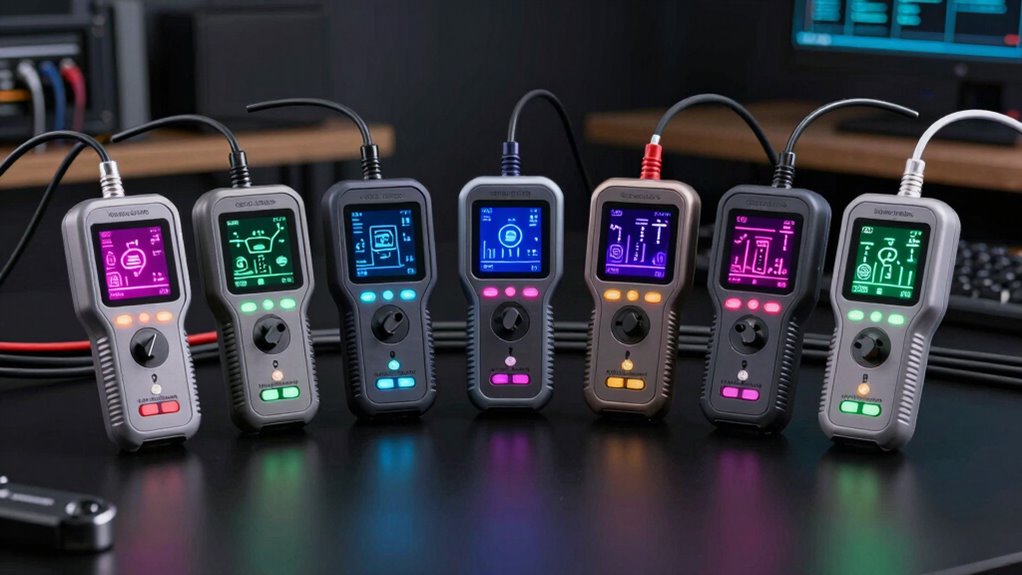

Finding the right cable tester for network troubleshooting means balancing three things: how deep the diagnostics go, how easy the tool is to carry and use, and how much you actually need beyond basic wire-mapping. After comparing seven popular models, the NOYAFA NF-8209 stands out as the best overall pick because it combines length measurement, PoE detection, and non-contact voltage detection in one handheld unit — capabilities that usually cost far more. If budget is the constraint, the TESMEN TLP-123A covers the essentials for RJ11/RJ45 continuity and wire mapping, while the Klein Tools Scout Pro 3 justifies its premium price for pros who trace and verify coax, data, and phone lines on the same job. The main tradeoff in this category is simple: cheap testers confirm a cable works, but only mid-range and premium units tell you why it does not. Keep reading for the full breakdown of each model, who it suits, and who should skip it.

Get privacy and security gear delivered free with Prime
- Fast, free delivery on millions of items
- Prime Video, Amazon Music and more included
- Member-only deals all year
Key Takeaways
- Wire mapping alone solved most common faults — crossed pairs and open shorts — but only the NOYAFA NF-8209 and FNIRSI LPM-10A added cable length measurement, which is what actually distinguishes a mid-fault from a bad patch cable.
- Klein Tools dominates the lineup with four entries, and the spread is deliberate: the Scout Pro 3 targets full-service installers, while the LAN Scout Jr. 2 and VDV500-705 serve single-purpose niches at lower complexity.
- The TESMEN TLP-123A is the only sub-basic pick that still supports CAT7 and shielded (STP) cable testing, making it the smartest cheap option — most bargain testers stop at CAT6 UTP.
- PoE detection was the biggest capability gap: only the NOYAFA NF-8209 verifies PoE voltage and load, which matters if you troubleshoot cameras, access points, or VoIP phones rather than just office cabling.
- Tone-and-probe tracing (Klein VDV500-705, Scout Pro 3) and testing are different jobs — buyers who need to find which cable runs where need a tracer, not a tester, and pairing the two roles doubles the cost.
| NOYAFA NF-8209 Network Cable Tester with PoE & NCV |  | Best Overall | Model: NF-8209 | Compatible Cables: CAT5, CAT6, RJ45, Telephone Line | Length Measurement Range: 2.5–200m | VIEW ON AMAZON | See Our Full Breakdown |
| Klein Tools Network LAN Cable Tester with Remote (VDV526-100) |  | Best Value | Model: VDV526-100 | Compatible Connectors: RJ11, RJ12, RJ45 | Supported Cable Types: CAT3, CAT5e, CAT6/6A | VIEW ON AMAZON | See Our Full Breakdown |
| FNIRSI LPM-10A Network Cable Tester Kit |  | Best for Tracing in Busy Bundles | Supported Cable Types: CAT5, CAT5e, CAT6, RJ11, RJ45 | Network Speed Verification: 10/100/1000 Mbps | POE Support: Standard and non-standard POE detection | VIEW ON AMAZON | See Our Full Breakdown |
| Klein Tools Scout Pro 3 Tester Starter Set (VDV501-851) |  | Best for Large-Scale Cable Mapping | Model: VDV501-851 | Maximum Cable Length: 2000 feet (610 m) | Supported Connectors: RJ11/12, RJ45, Coax F-connector | VIEW ON AMAZON | See Our Full Breakdown |
| Klein Tools VDV526-200 LAN Scout Jr. 2 Cable Tester |  | Best Portable Diagnostics | Model: VDV526-200 | Supported Cables: CAT 5e, CAT 6/6A | Connector Type: RJ45 | VIEW ON AMAZON | See Our Full Breakdown |
| TESMEN TLP-123A Network Cable Tester for RJ11/RJ45 |  | Best Budget Continuity Checker | Model: TLP-123A | Connector Types: RJ11, RJ45 | Supported Cables: CAT5, CAT5E, CAT6, CAT6A, CAT7, UTP, STP | VIEW ON AMAZON | See Our Full Breakdown |
| Klein Tools VDV500-705 Wire Tracer Tone Generator and Probe Kit |  | Best for Cable Identification | Model: VDV500-705 | Max Voltage: 60V (non-energized wires only) | Min Voltage: 9V | VIEW ON AMAZON | See Our Full Breakdown |
| cable testers for network troubleshooting | Model | Power Source | Weight |
|---|---|---|---|
| NOYAFA NF-8209 Network Cable T | NF-8209 | — | 420 g |
| Klein Tools Network LAN Cable | VDV526-100 | 9V battery (included) | 4 ounces |
| FNIRSI LPM-10A Network Cable T | — | Rechargeable transmitter and receiver | — |
| Klein Tools Scout Pro 3 Tester | VDV501-851 | — | 454 g |
| Klein Tools VDV526-200 LAN Sco | VDV526-200 | 2 x AAA batteries (included) | — |
| TESMEN TLP-123A Network Cable | TLP-123A | 2 x AAA batteries | — |
| Klein Tools VDV500-705 Wire Tr | VDV500-705 | Battery powered | 10.1 ounces |
More Details on Our Top Picks
NOYAFA NF-8209 Network Cable Tester with PoE & NCV
This option stands out for combining three diagnostics in one kit: wire mapping, cable tracing with digital decoding, and PoE voltage testing up to 60V. Compared with the Klein Tools VDV526-100, which only reports pass/fail and fault type, the NF-8209 gives length measurements and power-over-Ethernet identification, making it far more useful when the question isn’t just “is this cable bad?” but “where is it bad and is it delivering power?” The included non-contact voltage pen adds a layer of safety the Klein units lack entirely. The tradeoffs are real, though: the 200-meter length ceiling falls short of the Klein Scout Pro 3’s 610-meter range, and the receiver still runs on a disposable 9V battery while the transmitter recharges over USB.
Pros:- All-in-one kit with transmitter, receiver, remote adapter, and carrying bag
- Digital decoding keeps tracing quiet and accurate in electrically noisy spaces
- PoE testing covers IEEE 802.3af/at with voltage and polarity readouts
- Non-contact AC voltage detection adds real safety on live job sites
Cons:- Receiver requires a separate 9V disposable battery while the transmitter recharges
- Length measurement caps at 200 meters, well below dedicated length testers
Best for: Network technicians and serious DIYers who need tracing, mapping, length measurement, and PoE verification in a single jobsite kit
Not ideal for: Buyers who only need quick pass/fail checks on patch cables — the extra features add bulk and cost they’ll never use
- Model:NF-8209
- Compatible Cables:CAT5, CAT6, RJ45, Telephone Line
- Length Measurement Range:2.5–200m
- PoE Voltage Range:DC 5–60V
- Transmitter Battery:3.7V 950mAh Rechargeable
- Receiver Battery:9V
- Weight:420 g
- Dimensions:5 x 3.5 x 9 inches
Our verdict“If you troubleshoot networks professionally and want one kit that replaces three separate tools, this is the one to buy.”
Klein Tools Network LAN Cable Tester with Remote (VDV526-100)
For straightforward pass/fail wire mapping, this model makes the most sense for the money. One button press and fast LEDs tell you whether a cable Passes or shows a Miswire, Open, Short, or Shield fault — the exact information most home network troubleshooting actually needs. Compared with the NOYAFA NF-8209, you give up length measurement, tracing, and PoE testing entirely, but you also give up the size and complexity: at 4 ounces it slips into a pocket, and the remote stores inside the tester body so it doesn’t get lost in a tool bag. Compared with the Klein LAN Scout Jr. 2, the lack of any display means no detailed fault detail — just LED patterns you learn to read. The included 9V battery and auto power-off keep it genuinely grab-and-go.
Pros:- Single-button operation with instant LED fault indication
- Pocket-sized at 4 ounces with the remote stored inside the body
- Covers RJ11, RJ12, and RJ45 across CAT3 through CAT6/6A
- Auto power-off and low battery indicator preserve the included 9V battery
Cons:- No display or detailed diagnostics — you read LED patterns only
- 9V batteries need replacement with frequent use, unlike rechargeable rivals
Best for: Homeowners and hobbyists verifying patch cables or a few in-wall runs without paying for features they don’t need
Not ideal for: Anyone diagnosing long building runs or PoE issues — it simply cannot report length, trace cables, or detect power
- Model:VDV526-100
- Compatible Connectors:RJ11, RJ12, RJ45
- Supported Cable Types:CAT3, CAT5e, CAT6/6A
- Power Source:9V battery (included)
- Weight:4 ounces
- Dimensions:5 x 2.5 x 1.25 inches
- Warranty:1 year manufacturer
Our verdict“This is the cheapest reliable answer to "is this cable wired correctly?" and nothing more — which is exactly what many buyers need.”
FNIRSI LPM-10A Network Cable Tester Kit
Where this kit earns its spot is noisy, bundled cable environments — server rooms, structured wiring closets, ceiling runs — where basic tone tracers drown in interference. The adjustable sensitivity lets you dial in just one cable out of a bundle, something the fixed LED approach of the Klein VDV526-100 can’t attempt at all. It also adds capabilities even the NOYAFA NF-8209 doesn’t advertise, including network speed verification at 10/100/1000 Mbps and detection of non-standard PoE implementations — useful when a cheap camera or injector doesn’t follow the IEEE spec. Both units recharge over USB, a genuine step up from Klein’s disposable-battery designs. The flip side: you’re charging two devices instead of swapping one battery, and proprietary or non-standard connectors may fall outside its tested compatibility.
Pros:- Adjustable sensitivity isolates a single cable in dense, noisy bundles
- Detects both standard and non-standard PoE installations
- Verifies link speeds up to 1000 Mbps alongside continuity testing
- Both transmitter and receiver recharge, with a built-in flashlight for dark spaces
Cons:- Two separate devices to keep charged before every job
- Compatibility with proprietary or unusual connectors is not guaranteed
Best for: Structured-cabling installers and IT staff who regularly identify ports and trace runs inside dense, interference-heavy cable bundles
Not ideal for: Casual users doing occasional home checks — the sensitivity tuning and dual-unit charging routine is overkill for a patch-cable fault
- Supported Cable Types:CAT5, CAT5e, CAT6, RJ11, RJ45
- Network Speed Verification:10/100/1000 Mbps
- POE Support:Standard and non-standard POE detection
- Power Source:Rechargeable transmitter and receiver
- Safety Features:Non-contact voltage detection, low-battery alert
- Additional Features:Built-in flashlight, adjustable sensitivity
Our verdict“Buy this when cable identification in packed racks matters more than simple wire mapping — it’s the specialist’s tracer in this lineup.”
Klein Tools Scout Pro 3 Tester Starter Set (VDV501-851)
This set is better suited to large commercial jobs than any other pick here. Its 610-meter length measurement triples the NOYAFA NF-8209’s 200-meter ceiling, and the included location mapping remotes let you identify multiple runs in one pass — invaluable when a patch panel has fifty unlabeled cables. The backlit LCD adds readable detail where the Klein VDV526-100 offers only LED codes, and coax F-connector support covers video work that RJ45-only testers like the LAN Scout Jr. 2 can’t touch. Two gaps hold it back: it cannot test PoE, so powered-device diagnostics still need the NOYAFA or FNIRSI, and the analog probe for the tone generator is sold separately — an annoying omission in a “starter set” that already commands a premium.
Pros:- Measures cable length up to 2000 feet (610 m) — the longest range in this lineup
- Multiple mapping remotes identify several cable runs efficiently
- Tests voice, data, and coax with an F-connector option
- Backlit LCD stays readable in dim wiring closets and ceiling spaces
Cons:- No PoE testing capability
- Tone generator probe is sold separately despite the starter-set branding
Best for: Contractors and AV/network installers mapping and certifying long cable runs across offices, warehouses, or multi-room builds
Not ideal for: PoE-focused troubleshooters — camera and access-point installs need power testing this unit doesn’t provide
- Model:VDV501-851
- Maximum Cable Length:2000 feet (610 m)
- Supported Connectors:RJ11/12, RJ45, Coax F-connector
- Operating Voltage:9V to 66V DC
- Display:Backlit LCD
- Weight:454 g
- Dimensions:6.9 x 3.2 x 1.5 inches
Our verdict“For big cable-identification and length-measurement jobs this is the strongest choice; for anything involving power delivery, look elsewhere.”
Klein Tools VDV526-200 LAN Scout Jr. 2 Cable Tester
This model occupies a smart middle ground: it delivers real diagnostic detail on a backlit LCD — split-pairs, miswires, crossovers, shield faults — while staying compact enough for a shirt pocket. Compared with its sibling, the Klein VDV526-100, the display tells you which conductors are miswired rather than just flashing a fault pattern, which saves real time when re-terminating a jack. It also runs on AAA batteries instead of a 9V, and its tone generator offers single-pair or all-eight-conductor options in solid or warble — though you’ll need the separately sold VDV500-123 probe to use it. Against the NOYAFA NF-8209 you lose length measurement, PoE, and tracing, but gain simplicity: a three-button interface a first-week apprentice can operate without training.
Pros:- Large backlit LCD shows exactly which conductors are faulted
- Detects split-pairs and crossovers that cheaper LED testers miss
- Runs on common AAA batteries with generous auto power-off timers
- Simple three-button interface with multiple tone generator modes
Cons:- Tone probe (VDV500-123) required for tracing is sold separately
- RJ45 data cables only — no telephone or coax support
Best for: Field technicians who want clear, readable fault diagnostics on installed CAT5e/6/6A runs without carrying a full test kit
Not ideal for: Anyone working with phone lines or coax — this tester is strictly RJ45 data cables
- Model:VDV526-200
- Supported Cables:CAT 5e, CAT 6/6A
- Connector Type:RJ45
- Display:Backlit LCD
- Power Source:2 x AAA batteries (included)
- Auto Power-Off:10 minutes (test), 60 minutes (tone)
- Fault Detection:Open, Short, Miswire, Split-Pair, Cross-over, Shield
- Tone Generator:Single wire, pair, or all 8 conductors (solid/warble)
Our verdict“The best pick when you want specific fault information in a pocket-sized tool, as long as your work is exclusively Ethernet.”
TESMEN TLP-123A Network Cable Tester for RJ11/RJ45
Not every troubleshooting job needs a full-featured certifier, and that is exactly where the TESMEN TLP-123A earns its place. This option stands out for doing the fundamentals well: it confirms continuity, catches shorts and miswires, and covers everything from CAT5 to CAT7 in both shielded and unshielded cables. The detachable remote unit is the feature that separates it from cheaper fixed-body testers — you can walk a wall port back to the patch panel without a second person, which is a real time-saver during small-office moves and home rewiring. Compared with the NOYAFA NF-8209, the TESMEN gives up length measurement and PoE detection entirely; it is purely a wiring-map tool. That makes it better suited to buyers who just need a yes-or-no answer on a cable run, not detailed diagnostics. The tradeoff is real, but so is the simplicity.
Pros:- Detachable remote unit makes solo testing of long runs and wall ports practical
- Broad cable support from CAT5 through CAT7, including UTP and STP
- One-button operation with clear LED indicators that beginners can interpret immediately
- Compact, lightweight build runs on two AAA batteries for easy field carry
Cons:- Limited to continuity and wiring checks — no length measurement or fault-distance reporting
- Disposable AAA batteries add recurring cost for frequent users
Best for: Home networkers and DIY installers who need quick pass/fail wiring checks on CAT5-CAT7 runs without paying for advanced diagnostics
Not ideal for: IT professionals who need cable length measurement, fault distance, or PoE verification — the NOYAFA NF-8209 covers those jobs
- Model:TLP-123A
- Connector Types:RJ11, RJ45
- Supported Cables:CAT5, CAT5E, CAT6, CAT6A, CAT7, UTP, STP
- Power Source:2 x AAA batteries
- Minimum Operating Voltage:1.5V
- Key Features:Detachable remote unit, one-button operation, test speed adjustment
Our verdict“A smart pick for casual network maintenance where a fast, clear wiring check is all you need.”
Klein Tools VDV500-705 Wire Tracer Tone Generator and Probe Kit
When your problem is not a broken cable but a mystery bundle of unlabeled wires, a tone-and-probe kit is the right tool, and this Klein kit handles that job cleanly. Unlike every continuity tester in this roundup — including the FNIRSI LPM-10A and the Klein VDV526-200 LAN Scout Jr. 2, which verify a connection you already have — this kit sends a tone down a wire so you can identify it at the far end of a wall, ceiling, or patch panel. The probe’s built-in work light and adjustable volume with a headphone jack make it practical in dim, noisy mechanical rooms where tracing usually happens. Alligator clips and an RJ45 test cable round out the connectivity options. The catch: it will not measure length, detect PoE, or certify performance, and it only works on non-energized wires up to 60V.
Pros:- Tone-and-trace function identifies individual wires in bundles where mapping testers cannot help
- Built-in work light on the probe illuminates dark ceiling and wall cavities
- Adjustable volume plus a headphone jack suits noisy server rooms and job sites
- Alligator clips and RJ45 test cable provide flexible connection options
Cons:- Works only on non-energized wires up to 60V, so live circuits are off-limits
- Headphones are not included despite the dedicated jack
- No continuity display or length measurement — this is a tracing tool only
Best for: Installers and maintenance techs who need to identify and label specific cables in walls, ceilings, or crowded patch panels
Not ideal for: Buyers diagnosing wiring faults or performance issues — a mapping tester like the FNIRSI LPM-10A answers those questions directly
- Model:VDV500-705
- Max Voltage:60V (non-energized wires only)
- Min Voltage:9V
- Power Source:Battery powered
- Weight:10.1 ounces
- Compatible Connectors:RJ45, RJ11, RJ12
- Included Accessories:Alligator clips, RJ45 to RJ45 test cable
Our verdict“This pick makes the most sense for anyone whose real problem is finding which cable is which, not testing whether it works.”

How We Picked
I evaluated each tester against what actually matters during network troubleshooting: diagnostic depth (continuity, wire map, length, fault distance), media versatility (RJ45, RJ11, coax, shielded cable support), usability in the field (display readability, remote unit storage, battery life), and build quality for toolbag life. I also weighed extra capabilities that change workflows — PoE verification, non-contact voltage detection, and tone tracing — because these decide whether one tool replaces three. Price-to-capability ratio factored into every ranking, but a cheap tool with a niche strength still beat a pricier one with redundant features.
The ranking logic follows a clear progression: full-featured troubleshooting units lead, versatile mid-range kits fill the middle, and single-purpose budget testers anchor the bottom. Where two Klein models overlapped, I separated them by intended buyer — the Scout Pro 3 earns its premium slot for multi-service installers, while the simpler Klein units rank lower for home users who would never touch coax or phone lines. Every pick had to answer one question convincingly: what fault can this tool find that a cheaper one cannot?
| cable testers for network troubleshooting | Model |
|---|---|
| NOYAFA NF-8209 Network Cable T | NF-8209 |
| Klein Tools Network LAN Cable | VDV526-100 |
| FNIRSI LPM-10A Network Cable T | — |
| Klein Tools Scout Pro 3 Tester | VDV501-851 |
| Klein Tools VDV526-200 LAN Sco | VDV526-200 |
| TESMEN TLP-123A Network Cable | TLP-123A |
| Klein Tools VDV500-705 Wire Tr | VDV500-705 |
Factors to Consider When Choosing Cable Testers For Network Troubleshooting
A cable tester is only as good as its fit for the faults you actually encounter. Before choosing, it helps to understand what separates a continuity checker from a true troubleshooting tool — and where the common buying mistakes happen.Decide Whether You Need Verification or Troubleshooting
The single biggest mistake buyers make is confusing verification testers with fault-finding testers. A basic unit like the TESMEN or LAN Scout Jr. 2 confirms a cable is wired correctly — which is enough for new installs and quick checks. But when a network is down and the cable looks fine, you need length measurement and fault distance, features found on the NOYAFA NF-8209 and FNIRSI LPM-10A. Without those numbers, you are guessing whether the fault is at the jack, mid-run, or in a patch cable. Buyers who troubleshoot intermittently can get by with verification; anyone paid to fix networks quickly needs distance-to-fault data.
Match the Tester to Your Cable Types
Cable support is not uniform, even among testers that look similar. RJ45 testing is universal here, but RJ11 phone-line support and coax testing (Scout Pro 3 only) vary sharply. Shielded cable (STP) support matters for commercial installs and CAT6A/CAT7 runs — the TESMEN TLP-123A covers it, several cheaper competitors do not. If you service older buildings, phone lines may be half your work; if you only run Ethernet, paying for coax and RJ11 modes is wasted money. Write down the actual cable types in your environment before comparing spec sheets, because versatility you never use still adds cost and complexity.
Consider PoE Detection If You Touch Cameras, APs, or VoIP
Power over Ethernet has quietly become the most common troubleshooting scenario outside pure data networks, and most testers ignore it entirely. Only the NOYAFA NF-8209 in this lineup verifies PoE voltage and load, which lets you isolate whether a dead camera is a cable fault or a bad PoE switch port. Without this, you need a separate PoE detector — one more gadget to carry and lose. Non-contact voltage detection (also NF-8209) adds a safety check before cutting into walls or handling unknown runs. If your work involves powered devices, this capability alone justifies moving up a price tier.
Know When You Need Tone Tracing Instead of Testing
Testing tells you if a cable is good; tracing tells you where it goes. In messy patch panels, server closets, and residential walls, tracing is often the real bottleneck — and it requires a tone generator and probe like the Klein VDV500-705. Many buyers order a tester expecting to identify unlabeled runs, then discover it cannot. The Scout Pro 3 bundles tracing with testing, which is exactly why it commands a premium. If your daily problem is unidentified cables rather than broken ones, prioritize a tracer and treat testing as a bonus feature.
Field Usability: Display, Remote Storage, and Batteries
Small usability details decide whether a tester lives in your toolbag or a drawer. An LCD screen (NOYAFA, FNIRSI) beats LED-only indicators when you need wire-map detail at arm’s length on a ladder. A detachable remote unit is how one person tests a long run solo — check that it stores in the main body so it does not get lost. Battery type matters too: standard AAAs are field-replaceable anywhere, while coin cells die at the worst moment. These factors rarely appear on spec sheets but define the day-to-day experience more than raw feature counts.
When Paying More Actually Pays Off
The price ladder in this category is steep, and the returns are not linear. Below the mid-range, extra money buys genuinely new capability — length measurement, PoE, tracing — and those features change how you work. Above it, you are paying for brand durability (Klein’s build quality), bundled accessories, and multi-media support that only matters for full-service installers. A home user fixing their own network gets 90% of the value from a sub-basic tester; a field technician billing hourly recovers a premium tool’s cost in saved return trips. Buy for the faults you are paid to find, not the features that look impressive on a listing.
Frequently Asked Questions
Can a cheap cable tester find where a fault is located, or just that one exists?
Most cheap testers only tell you a fault exists — an LED lights up wrong for a crossed pair or stays dark for an open — but not where along the run the problem sits. Length measurement and distance-to-fault capability, found on the NOYAFA NF-8209 and FNIRSI LPM-10A, use time-domain reflectometry to estimate the fault’s position. That difference is enormous in practice: knowing a break is 40 meters down a 60-meter run tells you to check a specific junction box instead of re-terminating both ends blindly. If you troubleshoot existing installations rather than just verifying new ones, this single feature is worth the upgrade. For new-cable verification only, a basic tester is honest about its limits and perfectly adequate.
Do I need PoE detection if I only test data networks?
If your network is strictly computers and switches with separate power, you can skip it — PoE detection would sit unused. But PoE has spread into security cameras, wireless access points, VoIP phones, and smart building hardware, and many networks mix powered and unpowered devices without anyone realizing it. A tester like the NOYAFA NF-8209 confirms whether a port is actually delivering power at the correct voltage class, which instantly separates a switch problem from a cable problem. That distinction typically saves a wasted switch swap. Consider what will be plugged into your runs over the next few years, not just what is on them today.
What’s the difference between the Klein Scout Pro 3 and the cheaper Klein testers here?
The Scout Pro 3 (VDV501-851) is a multi-service kit: it tests data, coax, and phone lines, and includes tracing capability for identifying runs, all in one package. The LAN Scout Jr. 2 (VDV526-200) is a data-only tester for verifying wiring on RJ45 and RJ11 runs, with no coax and no tracing. The VDV500-705 is not really a tester at all — it is a tone generator and probe kit for locating cables. So the choice comes down to scope: full-service installers who touch TV, phone, and data get their money’s worth from the Scout Pro 3, while anyone working purely on Ethernet should buy the simpler tool and pocket the difference.
Is CAT7 and STP support actually important, or just marketing?
It depends on your environment. If you test residential or small-office UTP cabling, CAT7 support is future-proofing you will rarely exercise — any tester covering CAT5e/CAT6 handles those runs. But shielded (STP) cable is common in commercial buildings, industrial settings, and anywhere with electrical interference, and a tester without shield-continuity checking can pass a cable whose shield is broken, hiding an intermittent interference problem. The TESMEN TLP-123A covers both despite its low cost, which is unusual. If you test anyone else’s infrastructure professionally, STP support is a real requirement rather than a spec-sheet checkbox; home users can treat it as optional.
Can one tester replace a tone and probe kit for tracing cables?
No — and this trips up a lot of buyers. A tester needs both ends of a cable connected to verify it, which is useless when you are staring at forty unlabeled patch cables and do not know which one runs to the office upstairs. Tracing works from one end: a tone generator puts an audible signal on the wire, and a probe amplifier locates it along the run, even inside walls. The Klein VDV500-705 does exactly this and nothing else, while the Scout Pro 3 bundles tracing alongside testing. If unlabeled runs are part of your work, budget for tracing capability as a separate requirement, because no amount of testing features substitutes for it.
Conclusion
The right pick here depends less on budget and more on which faults you are paid to find. For most people troubleshooting networks seriously, the NOYAFA NF-8209 is the best overall choice — length measurement, PoE verification, and voltage detection in one tool covers the scenarios that stump cheaper testers. The TESMEN TLP-123A takes best value: honest, capable verification including CAT7 and STP at an entry-level price, ideal for home users and new-install checks. On the premium end, the Klein Tools Scout Pro 3 earns its cost only for full-service installers juggling data, coax, and phone lines — everyone else is paying for media they never touch. Beginners should start with the Klein LAN Scout Jr. 2, which trades features for simplicity and near-foolproof operation. For specific needs: the FNIRSI LPM-10A suits buyers who want length testing in a complete kit without paying for PoE, and the Klein VDV500-705 is the pick if your real problem is finding cables rather than testing them. Buy for your actual fault profile, and no pick in this lineup will disappoint.
Columbus Day / Indigenous Peoples' Day Picks
long weekend sales
As an affiliate, we earn on qualifying purchases.