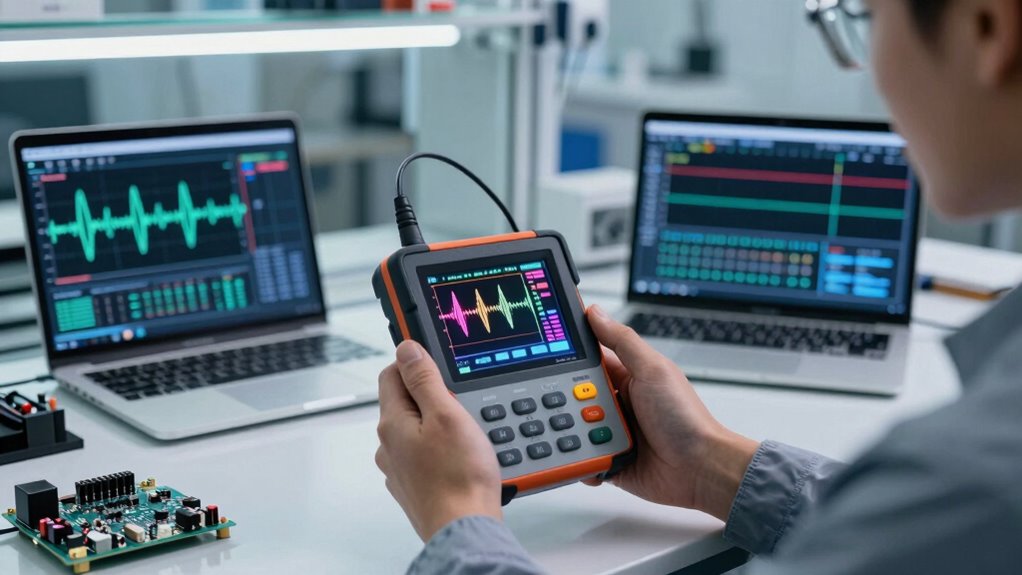
For technicians who need to diagnose signals away from a bench, the Siglent SHS810X is my best overall pick for its 100 MHz bandwidth, two channels, and multimeter mode. The Fluke 123B suits industrial service work, while the FNIRSI DSO152 is a simpler choice for basic checks. The main tradeoff is between measurement capability and portability: integrated multimeter and signal-generator features can reduce the number of tools you carry, but they do not replace choosing the right bandwidth, channel count, or input protection. Read on for how all 12 options compare and which fits your work.

Get privacy and security gear delivered free with Prime
- Fast, free delivery on millions of items
- Prime Video, Amazon Music and more included
- Member-only deals all year
Complete the kit


Key Takeaways
- The Siglent SHS810X leads this lineup for technicians who need two channels, 100 MHz bandwidth, and a multimeter mode in one handheld instrument.
- The Fluke 123B has a lower 20 MHz bandwidth than several alternatives, so its strongest fit is industrial troubleshooting rather than capturing faster signals.
- Several FNIRSI models combine scope, multimeter, and signal-generator functions; compare their channel and bandwidth specifications instead of treating the shared feature count as a performance measure.
- The FNIRSI DPOS350P lists 350 MHz bandwidth, making it the bandwidth-focused option, but technicians should weigh that against their need for field handling and other measurement tools.
- The DSO152, HO11, and other simpler models make more sense for straightforward checks than for work that depends on two-channel comparisons or broader diagnostic functions.


| handheld oscilloscopes for technician | Display | Sampling rate | Channels | Bandwidth |
|---|---|---|---|---|
| Dual Channel 3-in-1 Handheld O | 2.4-inch color TFT | 200MS/s | Dual | — |
| FNIRSI DSO-510 2-in-1 Handheld | 2.8-inch LCD, 320 × 240 | 48MS/s | — | 10MHz |
| ZT-703S 3-in-1 Handheld Oscill | — | — | Dual | — |
| FNIRSI DSO152 Handheld Oscillo | 2.8-inch HD LCD, 320 × 240 | 2.5MS/s | — | 200kHz |
| Siglent SHS810X Handheld Oscil | 5.6-inch TFT-LCD, 640 × 480 | — | 2 non-isolated scope channels; 1 isolated multimeter channel | 100MHz |
| FNIRSI 2C53T 3-in-1 Digital Os | 2.8-inch LCD | 250 MSa/s | 2 | 50 MHz |
| Fluke 123B Industrial ScopeMet | — | — | — | 20 MHz |
| FNIRSI DPOS350P 4-in-1 Digital | 7-inch touchscreen | — | 2 | 350 MHz |
| HANMATEK HO11 Handheld Digital | 2.8-inch full-color TFT | 48 MSa/s | — | 10 MHz |
| FNIRSI 2C23T 3-in-1 Handheld O | 2.8-inch HD LCD | 50 MSa/s | — | — |
| FNIRSI 2C53P 3-in-1 Handheld O | 4.3-inch IPS touchscreen, 480 × 272 | 250 MS/s | 2 | — |
| HANMATEK HO52 Handheld Digital | 3.5-inch backlit TFT | 250 MSa/s | 2 | — |
More Details on Our Top Picks
Dual Channel 3-in-1 Handheld Oscilloscope Multimeter with Signal Generator (70MHz)
For technicians who want scope, meter, and signal source functions in one compact tool, this model has the broadest mix in this group. Its 70MHz dual-channel scope and 200MS/s sampling rate give it more signal headroom than the FNIRSI DSO-510, whose bandwidth is 10MHz and whose meter function is absent. The 20,000-count True RMS multimeter and storage for measurement sets and waveforms also support jobs where recording readings matters. At 7.8 ounces, it is easier to carry than the much larger Siglent SHS810X. The tradeoff is visibility: a 2.4-inch screen leaves less room to inspect waveform details, and the stated four-hour battery life may fall short on a long service day. I’d choose it for versatility over extended viewing comfort.
Pros:- Combines a dual-channel oscilloscope, True RMS multimeter, and signal generator.
- 70MHz bandwidth and 200MS/s sampling offer more scope capability than the DSO-510.
- Stores up to 1,000 multimeter sets and 200 waveform records for job documentation.
- Replaceable 18650 battery and Type-C charging support portable use.
Cons:- The 2.4-inch display is cramped for detailed waveform inspection.
- Four-hour battery life may require recharging during extended field work.
- Combining three tools means more functions to learn than a basic handheld scope.
Best for: Field service technicians who need scope, True RMS meter, and signal generator functions in a lightweight kit.
Not ideal for: Technicians who spend long sessions comparing fine waveform details or need a larger display and longer runtime.
- Oscilloscope bandwidth:70MHz
- Channels:Dual
- Sampling rate:200MS/s
- Multimeter:20,000-count True RMS
- Display:2.4-inch color TFT
- Storage:1,000 multimeter sets; 200 waveform records
- Battery and charging:Replaceable 18650 lithium battery; Type-C 5V fast charging
- Weight:7.8 oz
Our verdict“Choose this model when carrying three measurement tools in one light package matters more than having a large screen or all-day battery life.”
FNIRSI DSO-510 2-in-1 Handheld Oscilloscope and DDS Signal Generator
The DSO-510 makes sense when a technician needs a portable scope and a basic signal source, but not an integrated multimeter. Its one-key AUTO setup lowers the effort of getting a usable trace, while infinite afterglow can help reveal intermittent events that a momentary view might miss. The 2.8-inch display is larger than the 2.4-inch screen on the 70MHz 3-in-1 model, though this unit’s 10MHz bandwidth is far lower. Its DDS generator reaches only 50kHz, so it suits basic low-frequency checks rather than broader signal-injection work. Compared with the ZT-703S, it has fewer integrated functions and less bandwidth, but its simpler scope-and-generator focus may be easier to approach. I’d pick it for straightforward electronics troubleshooting, not demanding signal analysis.
Pros:- Combines oscilloscope and DDS signal generator in one compact instrument.
- One-key AUTO setup helps get a waveform on screen quickly.
- Infinite afterglow can make transient signal behavior easier to observe.
- Waveform saving and export support basic test documentation.
Cons:- 10MHz bandwidth is limited compared with the 50MHz ZT-703S and 70MHz 3-in-1 model.
- The signal generator tops out at 50kHz.
- It has no integrated multimeter for technicians aiming to consolidate tools.
Best for: Technicians doing basic low-frequency electronics checks who want an approachable scope with a built-in signal source.
Not ideal for: Repair specialists who need a multimeter in the same instrument, higher bandwidth, or a generator above 50kHz.
- Bandwidth:10MHz
- Sampling rate:48MS/s
- Time base:50ns–20s
- Maximum voltage:400V
- Signal generator:Up to 50kHz; 13 waveform types
- Display:2.8-inch LCD, 320 × 240
- Battery:1000mAh lithium
- Charging:Type-C
Our verdict“Pick the DSO-510 for simple, low-frequency scope and signal-generator work when integrated meter capability is unnecessary.”
ZT-703S 3-in-1 Handheld Oscilloscope with Multimeter and Signal Generator (50MHz)
The ZT-703S is the stronger choice for technicians who want three functions and prioritize capture speed. Its stated 280MSa/s maximum sampling rate exceeds the 200MS/s listed for the 70MHz 3-in-1 model, while its 50MHz bandwidth remains useful for many electronics service tasks. A 25,000-count multimeter adds more display resolution than that model’s 20,000-count meter. AUTO waveform recognition can reduce setup time when the signal is unfamiliar. The tradeoff is a more involved instrument: the high-speed mode uses more power, and the feature set may take time to learn. The FNIRSI DSO-510 is simpler but lacks the meter and has much lower bandwidth. I’d favor the ZT-703S when its faster capture and integrated tools justify the extra complexity.
Pros:- Combines dual-channel scope, 25,000-count multimeter, and signal generator.
- Maximum 280MSa/s sampling rate supports faster waveform capture than the 70MHz 3-in-1 model’s stated rate.
- AUTO recognition can simplify initial waveform analysis.
- USB Type-C supports charging and data transfer.
Cons:- High-speed mode consumes more power.
- The broad feature set can require time with the manual.
- Its 50MHz bandwidth is lower than the 70MHz 3-in-1 model.
Best for: Electronics technicians who routinely switch between waveform capture, meter readings, and signal generation in the field.
Not ideal for: Occasional users who want a very simple scope or technicians who need to maximize runtime in high-speed mode.
- Model:ZT-703S
- Channels:Dual
- Maximum bandwidth:50MHz
- Maximum sampling rate:280MSa/s
- Storage depth:128K
- Multimeter:25,000 counts
- Functions:Oscilloscope, multimeter, signal generator
- Interface:USB Type-C
Our verdict“Choose the ZT-703S if you want three tools and faster sampling, and are comfortable learning a more involved interface.”
FNIRSI DSO152 Handheld Oscilloscope
The DSO152 is a focused pocket scope for technicians checking slow signals, basic control circuits, or simple sensor outputs. Its 200kHz bandwidth and 2.5MS/s sampling rate put it well below the DSO-510, ZT-703S, and 70MHz 3-in-1 model for higher-frequency electronics work. That limitation is also what makes its role clear: it offers a straightforward one-key AUTO setup and a supplied 10x probe rated for measurements up to 800Vpp, without the extra functions of a multimeter or signal generator. The 2.8-inch screen is larger than the 2.4-inch display on the 70MHz 3-in-1, but this is not the model to choose for dense or fast waveforms. I’d keep it as a compact troubleshooting tool for low-frequency checks.
Pros:- Pocket-sized format is easy to carry for quick field checks.
- One-key AUTO setup reduces manual adjustment for basic measurements.
- Included 10x probe supports measurements up to 800Vpp as specified.
- Type-C supports charging and data transmission.
Cons:- 200kHz bandwidth and 2.5MS/s sampling exclude many higher-frequency tasks.
- No integrated multimeter or signal generator.
- Approximate four-hour battery life may not cover a long shift.
Best for: Technicians who need a simple pocket scope for low-frequency signals, basic field checks, and occasional waveform viewing.
Not ideal for: Electronics repair technicians working with fast digital signals or needing an integrated multimeter and signal generator.
- Bandwidth:200kHz
- Sampling rate:2.5MS/s
- Display:2.8-inch HD LCD, 320 × 240
- Battery:1000mAh
- Battery life:Approx. 4 hours
- Maximum voltage with 10x probe:800Vpp
- Trigger modes:Auto, Normal, Single
- Interface:Type-C
Our verdict“Choose the DSO152 for simple, low-frequency checks where pocket portability matters more than bandwidth or three-in-one functionality.”
Siglent SHS810X Handheld Oscilloscope, 100 MHz, 2 Channel, 1 GSa/s, Multimeter Mode, 5.6-inch TFT-LCD
The SHS810X is the most capable scope-focused option in this batch for technicians who need deeper waveform records and a screen suited to extended analysis. Its 100MHz bandwidth, up to 1GSa/s single-channel sampling, and 12Mpts memory provide considerably more capture headroom than the compact 3-in-1 units, including the ZT-703S. A 5.6-inch display gives traces and measurements more room, and its separate isolated multimeter channel adds practical meter coverage. That capability comes with a real portability cost: at 10 pounds, it is far heavier than the 7.8-ounce 70MHz model, and the scope channels are non-isolated. I’d reserve it for service work where detailed capture matters more than pocket portability, and check channel isolation requirements before choosing it.
Pros:- 100MHz bandwidth and up to 1GSa/s single-channel sampling support detailed signal analysis.
- 12Mpts single-channel memory can retain longer waveform captures.
- 5.6-inch display is substantially larger than the screens on compact handhelds.
- Integrated isolated multimeter channel and 6900mAh battery support field measurement work.
Cons:- At 10 pounds, it is much heavier than the compact handheld options.
- The two scope channels are non-isolated, limiting some measurement situations.
- Dual-channel operation lowers the listed sample rate to 500MSa/s and memory depth to 6Mpts.
Best for: Field engineers and repair technicians who need deep memory, a larger display, and stronger scope performance in a transportable instrument.
Not ideal for: Technicians who need a lightweight handheld for frequent walking between jobs or require isolated scope channels.
- Bandwidth:100MHz
- Channels:2 non-isolated scope channels; 1 isolated multimeter channel
- Sample rate:1GSa/s single channel; 500MSa/s dual channel
- Memory depth:12Mpts single channel; 6Mpts dual channel
- Display:5.6-inch TFT-LCD, 640 × 480
- Multimeter:6000 counts
- Battery:6900mAh lithium-ion, UL2054 certified
- Weight:10 lb
Our verdict“Choose the SHS810X when detailed captures and a large screen matter more than low weight, while accounting for its non-isolated scope channels.”
FNIRSI 2C53T 3-in-1 Digital Oscilloscope, Multimeter, and Signal Generator (50MHz, 2CH)
The FNIRSI 2C53T suits technicians who want a scope, meter, and signal source in one compact field tool. Its 50 MHz bandwidth and two channels give it more scope headroom than the 10 MHz FNIRSI 2C23T, while the built-in multimeter and generator reduce how much gear needs to travel. XY, persistence, and math modes add useful ways to inspect signals. The tradeoff is depth: its 1 Kpts record depth can limit how much waveform detail you capture, and the generator stops at 50 kHz, far below the 2C23T’s 2 MHz output. The 2.8-inch screen also makes close waveform reading less comfortable than on the larger FNIRSI DPOS350P. I’d choose it for varied basic field checks, not extended signal analysis.
Pros:- Combines a two-channel oscilloscope, multimeter, and signal generator
- 50 MHz bandwidth exceeds the FNIRSI 2C23T’s 10 MHz
- XY, persistence, and math modes support varied signal checks
- Compact 400 g body with Type-C PC connectivity
Cons:- 1 Kpts record depth limits waveform capture detail
- 50 kHz generator ceiling is low for many signal tests
- Small 2.8-inch display can hinder detailed waveform reading
Best for: Field technicians who need scope, meter, and low-frequency signal generation in one portable instrument.
Not ideal for: Technicians capturing long or complex waveforms, or testing above 50 kHz with the built-in generator.
- Bandwidth:50 MHz
- Channels:2
- Sampling rate:250 MSa/s
- Record depth:1 Kpts
- Multimeter counts:19,999
- Signal generator maximum frequency:50 kHz
- Display:2.8-inch LCD
- Battery:3,000 mAh
- Weight:400 g
Our verdict“Choose the 2C53T if you want a capable three-tool field kit and can work within its shallow capture depth and low-frequency generator.”
Fluke 123B Industrial ScopeMeter Hand-held Oscilloscope, 2 Input Channels, 20 MHz Bandwidth, SCC120 Kit
The Fluke 123B is aimed at technicians diagnosing industrial electrical and electromechanical equipment, where a rugged instrument and fast setup can matter more than bandwidth. Connect-and-View and IntellaSet automate setup and readings, helping users get to a useful measurement with fewer manual adjustments. It also combines scope, meter, and recorder functions, with Fluke Connect and FlukeView support for sharing and archiving results. Compared with the FNIRSI 2C53T, it offers less bandwidth at 20 MHz and lacks the listed signal generator, so it is a narrower fit for electronics development. Its 7-hour battery life supports a work shift, but the 3.06-pound weight and larger kit dimensions make it less convenient to carry than the 400 g FNIRSI. Choose it for plant-floor fault finding, not compact everyday carry.
Pros:- Automated Connect-and-View and IntellaSet setup aids quick troubleshooting
- Combines oscilloscope, multimeter, and high-speed recorder functions
- Rugged design is suited to industrial environments
- Up to 7 hours of battery operation
Cons:- 20 MHz bandwidth is lower than the FNIRSI 2C53T’s 50 MHz
- No signal generator is listed
- At 3.06 pounds, it is heavier than compact handheld alternatives
Best for: Industrial maintenance technicians who troubleshoot electrical and electromechanical systems and value automated measurements and data sharing.
Not ideal for: Electronics technicians who need higher bandwidth, a built-in signal generator, or a lightweight instrument for frequent carry.
- Bandwidth:20 MHz
- Input channels:2
- Display resolution:5,000-count true-RMS
- Battery life:7 hours
- Charge time:4 hours
- Battery type:Lithium-ion
- Weight:3.06 pounds
- Connectivity:Fluke Connect and FlukeView software support
Our verdict“Pick the Fluke 123B for industrial fault finding where automated setup and ruggedness outweigh portability and higher bandwidth.”
FNIRSI DPOS350P 4-in-1 Digital Oscilloscope (350MHz, 2 Channel)
For technicians who need to inspect more than basic voltage waveforms, the FNIRSI DPOS350P packs an oscilloscope, spectrum analyzer, frequency response analyzer, and DDS generator into one battery-powered unit. Its 350 MHz bandwidth and 1 GSa/s sampling rate give it substantially more scope capability than the 50 MHz FNIRSI 2C53T. FFT, Bode plots, and waterfall displays also support work that would otherwise call for separate analysis tools. The large 7-inch touchscreen is easier to read than the 2.8-inch screens on the 2C53T and Fluke 123B. The price of that breadth is complexity: it may take time to learn, and the handheld format may be less stable than a benchtop setup for precision work. Its 47 Kpts memory depth also remains modest for longer captures.
Pros:- 350 MHz bandwidth and 1 GSa/s sampling exceed the FNIRSI 2C53T’s scope specifications
- Combines oscilloscope, spectrum analyzer, frequency response analyzer, and DDS generator
- FFT, Bode plots, and waterfall displays broaden field analysis
- 7-inch touchscreen and 8,000 mAh battery support extended portable use
Cons:- Broad feature set can be difficult for beginners to learn
- 47 Kpts memory depth may limit longer waveform captures
- Handheld form may be less stable than a benchtop instrument for precision work
Best for: Experienced field and electronics technicians who need scope, spectrum, frequency-response, and signal-generation functions in one instrument.
Not ideal for: Technicians who want a simple troubleshooting scope, deep waveform memory, or a stable benchtop platform for precision work.
- Bandwidth:350 MHz
- Channels:2
- Sample rate:1 GSa/s
- Memory depth:47 Kpts
- Resolution:8–16 bit
- Display:7-inch touchscreen
- Battery capacity:8,000 mAh
- Signal generator range:0–50 MHz
- Spectrum analyzer range:200 kHz–350 MHz
Our verdict“Choose the DPOS350P when advanced analysis features and higher bandwidth matter more than simplicity or benchtop stability.”
HANMATEK HO11 Handheld Digital Oscilloscope
The HANMATEK HO11 is the lightest, most stripped-back choice here for technicians who need a portable scope for routine signal checks. At just 166 g according to the description, it is easier to carry than the 400 g FNIRSI 2C53T, though the product information lists a conflicting 200 g weight. Its 48 MSa/s sampling, edge-trigger options, and X1 or X10 probe attenuation cover straightforward waveform capture, while USB-C charging keeps power simple. The compromise is capability: its 10 MHz bandwidth is well below the 50 MHz 2C53T and far below the 350 MHz FNIRSI DPOS350P. The supplied data also lists no multimeter or signal generator, so this is a focused scope rather than an all-in-one kit. Its 2.8-inch display limits detail.
Pros:- Very light handheld design at 166 g per the description
- USB-C rechargeable battery supports portable use
- Auto, Normal, and Single trigger modes help capture different signals
- X1 and X10 probe attenuation supports different measurement setups
Cons:- 10 MHz bandwidth is much lower than the FNIRSI 2C53T’s 50 MHz
- No multimeter or signal generator is listed
- Product data conflicts on weight, and the 2.8-inch screen is small
Best for: Technicians who want a very light, rechargeable scope for basic low-frequency checks and waveform capture.
Not ideal for: Technicians who need multimeter or signal-generator functions, or who regularly inspect signals above 10 MHz.
- Bandwidth:10 MHz
- Sampling rate:48 MSa/s
- Maximum voltage measurement:±400 V
- Probe attenuation:X1 and X10
- Display:2.8-inch full-color TFT
- Trigger modes:Auto, Normal, Single
- Battery capacity:1,800 mAh
- Charging interface:USB Type-C
- Weight:166 g (description); 200 g (product information)
Our verdict“Choose the HO11 for lightweight basic waveform checks, but pick a broader or higher-bandwidth tool for more demanding technician work.”
FNIRSI 2C23T 3-in-1 Handheld Oscilloscope, Multimeter, and DDS Signal Generator
The FNIRSI 2C23T makes sense for technicians who want three basic instruments in one handheld unit and can work within a 10 MHz scope bandwidth. Its dual-channel scope, 4-digit TRMS multimeter, and 2 MHz DDS generator cover a broader set of routine checks than the single-purpose HANMATEK HO11. The generator also reaches much higher frequencies than the 2C53T’s 50 kHz output, even though the 2C23T has less scope bandwidth than that 50 MHz model. High-voltage protection, waveform storage, and PC export add practical flexibility for automotive and DIY electronics work. Its 2.8-inch display remains cramped for detailed traces, and the 10 MHz bandwidth limits higher-frequency troubleshooting. This is a compact general-purpose kit, not a substitute for the FNIRSI DPOS350P when advanced analysis or wide bandwidth is needed.
Pros:- Combines a dual-channel oscilloscope, TRMS multimeter, and DDS signal generator
- 2 MHz generator reaches higher than the FNIRSI 2C53T’s 50 kHz generator
- High-voltage protection supports automotive and DIY testing
- Waveform storage and PC export aid documentation
Cons:- 10 MHz bandwidth is far below the FNIRSI 2C53T’s 50 MHz
- Small 2.8-inch display restricts detailed waveform viewing
- Less suited to advanced analysis than the FNIRSI DPOS350P
Best for: Automotive and DIY electronics technicians who need a compact scope, TRMS meter, and signal source for routine low-frequency work.
Not ideal for: Technicians troubleshooting higher-frequency signals or needing a large display and advanced analysis tools.
- Oscilloscope bandwidth:10 MHz
- Oscilloscope channels:2
- Sampling rate:50 MSa/s
- Record depth:32 kb
- Multimeter counts:10,000
- Signal generator maximum frequency:2 MHz
- Display:2.8-inch HD LCD
- Battery:3,000 mAh rechargeable
- Weight:10.4 ounces
Our verdict“Pick the 2C23T for a compact three-tool kit for routine automotive and DIY checks, provided 10 MHz bandwidth is enough.”
FNIRSI 2C53P 3-in-1 Handheld Oscilloscope, Multimeter, and DDS Signal Generator
The FNIRSI 2C53P suits technicians who want scope, meter, and signal source functions in one field instrument. Its dual-channel 50 MHz oscilloscope and 250 MS/s sampling match the HANMATEK HO52 on the listed core scope figures, while the 2C53P adds a 10 MHz DDS generator for basic signal injection without a separate tool. The 4.3-inch IPS touchscreen is also larger than the HO52’s 3.5-inch TFT, giving controls and traces more room on a portable unit. That breadth comes with limits: its roughly four-hour battery runtime calls for charging between longer shifts, and the generator is less suited to higher-frequency work. Choose it for varied service calls; skip it if long battery life or a dedicated high-bandwidth source matters most.
Pros:- Combines a 50 MHz dual-channel oscilloscope, multimeter, and DDS signal generator in one device.
- 250 MS/s sampling supports waveform capture for general electronics and service diagnostics.
- 4.3-inch IPS touchscreen is larger than the HANMATEK HO52 display.
- Type-C charging and one-key AUTO simplify setup and routine measurements.
Cons:- Approximately four hours of battery runtime may require recharging during extended field work.
- The signal generator tops out at 10 MHz, limiting higher-frequency signal injection.
Best for: Field service technicians who need scope, multimeter, and basic signal-generation functions in one portable instrument.
Not ideal for: Technicians working long shifts away from power or diagnosing signals that require a generator above 10 MHz.
- Oscilloscope bandwidth:50 MHz
- Channels:2
- Sampling rate:250 MS/s
- Multimeter count:19,999
- Signal generator maximum frequency:10 MHz
- Display:4.3-inch IPS touchscreen, 480 × 272
- Battery:4,000 mAh; approximately 4 hours
- Charging interface:USB Type-C
Our verdict“Choose the 2C53P if you want three useful diagnostic tools in one unit and can work within its four-hour battery and 10 MHz generator limits.”
HANMATEK HO52 Handheld Digital Oscilloscope 50MHz, 2-Channel with Multimeter
The HANMATEK HO52 is a focused pick for technicians who need waveform viewing and true RMS multimeter functions, without adding a signal generator to the kit. Its 50 MHz bandwidth and 250 MSa/s sampling match the FNIRSI 2C53P’s listed scope figures, but the 2C53P provides a third function and a larger screen. The HO52 counters with a stated 10,000 wfms/s refresh rate, which can make changing waveforms easier to follow, plus USB Type-C for power and PC data transfer. Its 3.5-inch display and storage for only four waveform or image groups constrain detailed review and record keeping. I’d pick it for routine field checks and computer-assisted analysis; choose a broader tool if signal generation is part of the job.
Pros:- Combines a 50 MHz, two-channel oscilloscope with a 4 1/2-digit true RMS multimeter.
- 250 MSa/s sampling and a stated 10,000 wfms/s refresh rate support responsive waveform viewing.
- USB Type-C supports power and data transfer to a computer.
- Auto-calibration, cursor measurements, waveform saving, and comparison functions support field diagnostics.
Cons:- The 3.5-inch display offers less viewing area than the FNIRSI 2C53P’s 4.3-inch screen.
- Storage is limited to four groups of waveforms or images.
- No signal generator is listed, so signal injection requires another instrument.
Best for: Automotive and electronics technicians who need a portable scope and true RMS meter for routine checks, with PC transfer available.
Not ideal for: Technicians who need an integrated signal generator, larger on-device viewing area, or room to save many waveform captures.
- Oscilloscope bandwidth:50 MHz
- Channels:2
- Sampling rate:250 MSa/s
- Refresh rate:10,000 wfms/s
- Display:3.5-inch backlit TFT
- Multimeter:4 1/2 digits, true RMS
- Maximum input voltage:AC 750 V / DC 1,000 V
- Interface:USB Type-C
Our verdict“Choose the HO52 for portable scope-and-meter checks with PC connectivity, but pick the FNIRSI 2C53P if built-in signal generation is worth having.”

How We Picked
I ranked these handheld oscilloscopes around technician tasks: tracing signals in the field, comparing channels, checking electrical values, and carrying fewer separate instruments. I gave weight to stated bandwidth and channel count, then considered whether multimeter or signal-generator functions add practical value for the intended work. Screen and form factor matter because a capable instrument is less useful if readings are hard to inspect or it is awkward to bring to a service call.
The ranking favors clear capability for varied troubleshooting, while assigning specialized models to the jobs they suit best. A high bandwidth specification can help with faster signals, but it does not by itself establish measurement accuracy, input safety, or ease of use. I also treated product names and feature labels as starting points: buyers should confirm the exact model variant, included probes, ratings, and documentation before relying on an instrument for a particular circuit.
Factors to Consider When Choosing Handheld Oscilloscopes For Technicians
Choosing a handheld scope starts with the signals and environments you actually encounter. I would set the measurement requirements first, then decide how much portability and tool integration matter for the workday.
Match Bandwidth to the Signals You Measure
Bandwidth determines how well a scope can represent faster signal changes, so it should reflect the circuits you service. A common mistake is to select the largest number in a product name without checking whether the probes and acquisition rate support the measurement you need. For slow control signals, a modest bandwidth may be sufficient and can leave more room in the budget for usability or protective features. For faster switching behavior, insufficient bandwidth can smooth edges and hide details. Think about the fastest rise times you expect, not only the signal’s repetition rate. If your work varies widely, choose some headroom while checking the full specifications and measurement limits.
Decide When Two Channels Matter
Two channels are useful when you need to compare an input and output, inspect timing between signals, or track cause and effect in a circuit. A single-channel instrument can handle many basic checks, but repeated probe repositioning makes comparisons slower and can obscure intermittent behavior. Before choosing by channel count, ask whether both signals must be captured at the same time. Confirm that the instrument supports the triggering and math functions your work requires; channel count alone does not promise those tools. Technicians who mostly verify one point at a time may prefer a smaller, simpler scope. Those diagnosing relationships between signals should treat two channels as a practical requirement.
Treat Input Protection as a Work Requirement
Portable use can put an instrument near unfamiliar circuits, so input limits and safety ratings deserve attention before feature count. Check the exact voltage and category ratings for the instrument and probes, and confirm they match the installation where you plan to work. Do not assume that a handheld design or multimeter mode makes a scope suitable for mains-connected troubleshooting. A model intended for low-voltage electronics may not be appropriate for industrial power work. Read the manual’s limits for each input and operating mode, since ratings can differ. When the documentation does not clearly cover your use case, choose a documented instrument rated for that environment.
Weigh Integrated Tools Against Dedicated Instruments
A built-in multimeter or signal generator can reduce what you carry and speed routine checks. The tradeoff is that each extra function may have different limits, controls, or performance than a dedicated instrument. Decide which tasks you actually perform during a typical service call, then check the specifications of each mode separately. A signal generator is helpful for injecting a known signal, but it does not substitute for a generator with the required output range or accuracy. Likewise, a multimeter mode should be judged by its measurement functions and ratings, not just its presence. Integrated tools make the most sense when convenience matters and their documented capabilities match your work.
Check the Screen, Controls, and Power for Field Use
On a bench, a large display and quick access to settings can matter less than they do when you are working in a vehicle, cabinet, or cramped service area. Consider whether the screen is legible at your usual viewing angle and whether essential controls are easy to reach one-handed. Battery runtime, charging method, and access to replacement power are also part of portability. A compact instrument is easier to carry, but a cramped display can slow waveform interpretation. Look for clear information about what accessories are included, since missing probes or leads may affect readiness for a job. If possible, compare the manual and control layout before choosing based on dimensions alone.
Buy for the Job, Not the Broadest Feature List
More functions can be useful, but every mode adds controls and specifications to understand. A beginner may get more from a straightforward interface and clearly documented limits than from a large set of tools they rarely use. Experienced technicians may prefer broader bandwidth or extra channels if those capabilities solve recurring diagnostic problems. The cost of a higher-spec instrument is harder to justify when the work rarely uses its added range. List your common measurements and the occasions when you need more, then prioritize the capabilities tied to those tasks. This keeps a specialized instrument from becoming an expensive compromise in daily use.
Frequently Asked Questions
Is a 20 MHz handheld oscilloscope enough for industrial troubleshooting?
It can be enough when your work centers on slower control, sensor, or power signals within the instrument’s documented limits. The Fluke 123B’s 20 MHz bandwidth makes it a more focused choice than the 100 MHz Siglent SHS810X or 350 MHz FNIRSI DPOS350P. The right choice depends on the fastest signal edges you need to inspect, not on a general label like industrial. Check input ratings separately, especially for equipment connected to hazardous voltages. If your jobs include faster switching circuits, a higher-bandwidth model may show more useful detail.
Should I choose a scope with a built-in multimeter?
A combined scope and multimeter can save space and make routine field checks quicker. It is a good fit when you regularly switch between waveform inspection and basic electrical measurements. Before buying, compare the multimeter’s ranges, accuracy, and safety ratings with those of a dedicated meter you might otherwise carry. A combined feature label does not guarantee that either function meets every job requirement. If your measurements demand specialized accuracy or protection, a separate instrument may remain necessary.
Do I need two channels for repair work?
One channel is often enough to inspect a single signal or verify whether a circuit is active. Two channels become valuable when you need to compare timing, input and output behavior, or two related points without moving a probe between captures. That simultaneous view can make intermittent faults easier to trace. The Siglent SHS810X and several listed models offer two-channel configurations, while simpler options may fit single-point checks better. Base the decision on how often your diagnosis depends on comparing signals at the same moment.
Is the FNIRSI DPOS350P a good choice just because it lists 350 MHz bandwidth?
Its stated bandwidth makes it the lineup’s bandwidth-focused option, but that number alone does not tell you whether it fits your work. Check the sample rate, probe specifications, input limits, triggering tools, and measurement accuracy in the exact model documentation. A higher bandwidth has little benefit for jobs that only involve slower signals. Compare its size and field controls with a more balanced option such as the Siglent SHS810X. Choose it when the additional signal range addresses a real diagnostic need.
What should I verify before using a handheld scope on mains-connected equipment?
Verify the oscilloscope’s and probes’ voltage limits and measurement category ratings for the exact connection you plan to make. Confirm that the ratings apply to the input and operating mode you will use, and follow the manual’s probe and grounding instructions. Handheld construction does not by itself make an instrument safe for mains work. If the documentation is unclear or the ratings do not match the installation, do not use that model for the measurement. A scope with documented suitability for the environment is the safer selection.
Conclusion
For a versatile technician’s kit, I recommend the Siglent SHS810X as best overall because its 100 MHz bandwidth, two channels, and multimeter mode cover a broad range of diagnostic tasks. For a premium industrial-focused pick, consider the Fluke 123B when its documented ratings and 20 MHz bandwidth fit your service work. The best value depends on the exact FNIRSI model and your needs: compare the DSO-510, 2C53T, 2C53P, and 2C23T by their specifications and included functions rather than their shared branding. Beginners focused on simple signal checks may prefer the FNIRSI DSO152, while the FNIRSI DPOS350P suits buyers who specifically need its stated higher bandwidth. Confirm input ratings, probes, and mode limits before choosing for field use.