
Electronic hearing protection works by instantly compressing dangerous noise — gunfire, machinery, nail guns — while amplifying safe sounds like voices and range commands, which is why it has largely replaced passive plugs for shooters and industrial workers. After comparing the field, ZOHAN EM035 stands out as the best overall pick thanks to its combination of active noise cancellation, Bluetooth 6.0, and strong amplification in one package. Walker’s Razor Slim earns the best-value slot for its slim, under-the-stock profile and reliable sound cutoff at a friendly price, while ISOtunes Caliber BT is the standout for anyone who prefers low-profile earbuds with certified noise blocking and Bluetooth audio. The main tradeoffs you’ll face in this category are between passive noise rating and electronics, between earbuds and muffs, and between audio features and battery life. Keep reading for the full breakdown of all 12 options.

Get privacy and security gear delivered free with Prime
- Fast, free delivery on millions of items
- Prime Video, Amazon Music and more included
- Member-only deals all year
Key Takeaways
- The Walker’s Razor Slim family appears in multiple configurations in this lineup because it dominates the mid-range — but the differences between variants are minor, so buying on price and color makes sense rather than hunting for a specific version.
- Amplification power varied more than noise rating: Floriogra‘s 5X amplification and PROHEAR‘s 4X clearly outperform standard 1X-2X muffs for hearing range commands, at the cost of faster battery drain and more wind noise.
- Bluetooth is now the biggest differentiator — ZOHAN EM035 and ISOtunes Caliber BT treat music and calls as core features, while most electronic muffs relegate audio to a basic 3.5mm aux jack.
- NRR alone didn’t predict real-world performance: a 23dB NRR muff with fast attack time often protects better in practical use than a 25dB unit with sluggish electronics.
- PROHEAR‘s AM/FM radio model fills a genuine gap for yard work and job sites where entertainment matters more than shot-driven compression, making it the pick that least overlaps with the shooting-focused options.
| Auto Ears Electronic Ear Protection with Auto On/Off Sensors, Gel Pads, Bluetooth, and 3.5mm Audio Jack |  | Best Overall | NRR: 22 dB (ANSI-certified) | Battery Life: 300 hours active, 10 years standby | Connectivity: Bluetooth, 3.5mm audio jack | VIEW ON AMAZON | See Our Full Breakdown |
| ISOtunes Caliber BT Bluetooth Shooting Earbuds |  | Best for Situational Awareness | NRR: 25 dB | Bluetooth Version: 5.2 | Battery Life: 13 hours (plus 2 case recharges) | VIEW ON AMAZON | See Our Full Breakdown |
| PROHEAR 027 AM/FM Radio Headphones with Digital Display, 25dB NRR Safety Earmuffs – Orange |  | Best for Yard Work and Workshops | NRR: 25 dB | Volume Limit: 85 dB | Radio: AM/FM with 10 presets each, LCD display | VIEW ON AMAZON | See Our Full Breakdown |
| Walker’s Razor Slim Electronic Muff |  | Best Low-Profile Value | Microphones: Two hi-gain omnidirectional | Design: Ultra low-profile cups | Headband: Padded metal wire frame | VIEW ON AMAZON | See Our Full Breakdown |
| PROHEAR Electronic Ear Protection Muffs with 4X Sound Amplification and NRR 23dB Noise Reduction |  | Best for Hunting and Long Sessions | NRR: 23 dB | Sound Amplification: 4X | Suppression Speed: Under 0.01 seconds | VIEW ON AMAZON | See Our Full Breakdown |
| EARMOR Electronic Shooting Ear Protection Noise Reduction Earmuffs, 25dB |  | Best Premium Protection | NRR: 25dB (ANSI S3.19, CE EN 352-1 certified) | Noise suppression speed: Under 1 millisecond | Sound amplification: Up to 5X with 360° omnidirectional microphones | VIEW ON AMAZON | See Our Full Breakdown |
| Walker’s Razor Slim Electronic Muff |  | Best Overall | Material: Plastic, rubberized coating, composite housing | Headband: Padded metal wire frame | Microphones: Two hi-gain microphones | VIEW ON AMAZON | See Our Full Breakdown |
| Walker’s Razor Slim Electronic Muff |  | Best Value Pick | Material: Plastic | Design: Ultra low-profile slim ear cups | Features: Sound amplification, audio input jack, rugged design | VIEW ON AMAZON | See Our Full Breakdown |
| Walker’s Razor Slim Electronic Ear Muffs |  | Best for Compact Storage | Fabric type: 100% nylon | Design: Ultra low-profile with extra slim ear cups | Microphones: Built-in hi-gain amplification of safe frequencies | VIEW ON AMAZON | See Our Full Breakdown |
| Walker’s Razor Slim Electronic Muff | 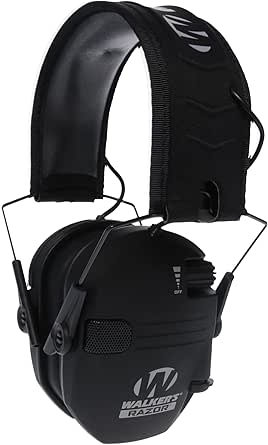 | Best for Media Listening | Fabric type: Plastic | Design: Ultra low-profile, slim ear cups | Microphones: Two hi-gain microphones | VIEW ON AMAZON | See Our Full Breakdown |
| Floriogra Electronic Ear Protection for Shooting with 5X Sound Amplification, NRR 23dB |  | Best for All-Weather Hunting | Brand: Floriogra | Model: EZ-50A | Sound Amplification: 5X | VIEW ON AMAZON | See Our Full Breakdown |
| ZOHAN EM035 Bluetooth 6.0 Shooting Earmuffs with Active Noise Cancellation and Sound Amplification (Green) |  | Best for Streaming While You Shoot | Brand: ZOHAN | Model: EM035 | Bluetooth: Bluetooth 6.0 (claimed) | VIEW ON AMAZON | See Our Full Breakdown |
| hearing protection electronic | NRR | Design |
|---|---|---|
| Auto Ears Electronic Ear Prote | 22 dB (ANSI-certified) | — |
| ISOtunes Caliber BT Bluetooth | 25 dB | — |
| PROHEAR 027 AM/FM Radio Headph | 25 dB | — |
| Walker’s Razor Slim Electronic | — | Ultra low-profile cups |
| PROHEAR Electronic Ear Protect | 23 dB | — |
| EARMOR Electronic Shooting Ear | 25dB (ANSI S3.19, CE EN 352-1 certified) | Ultra-slim, foldable, low-profile earcups |
| Walker’s Razor Slim Electronic | — | Ultra low-profile slim ear cups |
| Walker’s Razor Slim Electronic | — | Ultra low-profile slim ear cups |
| Walker’s Razor Slim Electronic | — | Ultra low-profile with extra slim ear cups |
| Walker’s Razor Slim Electronic | — | Ultra low-profile, slim ear cups |
| Floriogra Electronic Ear Prote | 23 dB | — |
| ZOHAN EM035 Bluetooth 6.0 Shoo | — | — |
More Details on Our Top Picks
Auto Ears Electronic Ear Protection with Auto On/Off Sensors, Gel Pads, Bluetooth, and 3.5mm Audio Jack
Most electronic muffs make you think about power buttons and battery checks before every range session — this model removes that friction entirely with patented auto on/off sensors that activate the moment you put them on. That, combined with 300 hours of runtime and 10-year standby, means the most common failure mode of electronic hearing protection (dead batteries at the worst time) largely disappears. Compared with the PROHEAR 066, which also claims 300 hours but requires manual activation, the convenience gap is real for frequent shooters. The gel pads and slim cups suit long sessions and rifle stocks alike, though gel wears faster than foam and will eventually need replacing.
Pros:- Auto on/off sensors eliminate dead-battery surprises and forgotten power buttons
- 300 hours of use with 10-year standby is exceptional for the category
- Slim cups clear rifle and shotgun stocks without breaking cheek weld
- Gel pads and adjustable fit accommodate large heads, women, and children
Cons:- Gel pads degrade faster than standard foam and will need replacement over time
- Feature set adds cost over basic electronic muffs with similar NRR
Best for: Frequent shooters and hunters who want set-and-forget protection with Bluetooth audio at the range
Not ideal for: Budget-focused buyers who don’t need Bluetooth or auto-sensing and would be fine with simpler muffs like the Walker’s Razor Slim
- NRR:22 dB (ANSI-certified)
- Battery Life:300 hours active, 10 years standby
- Connectivity:Bluetooth, 3.5mm audio jack
- Ear Pad Material:Gel
- Housing:Rugged ABS with rubberized coating
- Features:Auto on/off sensors, water-resistant, dust-proof
- Origin:Invented in the USA (imported)
Our verdict“If you shoot regularly and want protection that’s always ready with audio streaming built in, this is the most complete package in the lineup.”
ISOtunes Caliber BT Bluetooth Shooting Earbuds
Earbuds solve a problem muffs can’t: they disappear under hats, glasses, and hearing-protection doubles. The Caliber BT pairs a 25 dB NRR — higher than either the Auto Ears (22) or PROHEAR 066 (23) — with Tactical Sound Control that amplifies range commands and conversation while clipping gunfire instantly. The IP67 rating beats the splash resistance of every muff here, and the charging case stretches runtime well past the in-ear 13 hours. The tradeoff is fit: the twist-to-lock seal that makes the NRR possible takes practice, and shooters who can’t get a proper seal lose the protection advantage that justifies choosing buds over muffs.
Pros:- 25 dB NRR tops every muff in this roundup
- Tactical Sound Control amplifies ambient noise for range awareness
- IP67 dust and water resistance outclasses muff-level protection
- 13 hours per charge plus two case recharges for all-day sessions
Cons:- Twist-to-lock fit demands proper technique; a poor seal undermines the NRR
- In-ear design offers no physical coverage for the outer ear bone structure
Best for: Shooters who prioritize maximum NRR, invisibility under hats or helmets, and streaming audio without bulk
Not ideal for: Anyone who dislikes in-ear fit or struggles with seal-dependent protection — over-ear muffs like the Walker’s Razor Slim are more forgiving
- NRR:25 dB
- Bluetooth Version:5.2
- Battery Life:13 hours (plus 2 case recharges)
- Water/Dust Resistance:IP67
- Technology:Tactical Sound Control
- Case Weight:50 g
- Color:OD Green
Our verdict“This pick makes the most sense for experienced shooters who want the strongest protection-to-size ratio and will commit to getting the seal right.”
PROHEAR 027 AM/FM Radio Headphones with Digital Display, 25dB NRR Safety Earmuffs – Orange
Not everyone buying electronic hearing protection is shooting — and this model is built for the lawnmower crowd. The built-in AM/FM radio with LCD display and 20 presets turns eight hours of mowing into something tolerable, while the 85 dB volume limiter stops you from accidentally trading one hearing hazard for another. Unlike the ISOtunes Caliber BT, there’s no gunfire-reactive circuitry here — this is passive protection plus entertainment, which is exactly right for steady machinery noise. Compared with the PROHEAR 066, you get stronger 25 dB NRR but no sound amplification. Be aware the battery door is finicky; a loose AA can kill the radio mid-task.
Pros:- AM/FM radio with strong reception, LCD display, and 10 presets per band
- 85 dB volume limiter protects hearing during extended listening
- Lightweight at 7.36 ounces with a padded adjustable headband
- 3.5mm AUX input and carrying bag included
Cons:- Batteries not included, and lithium cells are discouraged
- Battery compartment fit is loose — the radio can cut out until shimmed
Best for: Homeowners, landscapers, and workshop users who want radio entertainment during long noisy tasks
Not ideal for: Shooters — there’s no impact-noise suppression or sound amplification for range use
- NRR:25 dB
- Volume Limit:85 dB
- Radio:AM/FM with 10 presets each, LCD display
- Power:2 AA batteries (not included)
- Weight:7.36 ounces
- Connectivity:3.5mm AUX
- Included:Audio cable, carrying bag, user manual
Our verdict“For mowing, sanding, and construction noise, the radio-plus-limiter formula beats shooting-oriented muffs at the same task.”
Walker’s Razor Slim Electronic Muff
The Razor Slim earns its spot by doing the fundamentals cleanly at a price well below feature-loaded rivals. Its ultra low-profile cups sit tighter to the head than the PROHEAR 066, working under hats and keeping a consistent cheek weld, while the twin omnidirectional mics deliver the natural, well-balanced sound amplification Walker’s is known for. Controls are refreshingly simple — external volume knobs and a battery door you can access without removing the muffs, something the Auto Ears makes moot with auto-sensing but which matters here. There’s no Bluetooth or radio, so compared with the ISOtunes Caliber BT this is strictly a protection-and-awareness tool. Build is rugged, but the rubberized shell is hand wash only.
Pros:- Ultra low-profile design fits under hats and clears rifle stocks
- Two hi-gain omnidirectional mics produce clear, natural amplification
- External volume controls and battery door allow adjustment while wearing
- Rubberized composite housing stands up to range abuse
Cons:- No wireless connectivity — audio requires a wired connection
- Hand wash only, limiting cleanup options after dusty sessions
Best for: Range shooters who want proven slim electronic muffs with clear amplification and no extra features to pay for
Not ideal for: Buyers who want built-in audio streaming or radio — the lack of Bluetooth means pairing with a separate device is required
- Microphones:Two hi-gain omnidirectional
- Design:Ultra low-profile cups
- Headband:Padded metal wire frame
- Housing:Composite with rubberized coating
- Features:Audio input jack, external volume control, external battery door
- Care:Hand wash only
- Origin:Imported
Our verdict“A dependable, no-frills slim muff for shooters who value fit and sound quality over smart features.”
PROHEAR Electronic Ear Protection Muffs with 4X Sound Amplification and NRR 23dB Noise Reduction
At 9.6 ounces, this is the lightest muff in the roundup, and that matters most for hunters who wear protection from before dawn until last light. The sub-0.01-second noise suppression reacts fast enough for rapid strings at the range, while 4X amplification lets you hear your hunting partner whisper or a deer move through brush — something the PROHEAR 027’s passive design can’t do at all. Battery life matches the Auto Ears at 300 hours, though you’ll be managing power manually since there’s no auto on/off. Compared with the Walker’s Razor Slim, the IPX4 rating is the deciding edge for damp-weather hunts, but the amplification is slightly less refined.
Pros:- Featherweight 9.6-ounce build is comfortable for dawn-to-dusk wear
- Suppression triggers in under 0.01 seconds for rapid fire
- 300-hour battery life on two AAA batteries
- IPX4 water and dust resistance suits field conditions
Cons:- Batteries not included, and there’s no auto-off to prevent accidental drain
- Amplification quality trails the more polished Walker’s mics
Best for: Hunters and all-day range visitors who need light weight, weather resistance, and amplified ambient sound
Not ideal for: Gadget-oriented buyers who want Bluetooth or radio — this model is amplification and protection only
- NRR:23 dB
- Sound Amplification:4X
- Suppression Speed:Under 0.01 seconds
- Weight:9.6 ounces
- Battery Life:300 hours (2 AAA batteries)
- Water Resistance:IPX4
- Included:Carrying pouch, 3.5mm cable, patches, manual
Our verdict“The right call for hunters and long-session shooters who prioritize light weight and weather resistance over connectivity.”
EARMOR Electronic Shooting Ear Protection Noise Reduction Earmuffs, 25dB
EARMOR’s M300A stands out for raw attenuation: a certified 25dB NRR backed by ANSI and CE testing, which beats the 22-23dB class where the Walker’s Razor Slim line and the Floriogra muffs sit. That extra margin matters most for indoor ranges, where sound reflects off walls and stacks on top of the muzzle blast. Sub-millisecond shutoff means gunshot clipping happens faster than you can perceive, while the 360-degree microphones with voice tracking amplify range commands up to 5X — a step up from the simpler hi-gain mic pairs on the Razor Slim variants. The tradeoff: all this tech lives in a pricier, busier package, and the 4-hour auto shut-off, while battery-friendly, can cut audio mid-session if you forget to cycle the power. The 100-hour runtime on included AAAs partly offsets that.
Pros:- Certified 25dB NRR from ANSI S3.19 and CE EN 352-1 standards — higher than most electronic muffs in this class
- Sub-millisecond impulse suppression clips gunshots before reaction time is affected
- 360-degree omnidirectional mics with dynamic voice tracking for clear commands and footsteps
- 100-hour battery life on two AAA batteries with auto shut-off
- Ultra-slim earcups avoid rifle and shotgun stock interference
Cons:- 4-hour auto shut-off can power down mid-session if not monitored
- Higher price point than simpler amplified muffs like the Walker’s Razor Slim
- Dry-clean-only care limits easy maintenance after sweaty range sessions
Best for: Indoor range shooters and hunters who want maximum certified attenuation without losing ambient awareness
Not ideal for: Casual weekend plinkers and yard-work users — the extra NRR and mic sophistication are overkill compared with cheaper Razor Slim options
- NRR:25dB (ANSI S3.19, CE EN 352-1 certified)
- Noise suppression speed:Under 1 millisecond
- Sound amplification:Up to 5X with 360° omnidirectional microphones
- Battery life:Up to 100 hours on 2x AAA (included)
- Auto shut-off:4 hours
- Weight:0.65 lbs
- Design:Ultra-slim, foldable, low-profile earcups
- Durability:IP-rated water and dust resistant housing
Our verdict“If certified maximum protection and communication clarity at indoor ranges are the priority, this is the pick; casual outdoor users can spend less.”
Walker’s Razor Slim Electronic Muff
This version of the Walker’s Razor Slim earns the top slot because it balances everything a shooter actually needs: a genuinely low-profile cut that clears a rifle stock, two hi-gain microphones tuned with enhanced low-end response for natural-sounding amplification, and a rugged rubberized shell over a padded metal wire frame that survives being tossed in a range bag. Compared with the EARMOR M300A, you give up a few decibels of NRR and voice-tracking sophistication, but the Razor Slim’s simpler circuitry means fewer things to fail and a lighter, less bulbous feel. The audio input jack lets it double as hearing-safe headphones between strings. Be honest about the downsides: plastic earcups feel less premium than composite-housed rivals, and the fixed-volume setup offers less fine control than muffs with programmable modes.
Pros:- Ultra low-profile cups clear rifle and shotgun stocks for proper cheek weld
- Hi-gain omni mics with enhanced low-end response for natural ambient hearing
- Audio input jack doubles them as hearing-safe headphones
- Rubberized coating over a metal wire frame shrugs off range-bag abuse
Cons:- Plastic construction feels less premium than higher-end composite models
- Fixed amplification tuning offers less control than muffs with adjustable sound modes
- Dry-clean-only care instructions make maintenance awkward
Best for: Shooters who want a proven, do-it-all electronic muff for range days and hunting without premium pricing
Not ideal for: Indoor-range regulars who need every decibel of attenuation — the EARMOR’s 25dB NRR is the safer ceiling
- Material:Plastic, rubberized coating, composite housing
- Headband:Padded metal wire frame
- Microphones:Two hi-gain microphones
- Features:Sound amplification, audio input jack, external volume control
- Design:Ultra low-profile slim ear cups
- Origin:Imported
Our verdict“The most sensible all-around choice for shooters who value fit, durability, and natural sound over maximum NRR numbers.”
Walker’s Razor Slim Electronic Muff
Of the several Razor Slim listings floating around, this one is the straightforward value play: the same core platform — low-profile cups, amplified omnidirectional hearing, audio jack, rubberized armor — without the incremental bells that push sibling listings up in price. Against the flagship Razor Slim variant (B06ZY6GMYD), the amplification tuning is more basic, so voices sound slightly less full at the range, but the protection and fit are functionally identical. That makes it the smarter buy for someone buying their first pair of electronic muffs or outfitting a guest bag. The all-plastic build is the real compromise — it has survived range abuse for years for most owners, but it lacks the metal-frame reassurance of pricier rivals like the EARMOR M300A. Volume control is also less conveniently placed than on models with external knobs.
Pros:- Same proven Razor Slim low-profile platform as pricier variants at a lower cost
- Amplifies safe sounds with clear omni-directional coverage
- Audio input jack supports music and phone audio
- Rubberized coating protects the electronics from drops and scrapes
Cons:- Fully plastic build feels less premium than metal-framed or composite alternatives
- Simpler sound tuning makes voices flatter compared with the flagship Razor Slim
- Volume control placement is less convenient than external-knob designs
Best for: First-time electronic muff buyers and multi-shooter households who want proven protection at the lowest entry point
Not ideal for: Audiophile-leaning users who want richer amplified sound — the tuning here is more utilitarian than the flagship Razor Slim
- Material:Plastic
- Design:Ultra low-profile slim ear cups
- Features:Sound amplification, audio input jack, rugged design
- Hearing:Amplified clear, natural omni-directional awareness
- Connectivity:Audio input jack for music or calls
- Origin:Imported
Our verdict“The cheapest sensible way into the Razor Slim family — buy it if budget leads your decision and you can live with basic amplification.”
Walker’s Razor Slim Electronic Ear Muffs
This Razor Slim listing is the one to pick when packability and concealability drive the decision. The extra-slim cups sit tight against the head, so the muffs slip under hats, hoods, or alongside a slung rifle without bulk — a sharper focus than the Auto Ears or the PROHEAR 027, both of which are noticeably chunkier packages. Hi-gain microphones keep ambient sound clear in every direction, and the audio jack preserves the headphone trick. Two genuine annoyances temper the appeal: the recessed volume knob is genuinely awkward to adjust while wearing the muffs, especially with gloves, and the external battery door is a known ingress point for dust and moisture at dusty outdoor ranges. Nylon construction keeps weight down but scratches easier than the rubberized shells on other Razor variants.
Pros:- Extra-slim cups stow flat and fit under hats and hoods
- Hi-gain microphones deliver clear omni-directional awareness
- Audio input jack enables music playback with protection
- Lightweight nylon build keeps all-day wear comfortable
Cons:- Recessed volume knob is hard to adjust while wearing, especially with gloves
- External battery door can admit dust and moisture
- Nylon housing scuffs more easily than rubberized-coated variants
Best for: Hunters and travelers who need muffs that disappear into a pack and stay out of the way under headwear
Not ideal for: Dusty or wet outdoor shooters — the external battery door is a weak seal compared with sealed-housing models like the EARMOR M300A
- Fabric type:100% nylon
- Design:Ultra low-profile with extra slim ear cups
- Microphones:Built-in hi-gain amplification of safe frequencies
- Controls:Recessed volume knob
- Connectivity:Audio input jack
- Care:Hand wash only
Our verdict“Choose this Razor Slim variant for the tightest, most packable fit — just plan your volume setting before you shoulder a gun.”
Walker’s Razor Slim Electronic Muff
What separates this Razor Slim listing is its sound-dampening composite housing paired with the audio input jack — the strongest combo in the lineup for shooters who actually want to listen to music or take calls between strings without abandoning protection. Compared with the basic value Razor Slim (B01AAH8CRU), the composite cups add a touch more passive dampening and a more finished feel, while the recessed volume control and exterior battery door keep controls glove-friendly and swaps quick. Against Bluetooth-equipped rivals like the ISOtunes Caliber BT earbuds or ZOHAN EM035, the wired jack is a limitation — no cables-free streaming — but it also means no pairing dropouts at busy ranges. The hand-wash-only care and imported plastic fit-and-finish are the honest compromises at this tier.
Pros:- Sound-dampening composite housing adds passive protection on top of amplification
- Audio input jack supports music and phone calls with hearing safety intact
- Recessed volume knob and exterior battery door are easy to operate gloved
- Padded metal wire frame headband stays comfortable through long sessions
Cons:- Wired-only audio — no Bluetooth compared with ZOHAN or ISOtunes alternatives
- Hand-wash-only care instructions add maintenance hassle
- Imported plastic fit and finish trails premium models
Best for: Range shooters who regularly stream music or podcasts and want wired audio without sacrificing protection
Not ideal for: Cord-haters — anyone wanting wireless audio should look at the ZOHAN EM035 or ISOtunes Caliber BT instead
- Fabric type:Plastic
- Design:Ultra low-profile, slim ear cups
- Microphones:Two hi-gain microphones
- Housing:Sound-dampening composite
- Headband:Padded metal wire frame
- Controls:Recessed volume control knob, exterior battery door
- Connectivity:Audio input jack
- Origin:Imported
Our verdict“The Razor Slim to buy if wired music and calls are part of your range routine; skip it if you want wireless freedom.”
Floriogra Electronic Ear Protection for Shooting with 5X Sound Amplification, NRR 23dB
This option stands out for hunters who work in unpredictable weather, thanks to an IPX4 water-resistance rating that most competitors lack — including the Walker’s Razor Slim, which offers no stated water protection at all. The 5X sound amplification is among the strongest in this roundup, and dual hi-gain omnidirectional microphones mean a deer stepping through brush is easier to place directionally than with the PROHEAR muffs’ 4X setup. Suppression kicks in above 82 dB within 0.01 seconds, fast enough that muzzle blasts never reach the ear uncompressed. At 0.6 lbs with a folding frame, the tradeoff is a slightly heftier feel than slim-profile range muffs, and the single volume knob means both cups adjust together — shooters who want independent left/right control should look elsewhere. For field use, though, the weather sealing and brown finish make this pick the most hunt-ready of the batch.
Pros:- IPX4 water, sweat, and dust resistance for reliable use in rain or humid conditions
- 5X omnidirectional amplification gives clearer, better-placed ambient sound than 4X rivals
- 0.01-second suppression above 82 dB prevents blast damage without cutting off conversation
- Folding 0.6 lb design packs easily into a range bag or hunting pack
Cons:- Single-knob volume control prevents independent left/right ear adjustment
- Low-profile cups still sit bulkier than dedicated slim muffs like the Walker’s Razor Slim
Best for: Hunters and outdoor shooters who need weather-sealed protection and strong directional sound pickup in the field
Not ideal for: Bench shooters who want independent per-cup volume control or the slimmest possible cheek weld for rifle stocks
- Brand:Floriogra
- Model:EZ-50A
- Sound Amplification:5X
- NRR:23 dB
- Response Time:0.01 seconds
- Activation Threshold:82 dB
- Certifications:ANSI S3.19, CE EN 352-1
- Water Resistance:IPX4
- Weight:0.6 lbs (0.43 kg)
Our verdict“This is the pick for hunters who need all-weather sealing and strong directional hearing, as long as shared volume control isn’t a dealbreaker.”
ZOHAN EM035 Bluetooth 6.0 Shooting Earmuffs with Active Noise Cancellation and Sound Amplification (Green)
Compared with the ISOtunes Caliber BT earbuds, the ZOHAN EM035 takes a different approach to wireless audio: full-sized muffs with Bluetooth streaming plus 4X ambient amplification, so range commands and music coexist rather than compete. The wide headband and 0.36 kg frame make it comfortable for long sessions, and ANSI/CE certification backs the 22 dB noise reduction for real protection. One caution: the claimed Bluetooth 6.0 is a non-standard version number not recognized by the Bluetooth SIG, which suggests proprietary marketing rather than a genuine generational leap — pairing still works fine, but buyers shouldn’t expect next-gen features. Compared with the PROHEAR 027’s radio tuning, streaming from a phone is far more flexible. The 22 dB rating also trails the EARMOR’s 25 dB, so indoor shooters at loud ranges give up a little raw attenuation for the convenience of wireless audio.
Pros:- Bluetooth audio streaming lets you take calls and music without removing muffs at the range
- 4X amplification keeps conversations and range commands audible over streamed audio
- Wide headband and lightweight folding frame suit all-day wearing comfort
- ANSI and CE certified hearing protection suitable for shooting and hunting
Cons:- Bluetooth 6.0 is not an official Bluetooth SIG version, hinting at exaggerated or proprietary specs
- 22 dB noise reduction trails higher-rated muffs like the EARMOR’s 25 dB
- Synthetic materials feel less premium than leather or composite builds
Best for: Recreational shooters who want music, podcasts, or calls streaming through their muffs without losing situational hearing
Not ideal for: Indoor-range shooters needing maximum attenuation, or buyers who expect certified cutting-edge Bluetooth rather than marketing versioning
- Brand:ZOHAN
- Model:EM035
- Bluetooth:Bluetooth 6.0 (claimed)
- Sound Amplification:Up to 4X
- Noise Reduction:22 dB
- Certifications:ANSI S3.19-1974, CE EN 352-1
- Weight:0.36 kg
- Material:Synthetic
Our verdict“Choose this if wireless audio at the range matters more than maximum attenuation, but skip it if spec transparency is a priority.”

How We Picked
I ranked these 12 products on four buyer-facing criteria: noise reduction performance (NRR plus how quickly the electronics clamp down on sudden impact noise), sound amplification quality (how naturally voices and ambient sound come through without hiss or distortion), comfort and fit (clamp pressure, ear cup depth for glasses wearers, weight during long sessions), and feature set relative to price (Bluetooth, aux input, auto on/off, battery life). Because several entries share a platform — the Walker’s Razor Slim appears five times in slightly different forms — I treated variants as one core product evaluated once, then noted where a specific configuration earns its place.
The ranking logic favors versatility and real-world usability over raw specs. A model with slightly lower NRR but faster attack time, better voice clarity, and Bluetooth ranked higher than a paper-spec champion. Dedicated-use picks, like the PROHEAR radio earmuffs for job sites or the ISOtunes earbuds for low-profile needs, were slotted by how well they serve their niche rather than forced into direct comparison with general-purpose muffs.
| hearing protection electronic | Design |
|---|---|
| Auto Ears Electronic Ear Prote | — |
| ISOtunes Caliber BT Bluetooth | — |
| PROHEAR 027 AM/FM Radio Headph | — |
| Walker’s Razor Slim Electronic | Ultra low-profile cups |
| PROHEAR Electronic Ear Protect | — |
| EARMOR Electronic Shooting Ear | Ultra-slim, foldable, low-profile earcups |
| Walker’s Razor Slim Electronic | Ultra low-profile slim ear cups |
| Walker’s Razor Slim Electronic | Ultra low-profile slim ear cups |
| Walker’s Razor Slim Electronic | Ultra low-profile with extra slim ear cups |
| Walker’s Razor Slim Electronic | Ultra low-profile, slim ear cups |
| Floriogra Electronic Ear Prote | — |
| ZOHAN EM035 Bluetooth 6.0 Shoo | — |
Factors to Consider When Choosing Hearing Protection Electronic
Choosing electronic hearing protection comes down to matching the technology to your actual environment and how long you wear the gear. Before picking from the 12 above, work through these factors — they explain most of the price differences and most of the buyer regrets in this category.
NRR vs. Electronic Attack Time
The printed NRR tells you how much passive blocking the earmuff provides when the electronics are off, but it says nothing about how fast the circuit reacts to a gunshot. A fast attack time matters more than an extra 2dB of NRR for shooting, because a slow circuit lets the initial muzzle blast through unprotected. A common mistake is buying the highest NRR number on the box and ending up with sluggish electronics that pop and distort. If you shoot indoors, where sound reflects and sustains, lean toward 25dB-class muffs like the EARMOR or PROHEAR radio model; outdoors, a 22-23dB NRR with quick compression is generally plenty. Dual protection — foam plugs under electronic muffs — is still the gold standard for indoor ranges, and good amplification lets you keep hearing commands despite the plugs.
Amplification: More Is Not Always Better
Amplification is what lets you hear a range officer or a hunting partner while protected, and it’s the feature that separates true electronic protection from passive muffs with a microphone bolted on. Models like the Floriogra with 5X amplification excel at distance — hearing game movement or quiet commands — but high gain also amplifies wind, rustling clothing, and your own footsteps, which fatigues some users. A moderate 1X-2X gain, like the Walker’s Razor Slim’s, sounds more natural for all-day wear. Try to buy from a seller with easy returns if you’ve never worn amplified muffs before; some people find the amplified soundscape disorienting for the first few sessions. Gain that is adjustable per volume step, rather than a single fixed level, adds real flexibility.
Form Factor: Muffs, Earbuds, or Both
Muffs and earbuds serve different shooters. Slim-profile muffs like the Walker’s Razor Slim exist specifically for rifle shooting, where a full-size cup bumps the stock and breaks your cheek weld. Electronic earbuds like the ISOtunes Caliber BT eliminate that problem entirely and disappear into a pocket, but they offer less protection against sustained indoor noise and are easier to lose at a busy range. Bigger cups generally mean more passive NRR and room for larger batteries and speakers, which is why full-size models dominate indoor and industrial use. If you switch between rifles and pistols, or shoot in both settings, a slim muff is the safer compromise. Earbuds also depend on a good seal in your ear canal — if foam tips don’t fit you well, the rated protection drops sharply.
Battery Life and Power Management
Battery design affects daily usability more than most buyers expect. Models with auto on/off sensors, like the Auto Ears, remove the single most common failure mode in this category: dead batteries discovered at the range. Rechargeable units save money over time but become a liability on multi-day hunts with no outlet, while AAA-powered muffs let you swap cells in seconds anywhere. Bluetooth and active noise cancellation are the biggest drains — the ZOHAN EM035’s ANC and wireless audio will deplete a charge faster than a bare-bones amplifier. Check whether the unit still functions as passive protection when the battery dies; every model in this roundup does, but some budget brands cut corners. A realistic target is 200+ hours for non-Bluetooth muffs and 10+ hours for feature-heavy wireless units.
Connectivity and Audio Features
Bluetooth has moved from gimmick to genuine feature, but only if it fits your use case. If you take calls on a job site or stream podcasts while mowing, integrated Bluetooth (ZOHAN, ISOtunes, Auto Ears) is worth paying for, because wearing earbuds under muffs is uncomfortable and reduces your NRR. A 3.5mm aux jack is the cheaper, more reliable alternative — no pairing, no battery drain, and it works with any radio or phone. For hunting and tactical use where situational awareness is safety-critical, skip audio entirely or use it at low volume; amplified ambient sound plus loud music is how people miss commands and warnings. Also check the microphone placement: dual mics give better directional awareness than a single top-mounted mic, which matters when locating sound sources is part of the job.
Comfort Details That Decide Long Sessions
The specs that don’t appear on the box often decide whether you reach for the muffs or leave them home. Gel ear pads, standard on the Auto Ears and available as an upgrade for many muffs, dramatically improve comfort for glasses wearers because they seal around temple arms instead of pressing them into your head. Clamp force is a double-edged sword: tighter means better NRR, looser means no headache after four hours. Deep cups matter if you shoot in cold weather, since shallow cups press earmuffs or cold skin painfully. Weight distribution matters most for earbuds — a bud pulling on its cable all day gets uncomfortable fast. Finally, foldability and a included case determine whether the unit survives a range bag, and replaceable pads extend the life of an otherwise good muff by years.
Frequently Asked Questions
Can I wear electronic muffs over foam earplugs for extra protection?
Yes, and for indoor ranges it’s the recommended setup. Combining a properly inserted foam plug with an electronic muff adds meaningful protection because the two attenuation curves stack — you can gain roughly 5-8dB of effective reduction beyond the muff alone. The electronic amplification is what makes the combo workable: it raises voices and commands back above the plug’s blocking so you’re not working deaf. The tradeoff is that you’ll run the volume higher, which drains batteries faster and adds some hiss on lower-quality units. Every muff in this roundup supports this pairing, but slim cups with high clamp force can get uncomfortable over plugs during long sessions, so budget-minded shooters often pick the Walker’s Razor Slim or EARMOR for dual-protection use.
Are Bluetooth shooting earmuffs safe to use at a live-fire range?
Safe, with conditions. The Bluetooth audio path is separate from the protection circuit in models like the ZOHAN EM035 and Auto Ears, so a gunshot triggers the same compression whether or not music is playing. The real risk is behavioral, not technical: loud music masks range commands, bystander warnings, and the click of a safety. Keep streamed audio at conversational volume, and use one ear or lower it further during cold range periods. Battery life is the other practical concern — wireless audio can cut a 300-hour standby unit down to a day of active use. If your primary reason for Bluetooth is calls rather than music, the ISOtunes Caliber BT with its certified blocking and call clarity is the better tool.
Do the multiple Walker’s Razor Slim versions actually differ, and which should I buy?
The variants in this lineup share the same core platform — the slim cup, similar NRR, and the same compression behavior — and differ mainly in color, packaging, and occasionally included accessories like a case or aux cable. That’s why they cluster together in the rankings rather than spread across the field. My advice: buy whichever configuration is cheapest or best-stocked at the time you order, and put the savings toward gel pads or a hard case, which improve the experience more than any variant difference. The one thing to verify before ordering is that you’re getting the electronic version and not Walker’s passive Razor-lookalike muffs, which share styling but have no amplification. If you need features the Razor Slim lacks, like higher amplification or Bluetooth, step up to the Floriogra or ZOHAN instead of hunting for a premium Razor variant.
Is a 23dB NRR enough, or do I need 25dB+?
For outdoor shooting, 22-23dB is generally sufficient, especially with fast electronics, because outdoor muzzle blasts are brief and don’t reflect back at you. Indoors is where the extra decibels earn their keep — reflected sound extends the exposure and raises the effective dose well above what the NRR number alone suggests. If most of your shooting is indoor, prioritize 25dB-class muffs like the EARMOR or PROHEAR, or pair a 23dB unit with foam plugs. Also remember that real-world NRR depends entirely on fit: a 25dB muff worn over hair, a hat, or glasses may deliver less true protection than a well-sealed 23dB unit. Fit and seal beat the label number every time.
Are electronic earbuds a real alternative to muffs, or just a convenience product?
They’re a legitimate alternative for the right use cases, but a poor substitute in others. The ISOtunes Caliber BT demonstrates the strengths: certified noise blocking, total compatibility with rifle stocks, no cheek-weld interference, and audio quality no muff speaker matches. Where earbuds fall short is sustained industrial noise and heat — a sealed ear canal gets fatiguing over a full day, and the small battery limits runtime compared to AAA-powered muffs. They’re also unforgiving of fit: the rated protection assumes a proper seal with the right tip size, and a loose tip silently degrades performance. For pistol shooting, hunting trips where packability matters, or job sites with intermittent noise, earbuds are arguably the better tool. For indoor rifle sessions or eight-hour machine work, a full-size muff still wins.
Conclusion
The right pick here depends less on specs and more on where you’ll wear the protection. For best overall, the ZOHAN EM035 combines active noise cancellation, Bluetooth 6.0, and amplification in a package that handles range days, job sites, and yard work without compromise. For best value, the Walker’s Razor Slim — in whichever variant is cheapest — delivers the core electronic protection experience with a proven design and slim cups that work for rifles. Best premium goes to the Auto Ears with its auto on/off sensors, gel pads, and dual audio options for buyers who want every convenience feature in one unit. For beginners, the PROHEAR 027 amplification muffs offer a forgiving, straightforward entry point with enough clarity to learn what good electronic protection sounds like. Specific needs round out the field: ISOtunes Caliber BT for low-profile earbud shooters and podcast listeners, PROHEAR AM/FM radio muffs for job sites and mowing, Floriogra for hunters who need maximum 5X amplification, and EARMOR for indoor shooters prioritizing the 25dB rating. Whatever you choose, prioritize fit and seal over the number on the box — that’s where real protection lives.