If you’re looking for the best lightning arrestors to protect your RF systems, I can help. I’ve reviewed top options like coaxial, N-type, and UHF arrestors that handle high surge capacities, weatherproofing, and low signal loss. These devices are designed to safeguard antennas, radio equipment, and communication lines from lightning strikes and transients. Keep in mind, choosing the right one depends on your application and system specs—stay tuned to learn more about each type.
Key Takeaways
- Different types of lightning arrestors suited for various RF frequency ranges and outdoor or indoor applications.
- Construction features like weatherproofing, corrosion resistance, and replaceable surge components enhance durability.
- Key specifications such as low insertion loss, VSWR, and high surge capacity ensure reliable RF signal protection.
- Compatible connectors (N, SMA, UHF, F-type) facilitate secure installation and maintain signal integrity.
- Proper grounding and installation practices are essential for optimal lightning and surge protection performance.
Proxicast Coaxial Lightning Arrester/Suppressor with UHF SO-239 Connectors

If you’re looking for a reliable lightning arrestor for VHF, UHF, or amateur radio setups, the Proxicast Coaxial Lightning Arrestor/Suppressor is an excellent choice. It features UHF SO-239 connectors, making it compatible with various RF systems, including ham radios and outdoor antennas. Built with durable, weather-resistant materials, it provides bi-directional surge protection while maintaining minimal RF loss. The device handles surges via a gas discharge tube, offering multiple strikes and supporting signals up to 350W. Easy to install, it ensures your equipment stays protected during lightning storms without compromising signal quality. Customer feedback confirms its solid build and effective performance.
Best For: amateur radio enthusiasts, outdoor antenna setups, and VHF/UHF radio users seeking reliable surge protection without signal loss.
Pros:
- Durable, weather-resistant aluminum construction suitable for outdoor use
- Effective multi-strike surge protection with replaceable gas discharge tube
- Minimal RF attenuation ensures signal integrity during protection
Cons:
- Gas discharge tube cover lacks an O-ring, requiring additional waterproofing for outdoor environments
- Replacing the GDT may require caution to avoid dropping the tube inside the unit
- Higher power levels (>1KW) necessitate GDT replacement with higher voltage tubes
Coaxial Lightning Arrester 2 Pack Surge Protector Connectors
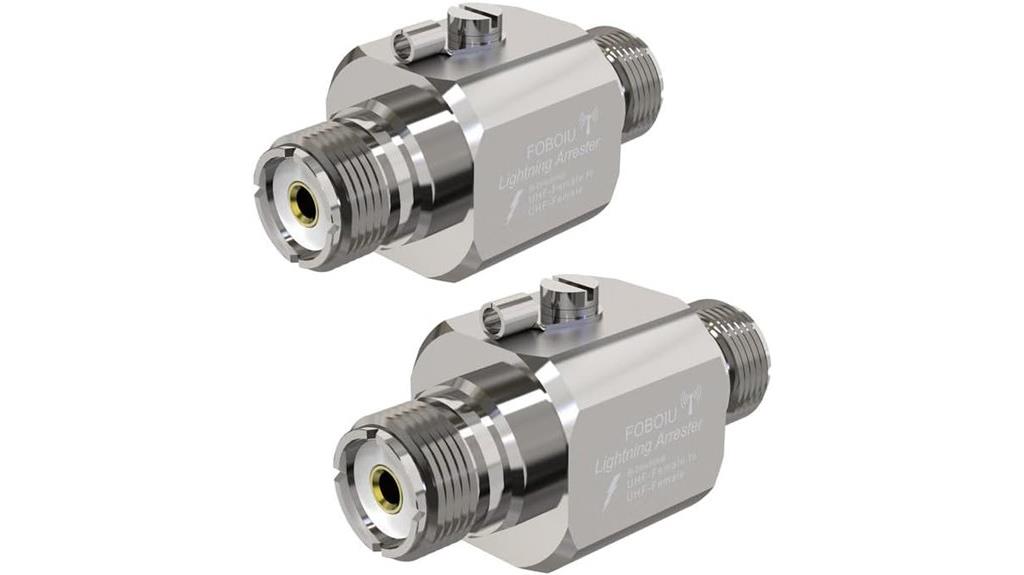
The Coaxial Lightning Arrester 2 Pack Surge Protector Connectors stand out as an ideal choice for amateur radio operators, communication professionals, and anyone seeking reliable surge protection for RF systems. Designed with dual UHF-Female (SO-239) connectors, they work with HF, VHF, UHF, CB, ham, and two-way radios, as well as GSM base stations, satellites, and GPS setups. Made from durable brass with nickel plating, they resist corrosion and weathering. Equipped with gas discharge tubes, these protectors divert surges safely. Easy to install near equipment, they offer low insertion loss and wide bandwidth, ensuring your systems stay protected against lightning and external surges.
Best For: amateur radio enthusiasts, communication professionals, and anyone needing reliable surge protection for RF and communication systems.
Pros:
- Durable construction with brass nickel plating for corrosion and weather resistance
- Easy to install near equipment with UHF-Female connectors for versatile use
- Incorporates gas discharge tubes for effective surge diversion and enhanced safety
Cons:
- Proper grounding and mounting are essential for optimal performance
- May require modifications, such as longer bolts, for specific mounting setups
- Limited to UHF-Female connectors; not compatible with all connector types
UHF Lightning Arrestor PL-259 Surge Protector Coaxial Connector

For radio enthusiasts and communication professionals seeking reliable lightning protection, the UHF Lightning Arrestor PL-259 Surge Protector Coaxial Connector stands out with its rugged construction and easy installation. Made from nickel-plated brass with a Teflon insulator, it offers durability and high performance. It’s designed for UHF frequencies from DC to 500MHz, with low RF insertion loss (<0.4dB) and a VSWR below 1.2, ensuring minimal signal disruption. The UHF-female connectors on each side make setup straightforward. Just remember, you’ll need an additional ground cable to maximize lightning protection. It’s an effective, dependable solution for safeguarding your radios and antennas against surges.
Best For: radio enthusiasts and communication professionals seeking reliable UHF lightning protection for their radios and antennas.
Pros:
- Durable nickel-plated brass construction ensures long-lasting performance.
- Easy to install with UHF-female connectors on both sides for straightforward setup.
- Low RF insertion loss (<0.4dB) and VSWR (<1.2) minimize signal disruption.
Cons:
- Requires an additional ground cable for optimal lightning protection.
- Designed specifically for UHF frequencies up to 500MHz, not suitable for higher frequency applications.
- Installation may be more complex for users unfamiliar with coaxial connectors.
RFiotasy Lightning Arrester BNC Lightning Protection Device

When looking to protect communication and monitoring equipment from lightning and power surges, the RFiotasy Lightning Arrester BNC Lightning Protection Device stands out as an excellent choice. Designed for frequencies up to 3 GHz, it’s compatible with BNC connectors and 50-ohm systems, including coax cables with AWG 8/9/10 grounding wires. Made from durable nickel-plated brass and featuring a Teflon insulator, it ensures reliable signal transmission and longevity. With a replaceable gas discharge tube, it provides effective surge protection for signal boosters, amplifiers, and antennas. Easy to install and built for harsh conditions, it offers peace of mind during thunderstorms, preventing costly equipment damage.
Best For: professionals and hobbyists seeking reliable lightning and surge protection for communication, monitoring, and video equipment operating up to 3 GHz in coaxial systems.
Pros:
- High-quality construction with nickel-plated brass and Teflon insulator ensures durability and reliable signal transmission.
- Easy installation with BNC connectors and a replaceable GDT for ongoing surge protection.
- Effective at preventing equipment damage during thunderstorms with low attenuation and VSWR.
Cons:
- Designed specifically for 50-ohm systems; may not be suitable for other impedance configurations.
- Requires grounding with AWG 8/9/10 wires, which might necessitate additional setup for some installations.
- Limited to applications within the 3 GHz frequency range; not suitable for higher frequency or specialized RF systems.
RAIGEN Lightning Arrestor for N-Type Male to N-Type Female Antennas

If you’re looking for a reliable lightning arrestor compatible with N-type connectors, the RAIGEN model stands out due to its robust construction and broad frequency support. Designed for outdoor use, it features heavy-duty brass, nickel plating, Teflon insulation, and moisture resistance, making it ideal for various RF applications from DC up to 3 GHz. It supports all major antenna types, including LoRa, WiFi, LTE, and ham radios. Equipped with a replaceable gas discharge tube rated for 5KA, it provides excellent surge protection. Its compact size and easy installation make it a practical, cost-effective solution to safeguard your antennas and RF equipment against lightning and static strikes.
Best For: outdoor RF enthusiasts, ham radio operators, and antenna setups requiring reliable lightning and static protection for N-type connections across a wide frequency range.
Pros:
- Heavy-duty brass construction with nickel plating for durability and corrosion resistance
- Supports a broad frequency range (DC-3 GHz) suitable for various wireless and radio applications
- Replaceable gas discharge tube with high surge capacity (5KA) for effective lightning protection
Cons:
- Ground cable not included, requiring separate purchase for proper grounding setup
- Installation near the building entry point may require additional grounding components
- Limited to N-type connectors; not compatible with other connector types without adapters
XRDS-RF Lightning Arrestor F Female to F Female 75 ohm Coaxial Lightning Arrestor
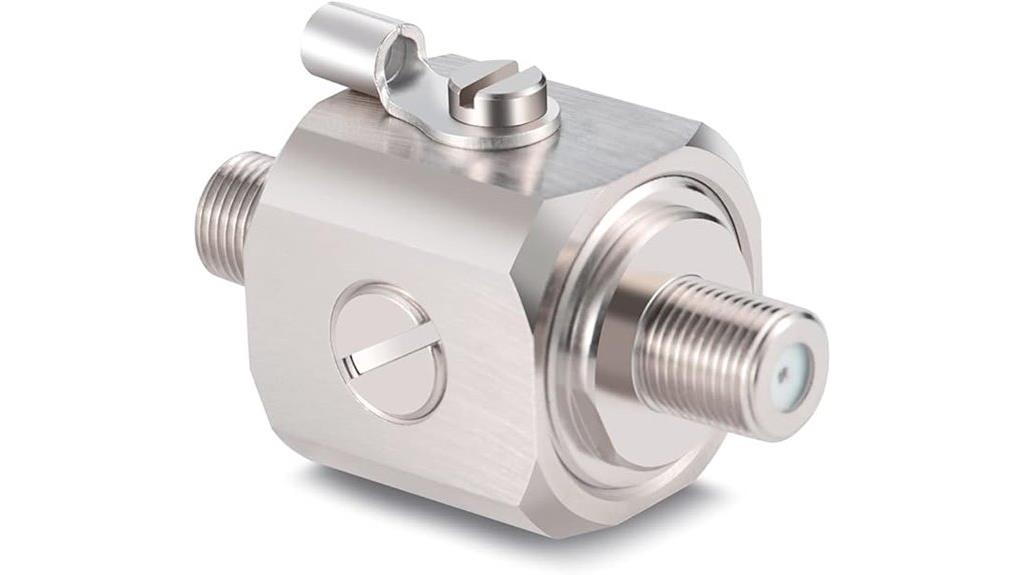
The XRDS-RF Lightning Arrestor with F female-to-F female connectors stands out as an ideal choice for outdoor RF systems requiring reliable surge protection. It features a 75 ohm impedance, making it perfect for satellite TV, cellular boosters, LTE antennas, and cable TV setups. Operating up to 3 GHz, it offers low loss with less than 0.4 dB attenuation and a low VSWR. The device includes a replaceable gas discharge element capable of handling high surge power (90V). To guarantee maximum protection, install it close to your equipment and ground it properly. This arrestor effectively prevents lightning-induced surges, safeguarding your valuable RF systems.
Best For: homeowners and technicians seeking reliable outdoor surge protection for satellite, cable, and cellular RF systems.
Pros:
- Provides effective lightning surge protection with high surge power capacity (90V gas tube).
- Low signal loss with less than 0.4 dB attenuation up to 3 GHz.
- Easy to install with F female-to-F female connectors and suitable for outdoor use.
Cons:
- Requires proper grounding for optimal performance.
- Installation near equipment is essential, which may be challenging in some setups.
- Limited to 75 ohm impedance systems; not compatible with 50 ohm setups.
SMA Lightning Arrestor, Cellular & GPS Surge Protector, SMA Male to Female

This SMA Lightning Arrestor with SMA Male to Female connectors is an excellent choice for outdoor RF system setups requiring reliable surge protection. It safeguards cellular boosters, GPS receivers, and wireless video systems from lightning-induced surges. Operating from DC to 6 GHz, it’s easy to install between outdoor antennas and amplifiers, with grounding required for maximum safety. Its high surge power capability features a gas discharge tube with a 90V breakdown voltage, and it maintains low signal loss with a VSWR under 1.3:1. Built with durable nickel-plated brass and Teflon insulators, it’s designed for harsh outdoor environments, ensuring your equipment stays protected.
Best For: outdoor RF system users seeking reliable surge protection for cellular boosters, GPS receivers, and wireless video systems.
Pros:
- Effective lightning surge protection with high surge power capability thanks to gas discharge tube.
- Easy to install with standard SMA-Male to SMA-Female connectors, suitable for outdoor environments.
- Durable construction with nickel-plated brass and Teflon insulators ensures long-term outdoor resilience.
Cons:
- Lacks bulkhead mounting hardware, which may complicate certain installations.
- Variable user testing results suggest performance may depend on specific setup conditions.
- No mention of included grounding hardware or comprehensive installation accessories.
UHF Lightning Arrestor for CB and HAM Radio Equipment
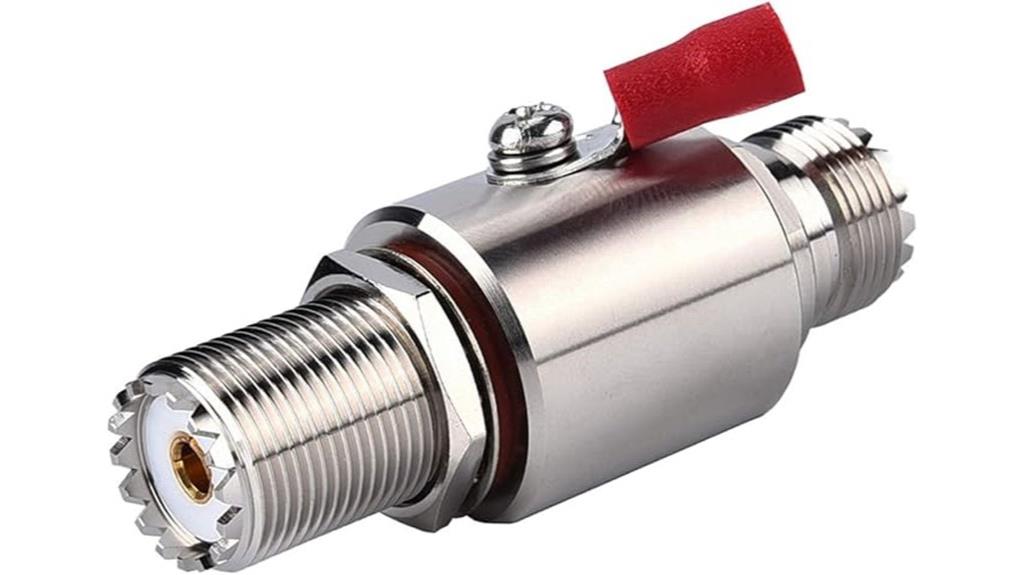
For those operating CB or HAM radios, the UHF Lightning Arrestor PL-259 offers reliable surge protection within the DC-1 GHz frequency range. It features UHF Female-to-Female connectors suitable for CB, HAM, and base station antennas, allowing easy inline or wall-mount installation. Made of high-quality copper with a 50-ohm impedance, it uses a gas discharge tube to shunt surges and limit voltage let through. With a maximum power capacity of 50W, it’s essential to stay within this limit. The arrestor includes a grounding lug for effective earth grounding. Customers praise its durability and effectiveness, making it a top choice for lightning-prone areas.
Best For: amateur radio enthusiasts, CB users, and base station operators seeking reliable lightning surge protection within the DC-1 GHz frequency range.
Pros:
- High-quality copper construction ensures durability and reliable performance
- Easy inline or wall-mount installation with effective grounding lug
- Low insertion loss (<0.1 dB) and fast surge dissipation for sensitive equipment protection
Cons:
- Limited to a maximum power capacity of 50W, unsuitable for high-power transmitters
- Requires proper grounding for optimal protection, which may involve additional setup
- Only compatible with UHF Female-to-Female connectors, limiting some configurations
DELTA Lightning Arrestors LA302R

If you’re protecting a 125/208/250-volt single-phase system, the DELTA Lightning Arrestors LA302R stands out as a dependable choice. Designed for 2-pole operation, it features 18-inch wire leads and weighs just over 11 ounces, making installation straightforward. Suitable for both residential and light commercial use, it effectively prevents power surges caused by lightning strikes. Since its release in December 2011, it’s been highly rated, with customers praising its ease of installation and surge protection. While some have reported inconsistent performance, proper installation by qualified electricians ensures peak reliability. Overall, the LA302R offers a solid solution for safeguarding your electrical system.
Best For: residential homeowners and light commercial users seeking reliable lightning surge protection for 125/208/250-volt single-phase electrical systems.
Pros:
- Easy to install with 18-inch wire leads, suitable for quick setup by qualified electricians.
- Highly rated by users with an average of 4.6 stars, indicating strong customer satisfaction.
- Designed specifically for 125/208/250V systems, ensuring compatibility and effective surge suppression.
Cons:
- Some users have reported inconsistent performance or failure to trip during surges.
- Limited to 2-pole operation, which may not be suitable for more complex or three-phase systems.
- Requires professional installation to ensure proper grounding and compliance with electrical codes.
UHF Lightning Arrestor PL-259 to SO239 Bulkhead Connector

The XRDS-RF UHF Lightning Arrestor with a PL-259 to SO239 bulkhead connector is an excellent choice for radio enthusiasts and professionals seeking reliable surge protection at their equipment’s entry point. It operates from DC to 500MHz with low RF loss (<0.4dB) and a VSWR below 1.2, ensuring minimal signal degradation. Its durable brass construction with nickel plating, combined with a Teflon insulator, guarantees longevity and stability in outdoor or indoor setups. Supporting up to 50W, it features a 230V gas discharge tube that effectively diverts lightning strikes and electrical surges, providing peace of mind during stormy weather.
Best For: amateur radio operators, CB radio users, and communication professionals seeking reliable lightning and surge protection for their UHF coaxial connections.
Pros:
- Low RF insertion loss (<0.4dB) ensures minimal signal degradation
- Durable construction with nickel-plated brass and Teflon insulator for longevity
- Supports up to 50W power and provides effective lightning surge protection with a 230V gas discharge tube
Cons:
- Installation requires proper grounding for optimal performance
- Limited to UHF frequencies up to 500MHz, not suitable for higher bands
- Slightly larger size may require adequate space for mounting
Diamond Antenna SP-Series Lightning Arresters SP1000

Diamond Antenna SP-Series Lightning Arresters SP1000 stand out as an excellent choice for RF system designers seeking reliable surge protection with wideband performance and low insertion loss. These coaxial protectors handle up to 1000V impulse wave discharge and 6000A capacity, ensuring robust defense against lightning strikes and power surges. With an insertion loss of less than 0.3 dB, they preserve signal integrity across a broad frequency range. Their multiple connection options, including UHF Female, facilitate versatile installation. Designed to pass DC current and feature replaceable elements, the SP1000 offers durability and easy maintenance, making it a dependable choice for safeguarding sensitive RF equipment.
Best For: RF system designers and technicians seeking reliable surge protection with wideband performance and low insertion loss for various RF applications.
Pros:
- Handles high impulse wave discharge (1000V) and current capacity (6000A) for robust surge suppression
- Maintains signal integrity with less than 0.3 dB insertion loss across a broad frequency range
- Versatile installation options with multiple coaxial connection types, including UHF Female
Cons:
- May require periodic maintenance or replacement of the surge arrester element
- Larger size compared to smaller RF protectors, potentially impacting space-constrained setups
- Not suitable for applications requiring surge protection beyond 1000V impulse wave discharge capacity
Lightning Surge Protector, N Female to N Female Bulkhead IP67
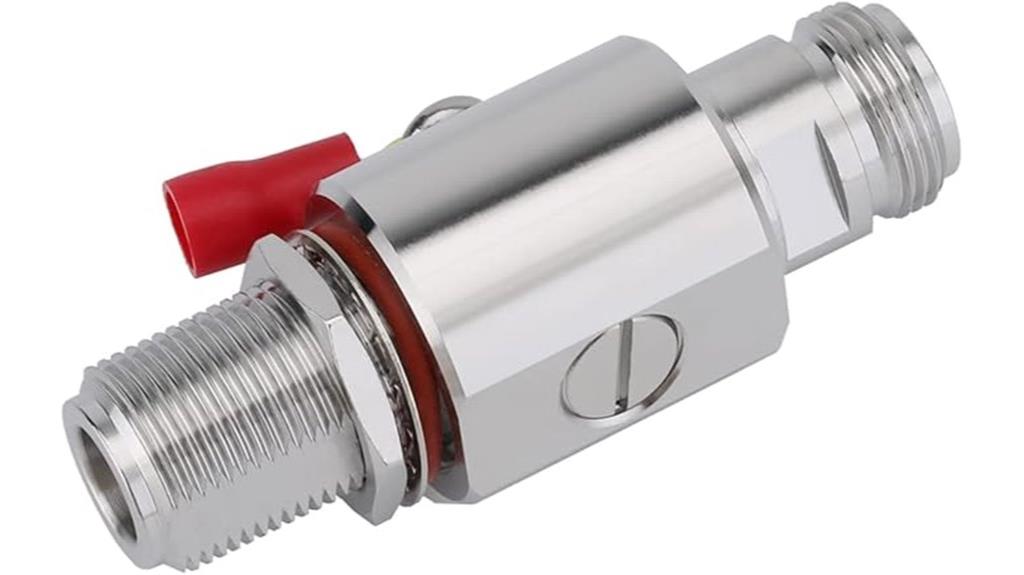
Designed for outdoor RF systems exposed to harsh conditions, the Lightning Surge Protector with N Female to N Female Bulkhead IP67 offers reliable protection against lightning strikes and power surges. Made of nickel-plated brass with gold-plated contacts and a Teflon insulation, it’s built to withstand salt spray for 48 hours. Its IP67 waterproof rating guarantees durability in wet environments. With a 50-ohm impedance and frequency range up to 3 GHz, it maintains signal integrity with less than 0.2 dB attenuation. Easy to install near equipment or antennas, it features a replaceable gas discharge tube for high surge power, ensuring long-term, dependable protection.
Best For: outdoor RF system installers and technicians seeking durable lightning and surge protection for harsh weather environments.
Pros:
- Constructed with corrosion-resistant nickel-plated brass and gold-plated contacts for long-lasting reliability
- IP67 waterproof rating ensures protection against water and dust in outdoor conditions
- High surge power capability with a replaceable gas discharge tube suitable for lightning strikes
Cons:
- Requires additional grounding cable for complete protection setup
- Installation should be close to equipment or antennas, which may limit placement flexibility
- Limited frequency range up to 3 GHz, not suitable for ultra-high frequency applications
N Type Lightning Arrestor for 0 to 6 GHz
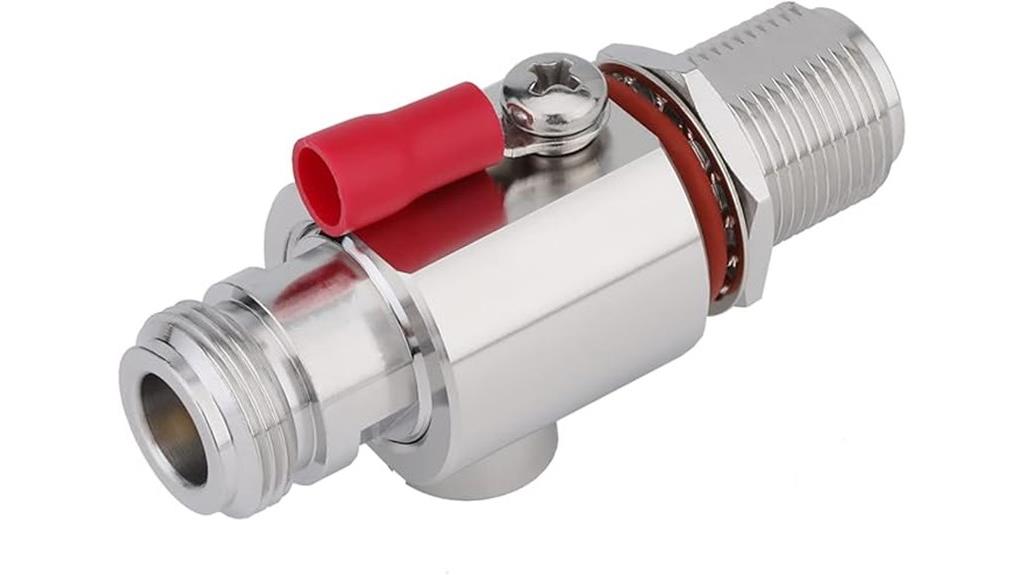
If you’re protecting outdoor antennas or RF equipment operating within 0 to 6 GHz, an N Type lightning arrestor offers reliable surge protection with high durability. It features high-quality brass nickel-plated N connectors and a rubber O-ring seal for secure mounting in harsh environments. Designed for inline or wall-mount installation, it passes DC and includes a ground lug for effective grounding. Capable of handling high-energy surges from lightning strikes, it provides bi-directional, multi-strike protection with replaceable gas discharge tubes. Its low insertion loss and minimal signal attenuation make it ideal for outdoor antennas, cellular boosters, Wi-Fi, GPS, and other RF applications.
Best For: outdoor antenna installers, radio hobbyists, and communication professionals seeking reliable surge protection for RF equipment within 0 to 6 GHz.
Pros:
- High-quality brass nickel-plated connectors ensure durability and corrosion resistance.
- Effective bi-directional, multi-strike surge protection with replaceable gas discharge tubes.
- Low insertion loss (<0.1 dB) maintains signal integrity across various RF applications.
Cons:
- May have limited power handling for high-power ham radio transmitters (above 50W).
- Installation requires proper grounding for optimal surge dissipation.
- Slightly compact size may limit use in some tight or complex setups.
Delta LA302R

The Delta LA302R stands out as an excellent choice for those needing robust surge protection at main and sub-panels, especially when installed more than 60 feet from the primary source. Its high surge capacity supports up to 60,000 amps and provides 2,000 joules per pole, ensuring reliable protection against lightning strikes. Built with a durable PVC case and silicon oxide varistor, it offers long-lasting, wear-resistant performance. Easy to install inside electrical panels, it’s ideal for safeguarding sensitive electronics and appliances. When combined with surge protectors, the LA302R delivers all-encompassing, high-level protection for your RF systems and electrical infrastructure.
Best For: homeowners and electrical professionals seeking reliable, high-capacity surge protection for main and sub-panels, especially when installation sites are more than 60 feet from the primary power source.
Pros:
- Supports up to 60,000 amps and 2,000 joules per pole for superior lightning surge protection
- Durable PVC case and silicon oxide varistor ensure long-lasting, wear-resistant performance
- Easy to install inside electrical panels, suitable for safeguarding sensitive electronics and appliances
Cons:
- Does not protect against smaller, everyday surges, requiring additional surge protectors for comprehensive coverage
- Installation requires familiarity with electrical panels, which may not be suitable for DIY beginners
- Limited information on compatibility with older electrical systems or specific panel models
UHF Coaxial Lightning Arrestor for Radio Antennas

For those working with low-power radio antennas, the UHF Coaxial Lightning Arrestor offers a reliable way to protect equipment from electrical surges. It features low RF insertion loss (<0.4dB) and a VSWR below 1.2, operating effectively from DC to 500MHz. Made with durable brass, Teflon insulators, and nickel plating, it’s built for long-term outdoor use. The device uses a gas tube to divert surges and is designed for surge protection in applications like Ham and CB radios. While rated around 90 watts, it’s best suited for receive or low-power setups. Proper grounding enhances its protective capabilities, making it a cost-effective safety addition.
Best For: low-power radio enthusiasts and outdoor antenna setups seeking affordable surge protection for receive or low-transmit power applications.
Pros:
- Low RF insertion loss (<0.4dB) and VSWR (<1.2) ensure minimal signal degradation.
- Durable construction with brass, Teflon insulators, and nickel plating for outdoor reliability.
- Replaceable gas tube allows for potential upgrades to higher power ratings.
Cons:
- Limited power handling (~90 watts), unsuitable for high-power transmitters.
- Some users report increased SWR (up to 2.7:1), indicating possible installation or compatibility issues.
- Sourcing higher-rated gas tubes can be difficult and may require custom matching.
Factors to Consider When Choosing Lightning Arrestors Rf Systems

When selecting a lightning arrestor for RF systems, I focus on ensuring it’s compatible with my equipment and can handle the required power levels. I also look at connection types, surge protection features, and how easy it is to install and ground properly. These factors are essential to keep my system safe and reliable during storms.
Compatibility With Equipment
Choosing the right lightning arrestor hinges on making certain it’s compatible with your RF equipment, so I always check the connector type, impedance, and frequency range first. Matching the connector type—whether UHF, N-type, or SMA—is essential for a secure connection. I also verify that the arrestor’s impedance, typically 50 Ohms, aligns with my system to avoid signal loss or reflections. Making sure the operating frequency range covers my equipment’s bands guarantees effective surge protection without hindering performance. I also examine the surge protection components to confirm they can handle the power levels and surge energies I might encounter. Finally, I verify that the mounting style suits my setup, whether inline, bulkhead, or wall-mount, to ensure a proper and secure installation.
Power Handling Capacity
The power handling capacity of a lightning arrestor is critical because it determines how much surge energy it can safely divert without sustaining damage. This capacity is typically measured in joules or watts and indicates the maximum surge energy the device can handle. For high-power transmitters and large antenna systems, you need arrestors with higher ratings—such as 1000W or 6000A surge capacity—to ensure reliable protection. Using an arrestor with insufficient power capacity risks equipment damage during lightning strikes or transient surges. It’s vital to match the arrestor’s specifications with your RF system’s maximum power output. Overloading an arrestor beyond its rated capacity can cause failure, compromising your entire system’s safety. Proper power handling capacity is key to effective and durable lightning protection.
Connection Types & Sizes
Selecting the right connector types and sizes for lightning arrestors guarantees a secure and reliable connection with your RF system. It’s vital to match the arrestor’s connectors—such as UHF, N-type, SMA, or F female—to your coaxial cables and ports. Proper compatibility ensures a snug fit, minimizes signal loss, and maintains ideal RF performance. Many arrestors feature replaceable gas discharge tubes with specific voltage ratings, so choosing the correct connection type also aligns with your system’s voltage needs. Additionally, consider whether the connectors are suited for indoor or outdoor use, as options like bulkhead or panel-mount connectors can influence installation and durability. Ensuring these details fit your equipment’s specifications is key to effective surge protection and long-term reliability.
Surge Protection Features
When evaluating lightning arrestors for RF systems, it’s essential to pay close attention to their surge protection features, as these determine how effectively they shield your equipment from transient electrical events. Key aspects include gas discharge tubes (GDTs) rated for specific voltages, which shunt high-voltage surges to ground, and bi-directional protection that handles surges from either direction without damage. The maximum surge current capacity, measured in kiloamperes (kA), indicates how much energy the device can safely divert—higher ratings mean better protection. Additionally, low RF insertion loss and favorable VSWR ensure signals remain unaffected during normal operation. Replaceable GDTs extend the lifespan of the arrestor, allowing for maintenance and continued protection after multiple transient events.
Installation & Grounding
Proper installation and grounding are essential for maximizing the effectiveness of lightning arrestors in RF systems. I recommend connecting the ground lug directly to a dedicated, low-impedance grounding system using a short, heavy-duty copper wire, like #6 gauge or larger. Placing the arrestor as close as possible to your equipment or antenna reduces unprotected cable length, enhancing surge dissipation. It’s imperative to maintain a single-point ground system to divert lightning surges effectively and avoid multiple grounding paths that can cause interference or damage. Use a properly rated grounding wire, securely attached, to lower resistance and prevent static buildup. Regular inspection and maintenance of grounding connections are vital to ensure ongoing surge protection performance and the integrity of your grounding system over time.
Durability & Weather Resistance
Durability and weather resistance are key factors to contemplate when choosing lightning arrestors for RF systems, especially for outdoor applications. I recommend selecting models with weatherproof enclosures made from resilient materials like nickel-plated brass, stainless steel, or UV-resistant plastics, which can withstand harsh elements. An IP67 or higher waterproof rating is essential to prevent moisture ingress during rain, snow, or high humidity. The arrestor should operate reliably across a wide temperature range, from -55°C to +155°C, to handle extreme environmental conditions. Corrosion-resistant coatings and insulating materials such as Teflon (PTFE) help maintain longevity and performance over time. Additionally, ensure the internal gas discharge tubes are rated for outdoor use and are easily replaceable, ensuring ongoing protection after surges or weather-related wear.
Maintenance & Replacement
Regular inspection and testing of gas discharge tubes (GDTs) are vital because these components can degrade over time, diminishing the arrestor’s surge protection capability. Many lightning arrestors feature replaceable GDTs, making maintenance straightforward and cost-effective—no need to replace the entire unit. The lifespan of a GDT depends on surge frequency and energy levels; frequent or high-energy surges can shorten its effective life. Proper storage and handling also play a key role in extending service life, so avoid physical damage and environmental exposure whenever possible. Routine replacement intervals vary based on environmental conditions and surge exposure, but experts often recommend replacing GDTs every few years for maximum safety. Staying proactive with maintenance ensures your RF system remains protected and operational.
Frequently Asked Questions
How Do Lightning Arrestors Impact RF Signal Quality?
Lightning arrestors can improve RF signal quality by preventing lightning-induced surges from damaging your equipment. They work by safely diverting high-voltage spikes to the ground, reducing noise and interference that can degrade signal clarity. Properly installed arrestors ensure minimal signal loss while providing protection. I’ve found that choosing high-quality arrestors tailored to your system’s frequency range makes a noticeable difference in maintaining strong, clear RF signals during storms.
What Are the Differences Between Surge Protectors and Lightning Arrestors?
Think of surge protectors as sturdy gates that block sudden energy surges, while lightning arrestors are vigilant sentinels guarding your fortress from lightning strikes. Surge protectors divert excess voltage from everyday power surges, protecting your equipment. Lightning arrestors specifically intercept and safely redirect lightning strikes, preventing catastrophic damage. Both are essential, but lightning arrestors are specialized for severe, high-energy events, offering targeted protection for your RF systems.
Can Lightning Arrestors Be Used for Both Indoor and Outdoor Systems?
Yes, lightning arrestors can be used for both indoor and outdoor systems. I’ve found they’re designed to withstand different environmental conditions, making them versatile for various settings. When choosing one, I always check the specifications to guarantee it’s rated for outdoor use if needed, so it effectively protects my equipment from lightning strikes and surges, whether indoors or outside. Proper selection ensures reliable, long-term protection.
How Often Should Lightning Arrestors Be Inspected or Replaced?
I recommend inspecting lightning arrestors at least once a year, or more frequently if your environment experiences severe weather. Regular checks make certain there are no corrosion, damage, or loose connections that could compromise protection. Replace them immediately if you notice any signs of wear or after a lightning strike. Staying proactive helps keep your RF systems safe and operational, preventing costly downtime or equipment damage.
Are There Specific Regulations for Lightning Protection in RF Installations?
Yes, there are specific regulations for lightning protection in RF installations, which vary by country and industry standards. I always recommend consulting local electrical codes and standards like UL, NFPA, or IEC guidelines to ensure compliance. It is vital to follow these regulations to protect your equipment and personnel. Regular inspections and proper grounding are also essential, and staying updated on regulations helps prevent costly penalties or damage.
Conclusion
Choosing the right lightning arrestor is like installing a sturdy shield around your RF system’s delicate heart. With options suited for every need, you can confidently protect your equipment from unexpected surges. Remember, the right protector isn’t just an accessory; it’s your system’s lifeline in stormy weather. So, choose wisely and keep your setup safe, because in the world of RF, a good defense is the best offense.