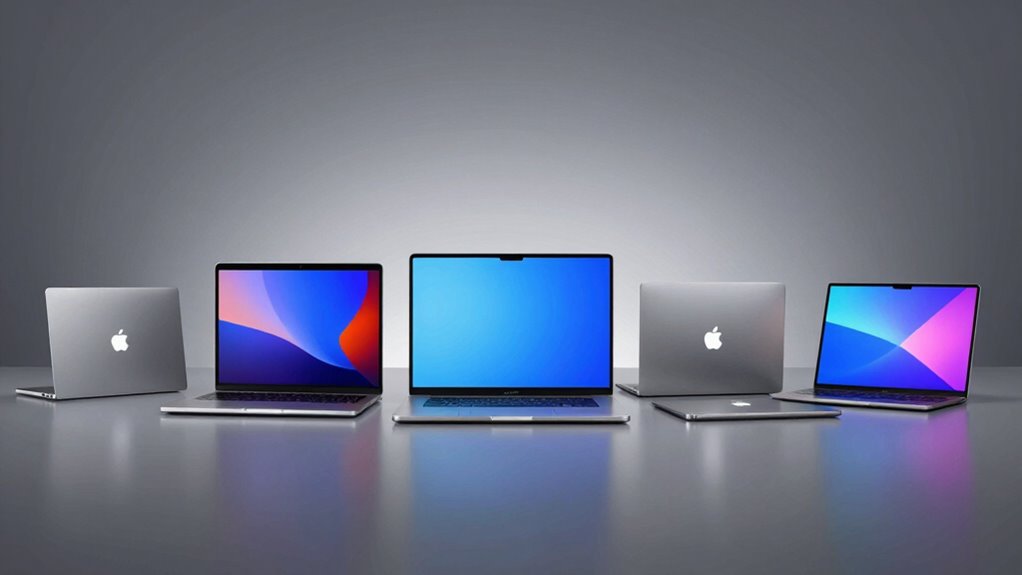

For demanding creative and professional work, my leading picks are the 16-inch M5 Max with 128GB memory for workloads that can use substantial graphics and memory resources, the 16-inch M5 Pro with 48GB and 2TB for a large-screen workstation with extra storage, and the 14-inch M5 Pro with 48GB for a more portable high-end setup. The right choice depends less on the MacBook Pro name than on how much memory, graphics capacity, screen space, and built-in storage your work can use.

Get privacy and security gear delivered free with Prime
- Fast, free delivery on millions of items
- Prime Video, Amazon Music and more included
- Member-only deals all year
This roundup ranks five configurations around those tradeoffs. The M5 Max is the most specialized choice; the M5 Pro models balance demanding work with more restrained configurations. The 14-inch M5 with 32GB is the least powerful option here, but it still offers a strong display and useful ports in a smaller chassis. I also flag a specification conflict in one listing, since a buyer should verify the exact chip before choosing it.
Key Takeaways
- The 16-inch M5 Max configuration leads for workloads that can take advantage of its 40-core GPU, 128GB unified memory, and 4TB SSD.
- The 16-inch M5 Pro with 48GB memory and a 2TB SSD adds storage over the otherwise similar 1TB M5 Pro configuration.
- The 14-inch M5 Pro with 48GB memory is the more portable Pro-class option in this lineup, though its listed weight is 2.14 kg.
- The 14-inch M5 with 32GB memory and 1TB storage suits demanding everyday work better than workloads that depend on the higher-end M5 Pro or M5 Max configurations.
- The 14-inch M5 Pro listing has conflicting chip specifications, so I would confirm its exact configuration before buying.


| macbook pro high end | Storage | Display | Chip | CPU |
|---|---|---|---|---|
| Apple 16-inch MacBook Pro with | 4TB SSD | 16.2-inch Liquid Retina XDR | Apple M5 Max | 18-core |
| Apple 16-inch MacBook Pro with | 2TB SSD | 16.2-inch Liquid Retina XDR | Apple M5 Pro | 18-core |
| Apple 16.2-inch MacBook Pro wi | 1TB SSD | 16.2-inch Liquid Retina XDR | Apple M5 Pro | 18-core |
| Apple MacBook Pro 14.2-inch wi | 1TB SSD | 14.2-inch Liquid Retina XDR, 3456 × 2234, 120Hz | — | — |
| Apple 14.2-inch MacBook Pro wi | 1TB SSD | 14.2-inch Liquid Retina XDR | Apple M5 | 10-core |
More Details on Our Top Picks
Apple 16-inch MacBook Pro with M5 Max, 18-core CPU, 40-core GPU, 128GB memory, and 4TB SSD
This is the most heavily configured option in the group: an M5 Max with a 40-core GPU, 128GB unified memory, and a 4TB SSD. Those capacities make it the clearest fit for demanding creative and professional projects that can use substantial memory, graphics resources, and local storage. Compared with the 16-inch M5 Pro models, its GPU and memory configuration place it in a different tier for work that can take advantage of them.
The 16.2-inch Liquid Retina XDR display gives demanding work more screen area than either 14-inch option, while the included 140W USB-C power adapter supports the larger configuration. The tradeoff is that this is easy to overspec for everyday office work, browsing, or projects with modest memory and graphics needs. It also prioritizes a large display and extensive capacity over the more portable 14-inch form factor. I would choose it when the work justifies the resources, rather than treating maximum specifications as a benefit in every workflow.
Pros:- M5 Max chip with a 40-core GPU for demanding graphics workloads
- 128GB unified memory supports large working sets
- 4TB SSD provides substantial local project storage
- 16.2-inch Liquid Retina XDR display offers more workspace than the 14-inch models
Cons:- Its extensive configuration may exceed the needs of everyday workloads
- The 16-inch size is less portable than the 14-inch options
Best for: Professionals whose graphics-intensive projects, large working sets, or local media libraries can make use of 128GB memory and 4TB storage.
Not ideal for: People who mainly handle routine office work, light creative tasks, or value a smaller laptop over maximum capacity.
- Chip:Apple M5 Max
- CPU:18-core
- GPU:40-core
- Unified memory:128GB
- Storage:4TB SSD
- Display:16.2-inch Liquid Retina XDR
- Peak brightness:1600 nits
- Power adapter:140W USB-C
Our verdict“I rank this first for buyers who can use its unusually large memory, GPU, and storage capacities in demanding professional work.”
Apple 16-inch MacBook Pro with M5 Pro, 18-core CPU, 20-core GPU, 48GB Memory, 2TB SSD, Space Black
This 16-inch M5 Pro configuration makes a practical case for choosing 2TB of built-in storage alongside 48GB unified memory. Its listed 18-core CPU and 20-core GPU match the other 16-inch M5 Pro configuration in this roundup, but it doubles that model’s SSD capacity. For sizeable project folders, media libraries, and work that stays on the laptop, that difference can matter more than moving to a higher chip tier.
Compared with the M5 Max pick, this configuration has a less expansive stated GPU and memory setup, so buyers whose work scales with graphics capacity or very large working sets may prefer the Max. Compared with the 1TB 16-inch M5 Pro, it gives the same stated memory and chip class with more room for local files. The 16.2-inch XDR display supports a roomy work area, but the description does not give a weight, and the larger chassis will not suit everyone who carries a laptop throughout the day. I see this as a focused professional configuration for buyers who want M5 Pro capability and more storage without jumping to the M5 Max setup.
Pros:- M5 Pro with an 18-core CPU and 20-core GPU
- 48GB unified memory for substantial multitasking
- 2TB SSD provides twice the listed storage of the 1TB M5 Pro option
- 16.2-inch Liquid Retina XDR display
Cons:- Less GPU and memory headroom than the M5 Max configuration
- 16-inch form factor is larger than the 14-inch alternatives
Best for: Creative and technical professionals who want a 16-inch screen, 48GB memory, and more local storage than the 1TB M5 Pro model.
Not ideal for: Buyers who need the M5 Max’s stated 40-core GPU and 128GB memory, or those who prioritize a compact laptop.
- Chip:Apple M5 Pro
- CPU:18-core
- GPU:20-core
- Memory:48GB
- Storage:2TB SSD
- Display:16.2-inch Liquid Retina XDR
- Peak brightness:1600 nits
- Included cable:USB-C to MagSafe 3, 2 m
Our verdict“I recommend this M5 Pro when 2TB of local storage and a large screen matter more than stepping up to the M5 Max.”
Apple 16.2-inch MacBook Pro with M5 Pro, 18-core CPU, 20-core GPU, 48GB Memory, and 1TB SSD
This 16-inch model keeps the same stated M5 Pro, 18-core CPU, 20-core GPU, and 48GB memory as the 2TB M5 Pro option, while providing a 1TB SSD. That makes the choice between those two configurations relatively clear: pick this one if 1TB fits your project library, or move to the 2TB model if keeping more work on the internal drive matters. Either way, both sit below the M5 Max in stated GPU and memory capacity.
The 16.2-inch Liquid Retina XDR display gives room for timelines, documents, or side-by-side windows, and the listing includes Thunderbolt 5, HDMI, SDXC, and MagSafe 3. Its stated support for up to three external displays and on-device AI workloads may appeal to people building a multi-screen work setup or running compatible tasks locally. At 4.71 pounds, though, it is a substantial laptop to carry; the 14-inch M5 Pro is the more compact direction, albeit with a different listed chip configuration. This is a sensible large-screen professional choice when display space matters more than carrying weight or doubling the SSD.
Pros:- M5 Pro chip with an 18-core CPU and 20-core GPU
- 48GB unified memory
- 16.2-inch Liquid Retina XDR display
- Thunderbolt 5, HDMI, SDXC, and MagSafe 3 connectivity
Cons:- Listed weight is 4.71 pounds
- 1TB SSD offers less local storage than the otherwise similar 2TB M5 Pro configuration
Best for: Professionals who want a large built-in display, 48GB memory, and M5 Pro performance with a 1TB SSD.
Not ideal for: People who need the extra 2TB capacity, maximum M5 Max graphics and memory, or a lighter travel laptop.
- Chip:Apple M5 Pro
- CPU:18-core
- GPU:20-core
- Display:16.2-inch Liquid Retina XDR
- Memory:48GB unified memory
- Storage:1TB SSD
- Weight:4.71 pounds
- Wireless:Wi-Fi 7, Bluetooth 6
Our verdict“I would choose this model over the 2TB sibling when 1TB is sufficient and the large-screen M5 Pro setup is the priority.”
Apple MacBook Pro 14.2-inch with M5 Pro, 48GB Memory, 1TB SSD, Space Black
This 14-inch MacBook Pro offers 48GB unified memory and a 1TB SSD in a smaller-screen configuration, giving it a distinct role beside the 16-inch M5 Pro models. It is the more portable direction for buyers who want substantial memory but prefer a 14.2-inch display. Its listed 3456 × 2234 resolution, 120Hz refresh rate, Liquid Retina XDR panel, and 12MP Center Stage camera make it a feature-rich option for work and calls.
There is a meaningful caveat: the product description says M5 Pro, while the listed chip details specify a 15-core CPU and 16-core GPU, unlike the 18-core CPU and 20-core GPU in the two 16-inch M5 Pro configurations. The stated weight is also 2.14 kg, so the smaller screen does not automatically make it light to carry. Compared with the 14-inch M5 with 32GB, this listing has more memory and names the Pro chip, but the conflicting chip information makes its exact position harder to judge. I would confirm the configuration before purchase and favor it when portability and memory are the main priorities.
Pros:- 48GB unified memory in a 14.2-inch configuration
- 1TB SSD and Liquid Retina XDR display
- Thunderbolt 5, HDMI, SDXC, and MagSafe 3 ports
- 12MP Center Stage camera and six-speaker audio
Cons:- Description and specs give conflicting chip information
- Listed weight of 2.14 kg may be substantial for a 14-inch laptop
- Less display area than the 16-inch M5 Pro models
Best for: Buyers who want a 14-inch screen and 48GB memory for professional multitasking, after confirming the exact chip configuration.
Not ideal for: Anyone unwilling to verify conflicting processor details, or buyers seeking the lighter option based on screen size alone.
- Chip description:Apple M5 Pro
- Listed CPU:15-core
- Listed GPU:16-core
- Display:14.2-inch Liquid Retina XDR, 3456 × 2234, 120Hz
- Memory:48GB unified memory
- Storage:1TB SSD
- Weight:2.14 kg
- Camera:12MP Center Stage
Our verdict“I see this as the portable-screen M5 Pro candidate, but I would verify its exact chip before ranking it above the clearer 16-inch configurations.”
Apple 14.2-inch MacBook Pro with M5 Chip, 32GB Memory, 1TB SSD, Space Black
This 14-inch M5 configuration is the most restrained pick in a roundup focused on high-end MacBook Pros, but it still combines 32GB unified memory and a 1TB SSD with a Liquid Retina XDR display. It suits demanding everyday work and creative projects that do not need the higher stated GPU and memory capacity of the M5 Pro or M5 Max models. The combination of Thunderbolt 5, HDMI, SDXC, and MagSafe 3 also gives it a useful range of built-in connections.
Compared with the 14-inch M5 Pro listing, it has 32GB rather than 48GB memory and names the standard M5 chip, making it a less capable fit for heavier professional workloads. In return, its listed 3.41-pound weight is below the 16-inch M5 Pro model’s 4.71 pounds, though it is still heavier than many small laptops. The 12MP Center Stage camera and six-speaker audio support calls and media use, but they do not change its position as the entry point among these five high-end configurations. I would pick it for a 14-inch MacBook Pro with ample everyday capacity, not for workloads that specifically call for M5 Pro or M5 Max resources.
Pros:- 32GB unified memory and 1TB SSD
- 14.2-inch Liquid Retina XDR display
- Thunderbolt 5, HDMI, SDXC, and MagSafe 3 ports
- 12MP Center Stage camera and six-speaker audio
Cons:- Standard M5 chip sits below the M5 Pro and M5 Max options in this lineup
- Less memory than the 48GB configurations
- Listed weight is 3.41 pounds
Best for: People who want a 14-inch MacBook Pro with 32GB memory, 1TB storage, a strong display, and varied ports for demanding daily work.
Not ideal for: Professionals whose work depends on the higher stated GPU and memory capacity of the M5 Pro or M5 Max configurations.
- Chip:Apple M5
- CPU:10-core
- GPU:10-core
- Memory:32GB unified memory
- Storage:1TB SSD
- Display:14.2-inch Liquid Retina XDR
- Weight:3.41 pounds
- Connectivity:Wi-Fi 7, Bluetooth 6
Our verdict“I recommend this as the capable 14-inch everyday option for buyers who do not need the higher-tier M5 Pro or M5 Max configurations.”

How We Picked
I ranked these configurations for buyers specifically looking for a high-end MacBook Pro, weighing the stated chip, memory, graphics configuration, storage, screen size, and portability. A high-end label alone does not make every configuration equally suited to professional work: workloads that use large project files, extensive multitasking, or graphics processing can benefit from higher memory and GPU capacity, while other buyers may value a lighter machine or more built-in storage.
I gave the strongest position to the configuration with the broadest stated capacity for intensive work, then compared the M5 Pro models by how their memory, storage, and screen size serve different professional needs. The 14-inch M5 configuration is included because its 32GB memory, 1TB SSD, XDR display, and broad port selection make it a capable option, though it sits below the M5 Pro and M5 Max models for the most demanding workloads. I treated missing or conflicting details as limitations rather than filling gaps with assumptions.
| macbook pro high end | Chip |
|---|---|
| Apple 16-inch MacBook Pro with | Apple M5 Max |
| Apple 16-inch MacBook Pro with | Apple M5 Pro |
| Apple 16.2-inch MacBook Pro wi | Apple M5 Pro |
| Apple MacBook Pro 14.2-inch wi | — |
| Apple 14.2-inch MacBook Pro wi | Apple M5 |
Factors to Consider When Choosing Macbook Pro High End
I would start with the demands of your work, then compare screen size, memory, storage, and mobility. The most expensive-looking configuration is only a good match when its added resources solve a real workflow need.Choose the chip around your workload
The M5, M5 Pro, and M5 Max labels separate the configurations in this roundup. The M5 Max model has a stated 40-core GPU and 128GB memory, making it the strongest match for work that benefits from substantial graphics capacity and large working sets. The M5 Pro options offer 48GB memory and a 20-core GPU in their 16-inch configurations, a more focused fit for professional multitasking and creative work. The 14-inch M5 has 32GB memory and is better matched to demanding daily work that does not call for the higher-tier configurations.
I would not select a chip by its name alone. Think about the applications and project sizes you actually use. When a specific workload needs graphics processing, large files in memory, or extensive multitasking, the higher configuration may have practical value. For lighter projects, some of that capacity may go unused.
Decide whether 14 or 16 inches fits your routine
The 14-inch models take up less screen area on a desk and are the more compact choice in this group. The 16-inch versions provide more room for timelines, spreadsheets, and multiple windows, which can reduce how often you rearrange a workspace. The listed weight varies, and the 14-inch M5 Pro listing is given as 2.14 kg, so I would check the physical specification instead of assuming that a smaller screen guarantees a light carry.
If the laptop travels regularly, compare the actual dimensions and weight against your bag and routine. If it spends most of its time at a desk, the 16.2-inch display may be a better everyday workspace, especially if you often work without an external monitor.
Match storage to the files you keep locally
The two 16-inch M5 Pro listings make storage an easy comparison: one has a 1TB SSD, while the other has a 2TB SSD, with the same stated chip, CPU, GPU, and memory. The M5 Max option goes further with 4TB. More built-in capacity can help when large project files, video libraries, or other work need to remain on the laptop. If most files are archived elsewhere and current projects fit comfortably, the 1TB configuration may be sufficient.
Consider the size and number of active projects rather than relying on a vague sense that more storage is always better. Built-in capacity is especially useful when you work away from external drives or network storage, while external storage can handle archives that do not need to stay on the machine.
Check ports and display needs before choosing
These configurations list ports including Thunderbolt 5, HDMI, SDXC, and MagSafe 3, which can simplify connecting displays, accessories, and memory cards. The 16-inch M5 Pro listing also states support for up to three external displays. If your workflow depends on a camera card slot, direct display connection, or several peripherals, check that the particular configuration provides the connections you need.
All five options include a Liquid Retina XDR display, but the listings differ in size and detail. The 14-inch M5 Pro listing specifies 3456 × 2234 resolution and a 120Hz refresh rate; the 16-inch models provide a larger panel. Think about whether you value a compact screen with detailed listed specifications or more physical space for simultaneous windows.
Verify configuration details when listings conflict
The 14-inch M5 Pro listing needs extra care: its description names an M5 Pro, while the chip specifications list a 15-core CPU and 16-core GPU. Those details differ from the 18-core CPU and 20-core GPU listed for the two 16-inch M5 Pro models. Since the chip affects how this option compares, I would confirm the exact configuration with the seller before deciding.
For any configuration, match the product title, chip, memory, storage, and model identifier to the item being sold. A small mismatch can change whether it suits your workload, particularly when comparing a standard M5 with M5 Pro or M5 Max systems.
Frequently Asked Questions
Which MacBook Pro in this roundup is the most powerful?
The 16-inch MacBook Pro with M5 Max, 128GB unified memory, a 40-core GPU, and 4TB SSD has the strongest stated configuration here. It is the clearest fit for workloads that can use substantial graphics and memory capacity. For routine productivity or lighter creative work, the M5 Pro or M5 option may be a more fitting match.
Should I choose the 1TB or 2TB 16-inch M5 Pro?
Both listed 16-inch M5 Pro configurations have an 18-core CPU, 20-core GPU, and 48GB memory. The main stated difference is storage: 1TB versus 2TB. I would choose the 2TB model if you keep large active projects or media libraries locally; choose the 1TB model if that capacity fits the files you regularly need on the laptop.
Is the 14-inch M5 Pro a better choice than the 16-inch M5 Pro?
The 14-inch model is the more compact-screen choice and lists 48GB memory and a 1TB SSD, while the 16-inch M5 Pro models offer a larger 16.2-inch display and list an 18-core CPU with a 20-core GPU. The 14-inch listing has conflicting chip details, though, including a description that says M5 Pro and specifications that list a 15-core CPU and 16-core GPU. I would verify those details before comparing it as a straightforward alternative.
Is 32GB of memory enough for a high-end MacBook Pro?
It can be a reasonable fit for demanding everyday work and creative projects that do not require unusually large working sets. In this roundup, the 14-inch M5 pairs 32GB memory with a 1TB SSD. The 48GB M5 Pro configurations and 128GB M5 Max option offer more headroom for heavier multitasking and workloads that can use more memory, so the best fit depends on the size and type of work you run.
What should I confirm before choosing a configured MacBook Pro?
Match the exact chip, CPU and GPU core counts, memory, storage, screen size, and included accessories to the listing. I would pay special attention to the 14-inch M5 Pro option in this group because its description and chip specifications do not match. Confirming the configuration helps make a fair comparison against the clearly specified 16-inch M5 Pro and M5 Max models.
Conclusion
For workloads that can use extensive graphics resources and memory, I would choose the 16-inch M5 Max with 128GB memory and 4TB storage. If you want a large-screen M5 Pro, the 2TB configuration is the better fit when you keep substantial project files locally, while the 1TB sibling suits buyers who need the same stated M5 Pro and memory configuration with less internal storage. For a 14-inch screen with 48GB memory, I would verify the chip details on the M5 Pro listing before buying. If your work is demanding but does not need the higher Pro or Max configurations, the 14-inch M5 with 32GB and 1TB is the more restrained choice in this lineup.