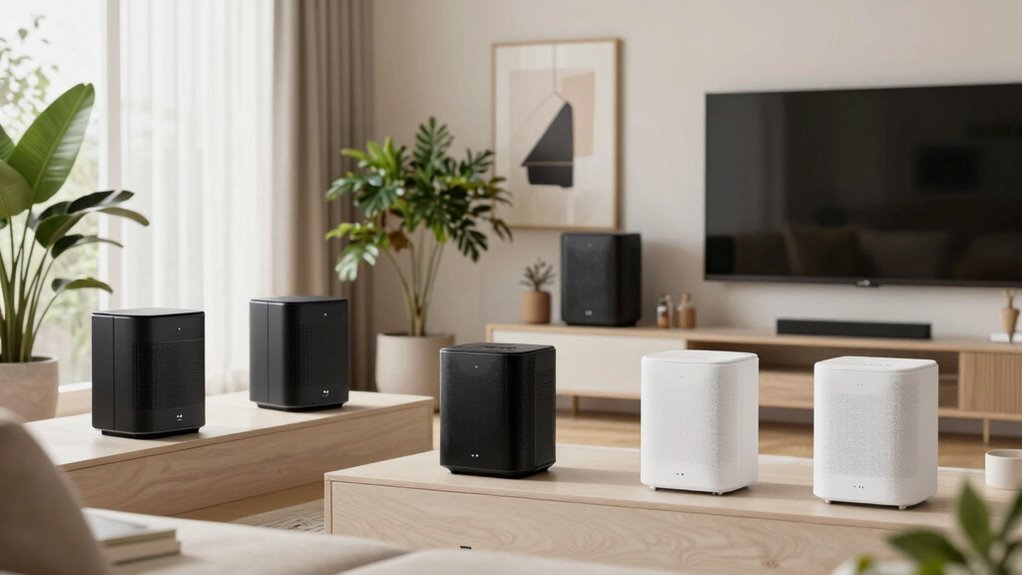

Choosing a mesh system for a large home means balancing more than the coverage number on the box: wireless backhaul, device load, wired ports, and WiFi generation all affect how well a network fits your layout. I put the TP-Link Deco 7 Pro BE10000 first for its tri-band WiFi 7 design, broad stated coverage, and multi-gig ports. The TP-Link Deco X55 is my practical WiFi 6 pick for homes with many devices, while the NETGEAR Orbi 370 offers WiFi 7 and a straightforward three-piece system.

Get privacy and security gear delivered free with Prime
- Fast, free delivery on millions of items
- Prime Video, Amazon Music and more included
- Member-only deals all year
The central tradeoff is clear: the Deco 7 Pro adds a dedicated 6 GHz band and higher device capacity, but many homes will not need its full feature set. Less costly-to-run WiFi 6 or WiFi 5 designs can suit ordinary browsing and streaming, though they offer less headroom. I rank these systems by how convincingly their coverage, backhaul options, device support, and management features serve a large-home buyer—not by a single maximum speed figure.
Key Takeaways
- The Deco 7 Pro is the strongest fit here for a large, busy home that can make use of tri-band WiFi 7, 6 GHz clients, and four 2.5 Gbps ports per unit.
- The Deco X55 offers a sensible WiFi 6 balance: stated coverage reaches 6,500 sq. ft., its system supports up to 150 devices, and every unit has three Gigabit ports.
- The Orbi 370 pairs WiFi 7 with a router and two satellites, but its dual-band design does not provide the Deco 7 Pro’s separate 6 GHz band.
- The Deco 7 BE5000 combines WiFi 7, coverage claims up to 6,600 sq. ft., and 2.5 Gbps ports without the Pro model’s tri-band configuration.
- The Deco S4 can suit basic whole-home connectivity, yet its WiFi 5 generation makes it a less future-ready choice than the other four systems.
| TP-Link Deco 7 Pro BE10000 Tri-Band Wi-Fi 7 Whole-Home Mesh System, 3-Pack |  | Best Premium | WiFi standard: WiFi 7 (802.11be) | Band configuration: Tri-band | Combined speed: Up to 10 Gbps | VIEW ON AMAZON | See Our Full Breakdown |
| TP-Link Deco X55 AX3000 Wi-Fi 6 Mesh System (3-Pack) |  | Best Value WiFi 6 | WiFi standard: WiFi 6 | Speed class: AX3000 | Band configuration: Dual-band | VIEW ON AMAZON | See Our Full Breakdown |
| NETGEAR Orbi 370 Series WiFi 7 Mesh System, 3-Pack |  | Best Router-and-Satellite WiFi 7 Pick | WiFi generation: WiFi 7 | Frequency bands: Dual-band | Maximum data transfer rate: Up to 5 Gbps | VIEW ON AMAZON | See Our Full Breakdown |
| TP-Link Deco 7 BE5000 Wi-Fi 7 Mesh System, Dual-Band, 3-Pack |  | Best Dual-Band WiFi 7 | WiFi standard: WiFi 7 (802.11be) | Band configuration: Dual-band | Combined speed: Up to 5 Gbps | VIEW ON AMAZON | See Our Full Breakdown |
| TP-Link Deco S4 AC1900 Mesh Wi-Fi System, 3-Pack |  | Best Basic Whole-Home Coverage | WiFi standard: WiFi 5 (802.11ac) | WiFi class: AC1900 | Frequency bands: Dual-band | VIEW ON AMAZON | See Our Full Breakdown |
| mesh wifi systems for large home | Coverage | Device capacity | WiFi standard | Ethernet |
|---|---|---|---|---|
| TP-Link Deco 7 Pro BE10000 Tri | Up to 7,600 sq. ft. | Over 200 devices | WiFi 7 (802.11be) | Four 2.5 Gbps WAN/LAN ports per unit |
| TP-Link Deco X55 AX3000 Wi-Fi | Up to 6,500 sq. ft. | Up to 150 devices | WiFi 6 | Three Gigabit ports per unit |
| NETGEAR Orbi 370 Series WiFi 7 | Up to 6,000 sq. ft. | Up to 70 devices | — | — |
| TP-Link Deco 7 BE5000 Wi-Fi 7 | Up to 6,600 sq. ft. | Over 150 devices | WiFi 7 (802.11be) | Two 2.5 Gbps WAN/LAN ports per unit |
| TP-Link Deco S4 AC1900 Mesh Wi | Up to 5,500 sq. ft. | Up to 100 devices | WiFi 5 (802.11ac) | Six Gigabit ports total |
More Details on Our Top Picks
TP-Link Deco 7 Pro BE10000 Tri-Band Wi-Fi 7 Whole-Home Mesh System, 3-Pack
I rank the Deco 7 Pro first because it is the most capable option here for a large, busy home that can use its extra radio capacity. Its tri-band WiFi 7 design adds a 6 GHz band alongside 5 GHz and 2.4 GHz, while the three-unit system is rated to cover up to 7,600 sq. ft. That combination gives compatible newer devices another band to use and provides more room for a household full of streaming, calls, gaming, and smart-home connections.
Its practical advantage over the dual-band Deco 7 BE5000 and Orbi 370 is not just the combined speed claim: the Pro also provides four 2.5 Gbps WAN/LAN ports per unit, USB 3.0, and support for wired or wireless backhaul. VPN support, HomeShield security, guest access, and Access Point Mode add useful network control. But these features bring complexity that a modest household may never need, and a separate modem is required. Wireless results will still depend on distance, obstacles, and placement.
I would choose this over the X55 when the home has compatible WiFi 7 devices, demanding simultaneous use, or multi-gig wired equipment. The X55 is a simpler WiFi 6 fit for a more typical connected home and includes many Gigabit ports. If most devices are older or the broadband plan is modest, the Deco 7 Pro’s extra capacity may not translate into a meaningful everyday difference.
Pros:- Tri-band WiFi 7 with a dedicated 6 GHz band
- Up to 7,600 sq. ft. stated coverage and support for over 200 devices
- Four 2.5 Gbps WAN/LAN ports and USB 3.0 on each unit
- Wired and wireless backhaul, VPN support, and HomeShield security
Cons:- Requires a separate modem
- Its full capabilities may be excessive for a lightly connected household
- Coverage and maximum speeds vary with obstacles and network conditions
Best for: Large households with many simultaneous users, newer WiFi 7 devices, or multi-gig wired equipment that can benefit from tri-band capacity.
Not ideal for: Buyers with modest internet needs, mostly older WiFi clients, or no interest in its advanced network and security features.
- WiFi standard:WiFi 7 (802.11be)
- Band configuration:Tri-band
- Combined speed:Up to 10 Gbps
- Coverage:Up to 7,600 sq. ft.
- Device capacity:Over 200 devices
- Ethernet:Four 2.5 Gbps WAN/LAN ports per unit
- USB:USB 3.0
- Management:TP-Link Deco app
- Modem:Separate modem required
Our verdict“I recommend the Deco 7 Pro for large, heavily connected homes that can make use of tri-band WiFi 7 and multi-gig networking.”
TP-Link Deco X55 AX3000 Wi-Fi 6 Mesh System (3-Pack)
The Deco X55 is my choice for a large household that needs broad coverage and capacity but does not need to move to WiFi 7. Its three units are rated for up to 6,500 sq. ft. and up to 150 devices, putting it close to the WiFi 7 Deco 7 BE5000 on stated coverage while keeping the feature set centered on WiFi 6. For homes with a mix of phones, laptops, TVs, and smart-home devices, that is a balanced combination rather than a bet on the newest standard.
Each unit has three Gigabit Ethernet ports, and wired backhaul is supported. If Ethernet runs connect rooms or floors, linking units by cable can reduce the strain on wireless links between them—a useful option in a sprawling or multi-storey home. Compared with the Deco S4, the X55 offers newer WiFi 6 and much higher stated device capacity. Compared with the Deco 7 Pro, it gives up WiFi 7, 6 GHz, and multi-gig ports, but many households will not need those upgrades.
The system is dual-band, so it lacks a third band that can add capacity to wireless mesh traffic. Also, most internet providers require a separate modem, which is not included in the stated system description. I would favor the X55 over the more advanced WiFi 7 picks when broad coverage, wired backhaul, and ports matter more than cutting-edge wireless capability.
Pros:- Up to 6,500 sq. ft. stated coverage
- Supports up to 150 connected devices
- Three Gigabit Ethernet ports on each unit
- Supports wired Ethernet backhaul
Cons:- Dual-band design has less wireless capacity than a tri-band system
- A separate modem is required for most internet providers
Best for: Families seeking WiFi 6 coverage across a large home, especially those who can connect mesh units with Ethernet.
Not ideal for: Buyers who want WiFi 7, a dedicated 6 GHz band, or 2.5 Gbps Ethernet ports.
- WiFi standard:WiFi 6
- Speed class:AX3000
- Band configuration:Dual-band
- Coverage:Up to 6,500 sq. ft.
- Device capacity:Up to 150 devices
- Ethernet:Three Gigabit ports per unit
- Backhaul:Wired Ethernet supported
- Management:Deco app
- Warranty:2 years
Our verdict“I would pick the Deco X55 for a capable, large-home WiFi 6 network, particularly when wired backhaul can be used.”
NETGEAR Orbi 370 Series WiFi 7 Mesh System, 3-Pack
The Orbi 370 stands out for buyers who want WiFi 7 in a clear router-and-satellite package: one router and two satellites, with stated coverage up to 6,000 sq. ft. and support for up to 70 devices. It offers up to 5 Gbps and works with WiFi 6 and WiFi 5 clients, so an existing mix of devices does not have to be replaced to use the system. App-guided setup and automatic firmware updates give the package a relatively approachable management path.
Against the Deco 7 BE5000, Orbi has a lower stated device limit and coverage figure, and both systems are dual-band WiFi 7 options. The Deco 7 BE5000 lists more than 150 devices and 2.5 Gbps ports on every unit, while Orbi lists 10 ports across the system and a 2.5 Gbps LAN port. Orbi’s stated coverage may still be enough for many large homes, but placement and construction will decide whether two satellites reach the rooms that matter.
Router protection and automatic updates are included, but the NETGEAR Armor trial lasts 30 days; ongoing Armor use requires a separate subscription. The system is specified for use in the US only. I would choose it for a buyer who likes the Orbi router-plus-satellite arrangement and wants a WiFi 7 upgrade, but not for someone seeking tri-band capacity or the largest device ceiling in this group.
Pros:- Router and two satellites rated for up to 6,000 sq. ft.
- WiFi 7 speed claim up to 5 Gbps with WiFi 6 and WiFi 5 compatibility
- App-guided setup and automatic firmware updates
- Expandable with another Orbi 370 Series satellite
Cons:- NETGEAR Armor requires a subscription after its 30-day trial
- Dual-band design does not offer a separate 6 GHz band
- Specified for use in the US only
Best for: US buyers who want a WiFi 7 router with two matching satellites, app-guided setup, and coverage for a large home.
Not ideal for: Households needing tri-band WiFi, support for more than 70 devices, or a system intended for use outside the US.
- WiFi generation:WiFi 7
- Frequency bands:Dual-band
- Maximum data transfer rate:Up to 5 Gbps
- Coverage:Up to 6,000 sq. ft.
- Device capacity:Up to 70 devices
- Configuration:Router and two satellites
- LAN port bandwidth:2.5 Gbps
- Security:WPA3, WPA2-PSK; router protection and automatic updates
- Region:For use in the US only
Our verdict“I recommend Orbi 370 when its router-and-satellite format and WiFi 7 support suit the household better than a higher-capacity Deco system.”
TP-Link Deco 7 BE5000 Wi-Fi 7 Mesh System, Dual-Band, 3-Pack
The Deco 7 BE5000 brings WiFi 7 to a three-unit mesh system without going tri-band. It is rated for up to 6,600 sq. ft. and more than 150 devices, and its dual-band configuration reaches a stated combined speed of 5 Gbps. That makes it a natural middle ground between the WiFi 6 Deco X55 and the tri-band Deco 7 Pro: newer wireless support and stronger device capacity than the X55, but without the Pro model’s third band.
Its clearest practical distinction is two 2.5 Gbps WAN/LAN ports per unit, alongside wired and wireless backhaul. Those ports can suit multi-gig broadband or faster local connections better than the X55’s Gigabit ports. AI-assisted roaming and app management also support a single mesh network across multiple rooms. But a dual-band design remains a compromise if satellites rely on wireless links and the household puts heavy simultaneous traffic through them. The stated system also requires a separate modem.
Compared with the Orbi 370, the Deco 7 BE5000 lists broader coverage and a higher device limit, plus multi-gig ports on each unit. Compared with the Deco 7 Pro, it loses the 6 GHz band and some of the Pro’s connectivity options, but that may be a sensible simplification when tri-band capacity is not needed. I place it below Orbi in the overall order because its strongest advantage is a feature-rich spec sheet; the right choice still depends on the home’s backhaul and device mix.
Pros:- WiFi 7 system rated for up to 6,600 sq. ft.
- Supports more than 150 devices
- Two 2.5 Gbps WAN/LAN ports per unit
- Supports wired and wireless backhaul
Cons:- Dual-band rather than tri-band
- A separate modem is required
- Backhaul requires at least two Deco units
Best for: Large homes wanting WiFi 7, high device capacity, and multi-gig ports without stepping up to a tri-band mesh.
Not ideal for: Buyers who need a dedicated 6 GHz band or expect wireless backhaul to handle intense traffic across multiple mesh links.
- WiFi standard:WiFi 7 (802.11be)
- Band configuration:Dual-band
- Combined speed:Up to 5 Gbps
- Coverage:Up to 6,600 sq. ft.
- Device capacity:Over 150 devices
- Ethernet:Two 2.5 Gbps WAN/LAN ports per unit
- Backhaul:Wired and wireless
- Management:Deco app
- Modem:Separate modem required
Our verdict“I would choose the Deco 7 BE5000 for WiFi 7 and multi-gig ports when the Deco 7 Pro’s tri-band design is unnecessary.”
TP-Link Deco S4 AC1900 Mesh Wi-Fi System, 3-Pack
The Deco S4 is the straightforward, older-generation option in this lineup. Its three units are rated for up to 5,500 sq. ft., support up to 100 devices, and create one network name for roaming around the home. Wired backhaul is supported, and the six Gigabit Ethernet ports across the system provide basic wired connectivity. For a household focused on everyday browsing, connected devices, and standard streaming, those features may be enough.
Its main limitation is its WiFi 5 standard. The X55 moves to WiFi 6 and raises the stated coverage to 6,500 sq. ft. while supporting up to 150 devices, making it a more capable choice for a growing or busier home. The WiFi 7 Deco models add newer wireless features and multi-gig ports. The S4’s strongest argument is simplicity: not every home needs the latest standard, but buyers should recognize that this choice gives up newer-generation capability.
Setup requires the Deco app on an Android or iOS device, and most internet providers require a separate modem. Parental controls and Alexa guest-network controls are useful additions, though they do not offset the generation gap for households with demanding broadband or heavy simultaneous activity. I would consider it for basic coverage needs, not as my first choice for a large home planning to keep its network for years.
Pros:- Three units rated for up to 5,500 sq. ft.
- One network name supports roaming around the home
- Wired Ethernet backhaul is supported
- Includes parental controls and Alexa guest-network controls
Cons:- WiFi 5 is older than the standards in the other four systems
- Requires the Deco app on an Android or iOS device for setup
- A separate modem is required for most internet providers
Best for: Households seeking basic mesh coverage, wired backhaul support, and simple roaming for everyday internet use.
Not ideal for: Large, busy households wanting WiFi 6 or WiFi 7 headroom, multi-gig ports, or the highest stated coverage in this comparison.
- WiFi standard:WiFi 5 (802.11ac)
- WiFi class:AC1900
- Frequency bands:Dual-band
- Coverage:Up to 5,500 sq. ft.
- Device capacity:Up to 100 devices
- Ethernet:Six Gigabit ports total
- Backhaul:Wired Ethernet supported
- Controls:Parental controls and Alexa guest WiFi controls
- Setup:Deco app on Android or iOS
Our verdict“I would pick the Deco S4 only for basic whole-home needs where WiFi 5 capability is sufficient.”

How We Picked
I ranked these five systems for the specific demands of large homes: reaching distant rooms, keeping devices connected as people move around, and maintaining useful performance when multiple activities share the network. Coverage claims are a starting point, not a promise. Walls, floor plans, building materials, and satellite placement can change the result, so I weigh practical network design alongside the stated square footage.
My ranking gives extra weight to backhaul flexibility, band configuration, Ethernet capacity, device support, and WiFi generation. Tri-band WiFi 7 has an advantage for heavy concurrent use and compatible newer devices; WiFi 6 remains a capable option for many households. I also account for setup and ongoing considerations such as modem requirements, app-based management, and subscription-dependent security. I do not treat maximum combined speed or a manufacturer’s coverage estimate as a guarantee of real-world performance.
Each product has a defined role rather than being presented as a universal winner. The Deco 7 Pro leads for capability, the X55 is the balanced WiFi 6 alternative, and Orbi 370 suits buyers who prefer a dedicated router-and-satellite arrangement. The Deco 7 BE5000 targets WiFi 7 buyers who do not need tri-band, while the Deco S4 is the basic choice for less demanding households. A buyer whose home has Ethernet cabling may get more from wired backhaul than from a higher headline speed; I reflect that in the comparisons below.
| mesh wifi systems for large home | WiFi standard | Band configuration | Coverage | Device capacity |
|---|---|---|---|---|
| TP-Link Deco 7 Pro BE10000 Tri | WiFi 7 (802.11be) | Tri-band | Up to 7,600 sq. ft. | Over 200 devices |
| TP-Link Deco X55 AX3000 Wi-Fi | WiFi 6 | Dual-band | Up to 6,500 sq. ft. | Up to 150 devices |
| NETGEAR Orbi 370 Series WiFi 7 | — | — | Up to 6,000 sq. ft. | Up to 70 devices |
| TP-Link Deco 7 BE5000 Wi-Fi 7 | WiFi 7 (802.11be) | Dual-band | Up to 6,600 sq. ft. | Over 150 devices |
| TP-Link Deco S4 AC1900 Mesh Wi | WiFi 5 (802.11ac) | — | Up to 5,500 sq. ft. | Up to 100 devices |
Factors to Consider When Choosing Mesh Wifi Systems For Large Homes
I would start with the home’s layout and network use, then compare the radio design and ports. Coverage figures can help narrow the field, but they cannot account for every wall, floor, or satellite location.Match mesh coverage to the floor plan
Use each system’s coverage rating as a rough comparison, not a guaranteed boundary. The Deco 7 Pro lists up to 7,600 sq. ft., followed by the Deco 7 BE5000 at 6,600, Deco X55 at 6,500, Orbi 370 at 6,000, and Deco S4 at 5,500. These estimates do not tell you how well a signal crosses dense walls or reaches a detached area. In a long, multi-storey, or irregular home, satellite placement can matter as much as the product’s maximum figure. Place units where they can still receive a useful signal from the main router rather than hiding them in the weakest room.
Choose WiFi generation and bands for the devices you own
The Deco S4 uses WiFi 5, while the Deco X55 is WiFi 6 and the Orbi 370, Deco 7 BE5000, and Deco 7 Pro are WiFi 7. Newer standards can offer more capability, but a mesh upgrade does not make older client devices WiFi 7 devices. The most distinct configuration here is the tri-band Deco 7 Pro, which adds 6 GHz to its 5 GHz and 2.4 GHz bands. The other WiFi 7 options are dual-band. If your household mainly uses older phones, TVs, and laptops, the X55 may be a more proportionate choice than paying for capabilities few devices can use.
Think about wired backhaul before buying more wireless capacity
If Ethernet cable already runs between floors or rooms, look for a system that supports wired backhaul. The Deco X55, Deco S4, Deco 7 BE5000, and Deco 7 Pro list wired backhaul support; the supplied Orbi specifications focus on its router-and-satellite configuration. A cable between units can keep their mesh connection from sharing wireless capacity with client traffic. The WiFi 7 Deco systems also have 2.5 Gbps ports, while the X55 and S4 use Gigabit Ethernet. Check your broadband service and wired devices before treating a multi-gig port as a deciding benefit.
Estimate the household’s device load
Device capacity is not a direct measure of how many gadgets can stream demanding video at once. The listed limits range from 70 for Orbi 370 to 100 for Deco S4, 150 for X55, over 150 for Deco 7 BE5000, and over 200 for Deco 7 Pro. Smart plugs and sensors typically create different traffic demands from video calls or 4K streams. For a crowded home with frequent simultaneous activity, I would give band capacity and backhaul more weight than the device limit alone. For a family with ordinary mixed use, the X55 may already provide ample room.
Check modem, setup, and security requirements
The Deco X55, S4, 7 BE5000, and 7 Pro descriptions specify that a separate modem is required; check what your internet provider has supplied before planning the setup. The Deco models use the TP-Link Deco app, while Orbi uses the Orbi app. Orbi includes router protection and automatic firmware updates, with a 30-day Armor trial followed by a separate subscription requirement for that service. The Deco 7 Pro lists HomeShield security and VPN support. Decide whether those controls fit your needs, and check any ongoing service terms directly before relying on optional features.
Frequently Asked Questions
Which system is my strongest pick for a very large, busy home?
I would start with the TP-Link Deco 7 Pro BE10000 if the household has many simultaneous users, compatible WiFi 7 devices, or multi-gig wired equipment. It has the largest stated coverage of these five systems, supports over 200 devices, and offers tri-band WiFi 7 with four 2.5 Gbps ports per unit. That capability is not necessary for every large home; a wired-backhaul Deco X55 can be a more proportionate choice when the network load is more ordinary.
Is WiFi 7 necessary for a large home?
No. Home size alone does not make WiFi 7 necessary. A large home with moderate broadband use and mostly WiFi 5 or WiFi 6 devices may be well served by the Deco X55, especially if Ethernet can connect its mesh units. WiFi 7 becomes more compelling when you have compatible devices, demanding concurrent use, or a reason to value features such as the Deco 7 Pro’s 6 GHz band and multi-gig ports.
Does the largest coverage figure guarantee signal in every room?
No. The stated coverage figures are estimates, and actual reach depends on walls, building materials, floor layout, interference, and where each unit sits. Even the Deco 7 Pro’s up-to-7,600-sq.-ft. claim cannot promise coverage in every corner or an outbuilding. I would place mesh units to preserve a useful connection between them and check whether the system supports a suitable wired backhaul if the building makes wireless links difficult.
Should I choose tri-band or wired backhaul?
They solve different problems. Tri-band, as found on the Deco 7 Pro, provides another wireless band and can offer more capacity for compatible clients and mesh traffic. Wired backhaul uses Ethernet to link mesh units, which can help avoid relying on a wireless connection between floors. If your home already has Ethernet cabling, a dual-band system such as the Deco X55 or Deco 7 BE5000 may work well with wired links; without cabling and with heavy network activity, tri-band may be more appealing.
Do these mesh systems include a modem?
The product information specifies a separate modem requirement for the four Deco models in this roundup: Deco X55, Deco S4, Deco 7 BE5000, and Deco 7 Pro. The Orbi 370 listing describes compatibility with cable or fiber service but does not specify a modem as part of the router-and-satellite pack. Check your provider’s equipment and the exact system package before setup so you know whether an additional modem is needed.
Conclusion
For a large home with heavy simultaneous use, newer WiFi 7 devices, or multi-gig wired connections, I recommend the Deco 7 Pro BE10000 for its tri-band design and broad port selection. If you want a balanced WiFi 6 system and can use Ethernet between units, the Deco X55 is my practical pick. Choose the Orbi 370 if you prefer a router with two satellites and want WiFi 7 in a system specified for US use; choose the Deco 7 BE5000 if dual-band WiFi 7 and 2.5 Gbps ports fit your needs without the Pro model’s 6 GHz band. I would reserve the Deco S4 for basic coverage where WiFi 5 is enough. In every case, match the system to your floor plan, client devices, and backhaul options rather than relying on coverage or speed claims alone.