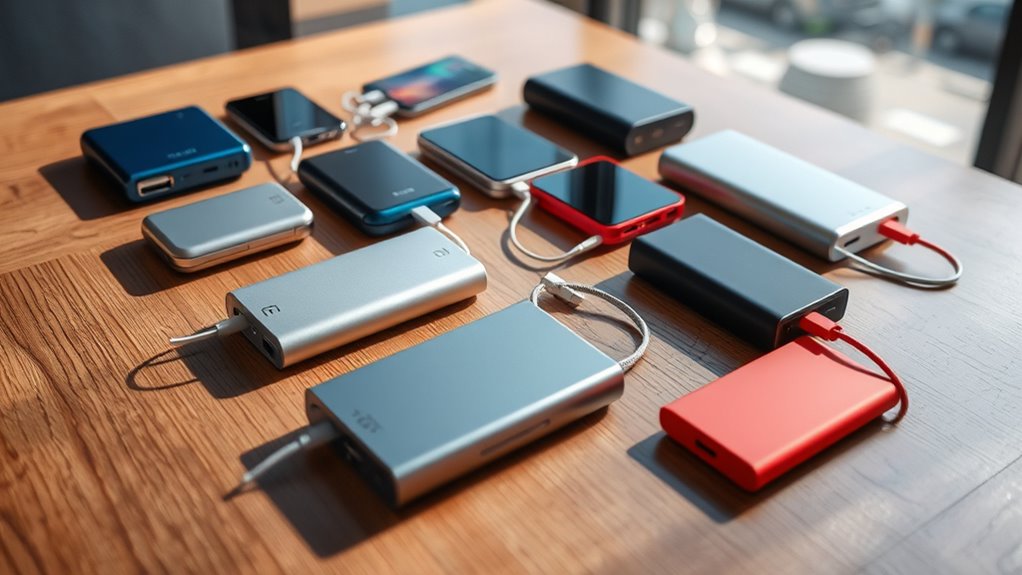

Portable chargers range from slim 5,500mAh emergency sticks to 60,000mAh bricks that can run a laptop, and the right choice depends almost entirely on how you travel and what you charge. The Anker Nano 10,000mAh with built-in retractable USB-C cable stands out as the best overall pick for its 45W output and knot-free design, while the Nimble Champ appeals to anyone who wants a repairable, sustainably built option with dual USB-C ports. The main tradeoff in this category is capacity versus portability — bigger batteries mean fewer outlets visited but heavier bags — followed closely by charging speed, since a 22.5W bank and a 45W bank feel very different when you’re topping up a modern phone. Budget shoppers get real value from the INIU and Charmast models, which hide built-in cables that eliminate the most forgotten accessory of all. Continue reading for the full breakdown of all ten chargers and which buyer each one suits best.

Get privacy and security gear delivered free with Prime
- Fast, free delivery on millions of items
- Prime Video, Amazon Music and more included
- Member-only deals all year
Key Takeaways
- Built-in cables were the biggest differentiator in this lineup: four of the ten chargers include them, which removes the most common failure point of a charging kit — forgetting the cable.
- The 10,000mAh capacity class dominated the top rankings because it balances phone-sized recharges, pocket portability, and airline-safe compliance better than the extremes on either end.
- The two 60,000mAh ZZI models are in a different product category entirely — they’re stationary backup power for camping or outages, not everyday carry, and are ranked accordingly.
- Charging wattage matters more than raw capacity for short top-ups: the Anker Nano’s 45W output refills a phone dramatically faster than the 22.5W field, and can even charge small laptops.
- Value picks like the Charmast 4-cable model and the Anker 2-pack undercut premium options mostly on warranty length and brand support, not on day-to-day performance.


| portable charger | Dimensions | Capacity | Weight | Warranty |
|---|---|---|---|---|
| ZZI Portable Charger Power Ban | 5.8 x 2.9 x 1.1 inches | — | — | — |
| Charmast 10000mAh Power Bank P | — | 10000mAh | 9.2 oz | — |
| Portable Charger 3 in 1 | 3.1 x 2.8 x 1.1 inches | — | 188g | 3-year replacement |
| Nimble Champ 10,000mAh Portabl | — | 10,000mAh | — | 2 years |
| INIU 10,000mAh Portable Charge | 0.6 x 2.79 x 5.3 inches | — | 210g | 3 years |
| Anker Nano Power Bank 10,000mA | 3.21 x 1.99 x 1.42 inches | 10,000mAh | 8.2 oz | 24 months |
| ZZI 60,000mAh Portable Charger | 5.8 x 2.9 x 1.1 inches | 60,000mAh | — | — |
| Mini 5500mAh USB-C Portable Ch | 3.14 x 1.45 x 0.98 inches | 5,500mAh | 0.23 lb | 36 months |
| Charmast 20,000mAh Portable Ch | — | 20,000mAh (77Wh) | 12.9 oz | 3 years |
| Anker Nano 10,000mAh Power Ban | 10.4 x 5.2 x 2.6 cm per unit | 10,000mAh per unit | — | — |
More Details on Our Top Picks
ZZI Portable Charger Power Bank 60000mAh, 22.5W PD Fast-Charging Battery Pack
Most power banks in this roundup top out around 10,000mAh, which makes the ZZI 60000mAh a different category of device entirely. Where the INIU 10,000mAh will recharge a phone twice, this one delivers roughly ten full iPhone charges, which changes who it is for: it is a shared station for a family, a campsite, or a power outage, not something you pocket for a commute. The built-in 3-in-1 braided cable covering USB-C, Lightning, and Micro USB means one brick can serve five devices at once without a tangle of cords, and the LED display removes the guesswork about remaining capacity.
The tradeoffs are real, though. It cannot fly — the capacity exceeds airline limits — and it takes about seven hours to refill itself, so you need to plan ahead. Its bulk also makes the Charmast or Nimble options far more sensible for everyday carry.
Pros:- 60000mAh capacity delivers up to ten iPhone charges from a single fill
- Charges up to five devices simultaneously with a built-in 3-in-1 braided cable
- 22.5W fast charging reaches 60% on an iPhone 15 in 30 minutes
- LED display shows exact remaining battery in real time
Cons:- Not permitted on airplanes due to its capacity
- Takes roughly seven hours to fully recharge the bank itself
- Heavier and thicker than standard 10,000mAh power banks
Best for: Families, campers, and emergency-preparedness planners who need many days of charges for multiple devices without wall power
Not ideal for: Air travelers and daily commuters — it exceeds airline battery limits and its size and weight defeat the purpose of everyday carry
- Battery Capacity:60000mAh
- Max Output Power:22.5W
- Number of Ports:3
- Rapid Charging:60% in 30 minutes
- Charge Time:7 hours
- Dimensions:5.8 x 2.9 x 1.1 inches
- Connector Types:USB Type A, USB Type C
Our verdict“Buy this if you need to keep several devices alive for days away from an outlet; skip it entirely if you fly often or want pocketable everyday carry.”
Charmast 10000mAh Power Bank Portable Charger with 4 Built-in Cables
The Charmast 10000mAh earns its spot by solving the problem most power banks ignore: forgotten cables. With four integrated reinforced cables plus a USB-C port and two USB-A ports, it can run up to six devices at once from a single slab. Compared with the Nimble Champ, which only offers dual USB-C and assumes you brought a cable, this model is self-sufficient — nothing extra to pack, nothing to lose in a bag.
Its slim, 9.2-ounce frame keeps it competitive with the 188g 3-in-1 charger for portability, and its multiple recharge paths (USB-C, USB-A, or Micro-USB input) mean you can top it up from almost anything. The obvious weak point is permanence: if a built-in cable frays or a connector breaks, it cannot be swapped out, and the whole unit degrades with it. That is the price of the all-in-one convenience.
Pros:- Four built-in cables plus three ports charge up to six devices simultaneously
- Eliminates the need to carry separate cords for USB-C, iPhone, and Micro-USB devices
- Multiple recharge options via USB-C, USB-A, or Micro-USB input
- Slim and lightweight at 9.2 oz for a fully self-contained charger
Cons:- Built-in cables cannot be detached or replaced if damaged
- Charging flexibility is capped by the fixed cable selection and available ports
Best for: Travelers and multi-device households who constantly misplace cables and want one charger that works for everything out of the box
Not ideal for: Long-term durability purists — integrated cables cannot be replaced if damaged, so a single frayed cord compromises the whole unit
- Capacity:10000mAh
- Built-in Cables:4
- Additional Ports:USB-C x1, USB-A x2
- Recharge Options:USB-C, USB-A, Micro-USB input
- Weight:9.2 oz
- Compatibility:USB-C phones, iPhone, Micro-USB devices, tablets
Our verdict“This is the pick for anyone tired of packing a nest of cables, as long as you accept that a broken built-in cord stays broken.”
Portable Charger 3 in 1 – 10000mAh Power Bank with Built-in Cables, 22.5W Fast Charging
What separates this 3-in-1 charger from the crowded 10,000mAh field is the dedicated 2.5W wireless pad for the iWatch. Neither the INIU 10,000mAh nor the Charmast can top up a watch without a separate accessory, so if an Apple Watch is part of your daily kit, this model quietly does a job the others cannot. It is also the lightest full-capacity option here at 188 grams, with a keychain loop that lets it ride on a bag strap rather than inside it.
Fast charging is competitive — 0% to 50% in 25 minutes matches the ZZI and INIU — and the certification stack plus 3-year replacement warranty adds confidence. The wireless pad is watch-only, so iPhone and Samsung watch users get nothing from it, and a wall adapter is not included. Capacity is roughly two phone charges, fine for a day but not a weekend.
Pros:- Dedicated wireless charging area for iWatch Series 4 through Ultra 3
- 22.5W fast charging takes a phone from 0% to 50% in 25 minutes
- Featherweight 188g design with keychain attachment for bag or belt carry
- Airline-safe certifications and a 3-year replacement warranty
Cons:- Wireless pad only charges iWatch, not iPhone or Samsung watches
- Wall adapter not included
- Capacity only recharges an iPad Pro about 1.2 times
Best for: Apple Watch and iPhone users who want one palm-sized charger covering phone, watch, and earbuds for day trips
Not ideal for: Android smartwatch owners and tablet-first users — the wireless pad is iWatch-exclusive and capacity only covers an iPad Pro about 1.2 times
- Battery Capacity:10000mAh
- Max Output:22.5W
- Number of Ports:5
- Charging Time:3.5 hours (18W adapter, not included)
- Weight:188g
- Dimensions:3.1 x 2.8 x 1.1 inches
- Certifications:UL2056, FCC, UN38.3, CE, RoHS
- Warranty:3-year replacement
Our verdict“If an Apple Watch is central to your setup, this is the most capable pocket-sized option in the lineup; everyone else can find better value elsewhere.”
Nimble Champ 10,000mAh Portable Charger with Dual USB-C Ports
The Nimble Champ makes this list on identity as much as performance. Built from certified recycled plastic and shipped in plastic-free biodegradable packaging, it is the only option here whose environmental footprint is a stated design goal rather than an afterthought. Capability-wise it sits between the Charmast and the INIU: dual USB-C ports handle two devices at once with 20W output, slightly behind the 22.5W chargers but fast enough for phones and earbuds.
The included lanyard is a thoughtful touch the others skip — it turns the charger into something you can hang from a backpack strap rather than bury in a pocket. The limitation is straightforward: with USB-C only, there is no USB-A fallback, so older cables, Lightning-only accessories, and borrowed cords from friends become dead weight. Compared with the Charmast’s four built-in cables, this is a minimalist’s tool, and you need to bring your own USB-C ecosystem to make it work.
Pros:- Constructed from certified recycled plastic with plastic-free biodegradable packaging
- Dual USB-C ports charge two devices simultaneously at up to 20W
- TSA compliant for air travel, unlike high-capacity options such as the ZZI
- Includes a USB-C cable and adjustable lanyard for hands-free carrying
Cons:- USB-C only, with no USB-A or Lightning compatibility
- 20W output trails the 22.5W options in this roundup
Best for: Environmentally conscious travelers who already live in a USB-C world and want a TSA-compliant, recycled-material charger
Not ideal for: Households with mixed older devices — no USB-A or Lightning support means legacy gear is left stranded
- Capacity:10,000mAh
- Maximum Output:20W
- Ports:Dual USB-C
- Material:Certified recycled plastic
- Packaging:Plastic-free and biodegradable
- Travel Compliance:TSA compliant
- Warranty:2 years
Our verdict“Choose the Nimble Champ if sustainability and simple USB-C travel matter more than raw speed or cable flexibility.”
INIU 10,000mAh Portable Charger with 22.5W Fast Charging
The INIU 10,000mAh is the balanced pick for people who want one charger that handles daily life without compromises in either direction. It matches the fastest output here at 22.5W with support for both PD 3.0 and QC 4+, so it negotiates top speed with iPhones, Samsung, and Pixel devices alike — an advantage over the Nimble Champ’s 20W ceiling. Its signature trick is the built-in phone stand: fold it out and the charger props your phone up for hands-free video while it refills, something no other product in this batch does.
At 210 grams and 0.6 inches thick, it slips into a pocket or the included travel pouch without effort, though it is slightly heavier than the 188g 3-in-1 charger. Capacity is standard for the class — roughly two phone charges — so anyone needing multi-day endurance should step up to the ZZI instead. For a single day out, this is the easiest all-rounder to live with.
Pros:- Full 22.5W output with both PD 3.0 and QC 4+ support across iPhone and Android
- Built-in phone holder enables hands-free viewing while charging
- Slim 0.6-inch profile at 210g slips easily into pockets or bags
- Includes a USB-C cable, travel pouch, and 3-year warranty
Cons:- Capacity is modest compared with larger banks like the 60000mAh ZZI
- Actual charge counts vary by device, so heavy phones get fewer full refills
Best for: Daily commuters and students who want one dependable fast charger that doubles as a phone stand for trains and desks
Not ideal for: Multi-day travelers and heavy device users — two phone charges per fill will not last a weekend away from an outlet
- Battery Capacity:10,000mAh
- Fast Charging Output:22.5W
- Number of Ports:3
- Connector Type:USB Type-C
- Weight:210g
- Dimensions:0.6 x 2.79 x 5.3 inches
- Special Features:Built-in phone holder
- Warranty:3 years
Our verdict“This is the default recommendation for most buyers — fast, compact, and practical — unless you need watch charging or multi-day capacity.”
Anker Nano Power Bank 10,000mAh 45W Portable Charger with Built-In Retractable USB-C Cable
This Anker Nano stands out as the most balanced pick because it solves the two most common portable-charger frustrations: forgotten cables and slow top-ups. The retractable USB-C cable rated for over 20,000 bends means one less thing to pack, and the 45W output charges an iPhone 16 Pro to roughly 50% in about 27 minutes — noticeably quicker than the Charmast 20,000mAh’s 22.5W ceiling. The smart display showing exact remaining capacity is a genuine step up from the ZZI 60,000mAh’s basic LED bar. Compared with the Anker Nano 2-pack, this model trades a second unit for a higher wattage ceiling and pass-through charging, which suits a single power user more than a family splitting chargers.
Pros:- 45W USB-C output charges an iPhone 16 Pro to roughly 50% in about 27 minutes
- Retractable built-in cable rated for over 20,000 bends eliminates cable clutter
- Smart display shows precise remaining charge, unlike simple LED indicators
- Flight-approved 10,000mAh capacity with a compact 8.2 oz footprint
Cons:- 45W max output is underpowered for larger laptops and high-draw devices
- If the built-in cable fails, the power bank loses a key feature
- Full recharge takes about 2 hours even at 30W input
Best for: Daily commuters and frequent flyers who want one charger that fast-charges a phone, earbuds, and a small tablet without carrying extra cables
Not ideal for: Laptop-first travelers — 45W won’t keep larger machines like a 16-inch MacBook Pro charged at full speed
- Capacity:10,000mAh
- Max Output:45W USB-C
- Input:30W
- Ports:Built-in retractable USB-C cable, USB-C, USB-A
- Weight:8.2 oz
- Dimensions:3.21 x 1.99 x 1.42 inches
- Special Features:Pass-through charging, smart display, retractable cable, flight-approved
- Warranty:24 months
Our verdict“If you want a single do-everything power bank with fast charging and no extra cables to carry, this is the one to buy.”
ZZI 60,000mAh Portable Charger with 22.5W Fast Charging
Where every other pick in this lineup tops out at 20,000mAh, the ZZI goes to 60,000mAh — enough capacity to keep a whole family’s devices alive across a weekend camping trip or a multi-day power outage. Charging up to five devices at once with a built-in 3-in-1 cable covering Type-C, iOS, and Micro USB makes it a genuine group charger rather than a personal one. That said, it makes real tradeoffs: unlike the Anker Nano 45W, output peaks at 22.5W, so individual phones charge more slowly, and its size makes it a base-camp battery rather than a pocket option. The deal-breaker for some: the product description states it cannot be taken on airplanes, so the Anker Nano or Charmast are better picks for flying.
Pros:- Massive 60,000mAh capacity outlasts every other charger in this roundup by 3x or more
- Charges up to five devices simultaneously
- Built-in 3-in-1 cable covers Type-C, iOS, and Micro USB without extra accessories
- Five-layer safety protection covering overcharge, overcurrent, overdischarge, overvoltage, and short circuits
Cons:- Not permitted on airplanes, ruling it out for travel by air
- 22.5W maximum output charges individual phones slower than the Anker Nano’s 45W
- Bulky 5.8 x 2.9 x 1.1 inch body is impractical for pockets or small bags
Best for: Families, campers, and emergency-preparedness planners who need to recharge many devices over multiple days far from an outlet
Not ideal for: Air travelers and daily commuters — it’s banned from flights and far too large for a pocket or work bag
- Capacity:60,000mAh
- Maximum Output:22.5W
- Simultaneous Charging:Up to 5 devices
- Built-In Cable:3-in-1: Type-C, iOS, Micro USB
- Dimensions:5.8 x 2.9 x 1.1 inches
- Display:LED battery-level display
- Safety Protection:Overcharge, overcurrent, overdischarge, overvoltage, short circuit
- Air Travel:Not allowed on airplanes per product description
Our verdict“Buy this if you need days of off-grid power for multiple people; skip it entirely if you ever fly with your gear.”
Mini 5500mAh USB-C Portable Charger for iPhone 17/16/15 and Android
Not everyone needs a battery that lasts all weekend — sometimes you just need 40% more phone to get home. That’s exactly the niche this mini charger fills. At 0.23 lb and roughly 3 inches long, it plugs directly into your phone’s USB-C port with no cable at all, making it dramatically smaller than even the compact Anker Nano models. The LCD percentage display tells you precisely how much juice remains, which the LED-dot chargers at this size rarely offer. The tradeoff is stark, though: 5,500mAh delivers about 0.9 charges for an iPhone 16, so think of it as an emergency reserve, not a primary power source. And unlike the Charmast 20,000mAh with its built-in iPhone cable, it won’t work with any Lightning-era iPhone.
Pros:- Featherlight 0.23 lb plug-in design disappears into a pocket or clutch
- Built-in USB-C connector means zero cables to carry or forget
- LCD display shows exact battery percentage rather than vague dots
- Recharges itself in about 2-3 hours with PD fast charging
Cons:- 5,500mAh provides only about 0.9 charges for an iPhone 16 — strictly backup territory
- Incompatible with all Lightning-port iPhones (14 and earlier)
- Phone cases thicker than 4mm must be removed before plugging in
Best for: Minimalists and night-outers who want an invisible pocket reserve for a USB-C phone — enough to get home with battery to spare
Not ideal for: Anyone with an iPhone 14 or earlier, or heavy users who need multiple full charges per day
- Capacity:5,500mAh
- Connector:Built-in USB-C
- Ports:1
- Weight:0.23 lb
- Dimensions:3.14 x 1.45 x 0.98 inches
- Display:LCD digital battery percentage
- Recharge Time:About 2-3 hours
- Compatibility:iPhone 17/16/15 and USB-C Android; not iPhone 14 or earlier
- Warranty:36 months
Our verdict“This is an emergency reserve for USB-C phone owners, not a full-day power solution — buy it for the pocket, not the backpack.”
Charmast 20,000mAh Portable Charger with Built-In Cables and AC Plug
The Charmast’s party trick is the foldable AC plug — it recharges itself straight from a wall socket, no adapter to hunt for in a hotel room. Add built-in iPhone and USB-C/Micro-USB cables plus a USB-A port, and you can leave every accessory at home. With 20,000mAh, it doubles the capacity of the Anker Nano 45W, making it the better choice for a full weekend rather than a single day. But the numbers cut both ways: plugging into AC takes roughly 11 hours for a full recharge (about 6.5 via USB-C), and when multiple devices are connected, total output drops to a shared 15W — slower per device than the ZZI’s 22.5W. At 12.9 oz, it also weighs noticeably more than the Anker Nano’s 8.2 oz.
Pros:- Foldable AC plug recharges the bank from any wall outlet without an adapter
- Built-in iPhone and USB-C/Micro-USB cables plus USB-A cover three devices at once with nothing extra to carry
- 20,000mAh / 77Wh rating is carry-on air travel friendly
- Digital display shows remaining battery level at a glance
Cons:- Multi-device charging drops total output to a shared 15W, slowing every connected phone
- AC recharge takes approximately 11 hours for a full tank
- At 12.9 oz, it’s heavier than comparable 10,000mAh options like the Anker Nano
Best for: Travelers who hate packing bricks and cables and want wall-outlet self-charging plus multi-day 20,000mAh capacity
Not ideal for: Speed-focused users — shared 15W multi-device output and an 11-hour AC recharge make this one of the slower picks here
- Capacity:20,000mAh (77Wh)
- Max Single-Device Output:22.5W
- Shared Multi-Device Output:Up to 15W (5V/3A)
- Ports and Cables:Built-in iPhone cable, built-in USB-C/Micro-USB cable, USB-A, USB-C input
- AC Input:100-240V, 50/60Hz
- Recharge Time:About 11 hours via AC plug; 6.5 hours via USB-C
- Weight:12.9 oz
- Warranty:3 years
Our verdict“The pick for travelers who value an all-in-one design over charging speed — just plan your overnight recharges carefully.”
Anker Nano 10,000mAh Power Bank with Built-in USB-C Cable, 30W Fast Charging, 2-Pack
Most roundups assume you need one charger, but households need two — and buying this 2-pack typically beats purchasing separate units. Each 10,000mAh bank includes a built-in USB-C cable plus USB-C and USB-A ports, with 30W bidirectional charging for both devices and the bank itself. Compared with the single Anker Nano 45W, each unit here charges a phone more slowly, but you get double the total hardware for splitting between bags, cars, and gloveboxes. The 80% recycled plastic casing also gives it an edge over the ZZI and Charmast picks for buyers who weigh sustainability. The compromises mirror the single-unit version: 30W won’t drive full-speed laptop charging, and the short built-in cable can be awkward for bedside use — the Charmast’s longer attached cables handle that scenario better.
Pros:- Two complete chargers cost less than buying comparable singles separately
- Built-in USB-C cable plus USB-C and USB-A ports on each unit covers phones, tablets, and earbuds
- 30W bidirectional fast charging works for both devices and recharging the bank
- Outer casing made with 80% recycled plastic
Cons:- 30W output can’t provide full-speed charging for some larger laptops
- The short built-in cable is limiting for bedside or couch use
- Each 10,000mAh unit needs recharging after several device top-ups
Best for: Couples and families who want a capable charger in two different bags, or one for home backup and one for travel
Not ideal for: Anyone needing maximum charging speed — 30W trails the Anker Nano 45W and won’t fully power larger laptops
- Capacity:10,000mAh per unit
- Pack Size:2 power banks
- Max Output:30W
- Ports:Built-in USB-C cable, USB-C, USB-A
- Recharging Input:30W
- Dimensions:10.4 x 5.2 x 2.6 cm per unit
- Materials:80% recycled plastic outer casing
- Compatible Devices:iPhone, MacBook, Galaxy, AirPods, and more
Our verdict“The smart buy when two people need dependable chargers — accept slower 30W speeds in exchange for double the hardware.”

How We Picked
My ranking logic starts with a simple question: how well does each charger solve the actual problem of keeping devices alive away from an outlet? I weighted capacity-to-weight ratio heavily, because a power bank you leave at home is worthless, and I favored models that keep cables self-contained — built-in or retractable — since a cable-free design is what separates a grab-and-go charger from one that needs a prep ritual. Output wattage was the third filter: 22.5W is the practical floor for fast-charging modern phones, while 30W and 45W open the door to tablets and laptops.
From there, I compared build quality, port selection, airline compliance, and the strength of brand support. Products were then sorted by buyer fit rather than raw specs — which is why the massive 60,000mAh units sit lower in the rankings despite winning on paper capacity, and why the compact emergency sticks earn their spot for a job no large bank can do.
Factors to Consider When Choosing Portable Chargers
Before settling on any single model, it helps to understand the broader landscape of portable chargers — the capacity classes, the hidden costs of cheap units, and the mistakes that lead to buyer’s remorse.Match Capacity to Your Actual Day, Not Your Worst Case
Capacity is the spec buyers over-inflate most often. A 10,000mAh bank delivers roughly two full charges for a modern phone, which covers a long travel day, a festival, or a dead-battery emergency with room to spare. Stepping up to 20,000mAh makes sense only if you’re charging multiple devices or going off-grid for a weekend. The mistake I see repeatedly is buying a 60,000mAh brick ‘just in case’ — those units weigh over a kilogram and spend their lives in a drawer. Buy for your typical day, and carry a small wall charger for the rare worst case.
Wattage Determines How Fast Life Returns to Your Device
Wattage is the spec that determines whether a top-up takes forty minutes or two hours, and it’s where cheap chargers quietly cut corners. A 22.5W output supports most phones’ fast-charging protocols and is the sensible baseline for 2026. Jumping to 30W or 45W matters most for large phones, tablets, and USB-C laptops — a 45W bank like the Anker Nano can genuinely serve as an emergency laptop charger. One common mistake: assuming a high-capacity bank charges quickly. Many giant capacity units still top out at 22.5W, so check the output rating before assuming speed scales with size.
Ports and Built-In Cables Change How You Actually Use It
Port selection is where convenience is won or lost. A bank with only USB-A forces you to carry the right cable everywhere; a model with built-in or retractable cables (the Charmast and Anker Nano approach) turns the charger into a complete self-contained tool. Dual USB-C ports matter if your household runs modern devices exclusively, while a legacy USB-A port still earns its place for earbuds cases, older accessories, and lending a charge to a friend. Also check whether the bank supports pass-through charging — the ability to charge the bank and your device from one outlet simultaneously — a feature frequent travelers rely on at crowded airport plugs.
Weight, Size, and Airline Rules
Every airline caps lithium batteries at 100Wh, which corresponds to roughly 27,000mAh — anything larger cannot fly in carry-on luggage at all, which immediately disqualifies the 60,000mAh class for travelers. Below that threshold, weight becomes the deciding comfort factor: the difference between a 200g slim bank and a 450g brick is felt daily in a jacket pocket or small bag. If you commute light, prioritize something that disappears into a pocket; if you carry a backpack anyway, a 20,000mAh unit with an AC wall plug built in — like the Charmast — can eliminate a separate charger from your kit entirely.
Brand Support, Certifications, and Long-Term Value
A power bank is a sealed lithium battery, and quality control matters more here than in almost any other accessory category. Established brands back their products with multi-year warranties and replace faulty units; unknown-label banks often ship with inflated capacity claims and weaker cell protection circuitry. Look for FCC, CE, or UL certification markers on the listing — these indicate the battery management system has passed basic safety screening. Paying slightly more for a reputable brand buys you overcharge protection, temperature management, and a realistic lifespan of three to five years instead of a unit that swells or dies within a year.
Sustainability and Repairability
Power banks are consumables — the cells degrade whether you use them or not — so longevity and end-of-life handling are worth a moment of thought. Brands like Nimble build chargers from recycled plastics and run take-back programs for dead batteries, which matters if you’re trying to limit e-waste. Repairability in this category is limited by design, but replaceable cables (rather than permanently attached ones) extend a bank’s useful life, since cables usually fail before cells do. A two-pack, like the Anker Nano bundle, also spreads risk across two smaller units rather than concentrating it in one.
Frequently Asked Questions
Is 10,000mAh enough for a full day away from outlets?
For most people, yes — a 10,000mAh bank holds roughly two complete charges for a current-generation phone, which comfortably covers a long travel day, heavy navigation use, or a full day of photo-taking. It becomes marginal if you’re charging two people’s devices, running a tablet, or using hotspot mode extensively, which drains phones faster than almost any other task. In those cases, step up to a 20,000mAh model like the Charmast with AC plug. Remember that advertised capacity is measured at the cell’s voltage, so real usable output is around 60–70% of the sticker number after conversion losses.
Are power banks with built-in cables a good idea, or do they break?
Built-in cables are one of the most practical features in this category because the single most common reason a power bank fails to help is a forgotten cable, not a dead battery. The tradeoff is that a fixed cable is a single point of failure — if it frays or snaps, you may lose the bank’s main charging path. Retractable designs like the Anker Nano’s protect the cable when stowed and tend to hold up better than permanently exposed loops. As a hedge, choose a model like the Charmast or INIU that keeps standard ports alongside the built-in cables, so you always have a backup method.
Can I take a large power bank on a plane?
Airline regulations cap lithium batteries at 100 watt-hours in carry-on baggage, which works out to roughly 27,000mAh, so both 60,000mAh models in this lineup are off the table for flights entirely. Banks between 100Wh and 160Wh require airline approval, and nothing in the typical consumer range exceeds that. All of the 5,500mAh, 10,000mAh, and 20,000mAh options here fly without issue, though they must go in carry-on, never checked luggage. If you fly often, this single rule should steer you toward the mid-capacity class regardless of other preferences.
What’s the difference between 22.5W, 30W, and 45W charging in practice?
Wattage dictates how quickly energy flows, and the gap is tangible: a 22.5W bank typically delivers about 50% charge to a modern phone in 30–40 minutes, while a 45W bank like the Anker Nano can do the same in roughly half that time under ideal conditions. Higher wattage also unlocks device categories — 30W and above can meaningfully charge tablets, and 45W handles many USB-C laptops in a pinch. Your device caps the benefit, though: an older phone that maxes out at 18W gains nothing from a 45W bank. If your devices support it, the faster output future-proofs the purchase for your next upgrade.
Why would I buy a tiny 5,500mAh charger when bigger ones exist?
Small-capacity banks solve a different problem than big ones — they exist for the pocket, not the backpack. A 5,500mAh unit like the Mini in this lineup typically weighs under a third of a 10,000mAh bank and slides into jeans or a clutch, which means it’s actually with you when your phone dies at a concert or on a walk. It delivers one full emergency charge rather than several, and that’s a fair trade for something you’ll carry every day without noticing. Many buyers end up owning both: a slim stick for daily carry and a larger bank for travel days.
Conclusion
The right portable charger depends less on specs and more on how you move through your day. For best overall, the Anker Nano 10,000mAh with retractable cable and 45W output hits the sweet spot of speed, self-contained design, and carry-friendly size. The INIU 10,000mAh and the Anker Nano 2-pack take best value — dependable fast charging at a lower buy-in, with the 2-pack doubling your coverage. For premium buyers, the Nimble Champ justifies its price with dual USB-C ports, recycled construction, and strong brand support. Beginners should start with the Charmast 10,000mAh with four built-in cables, because it works with virtually any device out of the box with zero accessories. And for specific needs: the Charmast 20,000mAh with AC plug for multi-device travelers, the Mini 5,500mAh for pocket-only carry, and the ZZI 60,000mAh for camping or outage backup — never for air travel. Match the pick to your routine, and you won’t think about battery anxiety again.
Halloween Picks
halloween
As an affiliate, we earn on qualifying purchases.