
The best solar generator for remote work in this lineup is the EF EcoFlow DELTA 3 Classic, pairing a 1,024Wh battery with a 220W panel for a strong balance of workday capacity and solar charging. The BLUETTI Elite 100 V2 is another 1,024Wh option for buyers weighing a different compact power-station setup, while the Jackery Explorer 2000 v2 suits longer off-grid stretches with its larger battery and two 200W panels. The main tradeoff is portability versus runtime: compact 300Wh-class units are easier to carry but may need recharging during a demanding workday, while large systems take more space and effort to move. Solar-panel output and device power draw also affect how much of a workday can be supported away from an outlet. Read on for the full breakdown, ranking logic, and advice on matching capacity to your work setup.

Get privacy and security gear delivered free with Prime
- Fast, free delivery on millions of items
- Prime Video, Amazon Music and more included
- Member-only deals all year
Complete the kit


Key Takeaways
- The 1,024Wh EF EcoFlow DELTA 3 Classic and BLUETTI Elite 100 V2 stand out as balanced workday choices; both offer more room for a laptop-and-accessories setup than the 292–300Wh-class picks.
- The Jackery Explorer 2000 v2 is the long-runtime choice, with a 2,000Wh-class battery and two 200W panels, but it is a larger commitment to transport and store.
- Small capacity does not automatically mean the best portable work setup: the 300Wh-class Jackery, DaranEner, ZeroKor, and EnginStar models call for careful energy budgeting and realistic expectations about solar replenishment.
- Panel size varies as much as battery capacity: the included panels range from 30W to 400W total, so kit contents can change how useful a station is during a sunny workday.
- The UDPOWER S2400 and S1200 occupy different roles: the S2400 prioritizes 2,083Wh capacity and 2,400W output, while the S1200 kit pairs a more moderate station with a 120W panel.
| UDPOWER S1200 Solar Generator Kit with 120W Solar Panel |  | Best for Multi-Device Remote Offices | Battery capacity: 1,190Wh | Battery type: LiFePO4 | Continuous output: 1,200W | VIEW ON AMAZON | See Our Full Breakdown |
| Jackery Explorer 300 Portable Power Station with 40W Solar Panel |  | Best for Light-Duty Remote Work | Battery capacity: 292Wh | Battery chemistry: LiFePO4 | Peak output: 600W | VIEW ON AMAZON | See Our Full Breakdown |
| DaranEner 300W Portable Power Station with 30W Solar Panel |  | Best Compact Pick | Battery capacity: 192Wh | Battery type: LiFePO4 | AC output: 300W | VIEW ON AMAZON | See Our Full Breakdown |
| Jackery Explorer 2000 v2 Portable Power Station with Two 200W Solar Panels |  | Best for Extended Off-Grid Work | Battery capacity: 2,042Wh | Battery type: LiFePO4 | AC output: 2,200W | VIEW ON AMAZON | See Our Full Breakdown |
| EF EcoFlow DELTA 3 Classic Solar Generator with 220W Solar Panel, 1024Wh |  | Best for Fast Backup and Recharging | Battery capacity: 1,024Wh | Battery chemistry: LiFePO4 | AC output: 1,800W | VIEW ON AMAZON | See Our Full Breakdown |
| Jackery Explorer 300 Portable Power Station, 292Wh |  | Best Compact Pick | Battery capacity: 292Wh | Battery chemistry: LiFePO4 | Peak surge: 600W | VIEW ON AMAZON | See Our Full Breakdown |
| ZeroKor 300W Portable Power Station with 60W Solar Panel | 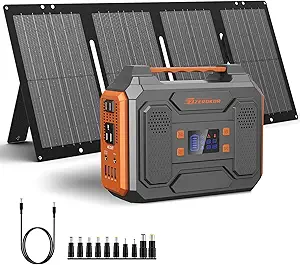 | Best for Solar-Ready Beginners | Maximum output: 300W | Solar panel: 60W monocrystalline, 20.5% conversion efficiency | AC outlets: 2, 300W maximum | VIEW ON AMAZON | See Our Full Breakdown |
| UDPOWER S2400 Portable Power Station, 2083Wh LiFePO4 Battery, 2400W Output |  | Best for a Stationary Home Office | Battery capacity: 2083Wh | Battery chemistry: LiFePO4 | Peak output: 3000W | VIEW ON AMAZON | See Our Full Breakdown |
| EnginStar 300W Portable Power Station with 60W Foldable Solar Panel |  | Best Lightweight Solar Kit | Battery capacity: 296Wh | AC output: 300W | AC outlets: 2 × 110V pure sine wave | VIEW ON AMAZON | See Our Full Breakdown |
| BLUETTI Elite 100 V2 Solar Generator with 200W Solar Panel, 1024Wh |  | Best Premium Remote-Work Backup | Battery capacity: 1024Wh | Power Lifting output: 2700W | Included solar panel: 200W; ships separately | VIEW ON AMAZON | See Our Full Breakdown |
| solar generators for remote work | Battery capacity | Weight | Included solar panel |
|---|---|---|---|
| UDPOWER S1200 Solar Generator | 1,190Wh | 25.8 pounds | 120W, foldable, IP65-rated |
| Jackery Explorer 300 Portable | 292Wh | 12.9 pounds | 40W |
| DaranEner 300W Portable Power | 192Wh | 5.84 pounds | 30W |
| Jackery Explorer 2000 v2 Porta | 2,042Wh | 39.5 pounds for power station; 66.8 pounds listed item weight | — |
| EF EcoFlow DELTA 3 Classic Sol | 1,024Wh | — | 220W bifacial |
| Jackery Explorer 300 Portable | 292Wh | Listed as 7.5 lbs in the description and 7.1 pounds in specifications | — |
| ZeroKor 300W Portable Power St | — | — | — |
| UDPOWER S2400 Portable Power S | 2083Wh | 41 lbs | — |
| EnginStar 300W Portable Power | 296Wh | 6.5 lbs for the station; 4 lbs for the solar panel | 60W foldable monocrystalline, 23% conversion efficiency |
| BLUETTI Elite 100 V2 Solar Gen | 1024Wh | — | 200W; ships separately |
More Details on Our Top Picks
UDPOWER S1200 Solar Generator Kit with 120W Solar Panel
The UDPOWER S1200 suits a remote-work setup that needs to keep a laptop, monitor, router, and smaller accessories running from one station. Its 1,190Wh LiFePO4 battery offers far more reserve than the Jackery Explorer 300, while 14 ports make it easier to power several devices without juggling adapters. The included foldable 120W IP65-rated panel adds a practical recharging option for outdoor work, though its output is modest beside the two 200W panels bundled with the Jackery Explorer 2000 v2. A claimed sub-0.01-second UPS switch is a particular draw for a desktop or network connection that should stay on through a brief outage. The tradeoffs are its 25.8-pound carry weight and the possibility that the station and panel arrive separately; the panel also has a shorter warranty.
Pros:- 1,190Wh capacity provides substantially more work-session reserve than compact 192–292Wh stations.
- Fourteen ports accommodate a broad mix of office and personal devices.
- Included 120W foldable panel is IP65-rated for outdoor use.
- LiFePO4 battery is rated for over 4,000 cycles, with claimed UPS switching under 0.01 seconds.
Cons:- At 25.8 pounds, the station is less convenient to carry between work locations than the DaranEner 300W.
- The 120W panel recharges more slowly than the 400W panel set included with the Jackery Explorer 2000 v2.
- Station and panel may ship separately, and the panel warranty is shorter than the station warranty.
Best for: Remote workers running several modest-power devices who want a large battery, varied ports, and included solar charging for a semi-mobile office.
Not ideal for: Travelers who need a very light kit, or workers who depend on fast solar replenishment and want a larger included panel.
- Battery capacity:1,190Wh
- Battery type:LiFePO4
- Continuous output:1,200W
- Peak output:1,800W
- Included solar panel:120W, foldable, IP65-rated
- Charging ports:14 total: 5 AC, 2 USB-C, 4 USB-A, 1 car port, 2 DC5521
- UPS switch time:Claimed less than 0.01 seconds
- Weight:25.8 pounds
- Warranty:5 years for power station; 1 year for solar panel
Our verdict“Choose the UDPOWER S1200 if your remote office needs a substantial device reserve and broad connectivity more than ultralight portability.”
Jackery Explorer 300 Portable Power Station with 40W Solar Panel
The Jackery Explorer 300 is the pick for a laptop-and-phone workday where portability matters more than running a full desk. Its 292Wh LiFePO4 battery and 12.9-pound weight make it easier to bring along than the UDPOWER S1200, but the smaller reserve means it is less suited to powering a monitor, router, and laptop for an extended shift. Two AC outlets plus USB and car ports let you charge several items, although the included 40W solar panel is a slow replenishment option: the product data estimates about 7.5 hours to reach 80%. That makes solar useful for topping up in suitable conditions, not a quick fix between work sessions. Compared with the 192Wh DaranEner, this Jackery offers more capacity and a longer stated cycle rating, at the cost of greater weight.
Pros:- 292Wh capacity is a useful step up from the DaranEner 300W’s 192Wh battery.
- Integrated handle and 12.9-pound weight support easier transport than larger office-oriented stations.
- AC, USB-C, USB-A, and car outputs can serve several device types.
- LiFePO4 battery is rated for over 4,000 cycles to 70% capacity.
Cons:- The 40W panel is slow, with a stated charging time of about 7.5 hours to reach 80%.
- 292Wh is a limited reserve for long shifts with a laptop, monitor, and networking gear.
- Power station and solar panel may ship separately.
Best for: Laptop-first remote workers who need a portable backup for a few essential devices and can recharge from AC power between outings.
Not ideal for: People powering a multi-monitor workstation or relying on the included panel to rapidly refill the battery during a short outdoor workday.
- Battery capacity:292Wh
- Battery chemistry:LiFePO4
- Peak output:600W
- Included solar panel:40W
- Ports:2 AC outlets, 1 USB-C PD, 2 USB-A, 1 car port
- Weight:12.9 pounds
- Charge cycles:Over 4,000 cycles to 70% capacity
- Warranty:3+2 years
Our verdict“Pick the Explorer 300 if you need portable backup for a small device kit, not an all-day power source for a full workstation.”
DaranEner 300W Portable Power Station with 30W Solar Panel
When a remote-work kit has to fit beside a laptop in a car or small bag, the DaranEner 300W is the most portable option here: it weighs 5.84 pounds and measures just 8.41 × 5.28 × 7.44 inches. Its 192Wh capacity and 300W AC output are enough for a restrained setup, such as charging a laptop and phone, but they leave much less working time than the Jackery Explorer 300’s 292Wh battery or the larger UDPOWER S1200. Two pure sine wave AC outlets and USB-C ports provide useful flexibility for its size. The included 30W solar panel can help extend use when conditions allow, but it is not a fast recharge source. This is a portability-first choice, not a substitute for a high-capacity desk backup.
Pros:- At 5.84 pounds, it is markedly easier to carry than the Jackery Explorer 300 or UDPOWER S1200.
- Two pure sine wave AC outlets provide flexibility for small AC-powered work gear.
- USB-C includes 60W PD and 30W outputs, alongside USB-A and DC ports.
- Can recharge from AC, a car socket, or the included solar panel.
Cons:- 192Wh capacity limits runtime compared with the Jackery Explorer 300 and larger stations.
- 300W AC output rules out many higher-draw devices and appliances.
- The included 30W panel is a slow way to replenish the battery.
Best for: Mobile workers who travel light and need a compact source for a laptop, phone, and a few low-power accessories.
Not ideal for: Remote workers running multiple displays, power-hungry equipment, or long shifts without access to another charging source.
- Battery capacity:192Wh
- Battery type:LiFePO4
- AC output:300W
- Surge output:600W
- Included solar panel:30W
- USB-C outputs:1 × 60W PD and 1 × 30W
- Total output ports:8
- Weight:5.84 pounds
- Recharging methods:AC, car, solar
Our verdict“Choose the DaranEner if low carry weight matters more than long runtime or powering a complete remote-work desk.”
Jackery Explorer 2000 v2 Portable Power Station with Two 200W Solar Panels
The Jackery Explorer 2000 v2 is the strongest fit for a remote office that needs long runtime and higher output rather than a lightweight carry. Its 2,042Wh battery and 2,200W AC output offer considerably more headroom than the UDPOWER S1200, while the included pair of 200W panels can recharge the station in a stated six hours under suitable conditions. That solar setup is also more substantial than the single 220W panel bundled with the EcoFlow DELTA 3 Classic. For workers who need to keep several devices or higher-draw equipment running away from the grid, the capacity is the main advantage. The cost of that reserve is portability: the station weighs 39.5 pounds, and the listed item weight is 66.8 pounds. Buyers must also check the DC8020 connection for Jackery panels.
Pros:- 2,042Wh capacity provides the largest stated energy reserve among these five options.
- 2,200W AC output gives more headroom for demanding work equipment than the UDPOWER S1200.
- Two included 200W panels provide a 400W solar array.
- 100W USB-C output and 20ms UPS switching support a range of work devices and backup needs.
Cons:- The 39.5-pound station, and 66.8-pound listed item weight, make this a poor choice for frequent carrying.
- The correct DC8020 plug connection is required for Jackery solar panels.
- Station and solar panels may ship separately.
Best for: Remote professionals setting up a semi-permanent off-grid office who need extended battery reserve, strong AC output, and a larger solar array.
Not ideal for: People who move their power station frequently, need a lightweight travel kit, or want simple panel connections without checking plug compatibility.
- Battery capacity:2,042Wh
- Battery type:LiFePO4
- AC output:2,200W
- AC ports:3
- Included solar panels:2 × 200W
- Solar charging time:6 hours with 400W panels
- USB-C output:100W
- UPS switching time:20ms
- Weight:39.5 pounds for power station; 66.8 pounds listed item weight
Our verdict“Choose the Explorer 2000 v2 for a stationary or semi-permanent remote office where long runtime outweighs carrying convenience.”
EF EcoFlow DELTA 3 Classic Solar Generator with 220W Solar Panel, 1024Wh
The EcoFlow DELTA 3 Classic balances usable workstation capacity with fast AC charging and quick outage response. Its 1,024Wh battery is smaller than the Jackery Explorer 2000 v2’s 2,042Wh reserve, but the 1,800W output and 3,600W surge capacity give it room for more demanding equipment than the compact Jackery Explorer 300. For grid-connected remote work, AC charging to 80% in a stated 45 minutes can make it easier to restore backup between work sessions. Its under-10ms UPS switching is also a strong fit for keeping sensitive electronics connected through brief interruptions. The included 220W bifacial panel is useful for solar charging, though the listed solar recharge time is 5.8 hours and is not a rapid top-up. Buyers should also expect the station and panel may arrive separately.
Pros:- 1,800W output and 3,600W surge capacity support more equipment than compact 300W-class stations.
- AC charging reaches 80% in a stated 45 minutes, useful between work shifts.
- Under-10ms UPS switching is suited to sensitive electronics and network gear.
- Included 220W bifacial panel offers a solar charging option.
Cons:- Its 1,024Wh capacity is half that of the Jackery Explorer 2000 v2, so it offers less extended off-grid reserve.
- Solar recharging with the included panel is listed at 5.8 hours.
- Power station and solar panel may arrive separately.
Best for: Remote workers who want a mid-to-high-capacity backup station with fast wall charging, strong AC output, and rapid UPS switching.
Not ideal for: Workers who need the longest off-grid runtime in this group or expect the included panel to recharge the battery quickly during limited sunlight.
- Battery capacity:1,024Wh
- Battery chemistry:LiFePO4
- AC output:1,800W
- Surge output:3,600W
- Included solar panel:220W bifacial
- AC charging:0–80% in 45 minutes
- Solar recharging time:5.8 hours with included 220W panel
- UPS switching time:Under 10ms
- Warranty:5 years
Our verdict“Pick the DELTA 3 Classic if quick AC recovery and fast UPS response matter more than the longest battery runtime.”
Jackery Explorer 300 Portable Power Station, 292Wh
For a remote worker who moves between a desk, a vehicle, and a temporary work spot, the 7.5-pound Explorer 300 is easier to carry than the 41-pound UDPOWER S2400. Its 292Wh capacity and 300W rated output suit a laptop, phone, and smaller accessories, but not a high-draw workstation or a long stretch without recharging. Two AC outlets plus USB-C and USB-A ports make it practical for charging several everyday devices, while the stated 100W USB-C PD output can serve compatible laptops directly. Unlike the EnginStar 300W, this listing does not include a solar panel, so off-grid charging adds another purchase. I’d also treat its listed weight and dimensions cautiously: the listing gives conflicting figures. Its LiFePO4 battery is rated for over 4,000 cycles, a strong durability point for frequent use.
Pros:- Lightweight design is easier to carry than the UDPOWER S2400
- 100W USB-C PD port can charge compatible laptops
- LiFePO4 battery is rated for over 4,000 charge cycles
- Two AC outlets plus USB and car-port outputs cover common work devices
Cons:- Solar panel is sold separately
- 292Wh capacity limits runtime for multiple devices or long workdays
- Listing provides conflicting weight and dimension figures
Best for: Mobile remote workers who carry a laptop and a few small devices between work locations and value a lightweight power station.
Not ideal for: People running power-hungry equipment or needing extended off-grid work sessions; its 292Wh capacity is modest, and a solar panel is not included.
- Battery capacity:292Wh
- Battery chemistry:LiFePO4
- Peak surge:600W
- AC outlets:2
- Ports:1 USB-C PD (100W), 2 USB-A, 1 car port (120W)
- Solar charging:80% in approximately 2.8 hours with a 100W panel; panel not included
- Weight:Listed as 7.5 lbs in the description and 7.1 pounds in specifications
Our verdict“Choose the Explorer 300 if portability matters more than long runtime and you are comfortable sourcing a compatible solar panel separately.”
ZeroKor 300W Portable Power Station with 60W Solar Panel
The ZeroKor makes the first step into solar power simpler by including a 60W monocrystalline panel, unlike the Jackery Explorer 300, which requires a separately purchased panel. Its 300W maximum output can support a laptop and small accessories, and AC, DC, and USB connections offer flexibility for mixed device setups. The included panel can also charge devices through its own USB-A and USB-C outputs, which may help when the power station itself is occupied. For remote work, though, the key gap is that battery capacity is not specified; I can’t judge likely runtime as confidently as I can with the 296Wh EnginStar. The panel’s junction box is not waterproof, so outdoor use calls for care around moisture. Treat this as a modest-power starter kit, not a dependable solution for high-wattage gear.
Pros:- Includes a 60W monocrystalline solar panel
- Can recharge from an AC outlet, solar panel, or 12V car port
- AC, DC, and USB outputs support several device types
- Flashlight includes reading and SOS modes
Cons:- Battery capacity is not specified, making runtime hard to estimate
- 300W maximum output rules out higher-power equipment
- Solar panel junction box is not waterproof
Best for: New solar-power users who want a panel included and need to charge a laptop or other devices within the 300W output limit.
Not ideal for: Remote workers who need a known runtime, use higher-wattage equipment, or expect to leave the panel exposed to wet weather.
- Maximum output:300W
- Solar panel:60W monocrystalline, 20.5% conversion efficiency
- AC outlets:2, 300W maximum
- DC output:9V–12.6V, 10A maximum
- USB outputs:3 × 5V/3A; 1 quick-charge port (5V/3A, 9V/2A)
- Solar panel USB outputs:USB-A and USB-C; each supports up to 15V/2A
- Recharging methods:AC outlet, 13V–23V solar panel, or 12V car port
- Protection:Short circuit, over-current, over-voltage, overload, and overheating protection
Our verdict“Pick the ZeroKor for an entry-level kit with a panel in the box, provided its unspecified capacity and 300W limit fit your work setup.”
UDPOWER S2400 Portable Power Station, 2083Wh LiFePO4 Battery, 2400W Output
The S2400 is the capacity-first option here: its 2083Wh battery and 2400W rated output give a remote office more headroom and longer working time than the Jackery Explorer 300 or the 296Wh EnginStar. Six AC outlets and multiple USB ports can keep a wider desk setup powered at once, while UPS switching within 0.01 seconds is aimed at maintaining power for connected equipment during an outage. The tradeoff is mobility. At 41 pounds, it suits a home office, RV, or fixed work base far better than a worker who carries gear between locations. It supports up to 440W solar charging, but no panel is listed as included. Its 1.3-hour AC recharge claim uses a 1600W input, so that fast refill depends on access to the specified charging setup.
Pros:- 2083Wh capacity offers far more stored energy than the compact 300W-class units here
- 2400W rated output and six AC outlets support a substantial desk setup
- UPS switching is specified at 0.01 seconds or less
- LiFePO4 battery is rated for over 4,000 charge cycles
Cons:- 41-pound weight makes frequent transport inconvenient
- Solar panel is compatible but not included
- Fast full recharge time depends on 1600W AC input
Best for: Home-based remote workers who need to keep a multi-device workstation running through outages and can leave the unit in one place.
Not ideal for: Digital nomads and frequent commuters who need a light, easy-to-carry power station or a solar panel included in the package.
- Battery capacity:2083Wh
- Battery chemistry:LiFePO4
- Peak output:3000W
- AC outlets:6
- Other ports:2 USB-C, 4 USB-A, 2 DC5521, 1 car port
- UPS switching time:≤0.01 seconds
- Maximum solar charging:440W; solar panel not listed as included
- Weight:41 lbs
Our verdict“Choose the S2400 for a mostly stationary remote office that needs substantial backup capacity, not for a lightweight mobile work kit.”
EnginStar 300W Portable Power Station with 60W Foldable Solar Panel
The EnginStar pairs a 296Wh battery with an included 60W foldable panel, giving it a clearer capacity story than the ZeroKor, whose battery capacity is not specified. At 6.5 pounds for the station, it is also a practical carry-on-the-road choice, though its panel adds another four pounds when you pack the full kit. The 300W AC limit is enough for a laptop and small accessories, not demanding workstation equipment; by comparison, the 1024Wh BLUETTI Elite 100 V2 offers much more capacity and output for a less mobile setup. EnginStar’s eight output ports and charging from solar, wall power, or a car socket help cover changing work locations. Its stated cycle life exceeds 1,000 charges, shorter than the 4,000-plus-cycle ratings on the Jackery and BLUETTI options.
Pros:- Includes a 60W foldable monocrystalline solar panel
- Station weighs 6.5 lbs and has a defined 296Wh capacity
- Eight output ports and three charging methods suit mobile work
- Battery protections guard against short circuits, overcharging, and overload
Cons:- 300W AC output cannot support higher-power appliances
- Battery cycle life is rated above 1,000 cycles, below the Jackery and BLUETTI figures
- Solar charging requires a compatible 12–25V panel
Best for: Remote workers who travel with a laptop and phone, want a solar panel included, and need a lightweight station for modest power demands.
Not ideal for: People powering high-wattage equipment or seeking a long-life battery with a 4,000-plus-cycle rating.
- Battery capacity:296Wh
- AC output:300W
- AC outlets:2 × 110V pure sine wave
- Output ports:8
- Included solar panel:60W foldable monocrystalline, 23% conversion efficiency
- Charging methods:Solar panel, wall outlet, or 12V car socket
- Maximum charging speed:65W
- Weight:6.5 lbs for the station; 4 lbs for the solar panel
- Battery cycle life:More than 1,000 charge cycles
Our verdict“Choose the EnginStar if you want a light, panel-included kit for laptop-scale work and value portability over high output or extended battery life.”
BLUETTI Elite 100 V2 Solar Generator with 200W Solar Panel, 1024Wh
The BLUETTI Elite 100 V2 balances meaningful workstation capacity with a package that is less imposing than the 41-pound UDPOWER S2400. Its 1024Wh battery and 1800W rated AC output suit a laptop-centered office with more connected equipment, while 11 ports reduce the need to rotate devices between sockets. The included 200W solar panel gives it a stronger starting point for off-grid recharging than the Explorer 300, which needs a separate panel. For outage-sensitive work, its 10ms UPS switchover is designed to keep devices such as routers and PCs powered through a brief interruption. TurboBoost AC charging is specified at about 70 minutes, but its 1200W input calls for a suitable power source. The panel ships separately, so it may not arrive alongside the station; check delivery timing before planning a solar-dependent setup.
Pros:- 1024Wh capacity and 1800W rated output suit a fuller home-office setup
- Includes a 200W solar panel
- 10ms UPS switchover supports backup for routers and PCs
- LiFePO4 battery is rated for over 4,000 cycles to 80% capacity
Cons:- Solar panel ships separately, which can delay a complete solar setup
- About 70-minute AC recharge depends on 1200W TurboBoost input
- More capacity and output than a minimalist laptop-only kit needs
Best for: Remote professionals who need to keep a router, laptop, and other office devices running during outages and want a substantial included solar panel.
Not ideal for: Workers who prioritize the smallest carry kit or need the solar panel to arrive at the same time as the power station.
- Battery capacity:1024Wh
- Power Lifting output:2700W
- Included solar panel:200W; ships separately
- Solar input:Up to 1000W
- AC charging:1200W TurboBoost; about 70 minutes stated recharge time
- Ports:11
- UPS switchover:10ms
- Battery:LiFePO4; over 4,000 cycles to 80% capacity
Our verdict“Pick the Elite 100 V2 if you need dependable backup for a multi-device remote office and can plan around the panel shipping separately.”

How We Picked
I ranked these solar generators around the needs of a remote worker: keeping a laptop, phone, hotspot, and—where capacity allows—a monitor running, then recovering enough energy to make the next work session practical. Battery capacity and rated output matter, but I also weighed the included solar panel, portability, and the tradeoff between a complete solar kit and a station sold without a panel. A larger watt-hour figure can support longer sessions, while higher output can accommodate more demanding devices; neither tells the whole story without the actual load and charging conditions.
The order favors useful workday balance rather than maximum capacity alone. The 1,024Wh EcoFlow and BLUETTI kits rank ahead for combining substantial storage with a 200W-class panel, while the Jackery 2000 v2 earns a place for buyers who prioritize extended runtime and solar collection. Compact 300Wh-class units rank lower for full-time work setups, though they can make sense for light loads or brief sessions. I also distinguish between listed product variants carefully: the Jackery Explorer 300 appears both as a panel kit and as a 292Wh station-only listing, so the included charging equipment changes the value of each setup.
Factors to Consider When Choosing Solar Generators For Remote Work
For remote work, the right generator is the one that fits your actual load, schedule, and charging opportunities—not simply the one with the largest capacity. I would plan around a normal workday, then account for cloudy weather, battery conversion losses, and whether you can recharge from a wall outlet between trips.
Estimate a Workday’s Energy Use
Start with the devices you plan to power and how long each will run, rather than choosing a battery by its headline capacity. A laptop used for several hours may be a modest load, while adding a monitor, cellular hotspot, lighting, and charging multiple devices can raise the daily total quickly. Check the wattage printed on adapters or the device maker’s power specifications, then multiply watts by hours for a rough watt-hour estimate. Add a buffer because inverter conversion and real-world conditions mean not all stored energy reaches your devices. A common mistake is sizing only for the laptop and forgetting that video calls, accessories, or a second screen run throughout the day. If your estimate is close to the station’s capacity, step up a size or plan a reliable recharge window.
Match Output to Your Devices
Capacity answers how long a station may run equipment; output determines whether it can power that equipment at all. Check the station’s continuous AC output against the combined demand of anything you intend to plug into its AC outlets, and account for brief startup surges from devices that use motors or compressors. For a laptop and phone, USB-C or other direct-current ports may avoid some inverter loss, but port type and supported charging rate still need to match the device. Do not treat a high wattage rating as proof that every port can deliver that amount simultaneously. If your work setup is limited to low-draw electronics, a high-output model may add bulk without helping your day. Buyers running specialized equipment should verify both its input requirements and the station’s port specifications before deciding.
Treat Solar Recharging as Weather-Dependent
A panel’s rated wattage is a laboratory-style ceiling, not a promise of that much power throughout the day. Sun angle, cloud cover, shade, panel temperature, and placement all affect actual collection, so a panel that works well at midday may contribute far less from a shaded campsite or apartment balcony. Think of solar as a way to extend runtime or refill energy when conditions cooperate, not as a guaranteed replacement for grid charging during every workday. Check the station’s solar input limits and supported connections as well as the panel rating; a powerful panel cannot exceed what the station accepts. Buyers who need dependable work continuity should plan for a wall outlet, vehicle charging, or a spare battery strategy where available. For a fixed remote-work location, first assess whether you can place panels in direct sun for several hours without moving them repeatedly.
Choose Portability for the Whole Setup
Remote work can mean a home office during an outage, a vehicle-based workspace, or a site reached on foot, and each setting changes what portability means. A compact station is easier to carry and store, but a smaller battery may require more frequent charging or tighter device limits. A high-capacity unit can reduce recharge anxiety yet take up more room and be harder to move with its panels and cables. Consider the weight and packed size of the entire kit rather than the power station alone. If you travel between locations daily, a modest unit that is easy to handle may be more useful than a large system that stays at home. For a stationary cabin or work shed, capacity and solar collection can matter more than carrying convenience.
Decide Whether a Panel Kit Is Worth It
Bundled panels make it easier to begin solar charging, but they are not automatically the best match for every buyer. A smaller included panel can be convenient for occasional top-ups yet slow to replenish a heavily used work station, while a larger panel may be awkward to position or transport. Compare the panel’s rated output with the station’s solar input capability and your likely exposure to direct sun. A station-only listing may suit someone who already owns compatible panels, but it leaves connection compatibility and panel selection to the buyer. Also check what cables and adapters the kit includes, since a mismatch can delay setup or require an extra purchase. Pay more for a larger bundled panel when regular solar recovery is central to the work plan; skip the bundle when you will mainly charge from AC power.
Set a Backup Plan for Uninterrupted Work
A solar generator is a finite energy store, and a cloudy afternoon can coincide with a deadline. Decide which devices are essential—often the laptop and internet connection—and which can be switched off first, such as a second monitor or decorative lighting. Keep a separate charging route for critical communications where practical, and save work locally when connectivity or power may be unreliable. Check whether the station supports the charging and pass-through arrangement you intend to use rather than assuming every model can power devices while it charges. For long calls or deadline-heavy days, a smaller backup battery for a laptop or hotspot can preserve the station’s reserve. This layered approach can be more dependable than buying a much larger generator solely to cover every unlikely scenario.
Frequently Asked Questions
Is a 300Wh-class solar generator enough for a full remote-work day?
It can be enough for a light setup or a shorter work session, but it may not cover a full day with several devices. The result depends on laptop power use, screen brightness, call time, and whether a hotspot or monitor stays on. A 300Wh-class station provides less reserve than the 1,024Wh EcoFlow and BLUETTI options in this lineup, so energy budgeting matters more. If you choose a compact model, charge devices directly from efficient ports where compatible and avoid powering unnecessary equipment. For a full workday without a dependable recharge source, a larger capacity is the safer fit.
Should I choose the Jackery Explorer 300 kit or the station-only version?
Choose the kit if you want a panel included and do not already have compatible solar equipment; it pairs the Explorer 300 with a 40W panel. The station-only Explorer 300 listing is the 292Wh option without a panel, which can suit buyers who already own compatible charging gear or expect to use AC charging. Neither configuration changes the basic limitation of a compact battery for extended, multi-device work. Compare the panel connection requirements and the station’s supported solar input before pairing third-party equipment. If solar charging is central to your plan, the kit avoids having to source a panel separately, though its 40W rating sets a modest collection ceiling.
Can a solar panel keep my work devices running while the generator is in use?
It may help offset power use, but you should not assume the panel will continuously replace everything your devices consume. Actual solar output changes with sunlight, shade, positioning, and weather, and the station’s own solar input limit can cap incoming power. When output falls below your work setup’s draw, the battery will still drain. Treat solar input as extra runtime and use battery capacity as your reserve for interruptions in sunlight. For deadline-critical work, plan a second charging source or reduce the load rather than relying on panel output alone.
When does a 2,000Wh-class model make more sense than a 1,024Wh station?
A larger station makes more sense when you need longer runtime between charges, expect to power several devices, or have limited opportunities to recharge. In this roundup, the Jackery Explorer 2000 v2 also comes with two 200W panels, while the UDPOWER S2400 lists a 2,083Wh battery and 2,400W output. Those capabilities come with a larger, less portable setup than a 1,024Wh class station. If your routine is a laptop, phone, and hotspot for a single workday, the extra capacity may be unnecessary. Base the decision on your measured daily energy use and how often you can recharge, not on capacity alone.
What should I check before using a power station with a laptop and monitor?
Check each device’s input requirements, then confirm that the station offers matching ports and enough continuous output for the equipment you plan to run at once. A USB-C connection can be convenient for a compatible laptop, but verify that its charging rate meets the laptop’s needs. For a monitor using AC power, include its wattage in your total load and allow capacity for other equipment. Also check the station’s port limits, since total output may be shared across connections. A short test at home with your normal work setup can reveal cable, adapter, and runtime issues before a remote workday depends on the system.
Conclusion
For a balanced remote-work kit, I would start with the EF EcoFlow DELTA 3 Classic as the best overall choice, with its 1,024Wh capacity and 220W panel. The best premium pick for longer sessions is the Jackery Explorer 2000 v2, especially for buyers who can make use of its two 200W panels and accept a larger setup. For buyers prioritizing a high-capacity station with substantial output, the UDPOWER S2400 is a specific alternative, though its listing does not include a panel. The best value-oriented option for light work is the DaranEner 300W kit, provided its 30W panel and compact capacity suit your limited device load; the ZeroKor and EnginStar kits are other small-kit alternatives with 60W panels. For beginners, the Jackery Explorer 300 with its included 40W panel offers a straightforward small-scale starting point, while the station-only version is better for buyers who already have compatible solar charging equipment. Choose a compact model for portability and lighter workloads, and move up to a 1,024Wh or larger station when a full workday and fewer charging breaks matter more.