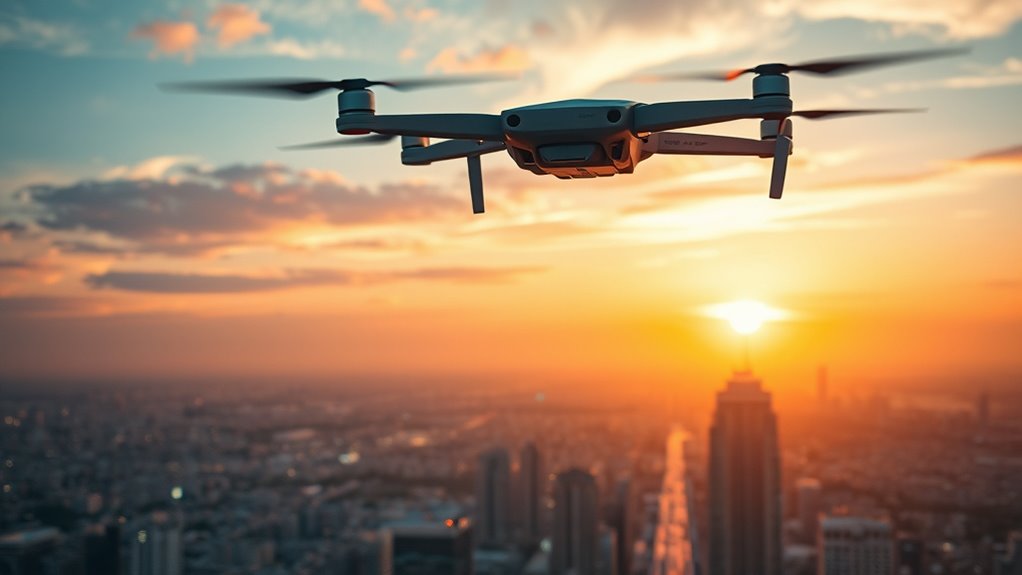

Sensor fusion blends data from multiple sensors to give you a clearer view of complex environments, whether you’re working with drones, self-driving cars, or data centers. By combining inputs like cameras, radar, and temperature sensors, you gain more accurate information than from any single source. This tech improves navigation, safety, and efficiency across various fields. Keep exploring, and you’ll discover how sensor fusion keeps advancing technology in surprising ways.
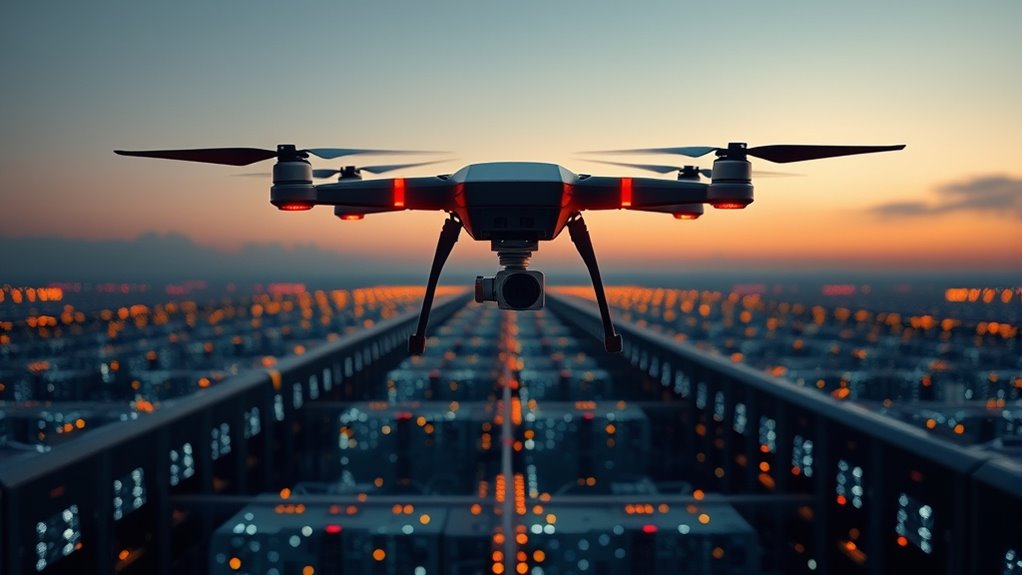
Sensor fusion combines data from multiple sensors to create a more accurate and reliable understanding of the environment. When you’re working with complex systems like drones or data centers, relying on a single sensor often isn’t enough. Each sensor has its strengths and weaknesses, so merging their outputs helps you get a clearer picture. For example, a drone using GPS for positioning might struggle indoors where GPS signals are weak. By integrating inertial measurement units (IMUs) and cameras, you can still determine the drone’s position accurately. In data centers, sensors monitor temperature, humidity, and airflow. Combining these readings helps you optimize cooling and prevent equipment failures more effectively than any single sensor could.
In practical terms, sensor fusion involves algorithms that process multiple data streams simultaneously. You’ll typically use methods like Kalman filters or particle filters to combine the data, smoothing out inconsistencies and reducing noise. These algorithms weigh each sensor’s data based on its reliability, giving more importance to the most trustworthy sources at any given moment. This dynamic adjustment ensures you maintain high accuracy even if one sensor temporarily produces faulty data. For instance, if a camera’s view gets obstructed, the system can rely more heavily on radar or ultrasonic sensors until the view clears. Similarly, in industrial automation, sensor fusion helps robots detect obstacles, navigate environments, and perform precise tasks with greater confidence.
Implementing sensor fusion requires careful calibration and synchronization. You need to ensure that the data from different sensors aligns temporally and spatially. If the timestamps are off or sensors aren’t properly calibrated, the fusion process might produce inaccurate results. This means regular maintenance and calibration are vital, especially in environments where conditions change frequently. Software also plays a crucial role; you’ll want robust algorithms that adapt to sensor drift and environmental variations. The goal is to build a system that’s resilient, accurate, and capable of functioning in real-time without delays.
Ultimately, sensor fusion enhances the capabilities of autonomous systems, making them smarter, safer, and more reliable. Whether you’re designing a drone that navigates complex terrains or managing a data center’s environment, understanding and applying sensor fusion principles allows you to leverage multiple data sources effectively. It’s about turning raw sensor data into actionable insights, ensuring your system responds appropriately and maintains optimal performance. As technology advances, sensor fusion becomes even more crucial, enabling smarter automation, better decision-making, and safer operations across countless industries.
Frequently Asked Questions
How Does Sensor Fusion Improve Autonomous Vehicle Safety?
Sensor fusion improves your autonomous vehicle’s safety by combining data from multiple sensors like cameras, radar, and lidar. This integration provides a more accurate and holistic understanding of your surroundings, allowing the vehicle to detect obstacles, predict movements, and react faster. With better perception, your vehicle can make safer decisions, avoid collisions, and navigate complex environments confidently, ultimately enhancing your safety on the road.
What Are the Main Challenges in Real-Time Sensor Fusion?
You face key challenges in real-time sensor fusion, like managing high data volumes and ensuring low latency. You need to synchronize diverse sensors with different sampling rates and accuracy levels, which can cause data inconsistencies. Additionally, you must handle noisy or conflicting data and maintain system robustness against sensor failures. Overcoming these hurdles requires advanced algorithms and efficient processing to deliver accurate, timely information essential for autonomous decision-making.
How Is Sensor Fusion Scaled for Large Data Centers?
You scale sensor fusion for large data centers by deploying distributed processing systems that handle massive data streams efficiently. You use high-performance computing resources, parallel algorithms, and optimized data pipelines to process and integrate sensor data in real time. Additionally, cloud infrastructure and edge computing help manage latency and bandwidth, ensuring seamless data fusion across vast, complex environments. This approach enables accurate, real-time insights at a data center scale.
What Are Future Trends in Sensor Fusion Technology?
You’ll see future sensor fusion evolve with AI-driven algorithms that interpret data faster and more accurately, blending inputs from diverse sources seamlessly. As sensors become smarter and more interconnected, expect predictive analytics to preempt issues before they arise. Integration across IoT devices will deepen, enabling real-time, adaptive responses. This acceleration will revolutionize industries, making systems smarter, more autonomous, and more resilient, ultimately transforming how you interact with technology daily.
How Does Sensor Fusion Impact Energy Consumption?
Sensor fusion can increase energy consumption because combining multiple sensors often requires more processing power. However, it also helps optimize energy use by providing more accurate data, allowing devices to make smarter decisions, like turning off unnecessary systems or adjusting operations efficiently. To balance these effects, you should focus on developing energy-efficient algorithms and hardware that minimize power draw while maximizing the benefits of sensor integration.

ELEGOO Upgraded 37 in 1 Sensor Modules Kit with Tutorial Compatible with R3 MEGA 2560 Nano
- Number of Sensor Modules: 37 components for Arduino projects
- High-Quality Modules: Includes GY-521, LCD1602, DS1307
- Compatible Boards: Designed for UNO R3, MEGA R3, NANO
As an affiliate, we earn on qualifying purchases.
As an affiliate, we earn on qualifying purchases.
Conclusion
Now that you’ve glimpsed the world of sensor fusion, imagine it as a symphony where each instrument’s unique sound blends into a harmonious masterpiece. You see how combining diverse data sources transforms chaos into clarity, powering everything from drones to data centers. Embrace this powerful technique, for it’s the unseen thread weaving precision through complex systems. Like a masterful painter, sensor fusion paints a clearer picture—guiding technology with the brushstrokes of innovation and insight.

Ultrasonic Sonar Sensor Module for Autonomous Obstacle Avoidance in Drones, Compatible with Mini Flight Controllers
- Enhanced obstacle detection: Accurate ultrasonic distance measurement
- Autonomous flight support: Automatically detects and avoids obstacles
- Easy integration: Plug-and-play with mini flight controllers
As an affiliate, we earn on qualifying purchases.
As an affiliate, we earn on qualifying purchases.

Multi-Sensor Fusion: Fundamentals and Applications With Software
As an affiliate, we earn on qualifying purchases.
As an affiliate, we earn on qualifying purchases.

Battery Monitor Sensor Module 13545954 13526054,Fit for GMC Acadia, Chevrolet Blazer/Malibu/Traverse/Trax/Cruze,Enclave/Encore/Envision, Cadillac XT4/XT5/XT6, 2016-2023
- Compatibility: Fits various GMC, Chevrolet, Cadillac models
- OE Replacement: Replaces part numbers 13545954 and 13526054
- Durable Quality: Made from high-quality materials for longevity
As an affiliate, we earn on qualifying purchases.
As an affiliate, we earn on qualifying purchases.