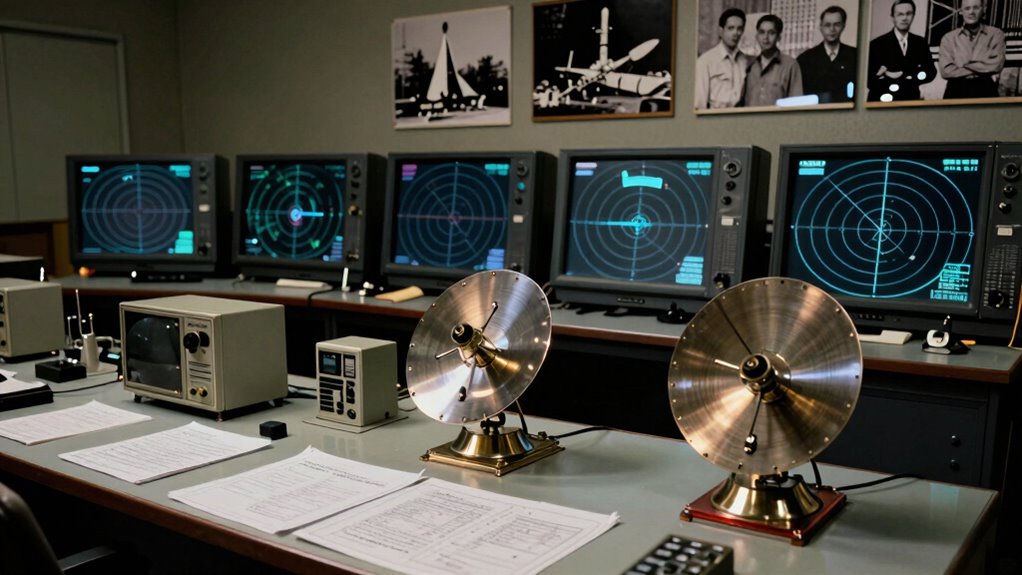

Spy satellites revolutionized intelligence gathering before the AI boom by providing essential imagery and signals from space. You see, their early focus was on reconnaissance with small cameras and limited resolution, but Cold War advancements improved these capabilities considerably. Satellites like CORONA and ARGON offered detailed views of military sites, while newer technologies like SAR allowed continuous, weather-independent surveillance. This transformed intelligence and strategic planning, shaping security efforts today—if you explore further, you’ll uncover even more about their fascinating evolution.
Key Takeaways
- Early spy satellites focused on photographic reconnaissance with limited resolution and stealth challenges.
- During the Cold War, satellites like CORONA and ARGON provided detailed imagery of enemy missile sites and bases.
- Transitioned from film-based images to signals and electronic surveillance for broader intelligence gathering.
- Technological advances led to smaller, high-resolution satellites and synthetic aperture radar for all-weather imaging.
- Space surveillance became essential for national security, military operations, and strategic decision-making.
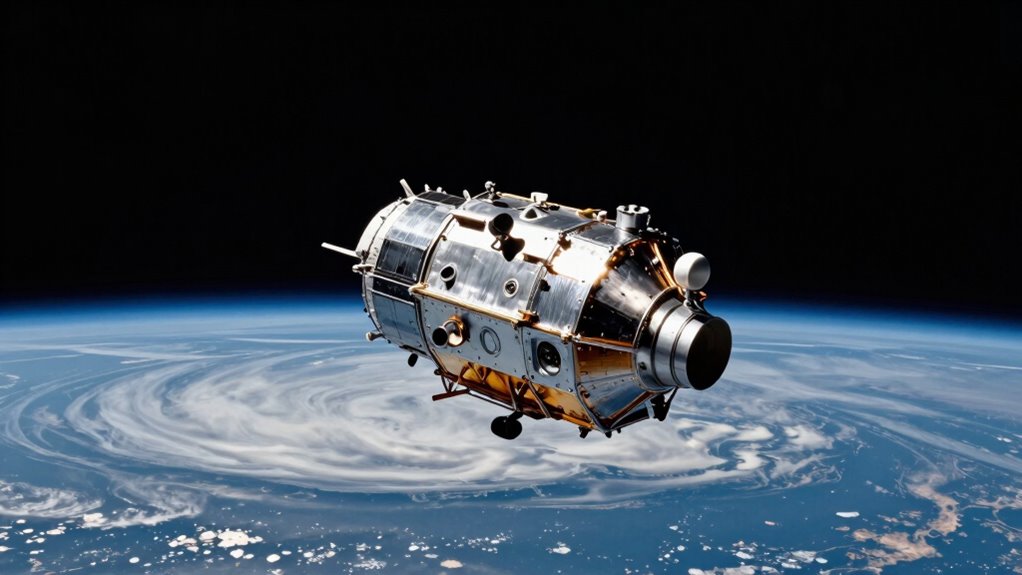
Spy satellites have revolutionized intelligence gathering since their inception, giving nations the ability to monitor global activities from space. When you consider the development of space surveillance, it’s clear how essential satellite technology has become for national security and strategic planning. Early efforts in satellite technology focused on understanding how to reliably capture images and signals from orbit, laying the groundwork for what would become a crucial component of modern intelligence operations.
Spy satellites have transformed intelligence gathering, becoming vital for national security and strategic planning from space.
In the initial stages, spy satellites were primarily designed for reconnaissance rather than communication. You might imagine the challenges faced in developing these early systems—tiny cameras, limited resolution, and the need for stealth. Despite these hurdles, the technology advanced rapidly during the Cold War era. Satellites like CORONA and ARGON allowed you to see enemy missile sites, military bases, and infrastructure with unprecedented detail, fundamentally changing how countries gathered intelligence. These satellites used film-based imaging, which required them to return to Earth for film retrieval, a complex and risky process but one that provided invaluable data.
As satellite technology evolved, so did your ability to conduct space surveillance. You could now track not only targets on the ground but also monitor missile launches, naval movements, and aircraft activity from space. This shift from purely photographic reconnaissance to signals intelligence and electronic surveillance marked a significant milestone. You began to understand the importance of an all-encompassing picture—combining imagery, electronic signals, and other data streams to create a detailed intelligence picture. This integration required sophisticated satellite systems capable of capturing and processing vast amounts of data, making space surveillance a cornerstone of national security strategies.
Throughout this period, satellite technology became more sophisticated, smaller, and more capable. You saw the rise of high-resolution imaging satellites that could identify objects as small as a few inches from orbit, dramatically improving your situational awareness. The development of synthetic aperture radar (SAR) allowed you to see through clouds and darkness, ensuring continuous surveillance regardless of weather conditions. These advances meant you could rely on space-based assets to provide real-time intelligence, supporting military operations, treaty verification, and diplomatic negotiations.

DIY Rotating Solar Satellite – 3D Wooden Puzzle Building Toy.STEM Educational Science Craft Model Kit for Kids.Creative Artificial Satellite Space Model.
- Solar-powered rotating satellite: No batteries needed, spins in weak light
- DIY assembly for skill development: Enhances hands-on skills and patience
- Educational STEM science kit: Teaches solar power and science concepts
As an affiliate, we earn on qualifying purchases.
As an affiliate, we earn on qualifying purchases.
Frequently Asked Questions
How Did Early Spy Satellites Influence Cold War Diplomacy?
Early spy satellites played a fundamental role in Cold War diplomacy by providing essential intelligence that shaped the space race and diplomatic espionage efforts. You see, they allowed you to monitor enemy activities secretly, reducing misunderstandings and fostering strategic negotiations. This technological edge increased your bargaining power, making diplomatic exchanges more informed and precise, ultimately influencing Cold War diplomacy by encouraging more cautious and calculated interactions between superpowers.
What Were the Main Technical Challenges in Developing Initial Spy Satellites?
You face major technical challenges in developing initial spy satellites, especially with optical resolution and signal interception. Achieving high-resolution images was tough; early satellites had resolutions around 10 meters, limiting detail. Signal interception required sensitive, secure systems to eavesdrop on communications without detection. Only 1 in 10 early designs succeeded, highlighting the complexity. These challenges pushed technological limits, laying foundations for future advancements in reconnaissance capabilities.
Which Countries Besides the US and USSR Developed Spy Satellites?
Besides the US and USSR, countries like the UK, France, China, and Israel developed spy satellites, advancing satellite technology and espionage tactics. You see, these nations recognized the strategic importance of satellite-based reconnaissance, investing in their own systems to gather intelligence globally. They faced challenges in miniaturizing equipment and ensuring stealth, but their efforts expanded global espionage capabilities, making satellite technology a vital element in modern intelligence gathering.
How Did Spy Satellites Impact International Intelligence Sharing?
Spy satellites, like secretive guardians, transformed international intelligence sharing by fostering closer alliances and exposing satellite secrecy. Countries shared satellite imagery to bolster collective security, creating intelligence alliances that crossed borders. This cooperation made spy satellites more effective, but also heightened tensions over classified data. You see, the more nations shared, the more transparent and interconnected intelligence efforts became, shaping global diplomacy and security strategies.
What Were the Legal and Ethical Issues Surrounding Early Satellite Espionage?
You’d find that early satellite espionage raised significant legal and ethical issues, especially around privacy concerns. Governments debated whether spying violated international regulations or sovereignty, sparking fears of diplomatic conflicts. Ethical dilemmas emerged about surveillance without consent, risking misuse of intelligence. These issues prompted calls for clearer international laws, but enforcement was complex, leaving many questions about the balance between national security and respecting privacy rights unresolved.
high resolution satellite imagery viewer
As an affiliate, we earn on qualifying purchases.
As an affiliate, we earn on qualifying purchases.
Conclusion
So, you see, spy satellites have silently shaped security and sovereignty, showcasing a saga of sophisticated surveillance and strategic superiority. From their early, elusive origins to their evolution amid evolving espionage ethics, these space-based sentinels have steadfastly served states’ secrets. As technology transcends, the tale of these terrestrial sentinels continues, cementing their essential role in covert conflicts. Remember, in this domain, innovation ignites influence, and the sky’s the limit for future espionage endeavors.

Synthetic Aperture Radar Signal Processing with MATLAB Algorithms
As an affiliate, we earn on qualifying purchases.
As an affiliate, we earn on qualifying purchases.

The Young Scientists Club Space Adventures Pack, STEM Kit, 13 Educational Activities, Includes Reusable Backpack, Space Navigator, DIY Constellations, Space Card Game & More, Multi (204755)
- Explore Space with Young Scientists: Intergalactic solar experiments and learning
- 13+ Hands-On Activities: DIY constellations, solar system, memory game
- Reusable Backpack Included: Sturdy, adjustable straps with activity guide
As an affiliate, we earn on qualifying purchases.
As an affiliate, we earn on qualifying purchases.