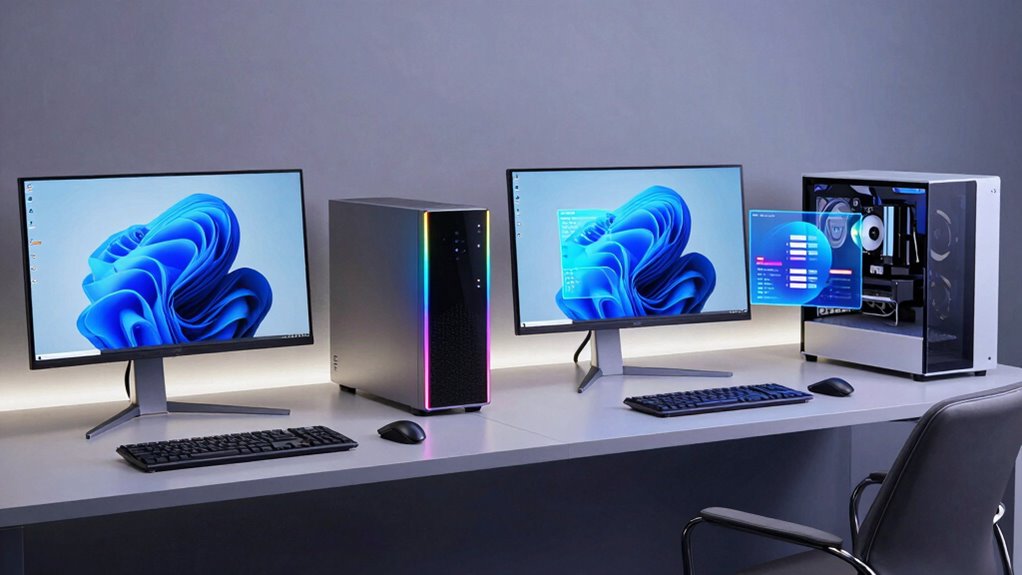
For a Windows workstation desktop, my leading picks are the Dell OptiPlex 7070 SFF for its eight-core processor and 32GB of memory, the Dell Tower Desktop with Core Ultra 7 for a newer platform and easier upgrades, and the Dell Pro Desktop Tower for current everyday office work. Those choices serve different needs: the OptiPlex offers more listed memory and storage, the newer towers offer a different balance of platform age and expandability, and the Pro Tower starts with more modest computing and graphics resources.

Get privacy and security gear delivered free with Prime
- Fast, free delivery on millions of items
- Prime Video, Amazon Music and more included
- Member-only deals all year
All five run Windows 11 Pro, but they are not interchangeable. Three are renewed, compact OptiPlex systems with 32GB of RAM; two are towers with 16GB, and only one lists a dedicated graphics card—none of the supplied descriptions actually specifies one. I rank them by how well their documented specifications suit a workstation role: sustained multitasking, storage, display support, upgrade potential, and the gaps a buyer would need to resolve before purchase.
Complete the kit
Key Takeaways
- The OptiPlex 7070 pairs an eight-core i7-9700 with 32GB RAM and a 1TB NVMe SSD, making it the strongest compact pick on listed compute and storage.
- The Core Ultra 7 tower has the newest named processor and tool-less access, but its storage capacity and graphics configuration are unspecified.
- The Pro Tower is the clearest choice for routine office workflows when new-generation DDR5, a 512GB SSD, and Wi-Fi 6 matter more than high core count.
- The OptiPlex 7060 offers six cores, 32GB RAM, and NVMe storage in a smaller case, but its 512GB drive gives less room than the 7070’s 1TB.
- The OptiPlex 7050 supplies 32GB and 1TB storage, yet its four-core i7-7700 and short seller warranty make it the least compelling workstation choice here.


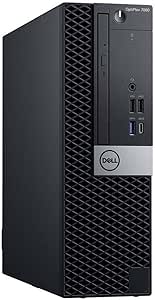


| windows workstation desktop | Processor | Memory | Operating system | Storage |
|---|---|---|---|---|
| Dell OptiPlex 7070 SFF Desktop | Intel Core i7-9700, 8 cores | 32GB DDR4 | Windows 11 Pro | 1TB NVMe M.2 SSD |
| Dell Tower Desktop with Intel | Intel Core Ultra 7 265 | 16GB DDR5 | Windows 11 Pro | — |
| Dell OptiPlex 7060 SFF Desktop | Intel Core i7-8700, 6 cores | 32GB DDR4 | Windows 11 Pro | 512GB NVMe M.2 SSD |
| Dell Pro Desktop Tower with In | Intel Core i3-14100, 4 cores / 8 threads | 16GB DDR5 | Windows 11 Pro | 512GB PCIe SSD |
| Dell OptiPlex 7050 SFF Desktop | Intel Core i7-7700, 4 cores | 32GB DDR4 | Windows 11 Pro 64-bit | 1TB SSD |
More Details on Our Top Picks
Dell OptiPlex 7070 SFF Desktop, Intel Core i7-9700, 32GB RAM, 1TB NVMe SSD, Wi-Fi 6E, Windows 11 Pro, Wireless Keyboard and Mouse (Renewed)
The OptiPlex 7070 SFF is my top pick because its documented configuration gives a workstation buyer fewer obvious compromises than the other compact renewed systems here. Its eight-core Core i7-9700, 32GB of RAM, and 1TB NVMe SSD make a strong combination for office multitasking, many open files, and local project storage. The OptiPlex 7050 also offers 32GB and 1TB, but its older four-core i7-7700 is a more significant limit when several demanding applications run together.
Compared with the larger Core Ultra 7 tower, the 7070 has less appealing upgrade potential and an older platform, but it gives specific memory and storage figures where that tower listing leaves gaps. Wi-Fi 6E, two DisplayPort outputs, and the included wireless keyboard and mouse make it ready for a dual-screen desk without adding those basics separately. The compact chassis is useful where desk space is limited, though small-form-factor systems can restrict future component choices. Its renewed condition also calls for more caution than the newer tower options. I would favor it for a compact business workstation, but not for GPU-heavy design, since no dedicated graphics configuration is specified.
Pros:- Eight-core Core i7-9700 and 32GB RAM support busy multitasking.
- 1TB NVMe SSD offers more listed capacity than the 7060’s 512GB drive.
- Wi-Fi 6E and wireless keyboard and mouse are included.
- Two DisplayPort outputs support a dual-monitor setup.
Cons:- Renewed condition may not suit buyers seeking a new desktop.
- Small-form-factor case can limit expansion choices.
- No dedicated graphics card is specified.
Best for: Office users who need a compact Windows 11 Pro desktop with 32GB RAM, substantial listed storage, and two-display support.
Not ideal for: Buyers who want a new system, plan major internal upgrades, or need a specified dedicated graphics card.
- Processor:Intel Core i7-9700, 8 cores
- Memory:32GB DDR4
- Storage:1TB NVMe M.2 SSD
- Operating system:Windows 11 Pro
- Wireless:Wi-Fi 6E
- Display outputs:2 DisplayPort; supports two displays
- Condition:Renewed
Our verdict“I rank the 7070 first for its unusually balanced compact configuration of eight cores, 32GB RAM, and a 1TB NVMe drive.”
Dell Tower Desktop with Intel Core Ultra 7 265, 16GB DDR5 RAM, and Windows 11 Pro
For buyers whose workstation plans include internal changes or an expansive display layout, this Core Ultra 7 tower has the strongest forward-looking case in the group. Its tool-less access can make opening the chassis less of a chore than working inside a small-form-factor OptiPlex, and its stated display support reaches four FHD monitors or two 4K displays. The OptiPlex 7070 is a more complete choice for memory and storage as sold, but this tower is the more promising starting point if future upgrades and multiple screens shape the desk.
The listing names a Core Ultra 7 265 and 16GB DDR5, yet it omits both storage capacity and graphics details. Those omissions matter for a workstation: I cannot tell how much local project space is available or whether graphics-dependent work is a fit. The 7070 and 7060 make storage easier to assess by listing their SSD sizes and give 32GB of memory from the outset. On the other hand, the tower’s hardware TPM, lock provisions, and one year of onsite service add practical business-oriented details. I see this as a flexible platform with key configuration questions to settle before choosing it, rather than the safest out-of-box recommendation.
Pros:- Tool-less case access can simplify upgrades.
- Supports up to four FHD displays or two 4K displays.
- Hardware TPM and lock provisions support business security needs.
- Includes one year of onsite service.
Cons:- Storage capacity is not specified.
- Graphics configuration is not specified.
- 16GB RAM is less than the 32GB included with the OptiPlex models.
Best for: Business users planning a multi-display desk who value a tower case, simpler access for upgrades, and onsite service.
Not ideal for: Buyers who need confirmed storage capacity, a specified graphics card, or more than 16GB RAM without making changes.
- Processor:Intel Core Ultra 7 265
- Memory:16GB DDR5
- Operating system:Windows 11 Pro
- FHD display support:Up to 4 displays
- 4K display support:Up to 2 displays
- Security:Hardware TPM, lock slot, and padlock loop
- Service:1 year onsite service
Our verdict“I place this tower second for its upgrade access and display capacity, while the missing storage and graphics details prevent a firmer recommendation.”
Dell OptiPlex 7060 SFF Desktop, Intel Core i7-8700, 32GB RAM, 512GB NVMe SSD, Windows 11 Pro (Renewed)
The OptiPlex 7060 SFF suits buyers who want the 32GB memory of the 7070 in a compact renewed desktop, with a capable six-core i7-8700 and a fast 512GB NVMe SSD. That six-core processor puts it ahead of the OptiPlex 7050’s four-core chip for parallel workloads, while the 7070 remains the stronger compact pick thanks to its newer eight-core i7-9700 and twice the listed SSD capacity. The 7060 makes sense when those extra cores and storage are less important than a smaller footprint and a substantial RAM allocation.
Dual DisplayPort outputs, built-in Wi-Fi and Bluetooth, and included wireless accessories help it serve a tidy workstation desk. It also lists a DVD+RW drive, which may help in offices that still work with optical media. Yet there is no dedicated graphics information, and the 512GB SSD can fill more quickly than the 7070’s 1TB drive when project files accumulate. Like the other renewed OptiPlex choices, its condition may be a drawback for anyone who prefers new hardware. I would choose it for general business multitasking and two screens, while directing users who need more storage or stronger listed processing to the 7070.
Pros:- Six-core Core i7-8700 and 32GB RAM suit multitasking.
- 512GB NVMe SSD provides fast local storage.
- Built-in Wi-Fi and Bluetooth plus wireless keyboard and mouse.
- Two DisplayPort outputs support two monitors.
Cons:- Less storage than the OptiPlex 7070’s 1TB SSD.
- Renewed condition.
- No dedicated graphics details are provided.
Best for: Users who want 32GB RAM, a six-core processor, and dual-monitor support in a compact renewed desktop.
Not ideal for: People with large local project libraries, graphics-heavy workloads, or a preference for new hardware.
- Processor:Intel Core i7-8700, 6 cores
- Memory:32GB DDR4
- Storage:512GB NVMe M.2 SSD
- Operating system:Windows 11 Pro
- Connectivity:Built-in Wi-Fi and Bluetooth
- Ports:5 USB 3.0, 2 USB 2.0, 2 DisplayPort
- Condition:Renewed
Our verdict“I recommend the 7060 when compact size and 32GB RAM matter more than the 7070’s extra cores and storage.”
Dell Pro Desktop Tower with Intel Core i3-14100, 16GB DDR5 RAM, 512GB SSD, and Windows 11 Pro
The Dell Pro Desktop Tower is the straightforward option for office and home productivity when a current named processor generation, DDR5 memory, and a specified SSD matter more than high core count. Its i3-14100 has four cores and eight threads, and 16GB of DDR5 should serve routine document work, browsing, and common business applications. In that role it is easier to evaluate than the Core Ultra 7 tower, whose storage is unspecified, but it lacks the 32GB memory and eight-core processor that make the OptiPlex 7070 a better fit for heavier multitasking.
Unlike the renewed OptiPlex systems, this tower lists integrated Intel UHD Graphics 730, Wi-Fi 6, Bluetooth, Ethernet, HDMI, and DisplayPort. That makes the basic workstation setup clear, though integrated graphics are not a substitute for a dedicated card in demanding 3D, rendering, or GPU-compute tasks. Its 512GB PCIe SSD is half the capacity of the 7070’s drive, and the listing gives conflicting USB port counts, so I would verify connectivity needs before relying on a particular number. The compact tower dimensions offer a useful middle ground between SFF size and larger tower access, but upgrade details are not supplied.
Pros:- 14th-generation Core i3 and 16GB DDR5 suit everyday productivity.
- 512GB PCIe SSD capacity is specified.
- Wi-Fi 6, Bluetooth, Ethernet, HDMI, and DisplayPort are listed.
- Windows 11 Pro includes business-focused capabilities.
Cons:- Four-core processor and 16GB RAM trail the OptiPlex 7070 for heavier multitasking.
- Integrated graphics are suited to everyday use rather than demanding graphics workloads.
- Provided details conflict on USB port counts.
Best for: Home and office users running everyday Windows applications who want a specified SSD and modern connectivity.
Not ideal for: Professionals doing graphics-heavy work or multitasking that benefits from 32GB or more memory.
- Processor:Intel Core i3-14100, 4 cores / 8 threads
- Memory:16GB DDR5
- Storage:512GB PCIe SSD
- Graphics:Intel UHD Graphics 730
- Operating system:Windows 11 Pro
- Wireless:Wi-Fi 6 and Bluetooth
- Video outputs:DisplayPort 1.4 and HDMI 2.1
- Dimensions:12.76 x 6.06 x 11.53 inches
Our verdict“I favor this tower for routine office work, but buyers with demanding workstation loads should step up to the 7070 or investigate the Core Ultra 7 configuration.”
Dell OptiPlex 7050 SFF Desktop PC, Intel Core i7-7700, 32GB DDR4 RAM, 1TB SSD, Windows 11 Pro (Renewed)
The OptiPlex 7050 SFF offers an appealing amount of memory and storage on paper: 32GB DDR4 and a 1TB SSD, plus Windows 11 Pro and dual-monitor support. I rank it last because its four-core i7-7700 is the oldest and least capable listed processor in this group. That difference matters when a workstation means keeping many applications responsive at once; the six-core OptiPlex 7060 and eight-core 7070 provide more headroom, while the Core Ultra 7 tower has a newer named platform.
For routine office tasks, the 7050’s storage and memory may still be useful, and its wired keyboard and mouse, Wi-Fi adapter, and power cord cover basic setup needs. The listing also states a 90-day seller warranty, a concrete support detail, although the term is limited compared with longer service coverage on the newer tower. Its renewed status and aging processor make it a specialized choice for buyers who value the listed 1TB SSD and 32GB RAM for lighter workflows. I would skip it for CPU-heavy creative work, long-term expansion plans, or anyone who prefers the greater processor headroom of the 7060 or 7070.
Pros:- 32GB DDR4 supports several open applications.
- 1TB SSD provides substantial listed capacity.
- Includes wired keyboard and mouse plus a Wi-Fi adapter.
- Dual-monitor support and a 90-day seller warranty are listed.
Cons:- Four-core i7-7700 is less capable than the six-core 7060 and eight-core 7070.
- Renewed condition.
- Seller warranty is limited to 90 days.
Best for: Basic office users who prioritize 32GB RAM and 1TB storage in a compact desktop and accept renewed hardware.
Not ideal for: Multitaskers with demanding applications, buyers wanting a newer processor, or people seeking longer listed warranty coverage.
- Processor:Intel Core i7-7700, 4 cores
- Memory:32GB DDR4
- Storage:1TB SSD
- Operating system:Windows 11 Pro 64-bit
- Form factor:Small Form Factor
- Display support:Dual monitor
- Warranty:90 days from seller
- Condition:Renewed
Our verdict“I would choose the 7050 only for lighter office work where its memory and 1TB SSD outweigh its older four-core processor.”

How We Picked
I ranked these desktops around the needs implied by Windows workstation desktop: running several business applications, keeping a responsive Windows environment, connecting useful displays, and leaving room for future changes. Core count, memory, and storage capacity matter because they affect how well a system can juggle active work and hold local files. I also looked at the kind of case and access provided, since a compact desktop can save desk space while limiting upgrades compared with a tower.
I gave more weight to complete, relevant specifications than to broad claims. For example, the Core Ultra 7 tower lists support for multiple displays and tool-less access, but does not name its storage capacity or graphics configuration. That limits how confidently I can recommend it for a storage-heavy or graphics-heavy workload. The Pro Tower names its SSD and integrated graphics, which makes its capabilities easier to judge, though those graphics are aimed at everyday use.
Three of these options are renewed OptiPlex systems. Their processor generation and case size help distinguish them, but renewed condition is a real ownership tradeoff, and the listed 90-day seller warranty applies only to the 7050. I do not treat Windows 11 Pro or included accessories as proof of workstation performance; instead, I rank each machine by its specific balance of processing, memory, storage, displays, and upgrade information. A buyer planning professional 3D work, large-scale rendering, or other GPU-dependent tasks should seek a configuration with a clearly specified graphics card.
| windows workstation desktop | Processor | Operating system |
|---|---|---|
| Dell OptiPlex 7070 SFF Desktop | Intel Core i7-9700, 8 cores | Windows 11 Pro |
| Dell Tower Desktop with Intel | Intel Core Ultra 7 265 | Windows 11 Pro |
| Dell OptiPlex 7060 SFF Desktop | Intel Core i7-8700, 6 cores | Windows 11 Pro |
| Dell Pro Desktop Tower with In | Intel Core i3-14100, 4 cores / 8 threads | Windows 11 Pro |
| Dell OptiPlex 7050 SFF Desktop | Intel Core i7-7700, 4 cores | Windows 11 Pro 64-bit |
Factors to Consider When Choosing Windows Workstation Desktop
I would match the desktop to the work it must handle every day, then check that the listing supplies enough detail to judge the configuration.Match processor and memory to your workload
For a workstation used with several applications at once, processor cores and memory are useful starting points. The OptiPlex 7070 pairs eight cores with 32GB RAM, while the 7060 offers six cores and the same listed memory. Those figures give them a clearer case for heavier multitasking than the 7050’s four-core processor or the Pro Tower’s 16GB configuration. The Core Ultra 7 tower names a newer processor and DDR5 memory, but its listing does not say how much memory the system can support or how it can be upgraded. I would not treat processor branding alone as a workload guarantee; the tasks, software, and complete configuration still matter.
Treat storage capacity as part of workstation fit
A fast SSD helps Windows and applications respond, while capacity determines how much local work can stay on the desktop. The 7070 and 7050 list 1TB drives; the 7060 and Pro Tower list 512GB SSDs. For large project files or local archives, that difference can shape daily convenience. The Core Ultra 7 tower leaves storage capacity unspecified, so I would confirm it before choosing that system. Speed labels alone do not answer the capacity question, and none of the descriptions states a dedicated graphics card or graphics memory that would make a demanding visual workload easier to assess.
Choose the case around desk space and future changes
The three OptiPlex systems use small-form-factor cases, which can fit better in a crowded desk area. Their compact size can restrict internal upgrades, though, so a buyer planning to change components should check what each specific unit supports. The Core Ultra 7 model explicitly lists tool-less access, giving it the clearest upgrade-oriented detail here. The Pro desktop is a compact tower by its dimensions, but its upgrade paths are not described. For a workstation expected to evolve, I would value a tower and explicit access details over an assumed upgrade path.
Check display connections and graphics needs
For office work across two screens, the OptiPlex 7070 and 7060 each list two DisplayPort outputs, and the 7050 says it supports dual monitors. The Core Ultra 7 tower goes further in stated monitor count, supporting up to four FHD or two 4K displays. The Pro Tower lists HDMI and DisplayPort, but the supplied information does not state a maximum display count. Display outputs do not tell the whole graphics story: the Pro Tower specifies integrated UHD Graphics 730, while the other systems lack full graphics details. I would seek a clearly named dedicated GPU for 3D work, rendering, or other software that depends on graphics acceleration.
Account for condition, support, and missing information
The OptiPlex 7050, 7060, and 7070 are renewed systems, so their condition differs from the newer tower listings. The 7050 names a 90-day seller warranty; the Core Ultra 7 tower lists one year of onsite service. The remaining descriptions do not provide a comparable service term. I would weigh that support information alongside the hardware rather than assuming all listings offer the same coverage. Before choosing any option, confirm the exact memory, storage, graphics, ports, and included accessories for the configuration being sold, particularly where the listing leaves a detail out or conflicts with itself.
Frequently Asked Questions
Which desktop is my strongest all-around workstation choice?
I rank the Dell OptiPlex 7070 SFF first because its eight-core i7-9700, 32GB RAM, and 1TB NVMe SSD form the most balanced clearly specified compact setup. It also supports two displays and includes Wi-Fi 6E. Its renewed condition and limited internal space are meaningful tradeoffs, and it is not a substitute for a workstation with a specified dedicated graphics card.
Which option is better for a multi-monitor desk?
The Core Ultra 7 tower states support for up to four FHD displays or two 4K displays, the broadest monitor support in this lineup. The OptiPlex 7070 and 7060 each list two DisplayPort outputs for dual-screen use. I would check the display resolution and connector requirements for the intended monitors, since output count by itself does not confirm every screen combination.
Are the renewed OptiPlex desktops suitable for business work?
They can suit routine business workloads when their specific processor, memory, and storage fit the work. The 7070 offers the strongest listed combination, followed by the six-core 7060; the 7050 has the oldest, four-core processor despite its 32GB RAM and 1TB drive. Each is renewed, so buyers should review the condition and any applicable support terms before committing.
Which desktop should I choose for graphics-heavy work?
None of these listings provides a clearly specified dedicated graphics card. The Pro Tower names integrated Intel UHD Graphics 730 and describes it for everyday productivity, while the other descriptions do not provide enough graphics detail to judge heavier workloads. For 3D, rendering, or GPU-dependent applications, I would look for a configuration that names the graphics card and confirms compatibility with the software.
Should I choose a compact OptiPlex or a tower?
I would choose an OptiPlex SFF when desk space and a ready-made compact setup matter most, especially the 7070 if the aim is strong listed memory and storage. A tower makes more sense when access and potential changes are priorities; the Core Ultra 7 model explicitly lists tool-less access. The tradeoff is that its storage and graphics configuration are not specified, so those details need checking before it can be compared directly with the OptiPlex models.
Conclusion
For a compact business workstation with the clearest balance of processing, memory, and storage, I recommend the Dell OptiPlex 7070 SFF. Choose the Core Ultra 7 tower if multiple displays, tool-less access, and onsite service matter more, after confirming its storage and graphics configuration. The OptiPlex 7060 is a sensible compact alternative for six-core multitasking with 32GB RAM, while the Dell Pro Desktop Tower fits everyday office work on a newer named processor. I would reserve the OptiPlex 7050 for lighter tasks where its 1TB SSD and 32GB RAM are the draw, since its older four-core processor is the main limitation.