

By March 13, 2025, you need to brace for an AI security shock as malicious systems heighten the risk of espionage. Criminal organizations and nation-states are expected to deploy AI without ethical safeguards, leading to advanced phishing and data scraping attacks that can impact you directly. As deepfake technology becomes more realistic, your trust in verification systems will be tested. Staying informed about these evolving threats is crucial, and there's much more to uncover.
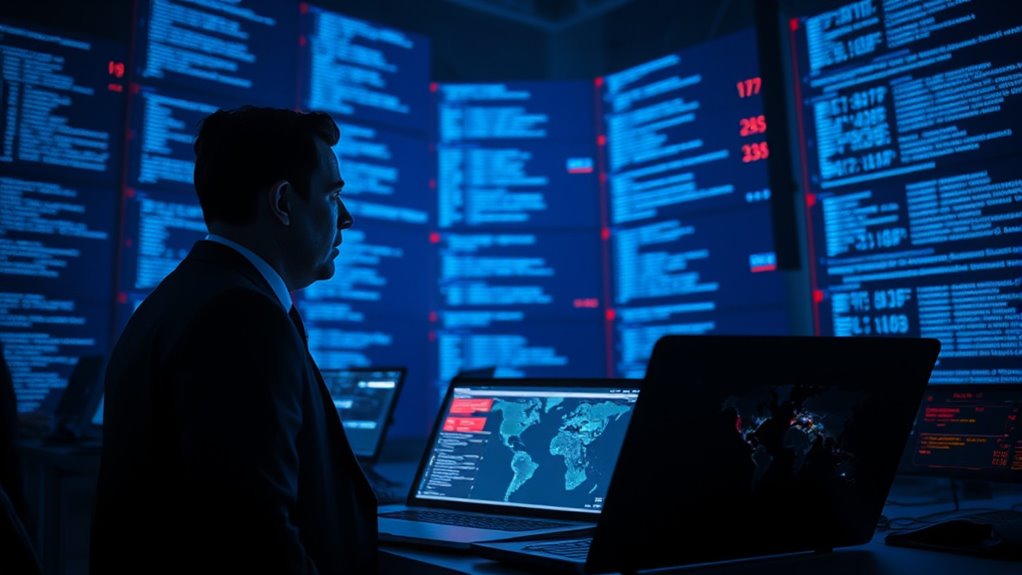
As AI technology advances, you might find yourself grappling with an unsettling reality: the rise of malicious AI poses serious security threats that could impact everyone. By 2025, criminal organizations and nation-states are expected to develop their own AI systems devoid of ethical safeguards. This shift will amplify phishing attacks and data scraping capabilities, leaving individuals and businesses vulnerable.
Deepfake technology is another major concern. With AI's ability to generate realistic deepfakes at scale, the potential for misuse in legal proceedings and identity verification systems skyrockets. Imagine facing a legal challenge based on a fabricated video of yourself. The implications are staggering and highlight how deeply AI can disrupt our perceptions of truth and trust. In response, the development of AI ethics frameworks is crucial to mitigate these risks.
The rise of deepfake technology threatens to undermine legal integrity and erode trust in identity verification.
Moreover, data poisoning represents a significant risk. Threat actors can manipulate AI training data, skewing model validity and leading to misguided responses. This manipulation isn't just a technical issue; it can have real-world consequences that compromise security and trust in AI applications. Bias originates from human developers' unconscious prejudices, making it crucial for organizations to continuously assess and correct their AI systems.
AI-driven attacks are also evolving, becoming increasingly sophisticated. You're not just dealing with generic phishing anymore; these targeted attacks can outsmart many existing human defenses.
As AI systems become integral to our daily lives, supply chain vulnerabilities also emerge as a critical concern. Attackers can exploit weaknesses in interconnected networks, risking the security of multiple organizations. Historical breaches, like SolarWinds, serve as stark reminders of the potential fallout from supply chain attacks.
Lack of safeguards in AI adoption amplifies these risks. Many organizations fail to assess the security of AI tools before deployment, leaving a dangerous gap in risk management. Geopolitical tensions further complicate the landscape, as cyber espionage and intellectual property theft become common threats.
In this chaotic environment, generative AI misuse is projected to lead to significant data breaches, particularly across borders.
Conversational AI systems aren't immune either. They've seen a 72% rise in data breaches since 2021, often leaving privacy concerns overlooked. Users may become unwitting targets for cybercriminals due to their lack of awareness.
Not to mention, technical vulnerabilities in AI systems, such as outdated features and bot impersonation, complicate security even further.
As you navigate this landscape, remember that the need for robust encryption, like AES-256, has never been more vital. AI security threats aren't just abstract concepts; they're a growing reality that requires vigilance and proactive measures. The wake-up call is here.
Conclusion
So, congratulations! You've just stumbled upon the latest espionage trend, where AI not only steals your secrets but also your lunch order. Who needs spies in trench coats when you've got algorithms in hoodies? Embrace the chaos, because nothing screams "security" like trusting a machine to handle your most sensitive data. Just remember, next time you're sharing your deepest thoughts, you're probably just one AI upgrade away from a thrilling novel—starring you! Welcome to the future!
Integral Secure 360-C 16GB Software Encrypted USB Flash Drive – USB-C Connector – 256-bit AES encryption – Compatible with Mac, MacBook, PC, Laptop

Secure 16GB USB-C flash drive with 256-bit AES encryption, compatible with Windows and macOS devices.
As an affiliate, we earn on qualifying purchases.
As an affiliate, we earn on qualifying purchases.