China's advanced AI-powered satellites can track U.S. submarines and military assets, raising significant concerns for national security. These satellites use sophisticated imaging to monitor fast-moving targets, like F-22 jets, with real-time detection capabilities. As China enhances its surveillance operations, the U.S. is responding through partnerships like AUKUS and developing AI systems to counter these threats. This escalating situation highlights the need for proactive measures. You might find more insights about these developments intriguing.

Get privacy and security gear delivered free — and shop member deals
- Fast, free delivery on millions of items
- Access to Prime Big Deal Days deals on October 6–7
- Prime Video, Amazon Music and more included
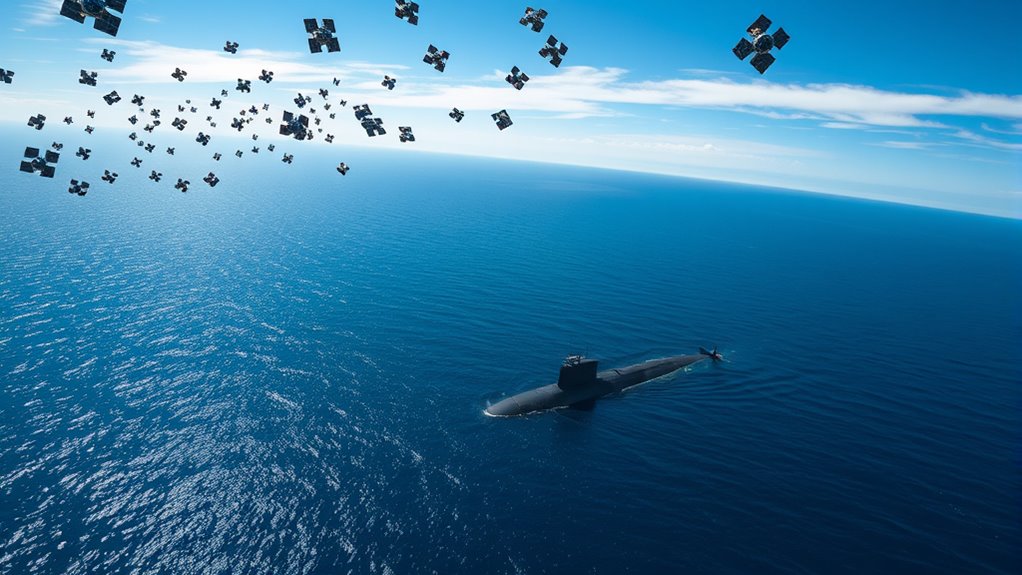
As tensions rise in the Asia-Pacific region, the Defense Intelligence Agency (DIA) has issued a stark warning about China's advanced AI-powered satellite systems that can track U.S. submarines. These developments are alarming, especially considering China's significant advancements in artificial intelligence and military technology. You should be aware that the DIA plays a crucial role in monitoring these capabilities, providing insights into how China's satellite systems are evolving to enhance their military might.
China's satellites possess surveillance capabilities that rival those of U.S. Keyhole spy satellites. With high-resolution imaging, they can track fast-moving targets like F-22 jets. The integration of AI allows these satellites to automatically detect and follow specific targets in real time, significantly improving their effectiveness in surveillance. Researchers have even developed methods to analyze wake patterns from ships, which helps identify particular models, even from low-resolution images. This capability gives China a strategic edge in monitoring U.S. naval assets worldwide.
China's advanced satellites, equipped with AI, enhance their surveillance capabilities, enabling real-time tracking of U.S. military assets.
The expansion of China's satellite network only amplifies these concerns. With a broader array of satellites, they can gather real-time data on U.S. military activities, and AI helps process this information more efficiently. This means that Chinese military planners can react swiftly to any perceived threats, making it essential for the U.S. to adapt its strategies in response. Furthermore, the U.S., UK, and Australia are testing AI for tracking Chinese submarines to enhance their joint capabilities.
In light of these advancements, the U.S. isn't sitting idle. Through the AUKUS partnership with the UK and Australia, the U.S. is developing AI-powered systems to counter China's military advancements, particularly in anti-submarine warfare. By integrating AI into sonar data processing, the U.S. aims to enhance the accuracy of submarine detection. Moreover, there's a growing focus on deploying stealthier assets, such as submarines, to evade China's surveillance capabilities.
However, the challenges don't stop there. China's anti-access/area denial (A2/AD) systems pose significant threats to U.S. surface warships, including aircraft carriers. With satellite-based surveillance and other technologies, China is increasingly capable of tracking and targeting U.S. naval assets. As a result, the United States must remain vigilant and proactive in addressing these evolving threats.
Conclusion
In light of the DIA's AI warning, it's clear that China's satellite capabilities pose a significant threat to U.S. submarines. As the technological race heats up, staying vigilant is more crucial than ever. You can't afford to let your guard down, as the stakes are high and the waters are murky. Just like a hawk watching its prey, the world must keep a sharp eye on emerging threats to ensure safety and security in these turbulent times.
underwater drone for military surveillance
As an affiliate, we earn on qualifying purchases.
As an affiliate, we earn on qualifying purchases.
Fall Picks
fall essentials
As an affiliate, we earn on qualifying purchases.