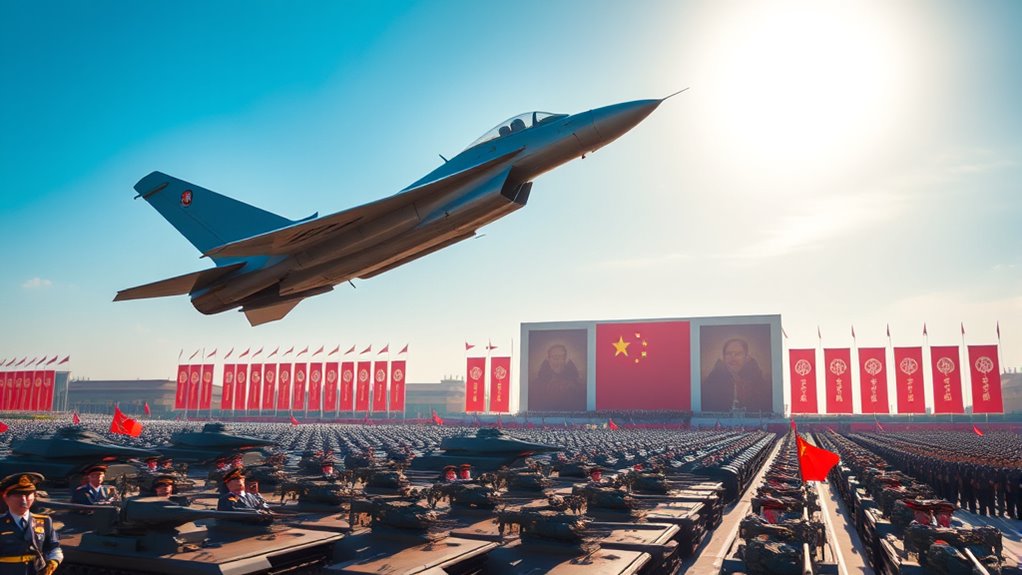

Xi Jinping's push for military modernization is making China's forces deadlier. With a 7.2% budget increase in 2025, advancements include the new Fujian aircraft carrier and the stealthy J-35A fighter jet, enhancing naval and air power. China's nuclear arsenal is also expanding, aiming for over 1,000 warheads by 2030. As tensions rise in the South China Sea and Taiwan Strait, this military build-up signals a more assertive China. There's much more to uncover about these developments.

Get privacy and security gear delivered free — and shop member deals
- Fast, free delivery on millions of items
- Access to Prime Big Deal Days deals on October 6–7
- Prime Video, Amazon Music and more included
Key Takeaways
- China's defense budget for 2025 has increased by 7.2%, emphasizing military modernization and advanced technology development.
- The military modernization includes the launch of the Fujian aircraft carrier and the J-35A stealth fighter jet.
- China aims to expand its nuclear arsenal to over 1,000 operational warheads by 2030, raising global security concerns.
- Structural reforms within the PLA enhance command efficiency and integrate advanced technologies for agile military operations.
- Rising military capabilities in China exacerbate regional tensions, particularly concerning Taiwan and the South China Sea.

As China continues to rise economically, it's also ramping up its military capabilities, with a 7.2% increase in its defense budget for 2025, bringing the total to around $249 billion. This strategic boost mirrors China's economic growth, keeping defense spending under 1.5% of GDP. You should be aware that this positions China as the world's second-largest military spender, trailing only the United States. Such a significant budget increase signals a commitment to modernization, focusing on advanced military technologies and new capabilities designed to assert China's geopolitical ambitions, particularly in the Taiwan Strait and the South China Sea.
You'll find that part of this modernization effort includes the development of cutting-edge naval assets. For example, the Fujian aircraft carrier has recently entered sea trials, significantly enhancing China's maritime operational reach. The Sichuan, equipped with advanced electromagnetic catapult technology, represents a leap in amphibious assault capabilities. Additionally, the debut of the J-35A stealth fighter jet marks a significant step forward in air force modernization. Defense spending remains below 1.5% of GDP, which is lower than the global average.
Moreover, China is rapidly expanding its nuclear arsenal, aiming for over 1,000 operational warheads by 2030, which undoubtedly raises eyebrows among global powers.
In terms of structure, the People's Liberation Army (PLA) has undergone reforms to improve command efficiency. With five theater commands established, military operations are now streamlined to enhance responsiveness. The Strategic Support Force has been dissolved, integrating its functions into the Central Military Commission, while the newly formed Information Support Force focuses on managing military networks. This restructuring reflects a shift towards more agile and technologically integrated military operations.
As regional tensions rise, especially in the South China Sea and Taiwan Strait, China's military buildup is increasingly viewed as a preparation for potential reunification efforts with Taiwan. Neighboring countries, like Japan, are responding by fortifying their own military capabilities, aware of the changing security dynamics. The implications for global security are considerable, as the modernization of China's military affects not just regional stability but also the broader international landscape.
Despite these advancements, the PLA faces challenges. While training emphasizes political indoctrination, it can detract from actual combat readiness. Corruption and logistical inefficiencies continue to plague the force, making it difficult to effectively utilize its advanced weaponry.
As China's military upgrade progresses, you can't ignore the intricate balance between power, readiness, and the potential for conflict in an increasingly tense world.
Fujian aircraft carrier model kit
As an affiliate, we earn on qualifying purchases.
As an affiliate, we earn on qualifying purchases.
Frequently Asked Questions
What Specific Technologies Are Being Upgraded in China's Military?
China's military is upgrading several specific technologies.
You'll notice advancements in nuclear capabilities, with a focus on both low-yield precision strike missiles and ICBMs.
The air force boasts new stealth fighter jets like the J-35A and improved aircraft systems.
Naval upgrades include advanced aircraft carriers and amphibious assault ships.
Additionally, cyber warfare capabilities are being enhanced through AI and big data, ensuring a stronger foothold in modern warfare and information operations.
How Does China's Military Budget Compare to Other Countries?
Imagine a financial chess game where China's defense budget sits as the formidable knight, commanding about $249 billion in 2025.
While it's the second-largest military spender, the U.S. looms like a towering king at roughly $895 billion.
In contrast, India plays a quieter role with its $81.72 billion.
China's spending, just shy of 1.5% of its GDP, reflects a careful balance between military ambition and economic stability.
What Are the Implications for Global Security?
The implications for global security are significant.
As you observe China's rise, you'll notice shifts in power dynamics, particularly with its military modernization. This expansion creates security dilemmas for neighboring nations and heightens tensions with the U.S.
You may see increased regional instability and a need for strategic alliances as countries react. The emergence of multipolarity challenges traditional security frameworks, necessitating international cooperation to navigate these complex, evolving threats effectively.
How Has Public Opinion in China Reacted to Military Upgrades?
You've likely noticed that public opinion in China regarding military upgrades is quite mixed.
Many citizens feel a sense of national pride as they see military advancements as a symbol of growing global influence. However, some express concerns about the economic implications of increased spending, especially during tough times.
Social media discussions often highlight technological achievements, while official narratives stress the importance of military modernization for national security and social stability.
What Historical Context Influences Xi Jinping's Military Strategies?
When you dive into Xi Jinping's military strategies, it's like stepping into a historical tidal wave!
The influence of Mao's absolute party control shaped the PLA's foundation, while Deng's efficiency reforms streamlined its operations.
Hu Jintao's "historic missions" pushed the military towards modern goals.
These legacies drive Xi's ambitions for a "world-class military."
Each reform builds upon the last, creating a complex tapestry that influences China's current military posture.
Conclusion
As China ramps up its military capabilities, it's easy to feel alarmed. You might think this escalation is just a show of force, but the reality is far more complex. A stronger military could lead to a more stable region, as it might deter aggression from neighbors. While concerns are valid, understanding the strategic motivations behind these upgrades can help you see that this isn't just about war—it's about asserting influence and maintaining peace through strength.
Fall Picks
fall essentials
As an affiliate, we earn on qualifying purchases.