
TL;DR
IdeaClyst is a local-first AI-powered war room designed for founders to rigorously test and develop ideas. It combines a council of AI advisors, a discovery engine, and a personal workspace, all grounded in real research. It helps prevent costly market mistakes by providing fast, evidence-based insights.
Ever stared at three open tabs, each with a promising idea, and felt that knot tighten in your stomach? That’s the founder’s dilemma: which idea deserves your next six months? Making that call isn’t about gut feelings anymore. It’s about having a real, evidence-based process that can save you from costly mistakes.
Enter IdeaClyst. It’s not just another idea tool. It’s a digital war room—an organized space where your ideas get tested, debated, and refined by a council of AI advisors, grounded in actual research. Whether you’re a solo founder or part of a growing team, this setup helps you decide with confidence, not hope.
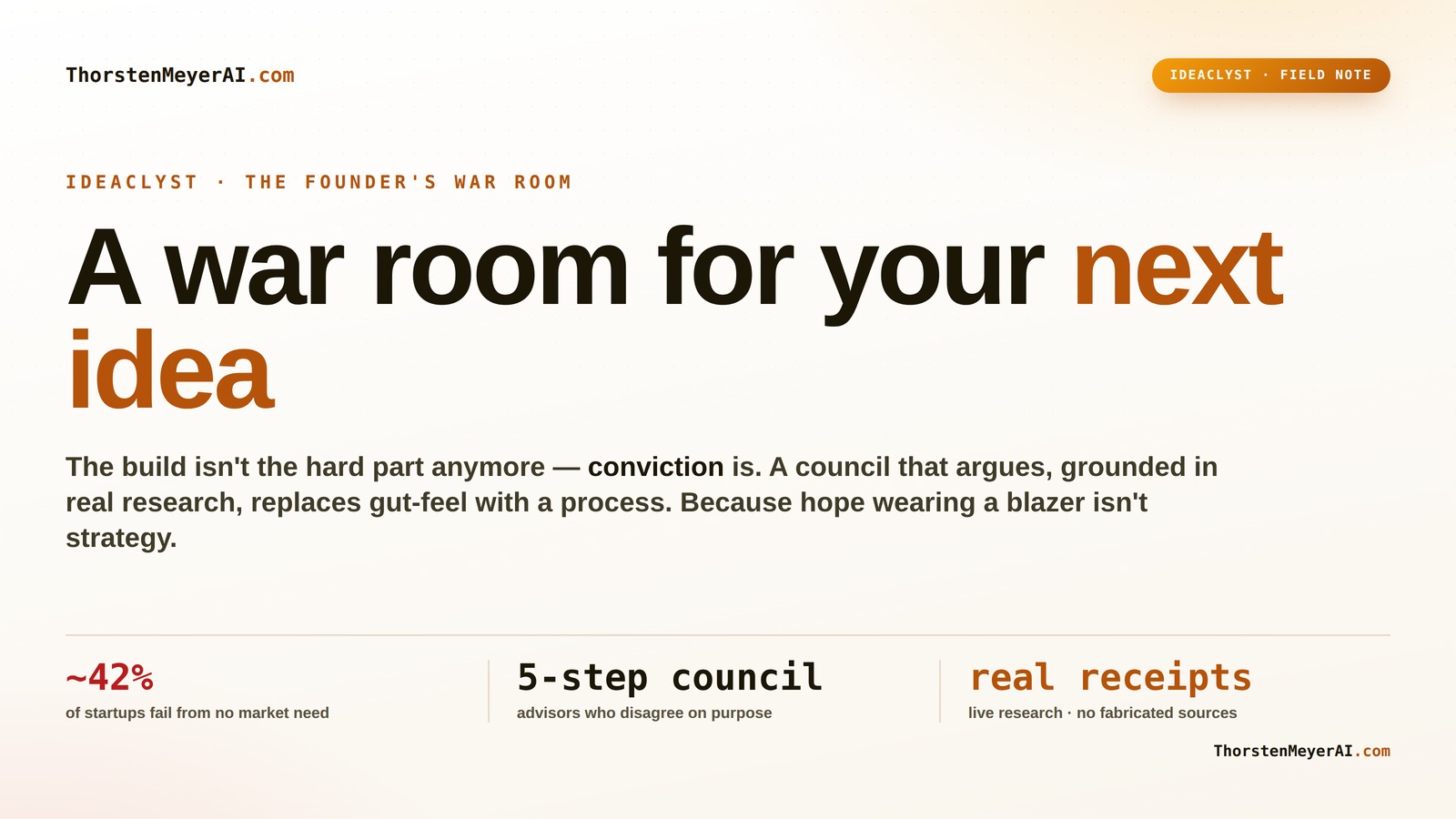
A war room for your next idea
The build isn’t the hard part anymore — conviction is. Knowing which idea deserves the next six months, and being able to defend it. Most founders answer with gut feel and optimistic math. That’s hope wearing a blazer. IdeaClyst replaces it with a process.
The most expensive decision is what to build
The single most valuable thing a tool can do is talk you out of the wrong six months. The numbers make the case better than any pitch.
Three tools in one — on your own machine
Strip away the framing and IdeaClyst is three things at once, all running locally with nothing leaving your laptop.
An AI council
Pressure-tests an idea you bring it — advisors who argue on purpose.
A discovery engine
Finds ideas you didn’t know to look for by hunting real demand signals.
A founder’s workspace
Carries winners from “interesting” all the way to “ready to build.”
Advisors who disagree on purpose
Not one confident, agreeable answer — a structured five-step deliberation where models play different roles and turn on their own work. The disagreement is the feature.
The five-step deliberation
A council that leads with the bad news surfaces the objections you’d otherwise find the expensive way, on month five.
Product strategy
Who’s it for, what’s the wedge, why now, what’s the business model.
Technical architecture
What would it actually take to build — and where’s the risk.
Critique pass
The council turns on its own work. Where’s the hand-waving? What kills this?
Second, independent critique
A different voice, a different angle — so blind spots don’t survive.
Final synthesis
Everything into one coherent founder packet: strategy, architecture, validation, plan.
When IdeaClyst cites a source, it actually fetched it
The hard departure from “ask an AI what it thinks of my startup.” It runs in a strict, real-data-only mode — if it can’t gather genuine evidence, it says so plainly rather than inventing a plausible paragraph.
Confidence with receipts
No fabricated statistics, no imaginary competitors, no made-up citations. The packet survives a skeptical co-founder or a sharp investor because the reasoning has receipts.
Market research first
Scouts the landscape before the council reasons about anything.
Competitor read
Real positioning, pricing signals, feature claims — differentiation vs. reality.
Validation with links
Not “talk to customers” — concrete signals & sources you can click.
From the blank page to build-ready
Evaluation is half the problem; the blank page is the other half. And a plan is worthless if it dies in a tab you never reopen.
Bring a space, not an idea
“AI for accountants,” “tools for indie game studios” — plus your goal and real capacity. It hunts demand signals across HN, Reddit, Product Hunt, GitHub, pricing pages.
- An honest market read — leads with the bad news when a space is hard
- An opportunity map — high pain, thin competition
- Ranked candidates — wedge, who pays, effort, risk, confidence
- each with KILL CRITERIA — when to walk away
A home and a forward path
Every promising idea gets carried forward, with every artifact in plain files on your disk.
- Validation tooling — sprint board, interview list, evidence browser
- Founder profile — a personal-fit lens; same discovery, different advice
- Build workspaces — funnel, personas, landing draft, version history
- “Build this idea” → a PRD + task queue, ready for a coding agent
Key Takeaways
- IdeaClyst’s structured AI council debates your idea from multiple angles, surfacing risks early and reducing costly mistakes.
- Grounded in real-time web research, it prevents reliance on outdated or overly optimistic assumptions.
- Local-first design keeps your data private, organized, and versioned—perfect for sensitive or early-stage ideas.
- The step-by-step process makes it easy to turn raw ideas into actionable plans without guesswork.
- Treat your idea space as a living document: revisit, critique, refine, and grow it continuously.
The Validation Breakthrough: Simple Techniques for Communicating with People with Alzheimer's and Other Dementias

As an affiliate, we earn on qualifying purchases.
As an affiliate, we earn on qualifying purchases.
What Exactly Is a War Room for Your Ideas?
Think of a war room as your command center—where strategy, progress, and real-time decisions happen. In the digital age, it’s a dedicated space, like IdeaClyst, where founders gather all their ideas, test them against structured debate, and keep everything organized.
For example, a startup founder might use it to decide whether to pivot or double down. They compile their core hypotheses, run them through the council, and see whether the data, architecture, or market feedback supports their gut feeling.
Unlike a physical war room, IdeaClyst stays on your laptop—secure, private, and always accessible. It’s your home base for every big decision, packed with notes, research, and critique that stay yours alone.
How IdeaClyst’s AI Council Disagrees on Purpose
IdeaClyst’s core feature is its AI council—five distinct models, each playing a different role. They challenge, critique, and debate your idea from multiple angles. This isn’t your usual AI cheerleader; it’s a structured debate that surfaces weaknesses early.
Why does disagreement matter? Because in complex startup environments, a single perspective often misses critical flaws. When AI models actively challenge each other, they mimic the diverse viewpoints you’d find in a real team. This process exposes hidden assumptions and potential pitfalls that might otherwise go unnoticed until costly mistakes are made.
For instance, one model might question your target market’s size, another might challenge your technical feasibility, and a third scrutinizes your business model. The disagreements are the goldmine—revealing flaws you’d miss with simple yes/no feedback. This layered critique helps you see your idea’s vulnerabilities early, so you can address them before investing significant time and resources.
The tradeoff? It requires more initial engagement and critical thinking from you, but the payoff is a more resilient, well-vetted idea that’s less likely to fail due to overlooked risks.
Grounded in Real Research, Not Just Model Vibes
Many AI tools give confident but vague answers—‘market is growing,’ ‘competition is fragmented’—without proof. IdeaClyst breaks that pattern by integrating live web research into its critique process. It pulls fresh data from the internet, giving your idea a fact-based reality check.
Why does this matter? Because decisions based solely on AI-generated insights without current data can lead you astray—especially in fast-changing markets. Outdated assumptions or overconfidence in unverified claims can cause you to build products nobody wants or miss emerging opportunities. By anchoring critiques in real-time data, IdeaClyst ensures your validation process is rooted in the latest market conditions, reducing the risk of costly missteps.
For example, when assessing a new telehealth platform, the tool can pull recent healthcare regulations, competitor launches, and market growth stats—saving you from building on outdated assumptions. This approach enhances your confidence that your idea aligns with current realities, not just historical or anecdotal evidence.
In essence, grounding in real data transforms your idea validation from a speculative exercise into a rigorous, evidence-based process—crucial for making smart, informed decisions in competitive environments.
How to Use IdeaClyst as Your Personal Idea War Room
- Start with a clear idea or hypothesis—write a one-sentence summary or a paragraph.
- Invite the AI council to critique it—let the models debate its strengths and weaknesses.
- Review the structured critiques, questions, and research gathered by the system.
- Refine your idea based on these insights, add new hypotheses, or pivot your approach.
- Save your final plan as a Markdown file—versioned, organized, and ready to share or build.
It takes about 15 minutes to set up your first idea and get meaningful feedback. As you iterate, the process becomes faster, sharper, and more confident.
What Sets IdeaClyst Apart from Other Ideation Tools?
| Feature | IdeaClyst | Typical Tools |
|---|---|---|
| Grounding in real research | Live web data integrated into critique | Vague market assumptions, static data |
| Structured debate | Multiple AI models critique from different angles | Single opinion or generic feedback |
| Local-first, private data | All data stays on your machine | Cloud-based, data sharing risks |
| Final founder packet | Organized Markdown report with critique, research, plan | Scattered notes or unstructured brainstorms |
This setup helps you avoid the optimism trap and build ideas rooted in reality. It’s a smart, disciplined approach for founders who want to make fewer costly mistakes.
Keeping Your Idea Space Organized and Actionable
Once you’ve run your idea through the council, the real work begins—organizing your insights into a clear plan. IdeaClyst writes everything as Markdown files—versioned, easy to update, and ready to turn into pitches or product plans.
Why does this matter? Because clear organization is essential for translating insights into action. When your research, critiques, and hypotheses are systematically documented, you reduce the risk of losing valuable information or making decisions based on incomplete data. This structured approach also makes it easier to revisit, update, or share your ideas with collaborators.
And because everything stays on your own machine, you maintain full control. No cloud subscriptions, no data leaks—just a private, disciplined workspace.
How to Keep Your War Room Alive Over Time
- Regularly revisit your ideas as new data, markets, or technology evolve.
- Use the critique process to challenge assumptions every few weeks.
- Update your research and refine your hypotheses based on fresh insights.
- Share the Markdown files with your team for collaborative refinement.
- Treat your idea space like a living document—always evolving, never static.
This discipline turns your war room from a one-time setup into a continuous decision-making hub that grows with you. By actively maintaining and updating your idea space, you ensure that your decision process remains relevant and responsive to change, reducing the risk of stagnation or outdated thinking that can derail progress.
Frequently Asked Questions
Is IdeaClyst suitable for solo founders?
Absolutely. IdeaClyst is designed to help solo founders simulate a team debate, grounding their ideas in research and critique without needing a full crew.Can I use IdeaClyst remotely?
Yes. Since it runs entirely on your machine, you can access your war room from anywhere, without relying on cloud servers or internet connectivity for your data.How long does it take to set up my first idea?
Typically, about 15 minutes. Once you’re familiar with the process, refining and critiquing ideas becomes faster, often under 10 minutes per iteration.Does IdeaClyst replace customer interviews?
Not quite. It accelerates research and validation but doesn’t replace direct customer conversations. Think of it as a prep tool that makes your outreach smarter.Is it open source? How secure is it?
Yes, it’s open source under the MIT license, and all data stays on your local machine. No cloud or third-party servers mean your ideas remain private and secure.Conclusion
Think of IdeaClyst as your personal command center—where ideas face honest debate, real data, and disciplined organization. It’s a tool designed to save you from building what nobody wants, while giving you confidence in your next move.
Your best ideas deserve a war room—an organized, debate-driven space that keeps you honest and sharp. Start small, iterate fast, and let your idea space grow smarter with every decision.