A spectrum analyzer measures the frequencies present in a signal and shows how strong or weak each one is. It helps you see what kinds of signals are there, whether they are clear or distorted. You can spot interference, harmonics, and unwanted noise that might affect performance. It also reveals the overall purity of the signal. If you want to understand more about how signals behave and improve your system, keep exploring.
Key Takeaways
- Spectrum analyzers show which frequencies are in a signal and how strong they are.
- They detect distortions, harmonics, and unwanted signals to assess signal purity.
- They measure signal amplitude across frequencies to identify dominant or weak signals.
- They analyze how signals behave in real-time for troubleshooting and performance optimization.
- They help ensure signals meet standards by identifying interference and spurious signals.
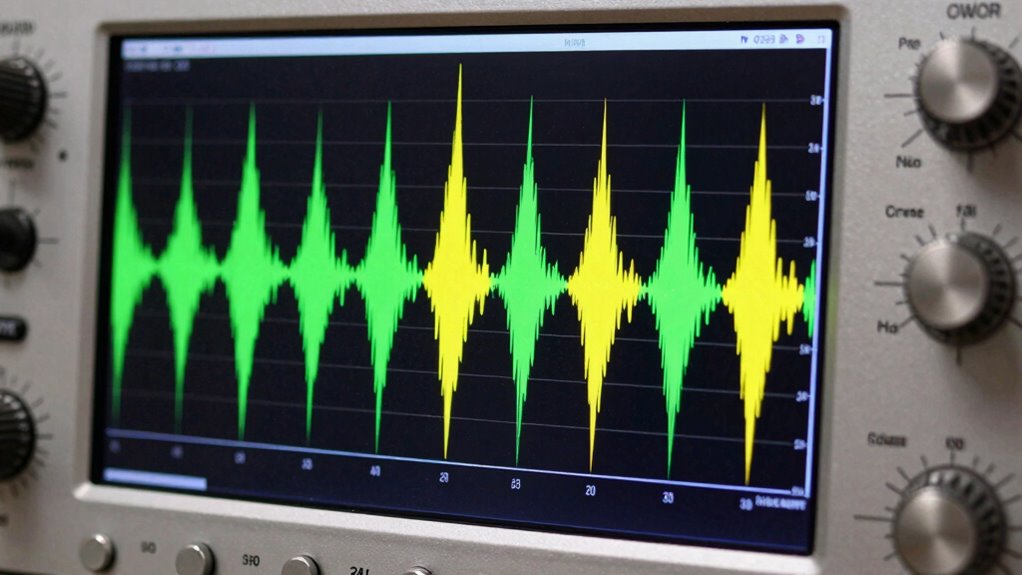
Spectrum analyzers are indispensable tools for analyzing the frequency content of signals, allowing you to see which frequencies are present and how strong they are. When you use one, you can identify specific signals within a complex mixture, making it easier to troubleshoot, design, or improve electronic systems. One key aspect you’ll notice is the spectrum analyzer’s ability to distinguish between closely spaced frequencies, which hinges on its frequency resolution. Higher frequency resolution means you can separate signals that are very close together, giving you a detailed picture of the spectrum. If your resolution isn’t sharp enough, multiple signals might blend into a single blurry line, making it harder to analyze the individual components accurately.
Higher frequency resolution allows you to distinguish closely spaced signals for detailed spectrum analysis.
Beyond just identifying frequencies, spectrum analyzers also reveal the amplitude or strength of each signal at different points in the spectrum. This information helps you determine which signals are dominant and which are weak or potentially problematic. For instance, if you’re working with radio communications, knowing the signal strength at different frequencies assists you in tuning your equipment for maximum performance. It also helps you spot interference or unwanted signals that could cause issues in your system. Understanding the importance of spectral resolution enhances your ability to interpret the data more precisely and make better adjustments. Recognizing how signal distortion impacts the overall signal quality is crucial for maintaining system integrity and performance. Additionally, the ability to detect harmonics and spurious signals is vital for ensuring signal purity and compliance with standards.
Another important measurement you need to understand is signal distortion. While you might think of signals as perfect sine waves, in reality, many signals are distorted due to non-linearities in electronic components or external interference. A spectrum analyzer can help you detect these distortions by revealing unexpected frequencies or harmonics that shouldn’t be there. These distortions can cause problems, like reduced signal clarity or data errors, so spotting them early is essential. When you analyze a signal and see additional frequencies or uneven power distribution, you can take steps to adjust your equipment or improve your design. Additionally, understanding side-channel emissions is vital for security, as they can be exploited to gather sensitive information.
In essence, spectrum analyzers measure the frequency content, amplitude, and purity of signals. They allow you to see not just what signals are present but how they’re behaving, how strong they are, and whether they’re distorted. This detailed insight is crucial whether you’re troubleshooting a malfunction, designing a new device, or ensuring your wireless communication stays clear. Understanding the importance of spectral resolution helps you interpret the data more accurately and make informed decisions. By understanding these measurements, you gain control over your electronic environment, making it easier to optimize performance and minimize issues. The power of a spectrum analyzer lies in its ability to give you a detailed, real-time view of the signals around you, making complex analysis straightforward and accessible.
Portable TinySA Spectrum Analyzer,SEESII Upgraded V0.3.1 Handheld Tiny Frequency Analyzer 100kHz to 960MHz MF/HF/VHF UHF Input,Signal Generator with 2.8 inch Touch Screen with ESD Protect Function
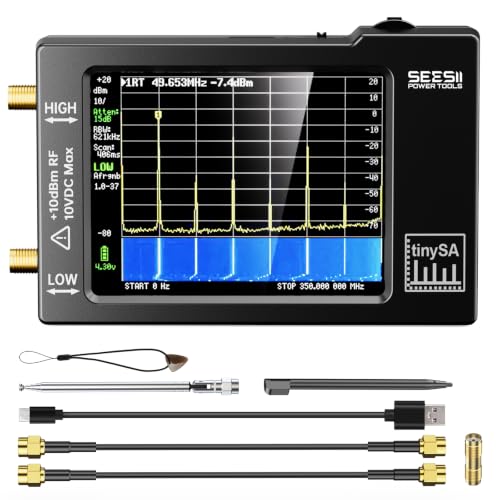
Portable TinySA Spectrum Analyzer with frequency range 100kHz-960MHz, signal generator, and touch screen for versatile RF testing.
As an affiliate, we earn on qualifying purchases.
As an affiliate, we earn on qualifying purchases.
Frequently Asked Questions
How Accurate Are Spectrum Analyzers in Different Environments?
Spectrum analyzers are quite accurate, but their precision varies with environment. Factors like signal resolution and frequency range impact measurement accuracy. In controlled environments, they perform best, with high signal resolution and a broad frequency range providing detailed insights. However, in noisy or cluttered settings, accuracy can decrease due to interference or signal distortion. Always consider environmental influences to guarantee reliable readings when using spectrum analyzers.
Can Spectrum Analyzers Detect Hidden or Encrypted Signals?
Imagine holding a magnifying glass over a secret message—spectrum analyzers can sometimes reveal hidden or encrypted signals lurking in the noise. While they excel at encryption detection and hidden signal identification, they can’t always decode complex encryption or find every covert transmission. You might catch a faint whisper of a hidden signal, but fully uncovering encrypted content often requires specialized tools beyond standard spectrum analyzers.
How Do Temperature Variations Affect Spectrum Analyzer Readings?
Temperature variations can affect your spectrum analyzer readings by causing drift in its components, impacting accuracy. To minimize this, guarantee temperature stability through proper cooling or heating. Regular calibration procedures help account for any temperature-related changes, maintaining measurement precision. By managing temperature effects carefully, you can rely on your spectrum analyzer to provide consistent, accurate results regardless of environmental fluctuations.
What Is the Typical Lifespan of a Spectrum Analyzer?
Think of your spectrum analyzer as a trusty compass; its lifespan depends on proper care. Typically, it lasts around 5 to 10 years with regular calibration procedures, ensuring accuracy and longevity. Battery life varies, but keeping it charged and maintained prevents premature wear. Just like any precision instrument, consistent updates and mindful usage help extend its life, so you get the most out of your investment over time.
Are Spectrum Analyzers Suitable for Measuring Digital Signals?
Yes, spectrum analyzers are suitable for measuring digital signals. They help you analyze digital modulation schemes, revealing how signals behave in the frequency domain. This is especially useful when dealing with signal encryption, ensuring your digital communication remains secure. By examining the spectrum, you can identify interference or distortions, making spectrum analyzers essential tools for troubleshooting and optimizing digital systems and secure transmissions effectively.
Conclusion
So, now you know what spectrum analyzers measure—everything from your Wi-Fi signals to those mysterious radio waves. Think of it as having a superpower that lets you peek into the invisible world of frequencies. Who knew that all those tiny signals could be so interesting? Next time your device works perfectly, just thank the spectrum analyzer for playing detective. After all, without it, you’d be lost in a sea of digital chaos—good luck steering through that!