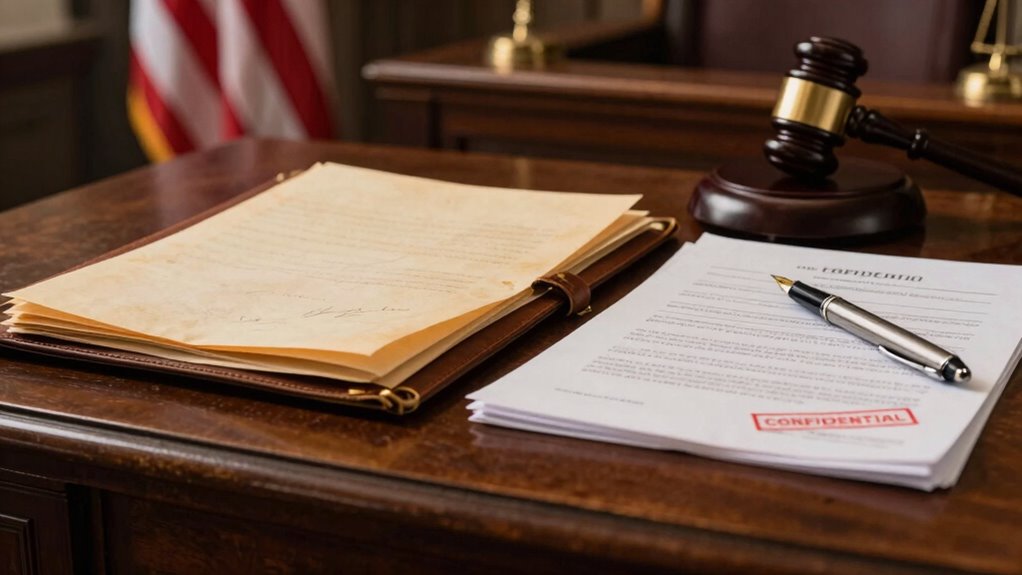

The Espionage Act still influences how leaks are prosecuted today by providing broad language that covers sharing sensitive information, even without proof of intent to harm. You’ll find it’s used to target national security breaches, but it also blurs the line between protecting secrets and free speech. This creates ongoing tension, affecting transparency and accountability. If you want to understand how this law continues to shape leak cases and the legal challenges involved, there’s more to explore.

Get privacy and security gear delivered free with Prime
- Fast, free delivery on millions of items
- Prime Video, Amazon Music and more included
- Member-only deals all year
Key Takeaways
- The Espionage Act’s broad language allows prosecutors to target a wide range of leak-related offenses without proving malicious intent.
- It is used to classify leaks as threats to national security, leading to severe penalties regardless of public interest.
- The law blurs the line between protecting security and suppressing free speech, influencing leak prosecution strategies.
- Its application can both shield national secrets and silence critics, impacting government transparency and accountability.
- Evolving legal interpretations and rapid information flow continuously shape how the Act is used to prosecute leaks today.

The Espionage Act has become a central tool in prosecuting government officials and others who leak classified information, raising critical questions about national security and free speech. When you consider the legal implications of this law, you realize how it shapes the boundaries of what can and cannot be disclosed. The act was originally enacted in 1917 to combat espionage during wartime, but it has since been adapted to address modern concerns about leaks, whistleblowing, and national security threats. Its broad language allows prosecutors to pursue individuals who share information they deem sensitive, often without requiring proof of intent to harm the United States.
As you examine cases involving leaks, you see how the law’s reach extends into the sphere of classified information. These are details kept under wraps by the government to protect sources, methods, or operations. When someone leaks such information, they risk severe legal consequences—ranging from fines to decades in prison. The law doesn’t differentiate easily between malicious leaks and those motivated by public interest or whistleblowing. That ambiguity complicates the legal landscape and calls into question whether the Espionage Act is being used to suppress transparency or genuinely protect national security.
The Espionage Act’s broad scope blurs lines between protecting security and suppressing transparency.
You also need to understand that the legal implications of using the Espionage Act go beyond just punishing leakers. Prosecutors often argue that revealing classified information compromises intelligence operations, endangers lives, or undermines diplomatic efforts. But critics contend that the law’s sweeping language can infringe on free speech, especially when individuals disclose information about government misconduct or systemic issues. This tension makes every leak case a delicate balancing act—should the government prioritize security above all else, or should it respect the public’s right to know?
Furthermore, the law’s application raises questions about transparency and accountability. When government officials misuse the Espionage Act to silence critics, they threaten democratic principles. Conversely, when leakers expose genuine security threats, they could be aiding enemies or harming national interests. As you navigate these legal waters, you realize that the act’s influence is profound—it can serve as both a shield and a sword. The legal implications of prosecuting classified information leaks under the Espionage Act continue to evolve, shaping how government transparency and national security coexist in a rapidly changing information landscape.
Espionage Act legal reference book
As an affiliate, we earn on qualifying purchases.
As an affiliate, we earn on qualifying purchases.
Frequently Asked Questions
How Has the Espionage Act Evolved Over the Years?
You see, the Espionage Act has evolved through a historical context of wartime and political tensions. Legislative amendments, like the Sedition Act of 1918 and later updates, expanded its scope to address new threats. Over the years, courts have interpreted its provisions differently, balancing national security with free speech. This evolution influences how prosecutors pursue leak cases today, shaping the legal landscape and the boundaries of government secrecy.
What Are Recent Notable Leak Prosecutions Under This Act?
Imagine a spy with a neon sign saying “Classified info,” getting caught in a web of red tape. Recent leak prosecutions involve individuals leaking sensitive government secrets, sparking debates on privacy concerns. Under the Espionage Act, these cases highlight how the government aggressively targets leakers, often blurring lines between protected free speech and national security. You see, even in today’s digital age, the act’s shadow looms large over whistleblowers.
How Does the Act Impact Whistleblower Protections?
The Espionage Act limits whistleblower rights by making it risky for individuals to disclose classified information, even if their intent is to expose wrongdoing. It weakens legal protections by often penalizing leaks rather than encouraging transparency. When you consider this, you see that the act discourages whistleblowers from speaking out, because they face severe legal consequences, which can overshadow their rights and protections meant to shield them.
Are There Any Legal Defenses for Accused Leak Perpetrators?
You might think there are many defenses, but under the Espionage Act, legal loopholes are rare. Accused leak perpetrators often struggle to find strong defenses, especially since public awareness has increased, making it harder to argue motives like whistleblowing. Still, some argue that the First Amendment offers protection, but courts have historically limited this. Ultimately, the law’s broad scope makes it tough to defend leaks legally.
How Does the Espionage Act Compare Internationally?
You’ll find that international legal standards and espionage treaties vary widely, making comparisons complex. Some countries have strict laws similar to the Espionage Act, while others prioritize transparency and whistleblower protections. Unlike the U.S., many nations lack extensive espionage treaties, leading to different approaches to leak prosecutions. You should consider how these differences influence legal risks, cooperation, and enforcement when comparing the Espionage Act internationally.
Conclusion
As you navigate today’s complex legal landscape, remember that the Espionage Act still plays a pivotal role in leak prosecutions, much like a digital-age Sherlock Holmes scrutinizing every clue. Even with all the modern tools at your disposal, this law’s legacy persists, guiding authorities in their quest to safeguard secrets. So, as you ponder the boundaries of transparency and security, keep in mind that the Espionage Act remains the unsung hero—or villain—in shaping how leaks are handled in our ever-evolving world.
Halloween Picks
halloween
As an affiliate, we earn on qualifying purchases.