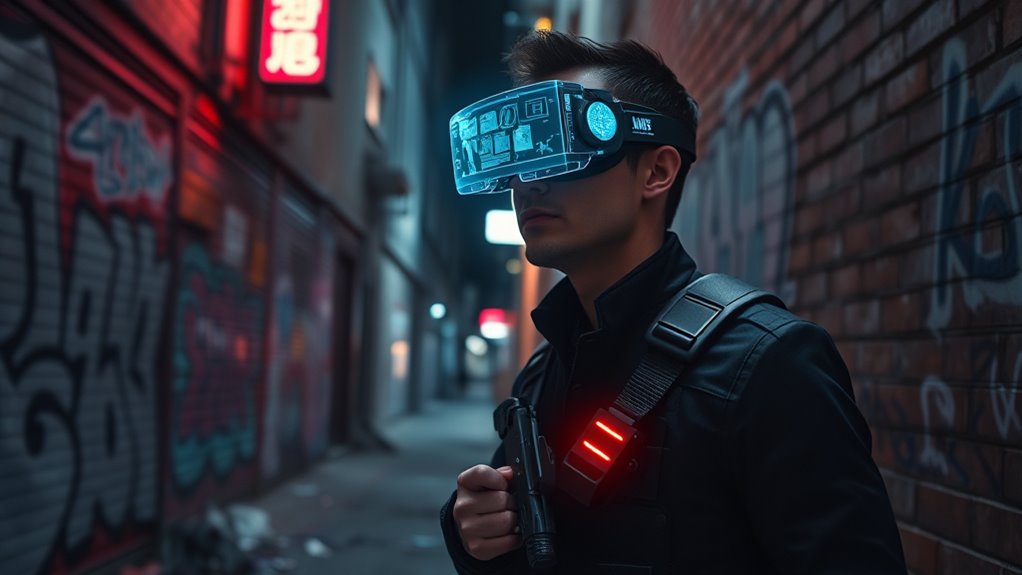

Augmented reality for agents overlays digital info onto your real-world view, giving you instant access to target data, maps, security patterns, and more during covert operations. It helps you stay aware of surroundings, coordinate with team members, and adapt quickly to changing environments—all while keeping a low profile. With dynamic updates and future enhancements like predictive analytics, AR becomes a crucial tool in spycraft. Keep exploring to discover how these advancements can boost your mission effectiveness.
Key Takeaways
- AR enhances situational awareness by overlaying real-time intelligence onto the environment for quick decision-making.
- Discreet data visualization minimizes equipment and maintains operational stealth during covert activities.
- Shared AR overlays improve team coordination, providing synchronized views of targets, hazards, and objectives.
- Dynamic updates ensure agents receive current intel, adapting swiftly to changing threat levels or environmental conditions.
- Future integrations like predictive analytics and environmental scanning will further refine AR’s role in spycraft.
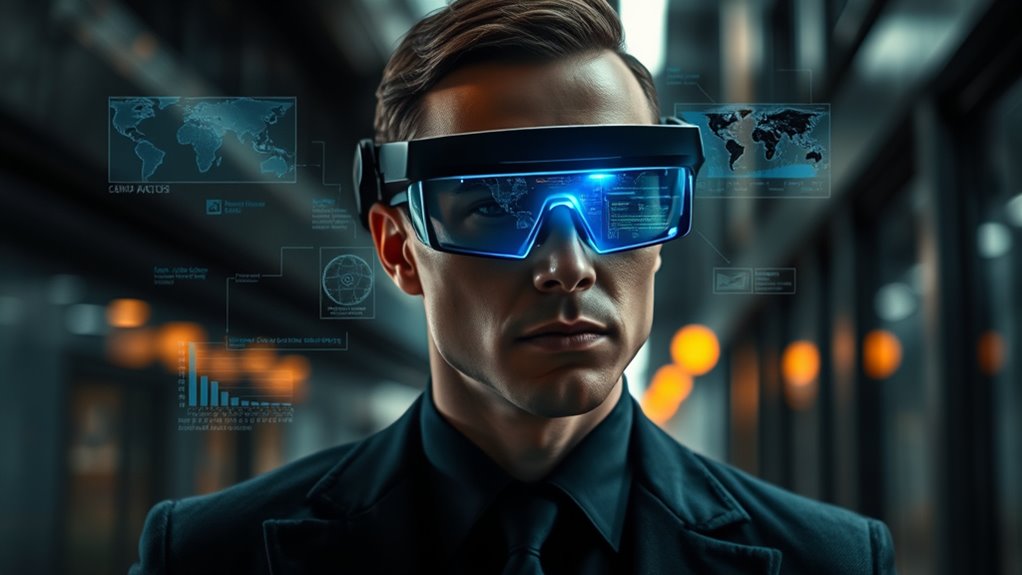
Augmented reality (AR) is transforming how agents perform their tasks by overlaying digital information onto the real world. This technology allows you to see essential data directly within your field of view, helping you make faster, smarter decisions in real time. When you’re in the middle of a covert operation, every second counts, and AR ensures you have instant access to critical information without having to pause or consult bulky devices. As you navigate complex environments, AR headsets or glasses project real-time data—such as target details, maps, or security patterns—so you can stay focused on your mission without distraction. This seamless integration of virtual info into your surroundings enhances situational awareness, giving you a tactical advantage that traditional tools simply can’t match.
In covert operations, staying discreet is key, and AR offers a discreet, efficient way to gather and analyze intel. Instead of carrying multiple devices or flipping through papers, you get all relevant data layered onto your visual field. For example, as you approach a building, AR can display real-time data about security cameras, personnel, or escape routes, helping you plan your moves with precision. This immediate access to essential details reduces the risk of mistakes, particularly in high-stakes scenarios where hesitation or misinformation can be costly. It also enables you to adapt swiftly, as the technology updates data dynamically, reflecting any changes in the environment or threat levels. Whether you’re surveilling a target or conducting a stealth infiltration, AR’s ability to deliver real-time data keeps you steps ahead.
Furthermore, AR enhances your ability to coordinate with team members during covert operations. Through shared digital overlays, you and your colleagues can see the same information—such as the location of team members, objectives, or hazards—without speaking or revealing your plans. This shared visual intelligence minimizes communication gaps and increases operational stealth. The technology also reduces cognitive load, allowing you to focus on strategic decisions rather than juggling multiple sources of information. As AR systems continue to evolve, expect even more sophisticated features, like predictive analytics or environmental scanning, to further refine your capabilities in the field. In essence, AR transforms the way you gather, process, and act on real-time data during covert missions, making you more efficient, adaptable, and effective in the pursuit of your objectives. Additionally, integrating reliable backup power solutions ensures uninterrupted operation of AR systems during critical moments, maintaining your operational edge.
Frequently Asked Questions
How Secure Is AR Technology Against Cyber Espionage?
AR technology’s security depends on how well it handles encryption vulnerabilities and data interception risks. You should be aware that cyber espionage can exploit weak encryption or intercept data during transmission. To stay secure, guarantee robust encryption protocols are in place, and use secure networks. Regular updates and vigilant monitoring are essential because attackers constantly find new ways to bypass security measures, putting your AR data at risk.
What Ethical Considerations ARise From Using AR in Spy Missions?
Using AR in spy missions raises ethical concerns like privacy issues and consent dilemmas. You must consider how sharing sensitive information could infringe on individuals’ privacy rights or breach confidentiality. Consent becomes complicated when targets or bystanders aren’t aware of being monitored or recorded. You need to balance effective intelligence gathering with respecting ethical boundaries, ensuring your use of AR doesn’t violate rights or compromise moral standards.
Can AR Systems Adapt to Unpredictable Real-World Environments?
Think of AR systems as chameleons blending into unpredictable environments. They adapt through sensor integration, constantly updating data from environmental variability. For example, during a covert stakeout, your AR system adjusts overlays when lighting shifts or obstacles appear, ensuring you stay informed. This real-time adaptability helps you navigate complex scenarios, making AR a dynamic tool that responds swiftly to the ever-changing real world.
How Do AR Tools Impact Agent Fatigue and Cognitive Load?
AR tools can reduce your fatigue and cognitive load by providing real-time, intuitive data, so you don’t have to process multiple sources mentally. However, if the sensors overload or display too much information, you might experience sensor fatigue and cognitive overload. To stay effective, verify the AR system is well-calibrated, focusing only on relevant data, which helps you stay alert and minimizes mental strain during complex operations.
What ARe the Limitations of Current AR Hardware for Covert Operations?
Your AR hardware’s current limitations are like trying to fit a spaceship into a pocket—tiny hardware constraints and poor situational adaptability hinder covert operations. You face bulky gear, limited battery life, and restricted field of view, which makes seamless concealment tough. These constraints prevent real-time data integration and quick adaptability in dynamic environments, so you’re often left with less versatile tools that can’t keep pace with the fast-changing demands of covert missions.
Conclusion
As you embrace the evolving landscape of augmented reality, you’ll find new ways to blend the virtual with the real, enhancing your skills and insights. It’s a subtle shift—an elegant dance between technology and intuition—that guides you through complex scenarios with quiet confidence. With each step forward, you navigate the unseen pathways, gently weaving the digital into your world. In this delicate balance, the future of spycraft quietly unfolds, inviting you to explore its subtle promise.