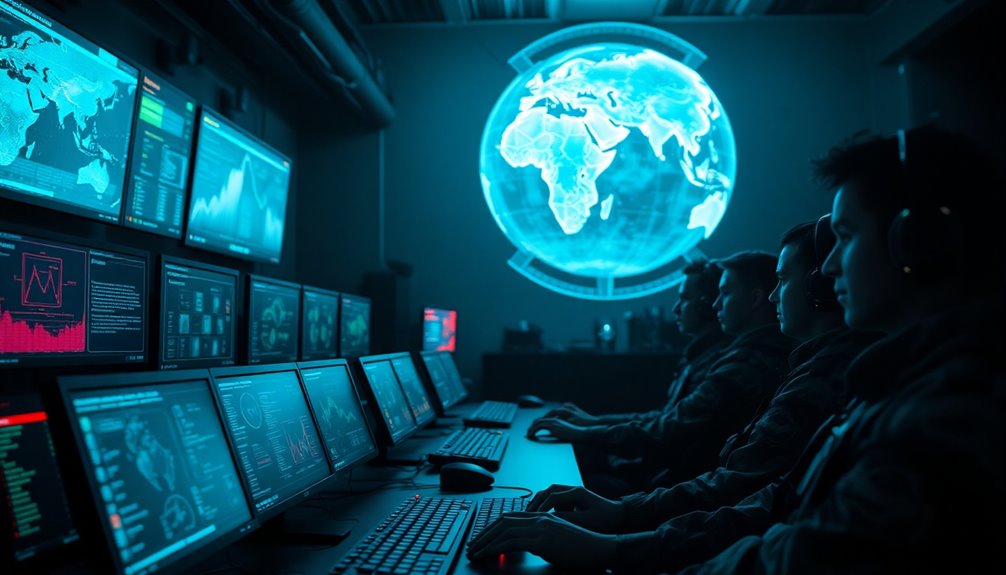


As cyber warfare continues to evolve, it’s clear that the digital battlefield has transformed how nations and non-state actors engage in conflict. This evolution started gaining traction in the late 1990s and early 2000s, with significant incidents like the Estonian DDoS attack in 2007 illustrating the potential of cyber operations.
Today, cyberattacks are a standard element of modern warfare, impacting military and civilian infrastructure alike. The global annual cost of these attacks is staggering, projected to reach as much as $6 trillion, showing just how critical it’s to address this growing threat.
Cyberattacks have become integral to modern warfare, with costs soaring to $6 trillion, highlighting the urgent need for robust cybersecurity measures.
Technological advancements have made cyber warfare more accessible and potent, allowing both state and non-state actors to participate in this new form of conflict. As you navigate this landscape, you’ll notice that smaller entities now have the capability to challenge larger powers through asymmetric warfare tactics. Cyber power has become a crucial resource for these actors, enabling them to level the playing field against traditional state powers.
This shift has led to a cyber arms race, with countries pouring resources into developing both offensive and defensive capabilities. However, the lack of clear international laws complicates the regulation around these engagements, leaving many questions unanswered.
The strategies employed in cyber warfare are increasingly sophisticated. Cyber operations can disrupt entire networks by exploiting common vulnerabilities, and in some cases, these attacks can commandeer weapon systems remotely. Such capabilities can even lead to decisive victories without any traditional military action.
Intelligence operations, enhanced by AI, can provide critical insights, automating attacks and making them more effective. Yet, navigating this offense-dominant domain presents its own challenges.
Defending against cyber threats often proves more costly than launching attacks, complicating security measures. Attribution difficulties further impede deterrence, leaving many nations unsure of how to respond effectively. Building robust defensive infrastructure is crucial, but the paradox lies in the cost and accessibility of cybersecurity education, creating significant barriers in workforce development.
As you explore the impact of cyber warfare on international relations, you’ll see a clear evolution of soft power strategies. Global power dynamics are shifting, with new players emerging in the digital realm.
The influence of traditional states is being challenged by civil society and tech giants, making it essential for nations to adapt. Hybrid warfare, incorporating cyber elements, is becoming the norm, necessitating new strategies and global cooperation to establish effective cyber regulations.
The defense tech revolution in cyber warfare is here, and it’s reshaping the world as we know it.
Cybersecurity for Beginners: A Hands-On Guide to Ethical Hacking and Defense: Master Real-World Skills Through Labs, Tools, and Practical Challenges

As an affiliate, we earn on qualifying purchases.
As an affiliate, we earn on qualifying purchases.