For readers who think about AI in terms of control, access and oversight, a new ebook asks the bigger version of that question. In Dots, Bots, and Math! When Intelligence Is No Longer Scarce, Thorsten Meyer looks at persistent agents, software that checks its own work, and who should be able to inspect the systems that act on our behalf. The book went into distribution to ebook stores and library platforms on October 16, 2026.

Get privacy and security gear delivered free with Prime
- Fast, free delivery on millions of items
- Prime Video, Amazon Music and more included
- Member-only deals all year
The book starts from an observation that is easy to overlook because it is everywhere. Schools, credentials, companies, wages, and the taxes financed by those wages were all built on the assumption that useful human thinking is scarce. Calculation stopped being scarce in the twentieth century, when machines replaced the rooms of people whose job title was once “computer.” What stayed scarce was the work around the calculation: understanding, coordinating, following up, and deciding. Meyer argues that the systems arriving now reach into exactly that remaining work.
Three ideas in the title
Dots are persistent AI agents: software that holds a person’s goals over days and keeps working after the conversation ends. The book uses “dot” in lowercase as a general term for any such agent, whichever company makes it. It looks at several products launched in 2026 by different companies, alongside open-source agents that people run themselves, and treats none of them as its subject. The book has no affiliation with any company that uses the name for a product.
Bots are systems that carry out and check real work. Here the book draws a line that many demonstrations blur: a plausible output is not the same as a completed, verified task, and the parts of a system that matter most are often the checks, the records, and the moments when it must stop and ask a person.
Math stands for machines producing new results faster than people can verify them. The book separates four things that are easily confused: a candidate result, a publication, a formal proof, and acceptance by the people who have to build on it.
Walkers and rocket builders
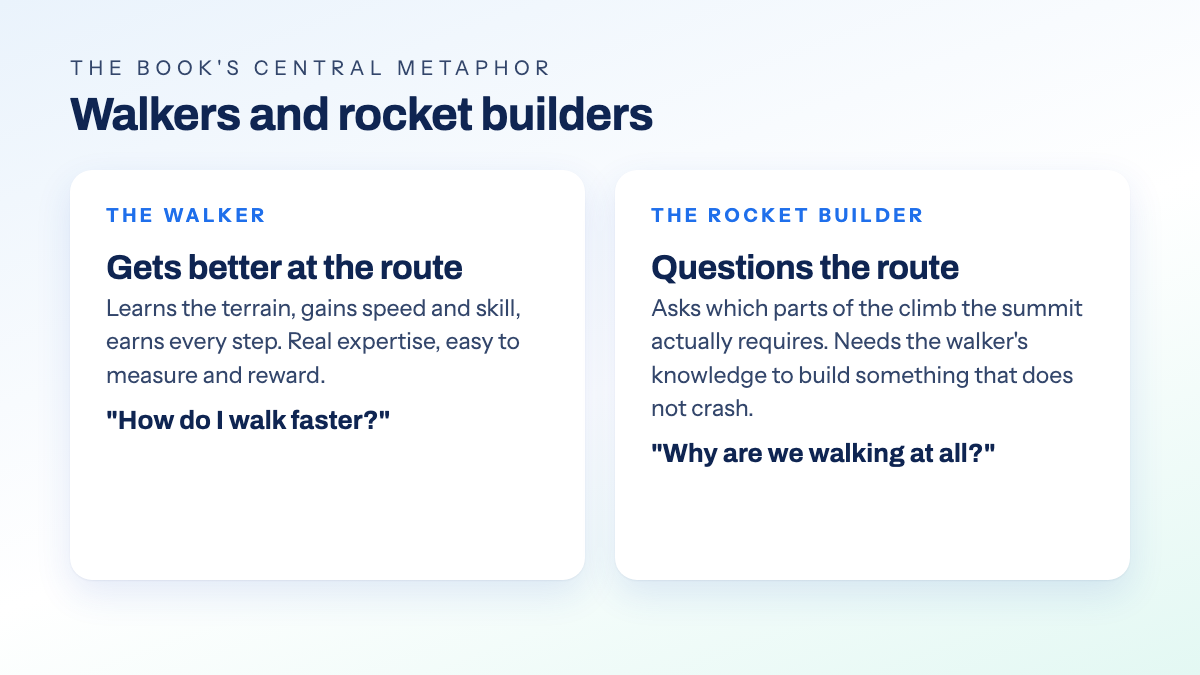
The book’s central image separates two kinds of intelligence. A walker gets better at a known route: faster, safer, more skilled. A rocket builder asks which parts of the climb the destination actually requires. Much early use of AI makes walkers faster. The bigger changes, the book argues, come when someone redesigns the route itself, for example when a weekly report is replaced by a system that alerts the right person when a decision is needed.
Meyer does not present redesign as a happy ending. The same chapters describe how redesigns fail, how they can concentrate power, and how they can remove work people valued. Rocket builders, in this telling, need the walkers’ knowledge more than ever: someone has to know where the ground is loose.
What does not get cheaper
A deliberate counterweight runs through the middle of the book. Energy, materials, physical work, trust, and legitimacy do not become cheap because thinking does. When one form of intelligence becomes abundant, the constraint shifts to whatever has not. That makes the economic questions in the final part of the book sharper rather than softer.

For any proposal about the AI economy, the book offers a four-question test: who controls the productive asset, who can inspect it, who carries the risk (and whether they can leave), and who receives the gain. It applies those questions to models, chips, cloud computing, data, and the agents themselves, and to older ways societies have shared the gains of a common resource.
More than a paycheck
One of the book’s most human chapters returns to the 1930s study of Marienthal, an Austrian village whose factory closed. Researchers there documented what a job provides besides money: a structure for the day, contact with other people, shared purpose, status, and regular activity. A society could become much richer and still leave many people adrift, Meyer argues, unless it deliberately builds other ways to provide what work used to provide.
The closing chapter does not prescribe a single policy. It describes several paths a society might take, with signposts readers can watch for themselves, and assesses a toolbox of options on evidence, feasibility, and trade-offs.
How the book is built
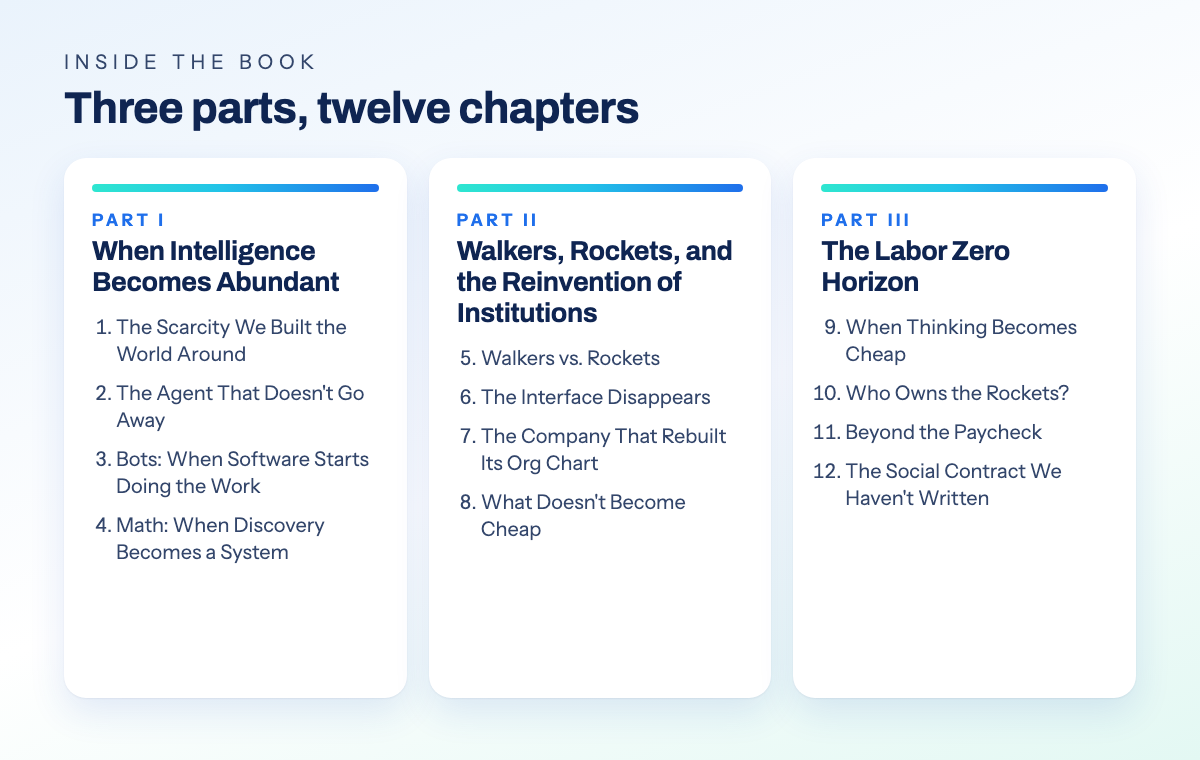
The book is written for general readers; no technical background is needed. It is not a how-to guide for AI tools and not a forecast. Each chapter opens with a scene, develops one idea, gives the strongest objection a fair hearing, and ends with a question that leads into the next. Claims are labeled as demonstrated, reported, independently validated, or scenario, and composite scenes are marked as such. The main text runs to about 75,000 words, supported by 613 source notes and a glossary of 55 terms.
Meyer writes from practice: he builds and runs software systems in which AI agents do real work, and he says openly in the book that AI systems assisted with its research, checking, drafting, and review, while the argument and judgments are his. His earlier book, Economics After Labor (2026), surveyed policy responses such as basic income and employee ownership; this one starts further back and asks how our institutions came to depend on scarce thinking at all.
Where to find it
The ebook is being distributed to stores including Apple Books, Barnes & Noble, Rakuten Kobo, tolino, Everand, Bookshop.org, and Fable, and to library platforms including OverDrive, hoopla, cloudLibrary, and BorrowBox. Availability appears store by store, so it may take a few days to show up everywhere.
Halloween Picks
halloween
As an affiliate, we earn on qualifying purchases.