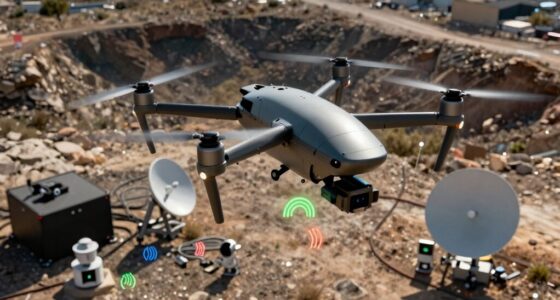
Electronic warfare tech like jammers and decoys work by disrupting or mimicking enemy signals, confusing their systems and causing them to misinterpret real threats. Jammers flood radars with noise, making it hard for the enemy to identify targets, while decoys send false signals to deceive their sensors. These tools manipulate the electromagnetic spectrum to create chaos and protect your forces. To understand how these complex techniques pull off this deception, there’s more to uncover.
Prime for Young Adults — start your free trial
Fast free delivery, streaming and member deals for eligible 18–24 year olds.
As an affiliate, we earn on qualifying purchases.
Key Takeaways
- Jammers emit noise or false signals to overwhelm or disrupt enemy radars, preventing accurate detection.
- Decoys generate fake targets or signals that mimic real ones, confusing enemy tracking systems.
- Both techniques manipulate the electromagnetic spectrum to mislead enemy sensors and deceive their perception.
- Modern electronic warfare tools adapt in real-time using AI to counter evolving enemy countermeasures.
- These methods provide strategic advantage by disrupting enemy operations and protecting friendly forces.

Electronic warfare technology plays a crucial role in modern military operations by disrupting, deceiving, or disabling enemy electronic systems. When you’re engaged in a conflict, your ability to interfere with enemy sensors and communication networks can turn the tide of battle. Two key techniques in this arsenal are radar jamming and signal spoofing, which are designed to confuse and mislead adversaries while protecting your own forces.
Radar jamming involves flooding enemy radar systems with false signals or overwhelming them with noise. When you deploy radar jammers, you create a cloud of interference that makes it difficult or impossible for enemy radars to identify real targets. This technique effectively blinds their detection capabilities, allowing friendly units to maneuver without being tracked or targeted. You can use continuous or pulsed jamming methods depending on the threat, tailoring your approach to evade specific radar frequencies. Radar jamming is especially valuable during aircraft or missile operations, as it can prevent enemy defenses from locking onto your assets, thereby reducing the risk of detection and attack.
Signal spoofing, on the other hand, involves deliberately transmitting fake signals that mimic legitimate ones. When you utilize signal spoofing, you deceive enemy systems into believing they’re receiving authentic data, when in fact it’s fabricated. For example, you might send false GPS signals to mislead enemy navigation systems or generate fake radio communications to create false targets on their radar screens. Signal spoofing can be highly sophisticated, making it appear as if real aircraft, ships, or units are elsewhere, or that a threat doesn’t exist at all. This tactic allows you to manipulate the enemy’s perception of the battlefield, causing them to waste resources or make strategic errors based on false information.
Both radar jamming and signal spoofing require precise knowledge of enemy systems and frequencies. You need to constantly adapt your techniques to stay ahead of evolving threats and countermeasures. Modern electronic warfare systems incorporate advanced algorithms and AI to detect and respond to enemy jamming efforts in real time, making your electronic countermeasures more effective. Additionally, understanding the fundamentals of electronic spectrum is crucial for designing successful electronic warfare tactics. By mastering these techniques, you’re able to create a multi-layered defense that confuses, delays, or disables enemy operations, while ensuring your own forces maintain the edge on the battlefield. In essence, these electronic warfare tools give you the power to manipulate the electromagnetic spectrum, turning your adversary’s technology against them and securing a strategic advantage.
radar jammer for military training
As an affiliate, we earn on qualifying purchases.
As an affiliate, we earn on qualifying purchases.
Frequently Asked Questions
How Effective Are Modern Electronic Jammers Against New Radar Systems?
Modern electronic jammers are quite effective against new radar systems, as they disrupt radar detection and signal interception. They emit targeted signals that confuse or overload the radar’s ability to identify threats accurately. While advanced radars incorporate countermeasures, jammers still play a vital role in reducing detection range and misleading enemy sensors, giving you a tactical advantage by masking your movements and evading detection.
What Are the Ethical Considerations of Deploying Electronic Warfare Techniques?
They say “with great power comes great responsibility,” and deploying electronic warfare techniques isn’t an exception. You must weigh privacy concerns and civilian impact against military advantages. While jammers and decoys protect troops, they can disrupt civilian communications and compromise privacy. Ethically, you’re responsible for minimizing harm and ensuring transparency whenever possible. Balancing national security and respecting individual rights is key to deploying these technologies responsibly.
Can Enemy Forces Develop Countermeasures to Electronic Jamming?
Yes, enemy forces can develop countermeasures to electronic jamming through countermeasure development, which evolves alongside electronic warfare tactics. They might use advanced signal processing, frequency hopping, or adaptive systems to bypass jamming efforts. As electronic warfare evolves, so does the enemy’s ability to counteract it, prompting continuous innovation in jamming and decoy techniques to stay ahead in modern combat scenarios.
How Long Do Decoys Typically Remain Operational During a Mission?
Decoys usually stay operational for about 10 to 30 minutes, acting like chameleons blending into the battlefield’s chaos. Their lifespan depends on mission intensity, electronic interference, and how well they’re maintained. During a mission, you can rely on their operational duration to buy essential moments, confusing enemy sensors and radar. Think of them as fleeting illusions, designed to vanish before the enemy catches on, giving you the upper hand.
What Are the Limitations of Current Electronic Warfare Technology?
You should know that current electronic warfare technology faces limitations and vulnerabilities, like being susceptible to advanced enemy countermeasures. Jammers can be overwhelmed or detected, reducing their effectiveness, while decoys may be identified and ignored. Additionally, rapid technological advances mean threats evolve quickly, rendering some systems obsolete. These vulnerabilities require ongoing upgrades and adaptive strategies to stay ahead, but inherent limitations still challenge full-spectrum electronic warfare effectiveness.
Conclusion
Just like a master illusionist, electronic warfare tech tricks the enemy’s senses, turning their own tools into ghosts of confusion. Jammers and decoys become shields and mirrors, symbolizing the unseen battles fought in the shadows of technology. Remember, in this silent war, your ingenuity acts as the lighthouse guiding your forces through the fog of deception. Embrace these tools—they’re your lanterns, illuminating the path to victory amid the chaos of electronic chaos.
Fall Picks
fall essentials
As an affiliate, we earn on qualifying purchases.