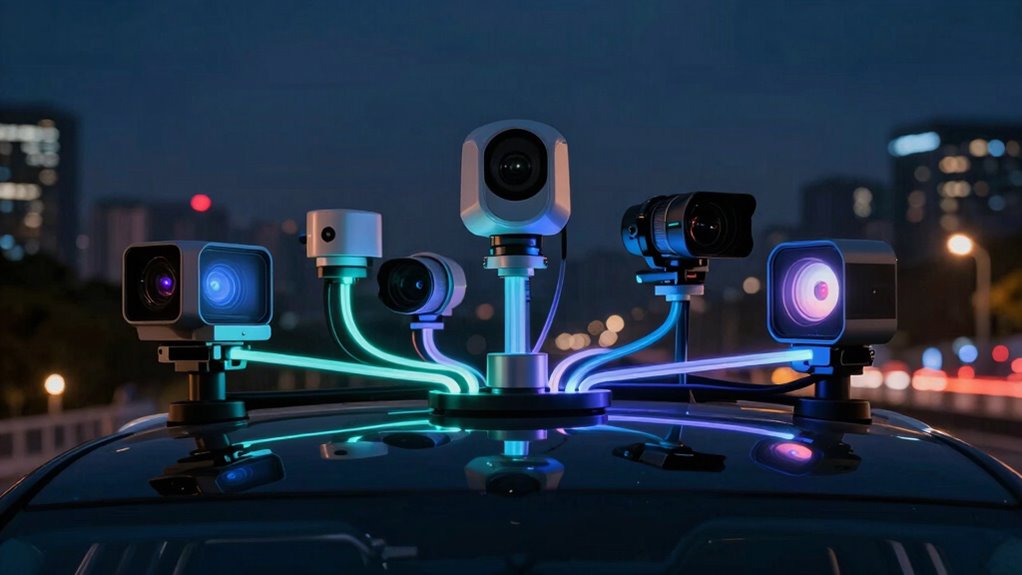

Sensor fusion is essential for modern situational awareness because it combines data from different sensors like cameras, radars, and lidars, giving you a clear and accurate picture of your environment. It helps you detect objects, avoid obstacles, and make quick decisions even in challenging conditions such as fog or low light. By merging data seamlessly, it reduces errors and noise, ensuring you stay safe and informed. If you keep exploring, you’ll discover how this technology transforms complex data into actionable insights.

Get privacy and security gear delivered free with Prime
- Fast, free delivery on millions of items
- Prime Video, Amazon Music and more included
- Member-only deals all year
Key Takeaways
- Sensor fusion integrates data from multiple sources to create a comprehensive and accurate understanding of complex environments.
- It compensates for individual sensor limitations, ensuring reliable perception in adverse conditions like low light or bad weather.
- By synchronizing and calibrating sensors, fusion ensures real-time, precise situational awareness for dynamic systems.
- It reduces false positives and negatives, enhancing decision-making accuracy in safety-critical applications.
- Sensor fusion is foundational for autonomous systems, enabling rapid, informed responses in unpredictable environments.

Have you ever wondered how modern systems accurately perceive complex environments in real time? The answer lies in the power of sensor fusion, a technology that combines data from multiple sensors to create a detailed picture of your surroundings. At its core, sensor fusion relies heavily on data integration, seamlessly merging inputs from cameras, radars, lidars, and other sensors. By doing so, it transforms disparate streams of information into a unified, coherent understanding, which is crucial for real-time analysis. This data integration process ensures that no critical detail is overlooked, even when individual sensors face limitations or occlusions, providing a more robust and reliable situational awareness. In addition, advanced algorithms such as machine learning are often employed to enhance the interpretation of fused data and improve predictive capabilities. Incorporating sophisticated sensor calibration techniques is also vital to maintain the accuracy and consistency of the fused data over time. Ensuring the synchronization of sensor data is equally important for maintaining the integrity of the fused information and avoiding discrepancies that could lead to errors. Precise temporal alignment of sensor readings further strengthens the consistency and reliability of the fused data.
Sensor fusion integrates data from multiple sensors for reliable, real-time environmental awareness.
When you’re operating in dynamic environments—like autonomous vehicles navigating busy streets or drones surveilling vast areas—timeliness is everything. Sensor fusion enables these systems to perform real-time analysis, processing vast amounts of data almost instantaneously. This rapid interpretation allows for quick decision-making, such as avoiding obstacles, tracking moving objects, or adjusting flight paths, all without delays that could compromise safety or efficiency. The ability to analyze incoming data swiftly is essential for adapting to changing conditions and ensuring that the system responds appropriately to new information as it becomes available.
Furthermore, sensor fusion enhances accuracy by compensating for the weaknesses of individual sensors. For example, cameras might struggle in low-light conditions, while radar can detect objects through fog or rain. When these inputs are fused together, the system can maintain a reliable awareness of its environment regardless of environmental challenges. This multi-sensor approach reduces false positives and negatives, giving you a more precise understanding of your surroundings. It effectively filters out noise and ambiguities, leading to better performance in critical situations.
Ultimately, the strength of sensor fusion lies in its ability to synthesize diverse data sources into a coherent, real-time picture. This synthesis not only improves the system’s perception but also provides a foundation for sophisticated decision-making processes. Whether in autonomous vehicles, robotics, or surveillance, sensor fusion’s role in data integration and real-time analysis makes it indispensable. It empowers these systems to operate safely, efficiently, and reliably in complex, unpredictable environments—transforming raw sensor data into actionable intelligence. Without it, modern situational awareness would be incomplete and far less effective, underscoring why sensor fusion is central to advancing autonomous and intelligent systems today.
sensor fusion development kits
As an affiliate, we earn on qualifying purchases.
As an affiliate, we earn on qualifying purchases.
Frequently Asked Questions
How Does Sensor Fusion Improve Real-Time Decision-Making?
Sensor fusion improves your real-time decision-making by enabling multi-sensor integration, which combines data from various sources for an all-encompassing view. You can rely on data correlation to identify patterns and anomalies quickly. This process reduces noise and false alarms, allowing you to respond faster and more accurately. By synthesizing diverse data streams, sensor fusion provides the clarity needed for better situational awareness and timely, informed decisions.
What Are Common Challenges in Implementing Sensor Fusion Systems?
They say, “A chain is only as strong as its weakest link,” and that’s true for sensor fusion systems. You’ll face challenges like data integration, ensuring different sensors communicate effectively, and managing system complexity, which can lead to errors or delays. Balancing these factors demands careful design and testing. If you don’t, the system’s reliability suffers, hampering accurate situational awareness and decision-making.
How Does Sensor Fusion Handle Conflicting Sensor Data?
Sensor fusion handles conflicting sensor data by using data reconciliation techniques that identify sensor discrepancies and weigh data based on reliability. You can implement algorithms like Kalman filters or Bayesian methods, which dynamically adjust for inconsistencies, ensuring the fused data remains accurate. This process helps you create a coherent, reliable picture of the environment despite variations or inaccuracies from individual sensors.
What Industries Most Benefit From Advanced Sensor Fusion Techniques?
You’ll find industries like aerospace, automotive, healthcare, and defense benefit most from advanced sensor fusion techniques. These sectors face interoperability challenges and require data standardization to combine diverse sensor data effectively. Sensor fusion enhances real-time decision-making, safety, and efficiency. By overcoming these hurdles, these industries can develop smarter systems, improve situational awareness, and respond swiftly to dynamic environments, ultimately saving lives and optimizing operations.
How Secure Is Sensor Fusion Against Cyber Threats?
Sensor fusion’s security depends on how well you address cybersecurity vulnerabilities and guarantee data integrity. You must implement robust encryption, access controls, and continuous monitoring to guard against cyber threats. Regular updates and strong authentication help prevent unauthorized access, while data validation ensures accuracy. By actively managing these security measures, you make sensor fusion systems more resilient, safeguarding critical information and maintaining trustworthy situational awareness.
Conclusion
You stand at the crossroads of chaos and clarity, where sensor fusion bridges the gap. Like a skilled conductor blending diverse instruments into harmony, it transforms scattered data into a clear picture. Without it, you’re left steering through a foggy landscape; with it, every detail aligns, revealing a vivid reality. In this dance of information, sensor fusion is your guiding light—turning chaos into clarity, confusion into confidence.
Fall Picks
fall essentials
As an affiliate, we earn on qualifying purchases.