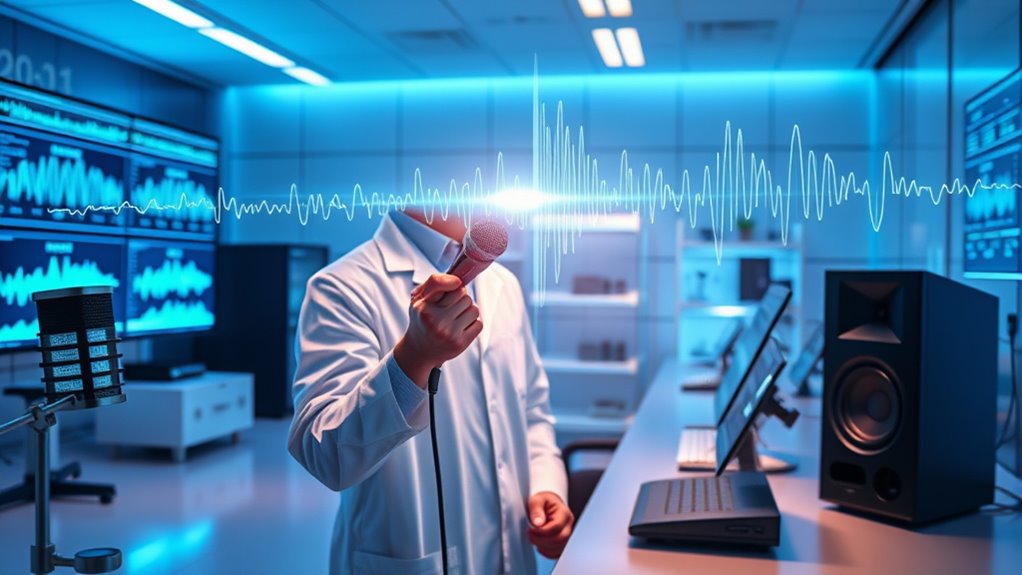

Voice recognition technology identifies people by analyzing unique features in their speech, like pitch, tone, and rhythm. It acts like a digital fingerprint, comparing live samples with stored voiceprints to verify identities quickly and discreetly. This tech is used in secure areas, for device control, and personalized services. As advancements reduce errors and improve security, you’ll discover more about how this powerful technology is transforming everyday interactions.
Key Takeaways
- Voice recognition technology analyzes vocal features like pitch, tone, and rhythm to identify individuals uniquely.
- It extracts spectral and temporal features to create a digital voiceprint for each user.
- The system compares live voice samples against stored profiles to verify identities in real-time.
- Advanced algorithms improve accuracy and reduce false acceptances or rejections.
- This technology enhances security and convenience across applications like banking, healthcare, and device access.

Have you ever wondered how voice recognition technology can understand your spoken commands so accurately? It all comes down to sophisticated systems that analyze the unique features of your voice. One of the core technologies behind this is speech biometrics, which focuses on identifying people based on their vocal characteristics. Unlike traditional passwords or PINs, speech biometrics leverages the distinct qualities of your voice, making it a highly secure and convenient method of authentication. When you speak into a device, these systems don’t just listen for words—they analyze pitch, tone, rhythm, and other vocal patterns to verify your identity. That’s where voice authentication plays a vital role, acting as a digital fingerprint for your voice. It’s a process that matches your speech patterns against stored voice profiles to confirm who you are. This combination of speech biometrics and voice authentication creates a seamless, hands-free way to access devices, apps, and secure systems without the need for passwords or physical tokens. Additionally, advancements in voice pattern analysis are improving the system’s ability to distinguish between different speakers with high accuracy, making the technology more reliable and secure. The technology works by capturing a sample of your voice and extracting unique features from it. These features include various spectral and temporal aspects that are difficult to imitate or mimic exactly. When you speak, the system compares the live sample with stored voiceprints, evaluating similarities through complex algorithms. If the match exceeds a certain confidence threshold, you’re granted access. This process happens quickly and discreetly, often in real-time, providing a frictionless experience for users. Voice authentication is particularly valuable in sensitive environments, such as banking, healthcare, and corporate security, where verifying identity accurately is essential. It also enhances user convenience, enabling voice commands to open devices or authorize transactions effortlessly. Speech biometrics isn’t just about security; it’s also about personalization. Your voice can be used to customize user experiences, from adjusting settings to providing tailored content. As voice recognition tech continues to advance, its ability to distinguish between different speakers with high accuracy becomes even sharper. This progress makes voice authentication more reliable, reducing false acceptances and rejections. Furthermore, ongoing improvements in speech biometrics help mitigate concerns about spoofing or voice replication, safeguarding your digital identity. In essence, the fusion of speech biometrics and voice authentication creates a user-friendly yet highly secure method of verifying identities, making voice recognition technology an integral part of modern digital life. It’s a future where your voice not only commands devices but also acts as your secure digital signature.
BOTSLAB 4K Security Cameras Wireless Outdoor, No Subscription, 4 Cam-Kit,Solar Camera for Home Security with Full Color Night Vision,32GB Local Storage Base Station,AI Recognition,360° PTZ,2.4GHz WiFi

Wireless 4K outdoor security cameras with AI, 360° view, local storage, and solar power for reliable home security.
As an affiliate, we earn on qualifying purchases.
As an affiliate, we earn on qualifying purchases.
Frequently Asked Questions
How Accurate Is Voice Recognition Technology in Noisy Environments?
Voice recognition tech’s accuracy drops in noisy environments due to noise interference and reduced audio quality. When background sounds are loud or unpredictable, the system struggles to distinguish your voice, leading to errors. However, advancements like noise-canceling and improved algorithms have boosted performance, making it more dependable in such conditions. Still, for peak results, it’s best to use voice recognition in quieter settings whenever possible.
Can Voice Recognition Differentiate Between Similar-Sounding Voices?
Yes, voice recognition can differentiate between similar-sounding voices, especially with advanced algorithms focused on speaker differentiation. When voice similarity is high, the technology analyzes unique vocal features like pitch, tone, and speech patterns to distinguish individuals. While it’s quite effective, some challenges remain with very similar voices, but continuous improvements in voice biometrics are making it increasingly accurate even in these tricky situations.
What Are the Privacy Concerns Associated With Voice Biometric Data?
Privacy pitfalls plague voice biometric data, as data breaches threaten your sensitive info, and user consent isn’t always clear. When you share your voice, you risk exposure to unauthorized access, misuse, or theft. You must be cautious and confident your data’s protected, demanding transparency from providers. Protecting your privacy means understanding how your voice data is stored, secured, and used—because safeguarding your security starts with knowing what you’re signing up for.
How Does Voice Recognition Technology Handle Accents and Dialects?
You might wonder how voice recognition handles accents and dialects. The technology uses advanced algorithms for accent adaptation and dialect recognition, allowing it to understand diverse speech patterns. It learns from a wide range of voices, improving accuracy over time. While some accents may pose challenges initially, ongoing improvements help the system become more inclusive, ensuring it recognizes your unique way of speaking effectively.
Is Voice Recognition Technology Vulnerable to Spoofing or Hacking?
Yes, voice recognition technology can be vulnerable to spoofing or hacking, which poses security vulnerabilities. Hackers might use recordings or synthetic voices to fool systems, risking fraud. To combat this, developers implement fraud prevention measures like liveness detection and multi-factor authentication. You should stay aware of these risks and make certain your systems use the latest security features to protect sensitive information and prevent unauthorized access.
Conclusion
As you explore voice recognition technology, remember it’s like a fingerprint for your voice—unique and identifiable. It can revolutionize security and personalize experiences, making interactions smoother and more secure. While it’s powerful, stay aware of privacy concerns and limitations. Embrace its potential like a key to new possibilities, but always use it responsibly. As this tech evolves, your voice will become not just a way to communicate, but a signature that defines you.